Blu Dreams: How Michael Jackson’s This Is It could help Elvis fans [The Film Frontier blog]

Many fellow Elvis fans seem to have tired of all of the recent comparisons with Michael Jackson. However, they should take notice of one Michael Jackson project. Filmed just days before Jackson’s death in June, This Is It opens in theaters and IMAX later this month.

Assembled from over a hundred hours of footage, the documentary captures rehearsals and other behind-the-scenes moments for Jackson’s concert engagement that ultimately was not to be. If This Is It turns out to be a big success, Jackson’s fans can expect to see even more of that footage in sequels or at least in an expanded version on Blu-ray with lots of bonus material.

Why should we Elvis fans care about this? Success for This Is It may well lead someone at Warner Home Video to finally wake up and remember that they are sitting on dozens of hours of valuable behind-the-scenes, rehearsal, and concert footage of another singer known as “The King.”

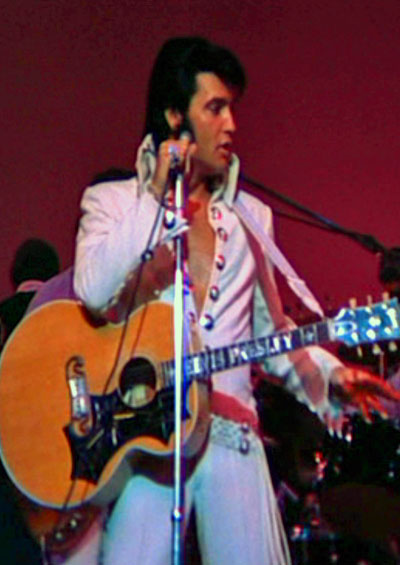
In 1970, MGM’s cameras filmed several rehearsals and concerts for his Elvis Summer Festival engagement at the International Hotel in Las Vegas. Released in November of that year, the resulting Elvis: That’s The Way It Is documentary was grand and captured Elvis in his prime–but left dozens of hours on the cutting room floor.

In 1972, MGM’s cameras rolled again, this time for Elvis On Tour, capturing rehearsals, behind-the-scenes, and concerts in March and April. The film went on to win a Golden Globe, the only Elvis movie so honored. Again, dozens of hours of footage were filmed but not used.

Since that time, we have seen a bit of these outtakes. In 1992, Warner released Elvis: The Lost Performances, an incredible one-hour VHS video that included outtakes from both films. In 2001, Warner released a new edit of That’s The Way It Is, containing so many outtakes and changes as to actually be a different film than the original. Though both were compelling, these projects were just the tip of the Elvis documentary iceberg.

Though both versions of That’s The Way It Is are available, Elvis On Tour and The Lost Performances never received DVD releases. Maybe we are unable to go back in time just yet, but Elvis fans should at least be able to experience these historic films and outtakes.

First off, the original versions of Elvis: That’s The Way It Is and Elvis On Tour should be fully restored in high definition and digital sound and released on Blu-ray (as well as DVD for those fans who have not yet upgraded), with top-notch bonus features.

Why stop there? Next, Warner should choose whichever That’s The Way It Is and Elvis On Tour concerts are most complete (not all were filmed in their entirety) and release them as separate, all-new concert experiences. Do not tag them as Elvis On Tour or That’s The Way It Is re-edits, just make completely new projects and leave the original documentaries to stand alone as accounts from the time. Most important, do not over-edit these concerts. Use Elvis’ original setlist and flow as much as possible.

Imagine if a That’s The Way It Is concert was given a full-fledged theatrical release, with an Elvis marketing blitz unheard of since his death. Just think about watching one of the That’s The Way It Is concerts on an IMAX screen.

Sure, theatrical and IMAX releases are long-stretches, but I think at least Blu-ray releases for Elvis: That’s The Way It Is and Elvis On Tour are real possibilities if Michael Jackson’s This Is It takes off.

A fan can dream, can’t he?

Guest blog: Elvis Super 8 Film Festival [The Film Frontier blog]

First of all, I’d like to thank Ty for giving me an invitation to guest blog here on The Film Frontier. As I’m both an Elvis fan and a movie buff, I thought I’d try to combine those two topics in my post.

As you might know, Elvis Week, where fans from around the world gather in Memphis to celebrate their idol’s life and career, has just ended. Among the many activities a film fest was held on August 11, where a couple of the King’s movies were screened in a real cinema. Reading about it made me think about an old idea of mine for an Elvis film festival.

I got the idea a couple of years ago when I bought some Elvis movies on Tradera, which is kind of a Swedish Ebay. Now, I’m not talking about VHS or DVD copies, but of Super 8 sound and color films.

The films in question are G.I. Blues, Blue Hawaii, Fun In Acapulco, Girls! Girls! Girls! and Roustabout. Each one consists of 375 feet of film and has a running time of about 18 minutes.
The reason I bought them in the first place is that I’m a sentimental guy, I guess. When I was a kid I had my own Super 8 movie camera (just like Elvis!) and I loved to make films, and also to buy home movies (both cartoons and feature films) and watch them with the help of my faithful super 8 projector.

I remember being fascinated by how the distributors of the super 8 movies could manage to edit down a full-length feature film like Son Of Frankenstein into a film with a running time of approximately four minutes, and somehow managed to keep the plot intact.

Thinking a bit more about it now, I realise how spoiled we are nowadays with the DVD format featuring the complete movie in perfect quality, as well as a lot of extra material. Back in the 60’s, 70’s and even the early 80’s people had to make do with four, ten or perhaps twenty minutes of super 8 film, sometimes without sound.

Now, here is my idea of a film festival: As my brother is a big fan of Elvis too, the plan is to invite him, buy a lot of Cheez Doodles that we both love, and screen my five super 8 Elvis movies. It might not be the biggest audience you’ve heard of, but it will be an attentive and appreciative one, of that I’m sure.

There’s just one problem. The reason why this festival hasn’t taken place so far and why I haven’t even watched any of my Elvis super 8 movies yet is because my projector can’t play sound. And watching an Elvis movie where you can’t hear the King singing just isn’t a very interesting concept, is it?

So now is the time to put forth an effort to find a super 8 projector with that capability so I can render my Elvis Super 8 Film Festival possible. Maybe I can find one on Tradera or Ebay. Then my brother and I can finally find out if the plot is intact on my Elvis super 8 movies. Given the not too complicated stories, and the fact that they run for about 18 minutes each, it probably is.

PS: All you sci-fi fans are invited too. You know why? Together with the five Elvis movies the seller threw in a super 8 edit of Star Wars lasting about 10 minutes. And it’s both in colour and with sound.

/Thomas, Elvis Today

REVIEW: From Elvis In Memphis CD Set (2009 Legacy Edition)

From Elvis In Memphis CD set (Sony Legacy, 2009)

Elvis takes it home

“Take it home, son, take it home,” Elvis proclaims near the end of his 1968 Comeback Special. Just a few weeks after the special aired, Elvis did just that. He had not formally recorded in his adopted hometown of Memphis since his last session for Sun in 1955.

By January 1969, the musical landscape had changed, the entire world had changed, and even Elvis had changed. The 20-year-old kid who last recorded in Memphis as he was on the verge of becoming an unrivaled superstar was now a 34-year-old husband and father looking to continue pounding his way out of a creative slump.

Was the success of the ’68 Special a fluke, or was Elvis truly back on the track? His January and February 1969 sessions at the American Sound Studio in Memphis would help answer that question.

Outside of the hit singles, I first heard most of these songs when my brother gave me The Memphis Record double LP set as a Christmas gift back in 1988. It collects 23 of the best tracks from the sessions, including all of the songs from the original From Elvis In Memphis album.

As an Elvis fan, The Memphis Record changed my life. As I said, I was already familiar with “Suspicious Minds,” “In The Ghetto,” and the other hits, but I remember being blown away right off the bat by “Stranger In My Own Home Town,” “Power Of My Love,” “Any Day Now,” and “After Loving You,” to name just a few.

How had I not heard these songs before? Why wasn’t the radio playing these constantly? Unlike most of the kids my age back then and their favorite music fads, I knew at that moment I was going to be an Elvis fan for the rest of my life.

As I typed those words, I have just realized that I am now 34-years-old, like Elvis during these Memphis sessions. Since I first played The Memphis Record back in 1988, the musical landscape has changed, the entire world has changed, and I have changed. I hear the words to some of these songs differently than I did as a 13-year-old. Yet, here I am, still listening to Elvis. Despite all the change, Elvis is still here.

In the early 1990s, I switched over to the CD format and eventually picked up The Memphis Record on CD and complimented it with Back In Memphis to get some of the remaining songs from the session—which I found I didn’t like as much. Even the Back In Memphis songs I was familiar with sounded “muffled” to me.

In 1993, RCA treated the Elvis world to From Nashville To Memphis: The Complete 60s Masters I, a five-disc set that included all of his non-movie and non-gospel studio master recordings from the 1960s, including the complete 1969 Memphis sessions. While this was probably the most authentic sound to date at the time (I only found out later that the mixes on The Memphis Record were slightly altered to sound more contemporary), I remember being just a touch disappointed by the 1969 Memphis sound again for some of the tracks.

For the thirtieth anniversary of the Memphis sessions, RCA released Suspicious Minds: The 1969 Memphis Anthology in 1999. The sound was improved over 1994, but still muffled and lacking to me at times. I figured that it was the best we were ever going to have, though, and I was content with it.

When I first heard about the Legacy Edition of From Elvis In Memphis, now upgraded to include Back In Memphis and all of the other songs from the sessions, I was not planning to buy it. As much as I loved them, I had bought these songs countless times over. Then, a new press release announced that From Elvis In Memphis—Legacy Edition was going to include the original mono versions of all of the singles.

There, Sony/RCA had hooked me. At first, I planned only to purchase the ten individual mono singles online as legal downloads. However, I realized that just for three or four dollars more, I could buy the entire set of 36 songs by just purchasing the CD in a store (buying Elvis music in an actual store: “it’s been a long time, baby”). I probably wouldn’t need all of those other songs, but at least the packaging looked nice.

I played the mono singles first on Disc 2, and once I heard the quality of their sound, I could hardly wait to go back to Disc 1 and play From Elvis In Memphis proper. I don’t know what Sony/RCA did differently this time, but they finally got rid of that sort of muffled sound some of the Memphis tracks had before. Crystal clear. I’m loving this release! What a great surprise!

Yet, I’m sure this won’t be the last time I buy these songs. Sony’s Follow That Dream Elvis collectors label will undoubtedly release both From Elvis In Memphis and Back In Memphis as part of their Classic Album series in the coming years. The whole world will probably have changed by then, but I’ll still be listening to Elvis.

Songs: 10 (out of 10)

Audio & Mix Quality: 10

Liner Notes: 5

Cover Art: 10

Packaging: 10

Overall Experience: 10

Elvis conquers Vegas: 40 years since the return of the King [The Film Frontier blog]

Forty years ago tonight, only eleven days after astronaut Neil Armstrong took his famous “one small step” on the moon, Elvis Presley took his own giant leap.

On that July 31st night in 1969, the singer stepped onto the stage of the International Hotel in Las Vegas and began proving once and for all that he was the greatest and most dynamic performer the world will ever know.

His “comeback” after years of making movies had actually started the year before, with his highly rated and critically acclaimed ELVIS TV special. He rode the tide of that success into his first Memphis recording sessions in nearly 15 years, resulting in smash hits “Suspicious Minds,” “In The Ghetto,” and “Don’t Cry, Daddy.”

Elvis was on top again, and his Vegas engagement was another crown jewel. With two shows a night, seven days a week, for four weeks, the concerts represented his first live appearances in nearly nine years, outside of four studio audience shows for his TV special.

RCA started recording the Vegas shows on August 21, capturing eleven complete concerts in all that summer. Some of the best tracks were selected for an album, Elvis In Person. More recently, several of the shows have been released in full:

  • August 21 Midnight Show on 2007’s Elvis: Viva Las Vegas (Limited Edition) Disc 2
  • August 22 Dinner Show on 2008’s Elvis In Person (FTD Edition) Disc 2
  • August 23 MS on 2003’s Elvis At The International
  • August 24 DS on 2001’s Live In Las Vegas Disc 1
  • August 26 MS on 2005’s All Shook Up

These recordings are some of Elvis’ best available concerts. To commemorate the fortieth anniversary of this engagement, author Ken Sharp (Writing for the King) next month is releasing ELVIS: Vegas ’69, a 200-page hardcover book examining the concert series in text and photos.

Elvis vs. Star Trek: There is no comparison (or maybe there is. . . .) [The Film Frontier blog]

There is a middle ground between genius and insanity. . . .
That’s the signpost up ahead!
You’ve just crossed over into . . . The Film Frontier.

A blogger pal of mine, Thomas over at Elvis Today, is looking to widen his knowledge of Star Trek. He has collected a few DVDs in the past, but this year’s new film has given him the bug again.

I am always looking for content, and this sparked an idea. What better way to acclimate an Elvis expert like Thomas to Star Trek than to relate them to each other? I am not sure how this is going to work out, but I am going to give it a shot.

I suppose Star Trek experts that are looking to expand their knowledge of Elvis could use these same comparisons in reverse. We here at The Film Frontier want to go green, so that makes this a dual-use post.

You have to be very careful when reading a post like this, or you might strip your gears!

  • Star Trek: The Original Series–The Complete Seasons 1-3 is to Star Trek as ELVIS: The King of Rock ‘n’ Roll-The Complete 50s Masters is to Elvis.
  • Inside Star Trek: The Real Story by Herbert F. Solow and Robert H. Justman is to Star Trek as Last Train To Memphis: The Rise of Elvis Presley by Peter Guralnick is to Elvis.
  • Star Trek: The Motion Picture is to Star Trek as Paradise, Hawaiian Style is to Elvis.
  • Star Trek II: The Wrath of Khan is to Star Trek as Elvis: That’s The Way It Is is to Elvis.
  • Star Trek IV: The Voyage Home is to Star Trek as “Are You Laughing Tonight?” is to Elvis.
  • Star Trek: The Next Generation Seasons 1 & 2 and Star Trek: Insurrection are to Star Trek as “C-O-N-F-I-D-ENCE” and “A Dog’s Life” are to Elvis.
  • Star Trek: The Next Generation Seasons 3-7 and Star Trek: Deep Space Nine are to Star Trek as ELVIS: Command Performances-The Essential 60s Masters II is to Elvis.
  • Star Trek: Voyager and Star Trek: Enterprise are to Star Trek as lousy imitators are to Elvis.
  • Star Trek Chronology: The History of the Future by Michael Okuda and Denise Okuda is to Star Trek as Elvis Day By Day: The Definitive Record of His Life and Music by Peter Guralnick and Ernst Jorgensen is to Elvis.
  • Star Trek: Remastered is to Star Trek as Elvis vs. JXL: A Little Less Conversation is to Elvis.
  • The 2009 Star Trek film is to Star Trek as ELVIS (’68 Comeback Special) is to Elvis.With apologies to the great Rod Serling for stealing and mangling his words at the top.

REVIEW – The Wonder of You (FTD CD)

The Wonder of You CD (Follow That Dream Records, 2009)

Strangers No More

When MGM filmed the first few days of Elvis’ August 1970 engagement at the International Hotel in Las Vegas, his third such series of appearances in a year, RCA tagged along and recorded six of the same concerts. RCA released just a few songs from these shows during Elvis’ lifetime, as part of the That’s The Way It Is album. In fact, it wasn’t until 2000’s That’s The Way It Is: Special Edition CD set that a nearly complete show became available.

The Wonder of You marks the fourth almost complete concert officially released from the August 1970 engagement. It contains several songs not featured in the other That’s The Way It Is concerts. Sit back and enjoy Elvis’ August 13 Dinner Show, the sixth and final show that RCA recorded for That’s The Way It Is.

Overview

This is a terrific concert, probably the second best of the That’s The Way It Is shows, behind only the August 12 Midnight Show. Highlights include “Don’t Cry Daddy”/”In the Ghetto,” “The Wonder of You,” “Stranger in the Crowd,” and “Bridge Over Troubled Water.” The sound is about as pristine as can be for a nearly forty-year-old recording.

About half of these performances have been previously released on other official albums. I’ll mention which mixes I think are better in my song-by-song analysis below. I have fun doing these kinds of comparisons, but I would like to point out that, when taken as a whole, this concert sounds great! Don’t read too much into my nitpicks. I’m also aware of the recent bootleg releases of this show, but I’m not going to get into comparing professionally-mixed, official releases to bootlegs.

* * *

“That’s All Right” (previously unreleased)

  • You can feel the excitement build as things kick off with a jungle-like rhythm. Soon, Elvis takes the stage and delivers a solid version of his first record, “That’s All Right.” The horns are mixed a little loud in the left channel at times, but not enough to detract from this classic. “That’s All Right” was the best opening song for Elvis. It worked much better than “Blue Suede Shoes,” “All Shook Up,” “See See Rider,” or various others.

“I Got A Woman” (previously released on That’s The Way It Is: Special Edition CD)

  • Elvis quickly slides into Ray Charles’ “I Got A Woman.” Elvis’ 1969 and 1970 versions of this song are usually fantastic, and this one is no exception. I prefer the mix on That’s The Way It Is: Special Edition, however, where the horns are less pronounced and are in both channels, rather than overpowering the left channel as they continue to do here.

“Hound Dog” (previously unreleased)

  • Elvis references the red snakeskin highlights of his jumpsuit prior to this song, leading to a brief ad-lib in a typical for this season break-neck-pace version of “Hound Dog.” After the song, Elvis goes into his Gatorade routine, and then jokes that he owns part of that company. A star these days would probably work some kind of endorsement deal to mention a product as much as Elvis did Gatorade.

“Love Me Tender” (previously unreleased)

  • Have you ever wondered how Elvis usually got away with kissing so many women in the audience without angering their husbands and boyfriends? “Only if the guy smiles, man, do I kiss her,” explains Elvis as he takes time out from kissing to occasionally sing “Love Me Tender.” The band sounds great and carries along quite well during the kissing interludes. Finally having this concert in a relatively complete form means that we can place his “That’s the most fun part of the whole show” line in context. First heard on the live compilation disc of That’s The Way It Is: Special Edition after “Make The World Go Away,” the comment actually follows the “Love Me Tender” kissing session here.

“Don’t Cry Daddy”/”In the Ghetto” (previously released on That’s The Way It Is: Special Edition CD)

  • I remember this medley blowing me away on the Elvis: The Lost Performances video back in 1992. To see Elvis singing two of my favorite songs for the first time, and together no less. For whatever reason, this CD splits the medley into two tracks, but it is actually a continuous performance. Mac Davis wrote both songs, and Elvis recorded them in his legendary 1969 American Sound Studio sessions in Memphis. Incidentally, these are complete versions, with only minimal fooling around by Elvis. This new mix is better than the previously released version. You can even hear Elvis yell, “Sing it, Charlie!” to Charlie Hodge early on in “Don’t Cry Daddy.”

“I Just Can’t Help Believing” (previously released on Writing For The King)

  • I have to be in the right mood to enjoy this sleepy song, but this is a fine performance. Elvis misses a word or two about halfway through and starts laughing a bit. I love that kind of stuff. If you are one of those people who insist on hearing the correct lyrics to every single song when listening to a live concert, then this isn’t the disc for you. Actually, I would say Elvis isn’t the artist for you, either. He played with or forgot lyrics all the time. Yet, somehow still made the songs sound so good. He really knew how to sell a performance. This mix feels very thin compared to the superior one on Writing For The King. I was hoping this whole disc would sound like this song did on Writing For The King.

“Stranger in the Crowd” (previously released on That’s The Way It Is: Special Edition CD)

  • Elvis jokes that this song, which he had recorded just two months earlier, wouldn’t be released until 1982. Every time I hear that line, it makes me a little sad, though, since Elvis would be gone five years by then. This is a great live rendition of “Stranger in the Crowd,” powered by Ronnie Tutt on drums. The studio version was one of the best numbers on the original That’s The Way It Is album, and it most certainly should have been a single. With a little more work on the arrangement (starting with getting rid of the Imperials’ “la la la la la la la” background vocals near the end), this live version also would have made a nice mainstay to his concert repertoire. Too bad it seems to have been abandoned after this. The mix of this same live version on That’s The Way It Is: Special Edition has a fuller sound, packing more punch than the one here.

“Make The World Go Away” (previously released on That’s The Way It Is: Special Edition CD)

  • Elvis jokes that this song was “written before Roy Acuff was born, which is about 1800.” Just for fun, I decided to fact-check Elvis. Country music legend Acuff was born in 1903. Hank Cochran wrote “Make The World Go Away” in 1963, just seven years before this live recording. Sorry, E. This is a beautiful live rendition that I prefer to the studio cut recorded that June for Elvis Country. This also made its debut on the Elvis: The Lost Performances video, leading me back then to truly appreciate this song for the first time. If for nothing else than the toning down of a buzzing sound present through much of the song, the audio and mix quality here beats the previously released one.

“Sweet Caroline” (previously unreleased)

  • Elvis cuts this Neil Diamond tune off nearly thirty seconds in when he forgets the words. He starts the song over and gets it right this time in a lively version. Every time I hear this song, I have to fight the urge to throw my arm back and forth like Elvis does when the horns go “dah-dah-daah.” I don’t always win that fight. Come on, you know you do it, too.

“You’ve Lost That Loving Feeling” (previously unreleased)

  • Elvis sounds distracted in this disappointing version of “You’ve Lost That Loving Feeling.” His extended performance of this same song from the night before (captured on Disc 2 of That’s The Way It Is: Special Edition) is the best rendition ever (yes, even topping the Righteous Brothers).

“Polk Salad Annie” (previously released on Elvis Aron Presley)

  • Elvis delivers a great version of Tony Joe White’s “Polk Salad Annie.” Who else but Elvis could pull off going from country to pop to soul to swamp rock in a matter of minutes? This performance was first released on the 1980 boxed set Elvis Aron Presley, the first release of any song from this show. Who would have thought it would take another 29 years before we were treated to the entire concert? Audio quality and mixing on this new release is much improved over the 1980 version.

Introductions (previously unreleased)

  • In a fun moment, Elvis first introduces guitarist James Burton as “Chuck Berry.” After introducing (most of) the rest of his crew, Elvis introduces television legend and audience member Art Carney (best known as Ed Norton on Jackie Gleason’s The Honeymooners). Carney gets a huge hand, probably the biggest reaction to a celebrity introduction I’ve ever heard at an Elvis show. Elvis goes on to talk briefly about his own appearances on Jackie Gleason’s Stage Show, and mentions his later appearances on the Milton Berle Show and the Ed Sullivan Show. Someone then reminds Elvis that he forgot to introduce background vocalist Millie Kirkham, and he apologetically does so.

“The Wonder of You” (previously released on The Way It Was)

  • One of the many highlights of the Elvis: The Lost Performances video was this performance of “The Wonder of You.” This version is almost as good as the single version recorded earlier the same year. The mix on this new FTD release of the song is an improvement over the previous release. I had to play them both a few times to come to that conclusion, though. While somewhat softer, the sound has better separation here, so it is easier to pick out distinctive instruments.

“Heartbreak Hotel” (previously unreleased)

  • After the big ending on the previous song, Elvis starts this one off sounding a little weak. This is a typical 1970 version of “Heartbreak Hotel.”

“Blue Suede Shoes” (previously unreleased)

  • A quick version, likely only done to please the crowd, lacking the power of his 1969 versions.

“One Night” (previously released on The Way It Was)

  • Elvis still sounds weak, or is it the mix playing tricks on us? Play the same song on The Way It Was and it sounds much better.

“All Shook Up” (previously released on The Way It Was)

  • “All Shook Up” had not yet become a complete throwaway in 1970, and this is a decent version. Which mix is better this time? Too close to call. This isn’t one I can play a dozen times in a row to figure out.

“Bridge Over Troubled Water” (previously unreleased)

  • A beautiful performance, possibly his best live version of “Bridge Over Troubled Water,” though due more to the orchestra this time around than Elvis. Considering that they blow it on some other songs during the That’s The Way It Is concerts, I have to give the horns some credit on this performance. They really carry this one and help to make it so powerful. This track was a nice surprise.

“Suspicious Minds” (previously unreleased)

  • I always look forward to hearing new live versions of “Suspicious Minds.” This is a decent version, but not particularly memorable. As with the other That’s The Way It Is concert versions of this song, the trumpets sound awful at times, blowing out on many of the high notes. After hearing their superb work on “Bridge Over Troubled Water,” though, I guess I can forgive them. Tutt gives the drums a real workout at the end.

“Can’t Help Falling In Love” (previously unreleased)

  • Elvis sounds tired again after “Suspicious Minds,” but puts some effort into his “Can’t Help Falling In Love” closer. A fantastic show comes to an end.

* * *

I’m not going to say much about the cover and other album artwork, except to point out that cover art has never been FTD’s selling point. They can get away with it because the Elvis content within their releases pretty much sells itself. I’m also not going to bother complaining about the lack of a booklet or liner notes. I’m just glad to finally have this concert.

The Final Verdict

I was only two when Elvis passed away, so I never had the chance to see him live in concert. Experiencing relatively complete shows like this one, when Elvis was in top form, means a lot to me. This is FTD’s best concert release to date, and I’ll be enjoying this show for years to come.

Songs: 10 (out of 10)

Audio & Mix Quality: 9

Liner Notes: N/A

Cover Art: 5

Packaging: 5

Overall Experience: 10

Elvis on FTD helps cure the “No More Boxed Sets Blues” [The Film Frontier blog]

For the last couple of years, around this time, ShopElvis.com has been kind enough to send me a 20% off coupon for use on CDs from Follow That Dream Records. FTD is Sony’s Elvis collectors label, aimed mostly at fanatics like me.

FTD releases are essentially official bootlegs. The Elvis bootleg industry is huge, but FTD provides a legal alternative with releases focusing on alternate takes and live performances. While the mainstream listens to yet another greatest hits compilation, the hardcore Elvis fans listen to FTD releases. Yes, there is still “new” Elvis material released all the time. Though the pace seems to have slowed in the last few months, at one time FTD was averaging about twelve releases a year.

I cannot afford to buy every FTD CD that comes along, so the 20% off allows me to splurge every now and then. Last night, I ordered three two-CD sets: Elvis Is Back!, Elvis Country, and New Year’s Eve.

Elvis Is Back! and Elvis Country are expanded editions of two of the best albums released in his lifetime. In addition to the original songs, multiple alternate takes and bonus songs from the same sessions are included.

Elvis recorded the Elvis Is Back! album in 1960, soon after returning from his two years of service in the US Army. It features a supreme mix of rock ‘n’ roll and blues. The highlight for me is “Reconsider, Baby” – a Lowell Fulson blues number with not only a fantastic performance from Elvis, but also one by Boots Randolph on sax.

During the same 1970 session that produced his masterpiece That’s The Way It Is album, Elvis also recorded the bulk of the songs on Elvis Country. Among the many highlights are “Tomorrow Never Comes” and “I Really Don’t Want To Know.”

New Year’s Eve captures Elvis’ December 31, 1976, concert in Pittsburgh. It was one of the longest concerts he ever gave, requiring two CDs. Unfortunately, the only available source is an audience recording. Since so many high quality concert recordings are out there, I have been wary of trying this one. Mostly positive reviews I have read over the years, not to mention 20% off, finally helped me take the leap, though. I am looking forward to finally hearing this show. Sadly, it was to be Elvis’ last New Year’s Eve.

That is a total of six discs of Elvis material on the way to me right now. Actually, seven if you count The Wonder of You, a newly released FTD CD that I pre-ordered some time ago and that shipped tonight. I will be reviewing that one soon.

My anticipation of multiple Elvis discs brings me back to what became another seemingly annual ritual for me in the 1990s: Counting down for and purchasing Elvis boxed sets.

This was back when they still put cool Elvis music on store shelves and you did not have to order them on the FTD label. We fans really were spoiled back in those days (as we are now). Here is a brief look back at some of the key Elvis boxed sets from the 1990s:

1991: Collectors Gold (3 discs): This collection focused on the 1960s, with one disc of alternates from various Nashville sessions, one disc of alternates from various Hollywood sessions, and one disc of live material from his 1969 Vegas shows. I bought this almost exclusively for the live disc, particularly to finally own a copy of the laughing version of “Are You Lonesome Tonight.”

1992: The King of Rock ‘n’ Roll: The Complete 50s Masters (5 discs): This is the definitive look at Elvis’ music in the 1950s, often considered his most historic. It contains master takes of every song he recorded in the studio during that time, and several alternate and live tracks. I graduated from high school about a year after this was released. I spent the bulk of the gift money I received from various people on this boxed set. I am sure they intended their money to be used for educational purposes, which is why I point out that this is a slice of American history.

1993: From Nashville to Memphis: The Essential 60s Masters I (5 discs): Since it was the only decade during which he recorded every year, the bulk of Elvis’ recordings are from the 1960s. Many of these are unfortunately bland movie tunes. Since it was not feasible to include a complete set of masters like the 1950s, this set instead wisely focuses on Elvis’ non-movie recordings. His live and gospel recordings from this decade are also left out, due to space considerations. What is left behind, though, is a surprising, strong collection of songs that were far too often previously hidden as bonus cuts on otherwise poor soundtrack albums. This set dramatically changed my opinion about Elvis’ work in the 1960s. Incidentally, a two-disc “Best of” collection of 1960s movie tunes, Command Performances: The Essential 60s Masters II, was released shortly after this set as a companion piece. His complete 1960s gospel recordings have also subsequently been released on two or three different multi-disc sets. A recent boxed set for his 1968 Comeback Special is also required listening, as well as the various 1969 Vegas live recordings.

1995: Walk A Mile In My Shoes: The Essential 70s Masters (5 discs): I remember being upset when this 1970s boxed set finally saw the light of day after various delays. From the cover art to the content, it lacked the care of the 1950s and 1960s sets. The 1970s are probably my favorite Elvis decade, so I was expecting a lot from this one. Like the 1960s set, they simply had too much material to fit onto five discs. Instead, they focused on the single releases on the first two discs, used a “best of the rest” approach on the next two discs, and concluded with a disappointing hodgepodge of live songs and rehearsals on the final disc. Unlike the 1950s and 1960s sets, this meant that the master takes were often presented out of sequence. The sound quality was the best yet for all of the songs, but their approach on this one was just a mess. As with a lot of releases of Elvis’ 1970s material, they seem to say, “It’s only the 1970s. Who cares? We can’t let it seem better than his 1950s work.” I used to believe there was actually a “conspiracy” of that nature at the record label starting in the early 1990s. Maybe I still believe this. Anyway, as with most poorly executed Elvis releases, the power of Elvis and his music saves this one, for there are a number of gems on here – including a previously unreleased studio version of “My Way.” I love this music, and I would not trade this set for anything, but it could have been so much more.

1997: A Life In Music (4 discs): I have come to appreciate this set of mostly alternate takes and live performances more over the years. It pales in comparison to the decade sets, though, which is probably why it seemed less than satisfying in their shadows at the time. Highlights here include alternate takes of “You’ll Never Walk Alone” and “If I Can Dream.”

Boxed set releases continued into the 2000s, but that annual tradition is mostly gone now. FTD helps fill the void. Here I am, counting down again. New-to-me Elvis music is on the way.