Elvis: That’s The Way It Is CD set (Follow That Dream Records, 2008 edition)
Welcome, Elvis fans! You are probably wondering why a science fiction site is reviewing an Elvis CD. In fact, the Star Trek, Star Wars, and Superman fans who visit here may be wondering the exact same thing. The answer is, The Film Frontier is much more than just a science fiction site these days. I’ve slowly started branching it out to cover anything in pop culture that interests me. And one of my biggest interests is Elvis Presley, who was kind enough to provide the soundtrack for my life.
Background: Every dream comes true a hundred times
For Elvis fans, choosing a favorite Elvis era is almost like being asked to choose a favorite child. However, I have put a lot of thought into this very question over the years. While I also love his many achievements before and after, my favorite time period in Elvis’ career has to be June 17, 1968, through January 16, 1971.
Why those specific dates at each end of the range? June 17, 1968, was the first day Elvis reported to work for his 1968 television special, ELVIS (now known as Elvis: ’68 Comeback Special). January 16, 1971, was the day Elvis accepted what most say he considered the highest honor of his life, the National Jaycees Award for being one of 1970’s Ten Outstanding Young Men of America. Despite the fact that Elvis rarely accepted awards in person and was not used to giving speeches, he delivered an incredible acceptance speech. To this day, I find his words inspiring:
“Thank you very much, ladies and gentlemen. I’d like to thank the Jaycees for electing me as one of the Outstanding Young Men.
When I was a child, ladies and gentlemen, I was a dreamer. I read comic books, and I was the hero of the comic book. I saw movies, and I was the hero in the movie. So every dream that I ever dreamed has come true a hundred times.
These gentlemen over here, it is these type people who care, who are dedicated. You realize that it is possible that they might be building the Kingdom of Heaven. It’s not too far-fetched from reality.
I’d like to say that I learned very early in life that:
‘Without a song, the day would never end,
Without a song, a man ain’t got a friend,
Without a song, the road would never bend,
Without a song.’
So I keep singing a song. Goodbye. Thank you.”
I see this moment as the perfect finale to the best part of Elvis’ career that began with the ’68 special. He had literally re-conquered the music world, when most had counted him out. He had never been quite this incredible before, and would never be again. Among Elvis’ work during this 31-month period are:
• ELVIS (TV special and album)
• Final three movies as an actor: Charro!, The Trouble With Girls, and Change of Habit, all of which are notable for breaking from the typical Elvis movie formula in some way
• American Studios sessions in Memphis (including #1 hit single “Suspicious Minds” and From Elvis In Memphis album)
• Return to live performances: 1969 and 1970 Las Vegas concert engagements
• RCA Studio B sessions in Nashville (including Elvis: That’s The Way It Is and Elvis Country albums)
• First documentary movie, Elvis: That’s The Way It Is, which captures rehearsals and performances from his third Vegas engagement, Summer 1970
• First concert tour since 1957
My favorite album released during Elvis’ lifetime is Elvis: That’s The Way It Is – which featured adult contemporary material from his June 1970 Nashville recordings, as well as four live cuts from his August 1970 Vegas engagement. It served as a soundtrack of sorts for the excellent documentary of the same name.
The original 1970 album
Though That’s The Way It Is eventually became my favorite album, it had to grow on me over the years. Though often overlooked, That’s The Way It Is contains some of the best songs and performances of his entire career. Though it’s my favorite, it’s not perfect.
Some criticize this album for not living up to one of its more rock-driven predecessors, From Elvis In Memphis. Unfortunately, rock ‘n’ roll fans sometimes dismiss That’s The Way It Is as an easy-listening bore. One of the causes of that issue, I believe, is the sequencing of songs on the album, meaning many of the songs should have been presented in a different order. That’s The Way It Is unfortunately starts with a live cover of the sleepy B.J. Thomas hit “I Just Can’t Help Believin’,” which immediately allows listeners to brand the album as easy-listening.
Proper sequencing of songs is very important (though perhaps less so these days in the more random iPod Age), and I believe it’s one of the areas where RCA/BMG often fails in their Elvis albums, going all the way back to the beginning.
Adding to the trouble, a couple of the live performances included on the album, “Patch It Up” and “I’ve Lost You,” are not as powerful as their studio counterparts, which should have been used instead. The studio versions had been released as singles prior to the album, so the live versions were likely considered as “bonus” items for fans that already bought the singles. The artistry of the album itself should have taken priority, though.
Apparently to complete the “feel” of a live recording, RCA overdubbed applause on the end of the studio version of “Bridge Over Troubled Water,” which closed out the album. Elvis’ vocals on the first verse of the song are also hard to hear, either on purpose or due to a technical glitch. You can better hear Elvis’ beautiful performance of this song, with his voice louder on the first verse and without the annoying applause overdubs, on Heart & Soul and the Elvis: Walk A Mile In My Shoes-The Essential 70s Masters boxed set.
The original That’s The Way It Is would have been greatly improved, and certainly better received by critics and fans, if a couple of different song versions had been used and the album had been sequenced as below. Call it “Elvis: That’s The Way It Should Have Been” – my “fantasy version” of Elvis: That’s The Way It Is.
Side 1
• “Stranger In The Crowd” (studio, as on original)
• “I’ve Lost You” (use studio version instead)
• “How The Web Was Woven” (studio, as on original)
• “You Don’t Have To Say You Love Me” (studio, as on original)
• “Bridge Over Troubled Water” (use studio version without applause overdub instead)
• “I Just Can’t Help Believin'” (live, as on original)
Side 2
• “Patch It Up” (use studio version instead)
• “Twenty Days And Twenty Nights” (studio, as on original)
• “Just Pretend” (studio, as on original)
• “The Next Step Is Love” (studio, as on original)
• “Mary In The Morning” (studio, as on original)
• “You’ve Lost That Lovin’ Feelin'” (live, as on original)
No matter the order you listen, though, the That’s The Way It Is material represents a true Elvis masterpiece.
FTD’s 2008 edition
Follow That Dream (FTD) Records is RCA/BMG’s Elvis Presley collectors label, aimed mostly at fanatics like me. FTD releases are kind of like “official” versions of bootlegs. The Elvis bootleg industry is huge, but FTD provides a legal alternative with releases focusing on alternate takes and live performances. While the mainstream is listening to yet another greatest hits compilation, the hardcore fans are listening to FTD releases. When I heard FTD was re-releasing Elvis: That’s The Way It Is on 2 CDs as part of its “Classic Album Series,” I at first wasn’t too excited, believe it or not.
Why? Well, I bought the original That’s The Way It Is on CD back in 1993 and was thrilled with it. In 1995, I bought the 5-CD set Walk A Mile In My Shoes, which included all of the songs from That’s The Way It Is (except the live versions of “Patch It Up” and “I’ve Lost You,” for which the studio versions were included).
In 1996, I bought A Hundred Years From Now: Essential Elvis, Volume 4, which included outtakes from the June 1970 sessions that produced That’s The Way It Is.
In 2000, I bought That’s The Way It Is again when RCA/BMG released a 3-disc “Special Edition” version to stores to celebrate the 30th anniversary of the album and documentary.
In 2002, I bought even more outtakes from the June 1970 sessions, on FTD’s excellent The Nashville Marathon CD. Plus, I have bought three or four other That’s The Way It Is related CDs, with rehearsals and live performances.
When it comes to That’s The Way It Is, you could say I’m pretty well covered. Did I mention it’s my favorite album? Much like Agent K in Men In Black (“This is gonna replace CDs soon; guess I’ll have to buy the White Album again”), I have learned to accept my fate. I will be buying Elvis: That’s The Way It Is at least once a decade for the rest of my life. Hey, that’s not such a bad deal!
Anyway, I wasn’t too interested in this FTD release, which compiles the original album with the relevant alternate takes from A Hundred Years From Now and The Nashville Marathon, as well as few other alternates and tracks. However, fan reviews by people I respect over at ElvisNews.com and Elvis Today changed my mind. The new version of That’s The Way It Is started shipping to US addresses on Friday. On Monday, it arrived here, and I was up until after midnight playing the two discs. Was it worth it?
The review
It’s been a long time since I reviewed an Elvis CD. Before I created The Film Frontier, I used to write and edit a small-time Elvis fan newsletter back in the 1990s. This was a real newsletter on actual paper. Remember those? None of this online stuff. On a good year, I had fifty concurrent subscribers – which was about the most I could support with no budget anyway.
The funny thing is, despite the newsletter’s miniscule circulation and the fact that it was never published online, an Elvis bootlegger actually somehow obtained and then plagiarized one of my articles and used part of it in an online “press release” promoting a new bootleg DVD several years ago. Imagine my surprise when I came across my own words when browsing through a random Elvis site! I wasn’t sure if I should be angry or flattered. It still turns up every now and then on different Elvis sites, whenever the bootleg DVD gets a new release or is mentioned. I can’t help but laugh when I see it.
I suppose if a bootlegger is going to rip off a company like RCA/BMG, ripping off a forgotten article from a defunct Elvis newsletter is no big deal. It certainly made me look at the bootleg industry in a whole new light, though. Anyway, it’s probably been over ten years since I wrote a review of an Elvis CD. These days, I have this small-time pop culture website, so it’s nice to get the chance to do it again.
So, I already have the 3-disc That’s The Way It Is: Special Edition from 2000, what do I need with this new 2-disc version? Though it included the original album, the focus of the 2000 version was really on the rehearsals and live performances as captured for the film. The focus of this new 2-disc version is on the June 1970 studio work for the album and its singles, so the releases are actually quite different. However, there is a lot of overlap with A Hundred Years From Now and The Nashville Marathon.
For the real verdict, let’s go through it song-by-song.
“I Just Can’t Help Believin'”
• Disc 1, Track 01, Live Master–8/11/1970 Dinner Show (DS) [4:40]: This original album version sounds good. As I noted above, the song does not serve well as an album opener. No other versions are included on this release. Elvis never formally recorded this song in the studio, but there are rehearsals and other live versions available. FTD was wise to focus on the Nashville session work here rather than taking up space with additional versions of “I Just Can’t Help Believin’.” The performance on the 8/11/1970 Midnight Show (MS), on RCA/BMG’s Live In Las Vegas boxed set, is the best live version of this song released so far–much less sleepy than this album track.
“Twenty Days And Twenty Nights”
• Disc 1, Track 02, Master–Take 9 [3:18]: This is the original album version, one of my favorites. For me, this song represents the adult Elvis, the recording artist Elvis that the mainstream so often overlooks in favor of songs like “Hound Dog” or, even worse, lousy imitators with fake sideburns, bad jumpsuits, and horrid voices.
• Disc 1, Track 15, Take 8 [3:17]: This complete take is a previously unreleased track. While nice to add to the collection, it is mostly unremarkable. It is interesting to note, though, that Elvis nailed the master version on the very next take after this one.
• Disc 2, Track 02, Rehearsal, Takes 1-3 [4:33]: Blink and you’ll miss the unreleased rehearsal (Elvis sings off-microphone) and instrumental takes 1 & 2, which take about a minute total. Take 3, the bulk of this track, was previously released on The Nashville Marathon.
• Disc 2, Track 16, Take 5, Take 6 [2:18]: Elvis sings a brief snippet of one of his 50s classics before “Take 5” here – a nice surprise. These performances are left out of the “In And Outtakes” list in the liner notes. Both of these are blown, incomplete takes and are previously unreleased.
• Disc 2, Track 17, Master–Take 9–Rough Mix [3:35]: This previously unreleased “rough mix” is notable mostly for being about 20 seconds longer than the released version. Some of the mixing is slightly different as well, though the released mix is better.
“How The Web Was Woven”
• Disc 1, Track 03, Master–Take 3 [3:26]: Another tough choice, but this is probably my favorite song of the original album. This is a great love song, which I rank right up there in the same league as the more well-known “Can’t Help Falling In Love.”
• Disc 2, Track 07, Rehearsal, Take 1 [4:55]: This rehearsal and take were previously released on The Nashville Marathon. The rehearsal is about a minute longer here, though, which is quite welcome. Take 1 is as good as, possibly even better than, the master. I wonder what happened to Take 2? I’d like to hear it, assuming it wasn’t just a blown opening or something else extremely short.
“Patch It Up”
• Disc 1, Track 04, Live Master–8/12/1970 DS [4:02]: Compared to the excellent studio version, this live version from the original album just feels like a throwaway (though you won’t think that if watching Elvis perform it in the film).
• Disc 1, Track 13, Studio Master–Take 8 [3:24]: This is a great performance and the sound quality here is significantly better than on Walk A Mile In My Shoes. The mix is slightly different as well (I don’t have the 1970 45 RPM of this song, unfortunately, so no way for me to determine which, if either, mix is “correct”). The song also goes about 15 seconds longer than the 1995 release before fading. Crank this one up!
• Disc 1, Track 19, Take 1 [2:43]: This is a previously unreleased take. The “Patch It Up” song itself is actually rather insignificant, yet you hear through this and subsequent takes that Elvis could take a mediocre song like this one and turn it into something special.
• Disc 1, Track 20, Takes 2-7 [5:17]: More previously unreleased takes, all of which are blown or cut short. This is that “fly-on-the-wall” aspect that makes this kind of release so appealing. You can hear Elvis putting this song together, improving it little-by-little until he gets an acceptable master take. Elvis literally curses out the song on the seventh take. The very next take would be the master.
• Disc 1, Track 21, Take 9 [3:16]: This is one take after the master, previously released on A Hundred Years From Now. Not a bad performance, but the master was appropriately chosen.
“Mary In The Morning”
• Disc 1, Track 05, Master–Take 5 [4:11]: This is a pretty, if forgettable, love song from the original album.
• Disc 2, Track 10, Takes 1-4 [7:45]: Two previously unreleased blown takes, followed by takes 3 and 4, which were first released on The Nashville Marathon. Like “Patch It Up,” the appeal is the illusion of being in the studio while Elvis and gang work through the song. “Mary In The Morning” is harder to listen to repeatedly, though. It just keeps going and going. Ty in the morning would fall back asleep if he had to listen to this song.
“You Don’t Have To Say You Love Me”
• Disc 1, Track 06, Master–Take 3 [2:32]
• Disc 2, Track 05, Rehearsal Composite [2:44]: This previously unreleased track is presumably edited together from a number of rehearsals. The editing here is nearly seamless, a fine job. Great to hear Elvis’ producer Felton Jarvis say enthusiastically at the end, “Bravo! That’s a gas, man!”
• Disc 2, Track 11, Take 1, Take 2 [3:12]: Take 1 is a short, previously unreleased flub. Take 2 first appeared on A Hundred Years From Now.
“You’ve Lost That Lovin’ Feelin'”
• Disc 1, Track 07, Live Master–8/12/1970 MS [4:25]: This live performance from the original version of the album is the definitive version of this song, by Elvis or anyone else. This is Elvis at his best, on stage doing what he loved the most. Incidentally, as released on the 2000 CD set as a separate track was an even longer version of the same performance of this song. Elvis does a fantastic reprise and the track time runs about two minutes longer. The 8/12/1970 MS is one of the best Elvis concerts I’ve ever heard, and it alone is worth picking up the 2000 edition (it comprises disc 2).
“I’ve Lost You”
• Disc 1, Track 08, Live Master–8/11/1970 DS [3:42]: While I love this live version of “I’ve Lost You,” one of the original album tracks and certainly a highlight, I prefer the studio version because the lyrics and the arrangement are more complicated. That being said, this is still a great version. I used to play the heck out of it for years until I first heard the studio version on Heart & Soul.
• Disc 1, Track 14, Studio Master–Take 7 [3:31]: This is another absolute favorite for me. Sure, this wasn’t on the original album, but this single did serve to promote that album. An extraordinary performance. Just close your eyes and listen. This is Elvis.
• Disc 2, Track 03, Rehearsal, Take 1 [5:25]: During the previously unreleased rehearsal, Elvis complains about the number of words in the song. This is likely why it was simplified for the live version. Take 1 originally appeared on The Nashville Marathon. It’s a quiet take, with more deliberate phrasing – probably because he’s reading the lyric sheet.
• Disc 2, Track 14, Takes 4-6 [5:22]: The previously unreleased takes 4 and 5 are cancelled before Elvis even sings a note. Take 6, which is an improvement over Take 1 but not as good as the master on Take 7, was previously released on A Hundred Years From Now.
“Just Pretend”
• Disc 1, Track 09, Master–Take 3 [4:04]: How much Elvis greatness can one man take? This is another favorite, an impressive performance from the original album that only Elvis could deliver.
• Disc 2, Track 12, Take 1, Take 2 [4:46]: Take 1 is previously unreleased. You guessed it, though, it’s just a false start. It barely starts at all, actually. Take 2 was previously released on A Hundred Years From Now.
“Stranger In The Crowd”
• Disc 1, Track 10, Master–Take 9 [3:48]: This is yet another great song, one of the best on the original album. Now do you see why I love this album so much?
• Disc 2, Track 08, Rehearsal, Take 1, Takes 3-5 [4:52]: Finally, some outtakes of this song! All of these are previously unreleased. Take 5 is nearly complete, but Elvis blows it near the end. “I’m sorry about that, man,” he says.
• Disc 2, Track 09, Master–Take 9–Rough Mix [4:33]: This previously unreleased rough mix runs about 45 seconds longer than the final version. This has a slightly different mix, with horns a bit lower. Nice to have as an alternate listening experience.
“The Next Step Is Love”
• Disc 1, Track 11, Master–Take 11 [3:33]: Here’s one studio song, from the original album, where I actually prefer the live version. The song is a little hokey either way, but the studio arrangement, complete with xylophone(?), doesn’t help matters.
• Disc 2, Track 06, Rehearsal, Take 2, Take 3, Take 6 [5:11]: The interesting thing about this previously unreleased rehearsal is that you can hear the song’s demo record playing in the background. The previously unreleased Take 2 and Take 3 are quick flubs. Take 6 was previously released on the Elvis: Today, Tomorrow & Forever boxed set.
• Disc 2, Track 13, Takes 7-10 [6:06]: Well, you know the pattern by now. Three previously unreleased blown takes, followed by one previously released, complete take. The Nashville Marathon included Take 10. This is actually a nice take of the song. No xylophone!
“Bridge Over Trouble Water”
• Disc 1, Track 12, Master–Studio Take 8 (with overdubbed applause) [4:38]: Unfortunately, the Heart & Soul version of this track, with Elvis’ vocal raised in the first verse and without the overdubbed applause, was not included on this release. I would have given up “Tiger Man” or one of the other unrelated songs to have this. As for this original version from the album, it’s really not one I ever listen to, once the studio version proper was released. It doesn’t do justice to his performance. The Heart & Soul version, though, I would contend as the best version of this song by anyone.
• Disc 1, Track 16, Live–8/11/1970 DS [4:14]: As noted by Thomas in his review at Elvis Today, if RCA wanted to close out That’s The Way It Is with a live version of this song, why not use an actual live version? The 8/12/1970 MS performance, for instance, is nearly as good as the studio version. This track from the 8/11/1970 DS was originally released on the Platinum boxed set. My question is, why didn’t FTD place an unreleased live version here instead? They could have used a performance from the 8/12/1970 DS or the 8/13/1970 DS.
• Disc 2, Track 04, Take 1 [5:01]: Just when I thought I was tired of hearing this song, this take came on. Beautiful. This was also on The Nashville Marathon.
• Disc 2, Track 15, Rehearsal, Take 2, Take 5 [5:40]: The previously unreleased rehearsal is interesting, for it features a much faster take on the song. “I don’t know, we’d better not,” Elvis says with a laugh. Too bad they apparently didn’t try a whole take like this! Take 2 is previously unreleased and really stops before it even starts. Take 5 was previously released on A Hundred Years From Now.
Other Songs (not on original album)
• Disc 1, Track 17, “Little Sister/Get Back” (Live–8/12/1970 MS) [3:10]: This great live track first appeared on the Elvis Aron Presley boxed set and was also on the That’s The Way It Is: Special Edition (2000) set. This features Elvis on electric guitar, not to be missed.
• Disc 1, Track 18, “Something” (Live Master–8/11/1970 MS) [3:37]: Another great live track. This one first surfaced on Walk A Mile In My Shoes. It appeared again on Live In Las Vegas, this time without the censoring of a mild curse by Elvis. Strangely, this FTD track is the censored version. In any event, this is Elvis’ best version of this Beatles classic released thus far.
• Disc 2, Track 01, “Tiger Man” (Studio Jam–6/4/1970) [2:49]: This instrumental jam first appeared on The Nashville Marathon, though, curiously, that CD labels the track as “Mystery Train/Tiger Man” while this release of the same track only acknowledges “Tiger Man.” Elvis can be heard off-microphone singing “Tiger Man” but not “Mystery Train,” as far as I can tell, so perhaps that’s the reason. However, the guitar opening of the jam itself sounds suspiciously like “Mystery Train.” In concert, Elvis normally performed these two songs together, as a medley. His 1969 and 1970 live versions of this coupling are fantastic.
Like other releases in FTD’s “Classic Albums” series, That’s The Way It Is comes in an oversized CD case, the size of a 45 RPM sleeve. All of the FTD releases are packaged on cardstock rather than within an actual jewel case, so I guess I’ve grown used to that over the years. I would prefer a more standard plastic jewel case presentation.
Anyway, the FTD cover replicates the cover from the original 1970 album. The oversized aspect does at least offer the advantage of allowing the art to look that much closer to the original record album – something hard to accomplish on a standard-sized jewel case. Inside, the CD labels are meant to resemble the Side 1 and Side 2 labels from the original LP. This is a nice touch, but just remember not to use the song list on them, as they are representative of the 1970 release and not this 2008 edition.
Unfortunately, on my copy, the CD holders are incorrectly glued off center for both discs. This means that they do not fully cover the artwork underneath them (which appear to be photos of the real labels from the 1970 album). A little more quality control was needed here. This is made up for by a great picture of Elvis playing the acoustic guitar from one of his July 1970 rehearsals for the Vegas show, just a month after the studio session in Nashville that produced most of this release.
The enclosed 20-page booklet starts off with another spectacular picture of Elvis from Summer 1970, wearing a black leather jacket and his trademark aviator glasses. The booklet contains over 30 other photos, most of which are well chosen and really add to the release.
Though a bit scattered (you will find yourself thumbing back and forth a lot), the booklet contains a ton of information – something that standard FTD releases, outside of the Classic Album Series, sorely lack. There is a complete track-listing with songwriter and musician credits. There is a useful listing of “In And Outtakes” which gives more information about each performance on the release, including its previously released status and previous album (if applicable).
“Masters” gives the master take number for each song in the June 1970 Nashville session. Don’t look for all of these tracks on this album, though, as the session also produced the Elvis Country and Love Letters From Elvis albums. A nice “Behind The Scenes” timeline follows the progress of both the original album and the documentary movie, from April 1970 when the movie deal is signed, until November 1970 when both the album and movie are released. On top of all of that, there are vintage newspaper clippings, memos, and other items of interest to round out the booklet.
The 2008 album producers (Ernst Jorgensen and Roger Semon) dedicate the release to Todd Morgan, a longtime Elvis Presley Enterprises staffer who passed away suddenly in March. “(He) worked tirelessly to maintain the legacy of Elvis Presley through his great work (and) will be sadly missed by all who knew him,” the tribute reads in part. For me, Morgan’s greatest contribution to Elvis’ legacy was his spearheading of 2004’s Elvis: ’68 Comeback Special-Deluxe Edition 3-DVD set and Elvis: Aloha From Hawaii-Deluxe Edition 2-DVD set, which released all of the available footage from these television specials.
There is over 40 minutes of new material on this 2008 version of That’s The Way It Is. Most of the performances not previously released on earlier editions of That’s The Way It Is, A Hundred Years From Now, and The Nashville Marathon are incomplete rehearsals and blown takes, though. However, there are some real gems on this release, including the multiple “Patch It Up” takes.
Plus, this edition pulls everything together in one nice package. Despite the potential strikes against it, this 2008 re-issue turns out to be a must-have for serious fans of Elvis: That’s The Way It Is. This is the definitive look at the outtakes of the That’s The Way It Is portions of the June 1970 Nashville sessions.
If wishes where horses. . . .
I am an Elvis fan, though, which means that I always want more. My thirst for That’s The Way It Is material is not yet satisfied. Here’s my FTD wish-list for future That’s The Way It Is-themed releases:
• Complete 8/12/1970 DS concert
• Complete 8/13/1970 DS concert
• Complete 8/11/1970 DS concert
• Remaining rehearsals from Summer 1970 (California & Nevada)
As long as I’m making wishes, from Warner Home Video/Turner Entertainment Company, which owns the rights to the documentary film, I wish for a definitive multi-disc DVD set containing as many That’s The Way It Is outtakes as commercially possible. (And while you’re looking at documentaries, Warner Brothers, hurry up already with that Elvis On Tour DVD release. The format’s going to be dead before you get around to releasing this Golden Globe winning movie.)
Songs: 10 (out of 10)
Liner Notes: 9
Cover Art: 8
Packaging: 7
Overall Experience: 10


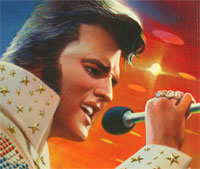
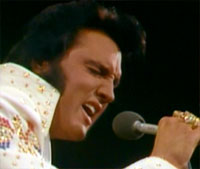 For a 1992 US Postal Servicing stamp voting campaign, Berkey also painted “Elvis Stamp B” (above), which depicted Elvis Presley as he appeared in his historic 1973 Aloha From Hawaii TV special (right). Berkey’s image lost to Mark Stutzman’s “Elvis Stamp A,” which depicted Elvis in 1956, his first year of national fame. Stutzman’s 1950s Elvis image became an official US stamp the following year, while Berkey’s 1970s Elvis image was never issued.
 The Mystery Train