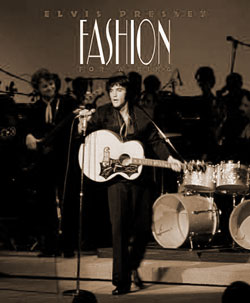
Fashion For A King (2011)
When I saw the press release for Fashion for a King, I was thrilled. An entire book (500+ pages) about Elvis’ jumpsuits? What could be better? (For me, anyway. I know some people groan at the thought.) According to the press release, the book promised to be “a full documentary of Elvis’ jumpsuits,” covering “the background story of each and every suit” – a “fully documented story and pictures of Elvis Presley’s stage outfits” and “an encyclopedia for fans…to learn more about these great original stage outfits.”
Needless to say I was excited. An encyclopedia of each and every suit, with documentation? My head filled with visions of unseen photographs and close-ups of each suit, along with documentation about when each suit was worn. Although not explicitly stated, I did get the impression that each concert would be individually documented, if not with a photo, then at least with a date and a listing of which suit was worn. In short, the press release promised a lot, and since the book had been written by fans, who often obsess about such details, I was very much looking forward to a reference that I would look at time and time again, much like I do with my Sessions books.
Unfortunately, upon paging through the book after I got it, it immediately became clear that it was much less than was I was anticipating. The majority of the photos in the book were ones I had seen before, either from well known sources, Follow That Dream releases, or simply from surfing the Internet. Only about 20 or so were new to my eyes, and it seemed as though the rest had been cobbled together from various sources that almost anyone could find. I felt a bit cheated paying over $100 US for a book full of photos that I probably could assemble most of myself given a few days of Internet usage. However, I could forgive the lack of rare photos if the rest of the book (the jumpsuit specifics) made up for it. Unfortunately the book failed in that area as well.
The text was bland and repetitive and followed exactly the same format in each section: Elvis’ tour lasted from this date to this date, he wore XYZ jumpsuits during the tour and he had Y band members with him. While the descriptions of which jumpsuits were worn on what dates were sadly lacking, oddly, the authors saw fit to inject commentary within the descriptions about Elvis’ health, state of mind, girlfriends or spending habits, often in the form of generalizations. I found it hard to distinguish whether or not the authors were trying to sympathize with Elvis or to condemn him. Regardless, in my opinion, a simple list of shows, dates, suits, capacities, grosses, and band members would have been much superior to prose that alternated from factual statements about dates and locations to editorial comments about Elvis’ state of mind. Somehow, in a work billed as an encyclopedia of Elvis’ jumpsuits, I wasn’t expecting to read about Elvis’ love life, or his spending, or the Colonel’s gambling habits. All of these things have been covered elsewhere. As it stands, the text came across to me as a canned, generic version of the stereotypical Elvis timeline that a non-fan might parrot back to you when talking about Elvis. In other words, lots of generalities, few actual facts, and most glaringly, very little relevance to what the book was ostensibly about. Oddly, though, given the lack of actual text concerning the specifics of Elvis’ jumpsuit usage, almost every section has specific details about the types of microphones Elvis used on a given tour, even down to the color of the tape used to secure the microphone windscreen – if only the jumpsuit information was this detailed and orderly!
To be fair, some of Elvis’ jumpsuits are described in detail, although I personally found the descriptions hard to follow, as often the authors would mention that Elvis wore ‘X’ jumpsuit with ‘Y’ belt during a specific Vegas engagement while not having a photo of said jumpsuit (and particularly said belt) to accompany the text. This was especially confusing when describing jumpsuits and belts that were originally created in previous years (say, when talking about jumpsuits and belts worn in both 1973 and 1974, for example). The text more often than not wound up reading like “Elvis wore jumpsuit X with original belt 1, although sometimes with non-original belt 2, along with jumpsuit Y” – I found myself having to page backwards through the book to remind myself if I actually saw a photo of “original belt 1” at some point. Given that I am a lifelong Elvis fan and a jumpsuit aficionado, I can only imagine how confused an average Elvis fan, or a new Elvis fan, might be with the descriptions. Having some photos of the jumpsuits as displayed at Graceland when talking about minutiae like how many buttons were on the sleeves of the given jumpsuit or how belt X had two chains per loop while belt Y had only one would have provided some excellent visual counterpoints to the printed details. Again, I am approaching this from the standpoint of someone who LOVES reading about things like how the differing versions of the flame suit can be determined by the color of the kick pleat in the legs, and even I found some of the text hard to follow.
Design-wise, the book is laid out well, but I did find that the authors included photos of Elvis wearing a given jumpsuit in a later year placed within the discussions from a previous year (with shots of Elvis from 1972, for example, appearing in sections covering Elvis’ November 1971 tours). While I can understand using shots from different periods when describing a specific jumpsuit, the book is primarily organized about specific tours and engagements, so personally I would have found it more stylistically interesting to include 72 shots with 72 tours where a given suit was worn. Again, including some static shots of the jumpsuits themselves when talking about their design would have been more interesting and appropriate to this reader.
The book is clearly a labor of love on the part of the authors, and one can tell that they enjoyed putting it together, but overall, I can’t really find much in the book that will interest the diehard fan, and in particular the diehard jumpsuit fan. The book has the feel of a project that fans might do in their spare time for their own enjoyment, which is essentially what this sprang from, according to the press release. As mentioned, I could see myself doing something similar just for the fun of it, although if I were to put it in book form for wider consumption I personally would feel an obligation to provide something, even if not necessarily new, at least useful as a reference.
Although this release is not produced by FTD, it was released in conjunction with them, and as with previous FTD book products, some Elvis music is included, this time in the form of Elvis’ Omaha, Nebraska show from July 1, 1974, and a Las Vegas show from December 14, 1975. Both of these have been around on the CD/CDR circuit, with parts of the former also being available in the form of some very good 8mm footage, but neither has appeared on soundboard. Both are a welcome treat, showing Elvis in good form, with the 1975 show providing an excellent set list. I remember hearing this show years ago as an audience recording and really enjoying it and the soundboard version confirms what I thought at the time. Elvis seems relaxed and in a good mood, and gives some very committed and unrushed performances. The oldies are tossed together and dispensed with in the first third of the show, leaving the remaining two-thirds for more powerhouse material, including “How Great Thou Art” (with a reprise of the ending), “Just Pretend,” “You Gave Me A Mountain,” and a rare (for this time period) performance of “Until It’s Time For You To Go.” Even more unusually, the show even features a performance of “It’s Now or Never” with Elvis singing the Italian lyrics. The show is also quite long for Vegas, running about 75 minutes. Overall, this show alone more than makes up for the book in my opinion, and I am very happy that this particular show has finally been released on soundboard.
The Omaha show is also of a good standard, with Elvis’ performance (in my opinion) being more serious and energetic than other releases from this time period, like June 19 in Amarillo or June 29 in Kansas City. Again, a nice bonus and nice compensation after my disappointment with the book.
In short, I was disappointed by Fashion for a King in almost every respect. On a scale of 1 to 10, I’d have to rate it right down the middle, with only the authors’ obvious love for the subject and the two included CDs saving it from a bottom of the barrel rating. Ironically, in thinking about it, this book might actually be more appealing (from a content standpoint) to a casual fan, as it does offer some nice photos in a coffee table book format. But for the diehard jumpsuit lovers like me, there is unfortunately little new on offer.
/Bryan Gruszka, Strange Paradise Online
Bryan Gruszka has been an Elvis fan since he was 6-years-old. A self-confessed jumpsuit afficionado, his favorite period is the 1970s. When not occupied with Elvis, Bryan is developing a book and website about Strange Paradise, an obscure Canadian gothic soap opera. Feel free to drop him a line or check out his website.

 The Mystery Train