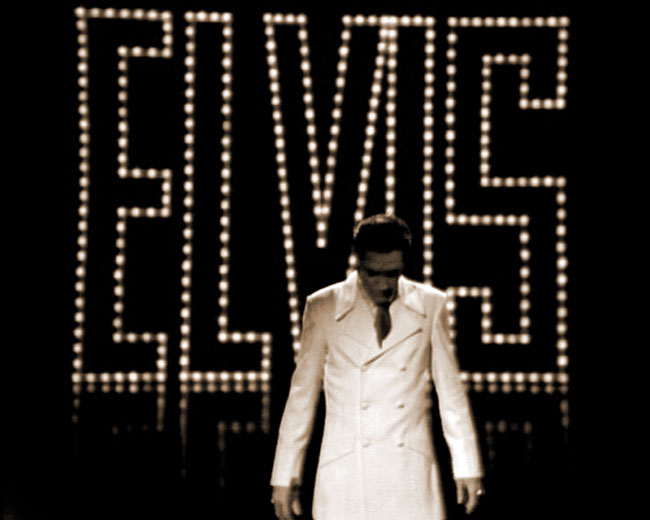
Elvis Presley: January 8, 1935—August 16, 1977
“It was hard to understand how somebody who came in and took away so many people’s loneliness could have ended up so lonely . . . because he deserved a lot better.” –Bruce Springsteen on Elvis Presley
Elvis Presley: January 8, 1935—August 16, 1977
“It was hard to understand how somebody who came in and took away so many people’s loneliness could have ended up so lonely . . . because he deserved a lot better.” –Bruce Springsteen on Elvis Presley

Elvis Presley: January 8, 1935—August 16, 1977
“To live in the hearts we leave behind is not to die.” –Thomas Campbell
On August 28, 1963, civil rights leader Rev. Dr. Martin Luther King, Jr., stands at the Lincoln Memorial in Washington, DC, and delivers his famous “I Have A Dream” speech during the March on Washington for Jobs and Freedom.
In Elvis Day By Day, Peter Guralnick and Ernst Jorgensen note, “Dr. King’s ‘I Have A Dream’ speech is one of Elvis’ favorite rhetorical pieces, something he recites often over the years” (p. 239).
At the Lorraine Motel in Memphis, Tennessee, on April 4, 1968, King is silenced by an assassin’s bullet at the age of 39.
Longtime Elvis friend Jerry Schilling describes the singer’s reaction to King’s death when they see the news:
“I’d heard him recite [King’s] beautiful, hopeful words many times. I looked over at Elvis now and saw that he was staring hard at the TV. There were tears in his eyes. ‘He always spoke the truth,’ he said quietly” (Me And A Guy Named Elvis, p. 187).
Elvis is in Hollywood finishing up his 28th movie, Live A Little, Love A Little, and is devastated that the murder took place in his hometown. He also believes it will confirm “everyone’s worst feelings about the South” (Careless Love, Guralnick, p. 297).
Actress Celeste Yarnall, who had a small role in Live A Little, Love A Little, states that she watched King’s funeral on TV with Elvis and held him in her arms as he cried (The Elvis Encyclopedia, Victor, p. 289).
Only nine weeks later, Senator Robert F. Kennedy is assassinated at the Ambassador Hotel in Los Angeles while running for President. This time, Elvis is in nearby Burbank – less than ten miles away. Rehearsals have begun for his ELVIS television special.
A few days later, W. Earl Brown writes “If I Can Dream” for Elvis to close the show. The song can be interpreted as a tribute to both fallen leaders, particularly King. “If I can dream of a better land, where all my brothers walk hand-in-hand, tell me why can’t my dream come true?” pleads Elvis in the song, echoing King’s 1963 speech.
It is a huge departure for Elvis, who has thus far avoided public commentary on social issues. His manager even tries to nix the song, but in a rare moment of defiance, Elvis insists on recording it.
NBC airs the ELVIS special on December 3, 1968, and it becomes the highest-rated program of the week and one of the most-watched specials of the year. “If I Can Dream” turns out not only to be the perfect song to close the special, but also an appropriate way to reflect on a tragic chapter in American history.
Martin Luther King, Jr., would have turned 84 on January 15. Today, the United States observes this hero’s birthday with a national holiday. His words, his ideas, his dreams live on.

John Wilkinson and Elvis on stage, January 12, 1973
Sad news in the Elvis world. John Wilkinson, who played rhythm guitar for Elvis on stage from 1969 through 1977, passed away today, January 11, 2013. He was 67.
Wilkinson first joined Elvis Presley’s core rhythm group in July 1969 for the singer’s spectacular Las Vegas return to live performances. He went on to appear with Elvis in the concert documentary films That’s The Way It Is (1970) and Elvis On Tour (1972).
He also appeared in the Aloha From Hawaii (1973) television event – which celebrates its 40th anniversary on Monday. Wilkinson is prominently featured in the television special Elvis In Concert (1977) while playing “Early Morning Rain.”
Wilkinson performed on the Elvis In Person portion of the 1969 double album From Memphis To Vegas/From Vegas To Memphis and has been on scores of Elvis concert albums since that time.
In addition to his live work, Wilkinson played for Elvis in his 1972 and 1975 sessions at RCA’s Studio C in Hollywood as well as in his 1976 sessions at Graceland. Results of those sessions included singles “Burning Love” b/w “It’s A Matter Of Time” and “Separate Ways” b/w “Always On My Mind” and albums Elvis Today, From Elvis Presley Boulevard, and Moody Blue – the last LP released before Elvis’ death.
He remained with the stage band right until the end, through Elvis’ final concert on June 26, 1977, in Indianapolis, Indiana.

John Wilkinson in 1970
John Wilkinson is survived by his wife, Terry. My thoughts and prayers are with his family and friends.
Further Reading

Elvis talks to the media, 1969
“Sometimes when I walk into a room at home and see all those gold records hanging round the walls, I think they must belong to another person. Not me. I just can’t believe it’s me.” –Elvis Presley, 1969
Elvis rarely talked about his success. I was inspired to dig this quote up, one of my favorites, based on a twitter conversation I was having this morning with Sheila O’Malley (of the thought-provoking Sheila Variations Blog).
The source of this quote is from a 1969 interview with Elvis by Ray Connolly for the London Evening Standard on the occasion of Elvis’ return to live performances. You can read the full article over on Connolly’s site.
[I do not, however, agree with Connolly’s post-script that Elvis did little but disappoint after 1969. Thomas Melin over at the Elvis Today Blog has previously addressed a similar dismissal by Connolly – and, ironically, pointed to the same Sheila Variations post that helped spark my quote search this morning. The circle continues!]
Donate funds to the American Red Cross.
My thoughts and prayers are with those affected.
 The Mystery Train Blog