You’re entering a fantastic land of imagination . . . the edge of reality.
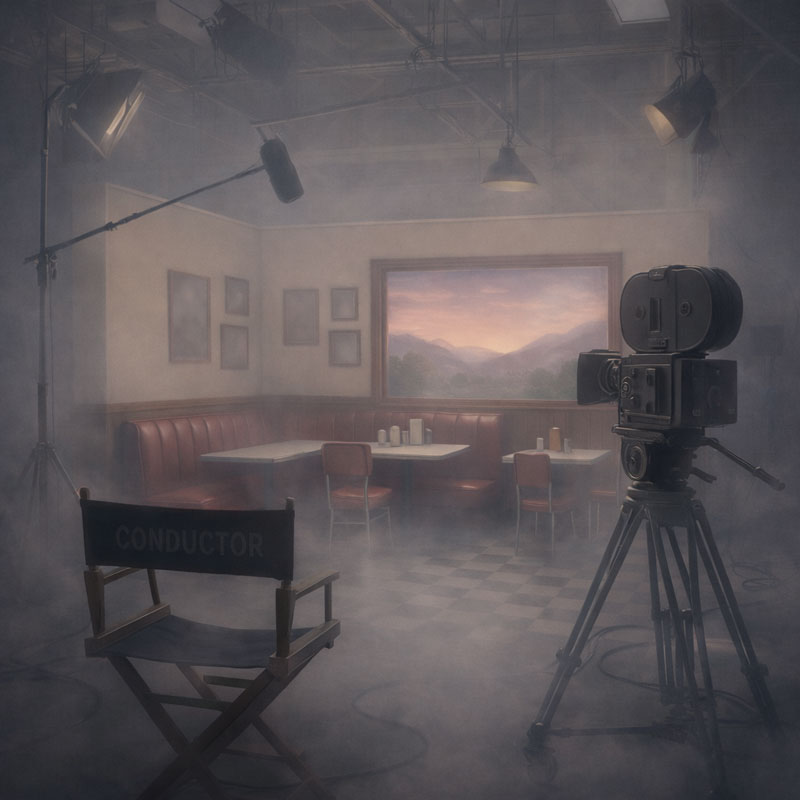
You are alone in the Mystery Train Diner.
The lights are out. The jukebox is dead.
In the empty restaurant, you hear only silence. Not even the noise of the train interrupts the stillness.
There is nothing.
A world without Elvis.
* * *
In the darkness, you slowly realize I am once more sitting in front of you.
“Nobody will ever know who it was,” I whisper, “But out there somewhere, somebody became the first person to play an Elvis song again after he died. The music was too strong to be silenced.”
Without warning, lightning flashes outside and illuminates the restaurant.

“The Memphis Flash” (Artwork created for The Mystery Train with assistance from ChatGPT)
As the train rumbles with the thunder, the diner and the jukebox hum back to life. You hear a simple but familiar melody begin with an acoustic guitar followed by an upright bass.
Listen along on Spotify.
The Elvis Odyssey
Part III: Storming The Mountain
On Monday, July 5, 1954, at Sun Studio in Memphis, producer Sam Phillips gives young Elvis Presley, a truck driver for Crown Electric, a chance to prove himself. Nothing clicks until Elvis and bassist Bill Black start having fun with a blues song by Arthur “Big Boy” Crudup. Guitarist Scotty Moore soon joins in. . . .
#95 That’s All Right (1954)
That’s All Right (Single)
Memphis, TN
Elvis had actually made his first recording about a year earlier, an informal demonstration record at Phillips’ Memphis Recording Service, located within Sun Studio, as a surprise for his mother.
Elvis: “I started out when I was just out of high school. I was driving a truck, and I was training to be an electrician, and I got wired the wrong way, baby. That’s what happened to me. . . . One day on my lunch break I went into a . . . record company to make a record for my own use. I really wasn’t trying to get into the business.”Q
Elvis: “I made the record. In fact, we’ve still got the record at home. It’s so thin, you can’t play it now. The record I made was ‘My Happiness’ and one of the Ink Spots’ numbers. . . . I had a little $20 guitar. It sounded like somebody beating on a bucket lid or something.”R
Marion Keisker, who worked at Memphis Recording Service, made a note of the singer who paid to record the My Happiness/That’s When Your Heartaches Begin acetate, but nothing came of it at first. Elvis came back a few months later and recorded another acetate demo, apparently hoping to get Phillips’ attention. His persistence eventually paid off in the formal session that resulted in “That’s All Right.”
Impressed by the singer’s take on “That’s All Right,” Phillips signs Elvis to the Sun label about a week later. Elvis’ first single, That’s All Right/Blue Moon Of Kentucky, becomes a regional hit, slowly spreading from Memphis.
Elvis: “My very first appearance after I started recording, I was on a show in Memphis . . . as an extra added singer, a big jamboree in an outdoor theater, outdoor auditorium.
“I came out on stage, and I was scared stiff. It was my first big appearance in front of an audience. I came out, and I was doing a fast-type tune, one of my first records. Everybody was hollering, and I didn’t know what they were hollering at.
“Everybody was screaming and everything, and then I came off stage and my manager told me that they was hollering because I was wiggling my legs. I was unaware of what I was doing. Bob Neal was my manager.
“And so I went back out for an encore and kinda did a little more, and the more I did, the wilder they went.”S
#96 Blue Moon (1954)
A Boy From Tupelo: The Complete 1953-55 Recordings
Memphis, TN Take 9 [master, alternate source]
A few weeks later, Elvis is back at Sun Studio experimenting. He records a haunting version of “Blue Moon,” but Phillips decides against releasing it. The recording eventually shows up in 1956 on his debut album, Elvis Presley.
#97 Good Rockin’ Tonight (1954)
Good Rockin’ Tonight (Single)
Memphis, TN
Elvis: “My daddy had seen a lot of people who played the guitar and stuff who didn’t work, so he said, ‘Make up your mind about either being an electrician or playing the guitar. I never saw a guitar player that was worth a damn!'”T
By late 1954, even Billboard is taking notice of Elvis with a positive review of his third single, Milkcow Blues Boogie/You’re A Heartbreaker. Music promoter “Colonel” Tom Parker, currently managing Hank Snow, also starts paying attention around this time and slowly begins working his way into the singer’s life.
#98 Baby, Let’s Play House (1955)
Baby, Let’s Play House (Single)
Memphis, TN
#99 I’m Left, You’re Right, She’s Gone (Alternate-1955)
A Boy From Tupelo: The Complete 1953-55 Recordings
Memphis, TN Take 5 (AKA “My Baby’s Gone”)
#100 Mystery Train (1955)
I Forgot To Remember To Forget (Single)
Memphis, TN
I don’t know that Elvis ever quite achieved another performance like his studio version of “Mystery Train” in terms of mood. I’m hard-pressed to think of one. Maybe the studio version of “Are You Lonesome Tonight,” which, of course is a whole different genre. Or “Blue Moon,” mentioned earlier. In any event, there’s something dark and contemplative about the 1955 “Mystery Train” that I love to my core.
#101 Tryin’ To Get To You (1955)
A Boy From Tupelo: The Complete 1953-55 Recordings
Memphis, TN
Over time, Parker lures Elvis away from Phillips and Sun Records by orchestrating a lucrative deal with RCA Records. Under Parker’s deal, Phillips sells Elvis’ recording contract and tapes to RCA Records in November 1955 for $35,000 (over $400,000 in 2025).
In January 1956, Elvis records in RCA’s Nashville studio for the first time.
#102 Heartbreak Hotel (1956)
Heartbreak Hotel (Single)
Nashville, TN
“Heartbreak Hotel” becomes Elvis’ first number one hit.14
From here at “Heartbreak Hotel” through “Lawdy, Miss Clawdy” is one of my favorite stretches of songs on the entire Elvis Odyssey.
#103 Money Honey (1956)
Elvis Presley
Nashville, TN
#104 I Was The One (1956)
Heartbreak Hotel (Single)
Nashville, TN
#105 Blue Suede Shoes (1956)
Elvis Presley
New York, NY
#106 My Baby Left Me (1956)
I Want You, I Need You, I Love You (Single)
New York, NY
#107 Lawdy, Miss Clawdy (1956)
Shake, Rattle And Roll (Single)
New York, NY
In March, Parker officially becomes Elvis’ manager. Around this time, Parker also parts ways with Snow. Parker eventually commands a 50% fee from Elvis, his sole client. Among other deals, Parker begins shopping Elvis around to the major movie studios.
Elvis: “I’ve had people ask me was I gonna sing in the movies. I’m not, I mean as far as I know, because I took strictly an acting test, and I wouldn’t care too much about singing in the movies.”U
#108 I Want You, I Need You, I Love You (1956)
I Want You, I Need You, I Love You (Single)
Nashville, TN
“I Want You, I Need You, I Love You” becomes Elvis’ second number one hit.
In the first six months of 1956, Elvis appears on national television eight times, with six appearances on Jackie Gleason’s Stage Show (CBS), hosted by the Dorsey Brothers, and two appearances on the Milton Berle Show (NBC).
Elvis: “It happened very fast to all of us–my mother, my father and all of us. Everything happened overnight and so we had to adjust to a lot of things very quickly. A lot of good things, I might say.”V
Elvis’ June appearance on the Milton Berle Show includes a wild performance of “Hound Dog,” which he has not yet formally recorded.
Elvis: “At that particular time, there was a lot of controversy. You didn’t see people moving out in public. They were getting it on in the back rooms, but you didn’t see it out in public too much.”W
It was really a toss-up for me to include Elvis’ live version of “Hound Dog” from the Berle show versus his studio master. I eventually went with the studio version because of its iconic status, but it’s another track that I could just as easily swap out next week.
On July 1, Elvis appears on the Steve Allen Show (NBC) and sings “Hound Dog” again. This performance is more subdued, but only adds to the legend.
Elvis: “They were going to tame me down, so they had me dressed in a tuxedo, had me singing to a dog on a stool.”X
Later in the evening, after the Steve Allen Show, a weary Elvis appears on a New York NBC affiliate’s Hy Gardner Calling interview program and is asked to address the controversy surrounding his music:
Elvis: “I don’t see that any type of a music would have any bad influence on people, when it’s only a music, I mean. I can’t figure it out. In a lot of the papers, they say rock ‘n’ roll is a big influence on juvenile delinquency. I don’t think that it is. . . . I don’t see how music would have anything to do with it at all.”Y
The next day, Elvis steps into RCA’s New York studio and records one of the biggest singles of his career.
#109 Hound Dog (1956)
Don’t Be Cruel (Single)
New York, NY
#110 Don’t Be Cruel (1956)
Don’t Be Cruel (Single)
New York, NY
Both sides of Don’t Be Cruel/Hound Dog become number one hits as controversy continues to follow the singer.
Elvis: “The police filmed the show one time in Florida because the PTA, the YMCA, or somebody, they thought I was something. They said, ‘Man, he’s gotta be crazy.’ So, the police came out, and they filmed the show. So, I couldn’t move. I had to stand still. The only thing I’d move was my little finger, like that.”Z
Meanwhile, the movie deal that has been percolating for some time comes to fruition.
Elvis: “My next move was Hollywood. That’s how it happens: You get a record, and you get on television, then you go to Hollywood. I wasn’t ready for that town, and they wadn’t15 ready for me.”AA
Elvis’ first movie, The Reno Brothers, goes into production in August.
Despite Elvis’ early belief to the contrary, there was no way the movie studios were going to feature the chart-topping star solely as an actor. That same month, he records the soundtrack to The Reno Brothers: Three awful songs that The Elvis Odyssey will skip and one with new lyrics set to the traditional tune of “Aura Lee.”
#111 Love Me Tender (1956)
Love Me Tender (Single)
Hollywood, CA
“Love Me Tender” becomes another number one hit for Elvis, with sales so strong that The Reno Brothers is renamed Love Me Tender prior to the film’s release. As for the film itself, Elvis is not happy with how it turns out.
Elvis: “They wanted to put me in a movie real quick. Love Me Tender, the first one, almost finished me off in the business. Well, it almost killed me. It was a rush deal. They rushed me in the thing just to get my name. . . . So, they did, and the picture wasn’t all that good of a picture. It was an old picture, I mean story-wise, and I shouldn’t have been in it from the beginning. And I started trying to act in it. I was trying to act in it, and the minute you start trying to act on the screen, you’re dead.”AA1
#112 Love Me (1956)
Elvis
Hollywood, CA
Though not released as a single, “Love Me” climbs to #2 on the charts on the strength of radio airplay and sales of the Elvis Vol. 1 Extended Play (EP) on which it features.
#113 Too Much (1956)
Too Much (Single)
Hollywood, CA
“Too Much” becomes a number one hit.
Elvis: “Then I went to the Ed Sullivan Show. . . . They photographed me from the waist up. And Sullivan’s standing over there saying, ‘Sumbitch.’ So, I said, ‘Thank you, Ed, thank you.’ I didn’t know what he was calling me at the time. . . . I did the Sullivan Show two or three times.”AB
On his third and final Ed Sullivan Show (CBS) appearance, television cameras show Elvis only from the waist up. Once again, an attempt to undermine the controversial singer only adds to his legend.
“Don’t Be Cruel” from that January 1957 Sullivan appearance is one of my favorite live recordings of that song. Though I defaulted to the 1956 studio master for this iteration of The Elvis Odyssey, this 1957 version, inspired by Jackie Wilson’s Las Vegas imitation of Elvis that the latter happened to see, is just as strong.
#114 All Shook Up (1957)
All Shook Up (Single)
Hollywood, CA
“All Shook Up” becomes a number one hit.
#115 Loving You (1957)
Teddy Bear (Single)
Hollywood, CA
#116 Teddy Bear (1957)
Teddy Bear (Single)
Hollywood, CA
Featured in Loving You, Elvis’ second movie, “Teddy Bear” becomes a number one hit.
#117 Is It So Strange (1957)
A Date With Elvis
Hollywood, CA
#118 I Beg Of You (1957)
Don’t (Single)
Hollywood, CA
“I Beg Of You” peaks at #8.
#119 One Night (1957)
One Night (Single)
Hollywood, CA
“One Night” peaks at #4.
I consider “One Night” to be one of the greatest of all Elvis songs, so it’s funny to see that it peaked at “only” number four. This is partially explained by the fact that, though recorded in 1957, it wasn’t actually released until Elvis was months into his U.S. Army service in late 1958. It could also just be my taste differs from typical listeners of 1958.
#120 When It Rains, It Really Pours (1957)
Elvis For Everyone!
Hollywood, CA
This fine 1957 recording of “When It Rains, It Really Pours” was held back even longer than “One Night,” not escaping from the vaults until it became an album cut in 1965. Elvis had also tried out the same song while at Sun in 1955. That early recording did not see the light of day until 1983.
After struggling to find privacy for him and his parents at various residences, Elvis buys a 1939 home in Memphis, called “Graceland” by its former owners, in March 1957 for $102,500 (over $1 million in 2025). He then spends another $500,000 renovating it (over $6 million in 2025). The property includes over 13 acres.
#121 Jailhouse Rock (1957)
Jailhouse Rock (Single)
Hollywood, CA
The title song of Elvis’ third movie, “Jailhouse Rock” is perhaps the best rock ‘n’ roll performance of his career.
“Jailhouse Rock” becomes a number one hit.
#122 Baby, I Don’t Care (1957)
A Date With Elvis
Hollywood, CA
Be sure to listen out for Elvis playing electric bass on “Baby, I Don’t Care.” I never realized this was him until reading Peter Guralnick’s liner notes to The King of Rock ‘n’ Roll: The Complete 50s Masters (1992) as a teen.
#123 Treat Me Nice (1957)
Jailhouse Rock (Single)
Hollywood, CA
#124 Don’t (1957)
Don’t (Single)
Hollywood, CA
“Don’t” becomes a number one hit.
#125 King Creole (1958)
King Creole
Hollywood, CA
#126 Hard Headed Woman (1958)
Hard Headed Woman (Single)
Hollywood, CA
Michael Curtiz, best known for 1942’s Casablanca, directs Elvis in his fourth movie, King Creole. Though the bulk of the song will be cut from the 1958 film, “Hard Headed Woman” becomes a number one hit.
#127 Trouble (1958)
King Creole
Hollywood, CA
#128 As Long As I Have You (1958)
King Creole
Hollywood, CA
Elvis: “I did four pictures, and I was getting used to the movie star bit. . . . I had a pair of sunglasses and riding in the back of a Cadillac, my feet up on the seat, saying, ‘I’m a movie star!’ . . . I was livin’ it up, eating hamburgers and drinking Pepsis. And then, I got drafted. So overnight, it all changed.”AC
Elvis is inducted into the U.S. Army in March 1958. He undergoes basic training at Fort Hood, Texas.
#129 A Big Hunk O’ Love (1958)
A Big Hunk O’ Love (Single)
Nashville, TN
During a short furlough after basic training, Elvis records a few songs in RCA’s Nashville studio at a one night session in June 1958. This is his only recording session while in the Army.
“A Big Hunk O’ Love” becomes a number one hit.
#130 A Fool Such As I (1958)
A Fool Such As I (Single)
Nashville, TN
“A Fool Such As I” peaks at #2.
Elvis’ mother, Gladys, passes away in August 1958 at the age of 46.
Elvis: “My mother, I suppose since I was an only child, that we might have been a little closer. Everyone loves their mother, but I was an only child, and Mother was always right with me, all my life.
“It wasn’t only like losing a mother, it was like losing a friend, a companion, someone to talk to. I could wake her up any hour of the night, and if I was worried or troubled about something, she’d get up and try to help me.”AD
Shortly after his mother’s death, Elvis is transferred to Germany, where he will spend the remaining 18 months of his military service.
Elvis: “At first, in the service, the guys just watched me to see what I was gonna do. . . . They saw I was doing the same thing that they were. They started to come around and talk, and everything went okay.
“I’ve had people ask me was it harder on me or was it easier or so forth. It was about the same. They didn’t make it any harder or any easier on me. I was just like everybody else.”AE
While his manager and record label do a good job of issuing singles from vault material while he is serving in the Army, Elvis returns from his two years of military service in March 1960 and almost immediately goes into the Nashville studio to close the nine-month gap since his last single release. He also records a new album. The sessions are his first in true stereo.
#131 Make Me Know It (1960)
Elvis Is Back!
Nashville, TN
#132 Stuck On You (1960)
Stuck On You (Single)
Nashville, TN
Elvis’ first single after the Army, “Stuck On You” hits number one.
#133 A Mess Of Blues (1960)
It’s Now Or Never (Single)
Nashville, TN
#134 Like A Baby (1960)
Elvis Is Back!
Nashville, TN
#135 It’s Now Or Never (1960)
It’s Now Or Never (Single)
Nashville, TN
“It’s Now Or Never,” which offers new lyrics to the tune of “O Sole Mio,” becomes a number one hit and Elvis’ biggest seller.
#136 Such A Night (Alternate-1960)
Fame And Fortune
Nashville, TN Take 1
#137 Are You Lonesome Tonight (1960)
Are You Lonesome Tonight (Single)
Nashville, TN
“Are You Lonesome Tonight” tops the chart.
Comparing the stellar recordings of “Are You Lonesome Tonight” or “Can’t Help Falling In Love” (1961) against “Love Me Tender” (1956) illustrate how much Elvis’ voice had matured by the early 1960s.
#138 Reconsider Baby (1960)
Elvis Is Back!
Nashville, TN
Either “Reconsider Baby” or “Santa Claus Is Back In Town” (1957) is Elvis’ best blues number. Here, he is aided by Boots Randolph on saxophone. A perfect track.
With a solid album, several successful singles, and a brief television appearance on The Frank Sinatra-Timex Show (ABC) under his belt, Elvis is back in Hollywood and in uniform for the comedy G.I. Blues.
#139 Doin’ The Best I Can (Alternate-1960)
Close Up
Hollywood, CA Take 12
Compared to his other top-notch 1960 albums, Elvis Is Back! and His Hand In Mine, the G.I. Blues soundtrack is a mixed bag of often mediocre or worse material. It is also the biggest seller of the three, proving Parker’s concept that the soundtracks would promote the movies while the movies would promote the soundtracks. It sets an unfortunate precedent that will recur multiple times in the 1960s.
#140 Pocketful Of Rainbows (1960)
G.I. Blues
Hollywood, CA
Don Siegel (Invasion of the Body Snatchers [1956], Dirty Harry [1971]) directs Elvis in his second movie of 1960, Flaming Star. The western, which includes minimal singing, features Elvis as a half-Native American, half-white character. Compared to G.I. Blues, the drama finds only moderate success at the box office.
In 1963, artist Andy Warhol would make a series of popular works based on a publicity still from Flaming Star, including Triple Elvis.
#141 Surrender (1960)
Surrender (Single)
Nashville, TN
“Surrender” becomes a number one hit.
#142 Crying In The Chapel (1960)
Crying In The Chapel (Single)
Nashville, TN
Elvis records “Crying In The Chapel” for His Hand In Mine, but it is left off the 1960 album. Though not released until 1965, “Crying In The Chapel” peaks at #3.
#143 Working On The Building (1960)
His Hand In Mine
Nashville, TN
#144 Lonely Man (Alternate-1960)
Today, Tomorrow & Forever
Hollywood, CA Solo-Take 1
From “Lonely Man”: “Searching, always searching for something he can’t find.”
In only six years, including two spent in the Army, Elvis has climbed from humble truck driver to the very top of the entertainment world—an ascent almost impossible to imagine.
Elvis Presley will return in The Elvis Odyssey Part IV: Valley Of Echoes.
Assorted Rambles
14While my posts for The Elvis Odyssey primarily look at the pop charts, an RCA reissue of “I Forgot To Remember To Forget” actually hit number one on the country & western charts prior to the success of “Heartbreak Hotel.”
I should also note that the (perhaps dubious) source I am using primarily for chart information is the 1987 double LP The Top Ten Hits, which is largely for nostalgic reasons. Though not made clear, I believe this album uses a combination of Billboard pop charts for its reference tables on the back cover.
If other charts are considered, such as Cashbox, Elvis’ hit total expands even further. However, I’m choosing to draw the line with The Top Ten Hits because it was a favorite of my teen years.↩︎
15That’s Southern for “wasn’t” or, in this case, “weren’t.”↩︎
Sources for Elvis Quotes
QAugust 24, 1969, Dinner Show, Las Vegas, NV↩︎
RMarch 24, 1956, Interview, New York, NY↩︎
SAugust 6, 1956, Interview, Lakeland, FL↩︎
Tca. July 1972 Interview↩︎
UApril 15, 1956, Interview, San Antonio, TX↩︎
VJune 9, 1972, Press Conference, New York, NY↩︎
WAugust 24, 1969, Dinner Show, Las Vegas, NV↩︎
XAugust 24, 1969, Dinner Show, Las Vegas, NV↩︎
YJuly 1, 1956, Interview, New York, NY↩︎
ZJune 27, 1968, 6 PM Show, Burbank, CA↩︎
AAAugust 24, 1969, Dinner Show, Las Vegas, NV↩︎
AA1ca. Late 1956, Phone Interview with “Buddy”↩︎
ABAugust 24, 1969, Dinner Show, Las Vegas, NV↩︎
ACAugust 24, 1969, Dinner Show, Las Vegas, NV↩︎
ADSeptember 22, 1958, Interview, New York, NY↩︎
AEAugust 24, 1969, Dinner Show, Las Vegas, NV↩︎
“Even in darkness light dawns for the upright, for those who are gracious and compassionate and righteous.”
Psalm 112:4

 The Mystery Train Blog