Endless Twilight

You’re wandering in an amazing land of imagination . . . the edge of reality.

Only Memories - Artwork created for The Mystery Train with assistance from ChatGPT

“Only Memories” (Artwork created for The Mystery Train with assistance from ChatGPT)

You awaken back in the Mystery Train Diner. As I welcome you over to the Conductor’s table again, you realize it wasn’t a dream. It was all real.

“When our story ended last time, Elvis was back on top,” I say. “His compelling work from June 1968 to August 1970 is rivaled only by his stunning output from 1955 to 1957. And after a stretch like that, well, even Elvis can’t run the whole race wide open. Maybe losing speed was bound to happen.”

Disappointed, you point out that Elvis still had seven years to go.

“Oh, don’t get me wrong, we have plenty more ’70s songs in the jukebox. Some of them will hold their own against even his peak work. However, after August 1970, something was different,” I contend.

I snap my fingers and the jukebox begins to play again.


The Elvis Odyssey

Part II: Endless Twilight

After completing his third stint at the International Hotel and a brief concert tour, his first since 1957, Elvis Presley’s grueling schedule sends him back to Nashville to finish a country album and record another single. The session is quick, and his mood is darker. . . .

Listen along on Spotify.

#49 Whole Lotta Shakin’ Goin’ On (Alternate-1970)
Walk A Mile In My Shoes
Nashville, TN [master, alternate mix]

Elvis’ studio take on “Whole Lotta Shakin’ Goin’ On” is impressive and provides a unique interpretation of the song first recorded by Big Maybelle in 1955 but best known for Jerry Lee Lewis’ 1957 version for Sun Records. Elvis’ live versions of this one tend to be throwaways, but this studio version is a solid rocker despite being used for the Elvis Country album.8

After all, it’s not just country, it’s Elvis country. There’s a difference.

Elvis: “Country music was always a part of the influence on my type of music, anyway. It’s a combination of country music and gospel and rhythm & blues all combined is what it really was. As a child, I was influenced by all that. . . .

“I liked all different types of music when I was a child. Of course, the Grand Ole Opry was the first thing I ever heard, probably, but I liked the blues, and I liked the gospel music, gospel quartets, and all that.”H

In January 1971, the United States Junior Chamber of Commerce (the Jaycees) award Elvis as one of the ten “Outstanding Young Men of the Nation” for 1970. Other recipients for 1970 include Dr. Mario Capecchi, biophysicist, and Thomas I. Atkins, politician and civil rights activist. Elvis is so honored by the civic award that he accepts it in person and gives a heartfelt speech.

Elvis: “When I was a child, ladies and gentlemen, I was a dreamer. I read comic books, and I was the hero of the comic book. I saw movies, and I was the hero in the movie. So every dream that I ever dreamed has come true a hundred times.

“These gentlemen over here, it is these type people who care, who are dedicated. You realize that it is . . . possible that they might be building the Kingdom of Heaven. It’s not too far-fetched from reality.

“I’d like to say that I learned very early in life that ‘Without a song, the day would never end. Without a song, a man ain’t got a friend. Without a song, the road would never bend. Without a song.’ So, I keep singing a song.”I

#50 Early Morning Rain (1971)
Elvis Now
Nashville, TN

After a fourth engagement at the International Hotel, Elvis is back at RCA’s Nashville studio in March 1971. This time, the goal of what is planned to be another marathon session is to create a number of singles and three albums, including his third Gospel LP and his second Christmas LP.9 Elvis initially leans toward making a folk album, but the concept never fully materializes.

Elvis’ version of “Early Morning Rain” is one of those tracks where the sound of his voice is simply soothing. I remember a local DJ “discovering” this song back in the 1990s when he picked up a copy of Elvis Now at a used record shop and played the song back-to-back on his weekly radio show the first night and then featured it for multiple weeks in a row.

Though suffering a severe cold, Elvis records four masters during the first night of the session, but is hospitalized the following day for a recurring glaucoma issue. The rest of the March session is eventually cancelled. He returns to Nashville in May and records over 30 more masters.

While many of the performances are strong, the underlying material is lacking at times compared to 1969 and 1970.

#51 I Shall Be Released (Informal-1971)
Walk A Mile In My Shoes
Nashville, TN

#52 Don’t Think Twice, It’s All Right (Informal-1971)
Our Memories Of Elvis: Volume 2 – More Of The Pure Elvis Sound
Nashville, TN Take 1 [extended master, alternate mix]

#53 Amazing Grace (Alternate-1971)
Walk A Mile In My Shoes
Nashville, TN Take 2

In this alternate take of “Amazing Grace,” Elvis and the musicians add a bluesy feel. Unfortunately, his producer suggests they back it off so the official master, though beautiful in its own right, sounds much more conventional.

#54 I’ve Got Confidence (1971)
He Touched Me
Nashville, TN

#55 Lead Me, Guide Me (1971)
He Touched Me
Nashville, TN

#56 I’m Leavin’ (1971)
I’m Leavin’ (Single)
Nashville, TN

#57 It’s Only Love (Alternate-1971)
Elvis Aron Presley
Nashville, TN Take 10 [master, alternate mix]

#58 It’s Still Here (Alternate-1971)
Elvis Aron Presley
Nashville, TN Take 5 [master, alternate edit]

I first heard “It’s Still Here” on the 1988 compilation album Elvis In Nashville. Not only did I appreciate the heartache of the lyrics, but I also loved that it featured Elvis on piano.

In June, Elvis returns to the Nashville studio. In the course of three nights, he records a half dozen more gospel masters and even takes a stab at Frank Sinatra’s signature hit “My Way” before leaving the studio in frustration. He never records in Nashville again.

Nevertheless, the gospel album, He Touched Me, goes on to earn Elvis his second Grammy Award.

Elvis: “Once you get involved in this racket, this business, your life is public, really.”J

#59 Burning Love (1972)
Burning Love (Single)
Hollywood, CA

Now formally separated from his wife, Elvis arrives at RCA’s Hollywood studio in March 1972 for a short but productive recording session. His focus and energy are on songs of love lost, so friends and bandmates must goad him into recording the upbeat “Burning Love.”

Peaking at number two, the song becomes his most successful since “Suspicious Minds.” “Burning Love” proves to be his 38th top ten hit in 16 years. Rather than release the cut as part of a regular Elvis album, RCA reserves it for a budget compilation consisting primarily of old movie tunes.

I can only imagine how confused potential new fans were who bought the album on the strength of “Burning Love,” and the move, in my opinion, undoubtedly impacted future record sales.

#60 Separate Ways (1972)
Separate Ways (Single)
Hollywood, CA

Written by Elvis’ friend and bodyguard Red West, “Separate Ways” is one of the love-lost songs that commands the singer’s attention during the Hollywood session.

Though released together as a single, “Separate Ways” and “Always On My Mind” from the session are also relegated to yet another budget album of otherwise old songs.

From “Separate Ways”: “Someday when she’s older, maybe she will understand why her mom and dad are not together. The tears that she will cry when I have to say goodbye will tear at my heart forever.”

Pass me that napkin, will ya? My cheeseburger must have some really strong onions.

#61 For The Good Times (1972)
Walk A Mile In My Shoes
Hollywood, CA

Elvis: “I’m in a publishing firm, but I’ll take songs from anywhere or from anybody if they’re good. It doesn’t have to be in my company, it could be just completely an unknown person, and just anybody that writes a song, if they can get it to me and if it’s good, I’ll do it.”K

After the session ends, Elvis and company stick around for a couple more days to rehearse for their April tour as well as run through a staged recording session for the benefit of MGM’s cameras that have arrived to film a new documentary, Elvis On Tour.

#62 Young And Beautiful (Rehearsal-1972)
Elvis On Tour
March 31, Hollywood, CA [alternate mix]

This surprise run through of “Young And Beautiful” from 1957’s Jailhouse Rock was a highlight of FTD’s 2004 album Elvis On Tour: The Rehearsals. I expected it to be a one-liner or tossed off, but Elvis actually does a serious, full version of the song.

#63 Always On My Mind (Remake-1972)
Elvis On Tour
March 30, Hollywood, CA Take 3 Master [alternate mix]

As part of the staged session for MGM, Elvis remakes “Always On My Mind,” the master version of which he had just recorded the night before.

This version of “Always On My Mind” is even better than the master, as it sounds a little less country. This same take is later used as the basis for a slight remix on the This Is Elvis soundtrack (1981), the version that first drew my attention to this incredible performance.

#64 Johnny B. Goode (Alternate-1972)
Elvis On Tour
March 30, Hollywood, CA Take 3 Master [alternate mix]

Elvis: “Man, I was tame compared to what they do now. Are you kidding? I didn’t do anything but just jiggle. . . . I really can’t criticize anybody in the entertainment field. I think there’s room for everybody, and I hate to criticize another performer.”L

Including his Vegas stints and multiple tours, Elvis performs 165 concerts in 1972. RCA records shows during his winter engagement at the Las Vegas Hilton (formerly the International), his April tour, and his June shows at Madison Garden. RCA captures so much live material that most of it remains unreleased for decades to come.

#65 Never Been To Spain (Live-1972)10
Elvis On Tour
April 10, Richmond, VA

#66 You Gave Me A Mountain (Live-1972)
Elvis On Tour
April 10, Richmond, VA

#67 It’s Over (Live-1972)
Walk A Mile In My Shoes
February 17 Dinner Show, Las Vegas, NV

#68 I Can’t Stop Loving You (Live-1972)
Elvis On Tour
April 10, Richmond, VA

#69 How Great Thou Art (Live-1972)
Elvis On Tour
April 9 Evening Show, Hampton Roads, VA

While MGM/Turner released this incredible live version of “How Great Thou Art” on the Elvis: The Lost Performances videotape back in 1992, RCA/BMG/Sony only first made it available in an audio release in 2022.

#70 It’s Impossible (Live-1972)
Elvis (Fool)
February 16 Midnight Show, Las Vegas, NV

I first heard “It’s Impossible” when a DJ spun it at a local restaurant that has long since closed (an inspiration for the Mystery Train Diner). I remember it felt amazing at that time to hear a “new” Elvis live song, as I (quite wrongly, I might add) thought I had heard them all by then. All these years later, I still haven’t heard ’em all.

In January 1973, Elvis arrives in Hawaii shortly after his 38th birthday. He’s there not to vacation but to deliver a live benefit concert that will be broadcast live via satellite to select countries.11

His last television special, 1968’s ELVIS, had closed with “If I Can Dream,” a “message” song written especially for Elvis and the show. Performed with passion by Elvis, it had been a bold musical statement on the tragic national events of that year while still maintaining hope for a better future. For the Elvis: Aloha From Hawaii special, however, there would be no such risks. In fact, no original songs were commissioned for the special at all.

Elvis: “It’s a great privilege to do this satellite program, and I’m going to do my best, and all the people that work with me, to do a good show, which is pure entertainment–no messages and no this and that–just to try to make people happy for that one hour that it comes across. If we do that, then, I think we’ve done our jobs.”M

#71 What Now My Love (Live-1973)
Aloha From Hawaii via Satellite
January 14, Honolulu, HI

From “What Now My Love”: “No one would care, no one would cry, if I should live or die.”

#72 I’ll Remember You (Live-1973)
Aloha From Hawaii via Satellite (2022 FTD Edition)
January 14, Honolulu, HI [master, alternate mix]

#73 A Big Hunk O’ Love (Live-1973)
Aloha From Hawaii via Satellite
January 14, Honolulu, HI

After the satellite show, Elvis returns to Las Vegas for his normal routine at the Hilton. In June and December, he records at Stax Studio in Memphis.

#74 Promised Land (Alternate-1973)
Promised Land (2011 FTD Edition)
Memphis, TN Take 6 [undubbed master]

I can still remember the first time I heard the Promised Land album. I was in 7th grade and borrowed it from my brother’s record collection. Due to the title, I thought it was a gospel album. I sure was in for a surprise when I dropped the needle and Elvis rocked into “Promised Land.” It remains one of my all-time favorite Elvis albums.

#75 It’s Midnight (Alternate-1973)
Memphis
Memphis, TN Take 19 [undubbed master]

#76 For Ol’ Times Sake (1973)
Raised On Rock (Single)
Memphis, TN

#77 You Asked Me To (1973)
Promised Land
Memphis, TN

#78 I’ve Got A Thing About You, Baby (Alternate-1973)
Memphis
Memphis, TN Take 15 [undubbed master]

#79 Lovin’ Arms (1973)
Good Times
Memphis, TN

#80 Good Time Charlie’s Got The Blues (Alternate-1973)
Memphis
Memphis, TN Take 9 [undubbed/unedited master]

In October, Elvis’ divorce from Priscilla is finalized.

From “Good Time Charlie’s Got The Blues”: “You know my heart keeps telling me, ‘You’re not a kid at 33. Play around you’ll lose your wife. You play too long, you’ll lose your life.'”

#81 Thinking About You (1973)
My Boy (Single)
Memphis, TN

#82 Your Love’s Been A Long Time Coming (Alternate-1973)
Rhythm And Country
Memphis, TN Take 4

Though Elvis does not record in the studio in 1974, RCA does capture a live album on March 20, Elvis Recorded Live On Stage In Memphis. A powerful rendition of “How Great Thou Art” on that album secures Elvis his third and final Grammy.

#83 Shake A Hand (1975)
Today
Hollywood, CA

In March 1975, Elvis returns to RCA’s Hollywood studio and efficiently records an entire album, Today.

#84 Bringing It Back (1975)
Bringing It Back (Single)
Hollywood, CA

#85 America The Beautiful (Live-1975)12
Holiday Season In Vegas
December 13 Midnight Show, Las Vegas, NV [undubbed master]

In anticipation of the 1976 U.S. bicentennial, Elvis begins trying out “America the Beautiful” in his live shows during 1975.

#86 For The Heart (Alternate-1976)
Memphis
Graceland, Memphis, TN [master, alternate mix]

With Elvis ever more reluctant to enter the studio, RCA takes the unusual step in 1976 of bringing equipment to Graceland to establish a temporary recording studio in Elvis’ den. Elvis records there in February and October.

Wasted as a B-Side to “Hurt,” “For The Heart” is one of those overlooked Elvis numbers that should be a real classic. I love both the master and this stripped-down mix released on last year’s Memphis boxed set. It was a real struggle to choose one over the other. I went with this one for now. Next week, I might swap the master back into the jukebox, though.

Elvis: “I suppose the most important thing in a person’s life is happiness. I mean, not worldly things because, gee whiz, you can have cars, you can have money, you can have a fabulous home, you can have everything. If you’re not happy, what have you got?”M1

#87 Solitaire (Alternate-1976)
Memphis
Graceland, Memphis, TN Take 11 [undubbed master]

From Elvis Presley Boulevard, Memphis, Tennessee is a dark, depressing album, but I have loved it since first hearing it as a teen. I consider it one of Elvis’ greatest achievements in terms of albums. “Solitaire” really stands out and this undubbed version from the 2024 Memphis set somehow makes it even better.

Elvis: “The image is one thing, and the human being is another. It’s very hard to live up to an image.”N

#88 She Thinks I Still Care (Alternate-1976)
Way Down In The Jungle Room
Graceland, Memphis, TN Take 2B

This slightly faster take on “She Thinks I Still Care” first surfaced as the underlying source of a remix on the 1980 Guitar Man album. Its first release in pure form on the 1995 Walk A Mile In My Shoes boxed set proved that it should have been chosen as the master for the Moody Blue album.

#89 Moody Blue (Alternate-1976)
Memphis
Graceland, Memphis, TN Take 10 [undubbed/unedited master]

#90 Blue Eyes Crying In The Rain13 (Alternate-1976)
Memphis
Graceland, Memphis, TN Take 5 [undubbed/unedited master]

#91 Unchained Melody (Live-1977)
Moody Blue
April 24, Ann Arbor, MI

#92 Pledging My Love (1976)
Way Down (Single)
Graceland, Memphis, TN

#93 Way Down (1976)
Way Down (Single)
Graceland, Memphis, TN

Elvis’ final single, his 100th, is Way Down/Pledging My Love.

Elvis: “What do I look at myself as? . . . As a human being, really, who has been very, extremely fortunate in so many ways. . . .

“I’ve experienced a lot of the different phases in life. I’ve experienced happiness and loneliness, the wealthy side of life, the average side of life–not having anything, but not knowing what it’s like to have anything–and tragedy . . . like losing my mother while I was in the Army. . . .

“I look at myself strictly as a human being who’s, like I said, been very lucky, but whose life–I have blood running through my veins–can be snuffed out in just a matter of seconds, not as anything supernatural or better than any other human being.”O

#94 My Way (Live-1977)
My Way (Single)
June 21, 1977, Rapid City, SD

Elvis: “Until we meet you again, may God bless you. Adiós.”P

Elvis performs his last concert on June 26, 1977, in Indianapolis, Indiana. The 42-year-old has the next six weeks off and then is scheduled to leave for another concert tour on August 16. He spends the downtime at Graceland, much of it with his 9-year-old daughter, Lisa Marie.

The next tour is never to be. Sometime on the morning of Tuesday, August 16, Elvis Presley dies alone at Graceland.

In the twilight glow, the music never ends.

Neither does our story.

Elvis Presley will return in The Elvis Odyssey Part III: Storming The Mountain.


Assorted Rambles

8An extended edit of “Whole Lotta Shakin’ Goin’ On” is available on some albums. Elvis sounds nearly manic after where the song traditionally fades, and I don’t like the longer version nearly as much. Sometimes less is more.↩︎

9I love Christmas music, especially by Elvis, so don’t take their exclusion thus far to mean anything other than I’m saving seasonal favorites to spotlight in the jukebox in a future post.↩︎

10This next stretch of songs in The Elvis Odyssey represents some of my personal favorites of live recordings from this year. However, you could reasonably swap in whatever 1972 versions of these songs you prefer, as just about all of them are strong. No need to use these exact versions.↩︎

11An entire mythology has built up around Aloha From Hawaii that I will not spend much time debunking. The special, though a ratings success, was not watched live by billions of people even when including the many countries that showed it on tape delay. In the US, NBC did not even air Aloha From Hawaii until April 4, which was over 11 weeks after Elvis performed the concert and 2 months after the accompanying live album hit record stores. During the Aloha concert, Elvis appears rather subdued and nervous at first, but eventually loosens up in the second half of the program, from which all of The Elvis Odyssey selections are drawn.↩︎

12This performance of “America The Beautiful,” captured directly from the soundboard rather than as a formal recording, was released as the flipside to “My Way,” the first Elvis single after his death. While I remember hearing his records before his death, these are the first two Elvis songs I can specifically remember, so I include “America The Beautiful” here for that reason alone.↩︎

13The whole reason I first got to hear From Elvis Presley Boulevard was because Mom bought the album for “Blue Eyes Crying In The Rain.” She had recently heard that this, along with “Unchained Melody,” was one of the last songs he ever sang on the morning of his death. Of course, the actual moment was not recorded. It was just Elvis rehearsing at the piano. No one knew it would be the last time.↩︎


Sources for Elvis Quotes

HFebruary 27, 1970, Press Conference, Houston, TX↩︎

IJanuary 16, 1971, Acceptance Speech, Memphis, TN↩︎

Jca. September 1962, Interview, Hollywood, CA↩︎

KJune 9, 1972, Press Conference, New York, NY↩︎

LJune 9, 1972, Press Conference, New York, NY↩︎

MNovember 20, 1972, Press Conference, Honolulu, HI↩︎

M1ca. Late 1956 Phone Interview with “Buddy”↩︎

NJune 9, 1972, Press Conference, New York, NY↩︎

Oca. September 1962, Interview, Hollywood, CA↩︎

PJune 19, 1977, Concert, Omaha, NE↩︎


“My health may fail, and my spirit may grow weak, but God remains the strength of my heart; He is mine forever.”
Psalm 73:26

A New Summit

You’re traveling through an amazing land of imagination . . . the edge of reality.

Five Cents, One Play — Artwork created for The Mystery Train with assistance from ChatGPT

“Five Cents, One Play” (Artwork created for The Mystery Train with assistance from ChatGPT)

As the train rumbles along, you make your way into the dining car and enter a new world. Your breath catches. You are in a 1950s restaurant that is much larger than any train car could ever be. Before you can ponder this further, a hostess seats you at a booth that says “Reserved – Conductor & Guests.”

Soft music begins to play from a large and colorful jukebox that helps illuminate a dance floor. You can’t quite figure out the tune, perhaps something from Star Wars? But who would play Star Wars music in a 1950s diner?

At that moment, I slide into the seat in front of you. “I’m TY, your conductor. Welcome to the Mystery Train Diner. I hope you’re hungry.” I produce a menu from nowhere and hand it to you.

You glance down the food list, which features cheeseburgers, old-fashioned milkshakes, crinkle fries, pizza, and even lasagna. Today’s special is somehow your all-time favorite food.

“Have whatever you want. It’s on me. But you’re not really here for the food, are you?”

You shake your head no. You entered the dining car because you thought you heard a song coming from here. A song from your childhood. Something by Elvis.

“It always comes back to Elvis, doesn’t it?” I ask. I point towards the jukebox. The incidental music stops and you hear a familiar voice.

Elvis: “I’d like to talk to you . . . about how I got in this business and when–a lot of things that happened from my side of the story. There’s a lot’s come out about what happened but never from my side.”A

As you listen to his words, you look around the restaurant. You don’t even feel the motions of the train anymore. You realize this isn’t really a 1950s diner, as you see decorations representing multiple decades. Above the conductor’s table is a large portrait of Elvis backstage in 1970, decked out in blue and wearing his aviator-style sunglasses.

“I filled that jukebox with a lot of my favorite music, including 200 Elvis songs,” I explain. “When I sequenced the Elvis songs, I realized they did a wonderful job of telling the story of his career. I call it, The Elvis Odyssey.”

Though you never ordered, your food arrives. Exactly what you want.

“So, enjoy yourself here at the Conductor’s table,” I tell you. “Or if you prefer the ice-cream counter, there’s still an open stool over there. Make yourself comfortable as I punch up the songs.”

You tell me to turn the jukebox way up high.

I nod and crank the sound as I say, “As all the best stories do, we’ll join the legend of Elvis Presley already in progress.”1


The Elvis Odyssey

Part I: A New Summit


Rejuvenated by his recent television special, Elvis Presley returns home to Memphis to record there for the first time in over a decade. Though he never truly left, the city has changed, and so has he. . . .

Listen along on Spotify.2

#1 Stranger In My Own Home Town3 (1969)
From Memphis To Vegas/From Vegas To Memphis (Back In Memphis)
Memphis, TN

#2 Power Of My Love (1969)
From Elvis In Memphis
Memphis, TN

#3 Only The Strong Survive (1969)
From Elvis In Memphis
Memphis, TN

#4 Any Day Now (1969)
In The Ghetto (Single)
Memphis, TN

#5 Suspicious Minds (1969)
Suspicious Minds (Single)
Memphis, TN

“Suspicious Minds” is a song Elvis believes in enough to fight for. His instinct is right. It becomes his first number one hit since 1962 and his eighteenth chart topper overall.

#6 Long Black Limousine (1969)
From Elvis In Memphis
Memphis, TN

#7 Wearin’ That Loved-On Look (1969)
From Elvis In Memphis
Memphis, TN

#8 After Loving You (1969)
From Elvis In Memphis
Memphis, TN

#9 Rubberneckin’ (1969)
Don’t Cry Daddy (Single)
Memphis, TN

Elvis ends up using “Rubberneckin'” in his movie Change of Habit, his final film as an actor.

It’s fun watching him jam to the song, and it’s a great little film as Elvis movies go.

#10 Don’t Cry Daddy (1969)
Don’t Cry Daddy (Single)
Memphis, TN

#11 In The Ghetto (1969)
In The Ghetto (Single)
Memphis, TN

The first single released from these sessions is “In The Ghetto,” which makes it to number three–scoring Elvis his first top ten hit since 1965. Songwriter Mac Davis also penned “Don’t Cry Daddy,” which made it to number six after the overwhelming success of “Suspicious Minds.”

Elvis: “‘Ghetto’ was such a great song. I just couldn’t pass it up after I heard it.”B

#12 Kentucky Rain (1969)
Kentucky Rain (Single)
Memphis, TN

#13 Do You Know Who I Am (1969)
From Memphis To Vegas/From Vegas To Memphis (Back In Memphis)
Memphis, TN

This quiet song wraps up the Memphis sessions perfectly for me.

From “Do You Know Who I Am”: “Do you know who I am, have you any idea who I am?”

If you don’t know, these sessions are the answer.

#14 Clean Up Your Own Backyard4 (Alternate-1968)
Double Features: Live A Little, Love A Little/Charro/The Trouble With Girls/Change Of Habit
Hollywood, CA [undubbed master]

#15 Change Of Habit (1969)
Let’s Be Friends
Hollywood, CA

I love the bass line on “Change Of Habit.” Though recorded after the Memphis sessions, it fits in quite well with “Rubberneckin'”. “Change Of Habit” does not have as much depth as “If I Can Dream” or “In The Ghetto” when it comes to social awareness, but it at least tries to say something.

#16 Let Us Pray (Alternate-1969)
Today, Tomorrow & Forever
Hollywood, CA Vocal Overdub Take 8 [rejected master]

Also from Change Of Habit, I love “Let Us Pray,” especially this alternate version that features Elvis singing the opening lick before the song begins and letting out a whew after the song ends.

His last movie in the can if not yet on screens, Elvis moves on to Las Vegas for his first public concerts since 1961. He performs 57 shows at the newly opened International Hotel from July 31 to August 28. RCA arrives during the last week and records 11 of the shows.

Elvis: “I missed the closeness of an audience, of a live audience, so just as soon as I got out of the movie contracts, I started to do live performances again.”C

#17 Mystery Train5/Tiger Man (Live-1969)
ELVIS LIVE 1969: International Hotel, Las Vegas, Nevada
August 25 Midnight Show, Las Vegas, NV [master, alternate mix]

#18 My Babe (Live-1969)
Hot August Night: The Complete Midnight Show, August 25, 1969
August 25 Midnight Show, Las Vegas, NV [master, alternate mix]

Elvis: “It’s really great to be back working again.”D

The summer 1969 stint is so successful that the International invites Elvis back for a multi-year deal, and he returns for a winter 1970 engagement. Vegas is usually empty during January and February, but not when Elvis comes to town. RCA arrives mid-engagement to record another live album.

#19 Polk Salad Annie (Live-1970)
On Stage: February 1970
February 18 Midnight Show, Las Vegas, NV

#20 See See Rider (Live-1970)
Today, Tomorrow & Forever
February 19 Dinner Show, Las Vegas, NV

#21 Runaway (Live-1969)
ELVIS LIVE 1969: International Hotel, Las Vegas, Nevada
August 23 Midnight Show, Las Vegas, NV [alternate mix]

#22 Are You Lonesome Tonight (Live-1969)
ELVIS LIVE 1969: International Hotel, Las Vegas, Nevada
August 24 Midnight Show, Las Vegas, NV [master, alternate mix]

#23 Suspicious Minds (Live-1969)
ELVIS LIVE 1969: International Hotel, Las Vegas, Nevada
August 25 Midnight Show, Las Vegas, NV [alternate mix]

The hit single of “Suspicious Minds” is a fine record, but the live version takes it to another level. This particular performance is probably my favorite due to an apparently flubbed opening that results in a longer than usual guitar intro by James Burton which only makes the song better.

#24 The Wonder Of You (Live-1970)
The Wonder Of You (Single)
February 18 Midnight Show, Las Vegas, NV

RCA releases this version of “The Wonder Of You” as a single, and Elvis scores another top ten hit. At the same concert, Elvis introduces one of his musical influences.

Elvis: “A guy that was a kind of an inspiration to me when I started out in the business, and he’s got, I don’t know how many gold records he’s got, man, 19 or 20 at least. I’d like you to say hello to Fats Domino.”E

Elvis has proven himself in Memphis. He has proven himself in Las Vegas. Now, he returns to Nashville for what turns out to be a marathon recording session that will produce two of his best albums.

#25 Stranger In The Crowd (Alternate-1970)
That’s The Way It Is (2008 FTD Edition)
Nashville, TN Take 9 [unedited master, rough mix]

I still can’t figure out why “Stranger In The Crowd” wasn’t a single. Instead, it’s one of a number of hidden gems on the That’s The Way It Is album.

Elvis’ next single after The Wonder Of You/Mama Liked The Roses is I’ve Lost You/The Next Step Is Love.

As much as I love “I’ve Lost You,” perhaps it should have been a B-side to “Stranger In The Crowd.” Instead, the chart momentum, if not the creative momentum, begins to slow here.

#26 The Next Step Is Love (Alternate-1970)
From Elvis In Nashville
Nashville, TN Take 11 [undubbed master]

#27 How The Web Was Woven (1970)
That’s The Way It Is
Nashville, TN

#28 I Just Can’t Help Believin’ (Live-1970)
That’s The Way It Is (2014 Deluxe Edition)
August 12 Dinner Show, Las Vegas, NV

#29 Bridge Over Troubled Water (Alternate-1970)
Heart & Soul
Nashville, TN Take 8 Master [alternate mix]

#30 Patch It Up (1970)
You Don’t Have To Say You Love Me (Single)
Nashville, TN

#31 Twenty Days And Twenty Nights (1970)
That’s The Way It Is
Nashville, TN

#32 Just Pretend (1970)
That’s The Way It Is
Nashville, TN

Elvis’ next single is You Don’t Have To Say You Love Me/Patch It Up.

“Just Pretend,” another incredible song left only as an album track, would have been a far better pairing with “Patch It Up” as a single.

#33 I’ve Lost You (Alternate-1970)
Heart & Soul
Nashville, TN Take 7 [unedited master, alternate mix]

#34 You Don’t Have To Say You Love Me (Alternate-1970)
From Elvis In Nashville
Nashville, TN Take 3 [undubbed master]

#35 You’ve Lost That Lovin’ Feelin’ (Live-1970)
That’s The Way It Is (2014 Deluxe Edition)
August 12 Midnight Show, Las Vegas, NV [unedited master; alternate mix]

Elvis’ powerhouse version of “You’ve Lost That Lovin’ Feelin'” runs over six minutes here due to a two-minute reprise that is left off of the original That’s The Way It Is album. While that is the right decision for 1970, it sure is a fun listen now.

During that Nashville session, in the middle of recording contemporary songs, Elvis begins playing around with some country songs, with the end result being an entire album dedicated to his interpretation of that genre.

#36 I Really Don’t Want To Know (Alternate-1970)
Walk A Mile In My Shoes
Nashville, TN [master, alternate mix]

#37 I Was Born About Ten Thousand Years Ago (Alternate-1970)
From Elvis In Nashville
Nashville, TN Take 1 [undubbed/unedited master]

#38 Make The World Go Away (Alternate-1970)
Walk A Mile In My Shoes
Nashville, TN [master, alternate mix]

#39 Tomorrow Never Comes (Alternate-1970)
Walk A Mile In My Shoes
Nashville, TN [master, alternate mix]

“Tomorrow Never Comes” is one of the best Elvis songs that no one has ever heard of.

#40 Funny How Time Slips Away (Alternate-1970)
Walk A Mile In My Shoes
Nashville, TN [master, alternate mix]

In July, MGM camera crews filming a documentary begin following Elvis as he prepares for his third concert series at the International Hotel.

#41 Little Sister/Get Back (Rehearsal-1970)
That’s The Way It Is (2020 Collector’s Edition)
July 29 Hollywood, CA [alternate mix]

In August, RCA is releasing the first Elvis LP boxed set, Worldwide 50 Gold Award Hits: Vol. 1. During rehearsals captured for the documentary movie, which will eventually be titled Elvis: That’s The Way It Is, Elvis is looking at what is most likely a listing of the 50 songs included on this set–resulting in a number of off-the-cuff performances of his classic hits.

A tune that Elvis and the band puts a little more effort into is “Little Sister” in a version that manages somehow to transcend even the original.

#42 I Washed My Hands In Muddy Water (Rehearsal-1970)
That’s The Way It Is (2020 Collector’s Edition)
July 29 Hollywood, CA [alternate mix]

#43 Oh Happy Day (Rehearsal-1970)
That’s The Way It Is (2020 Collector’s Edition)
August 7 Las Vegas, NV [alternate mix]

#44 Men With Broken Hearts6/Walk A Mile In My Shoes7 (Live-1970)
That’s The Way It Is (2014 Deluxe Edition)
August 11 Midnight Show, Las Vegas, NV [alternate mix]

Elvis: “There was a guy who said one time, he said, ‘You never stood in that man’s shoes or saw things through his eyes. Or stood and watched with helpless hands while the heart inside you dies. So, help your brother along the way, no matter where he starts. For the same God that made you, made him, too–these men with broken hearts.’ I’d like to sing a song along the same line: ‘Walk A Mile.'”F

In conjunction with the MGM documentary, RCA records the first six shows of the summer engagement. A few of the songs will wind up on the That’s The Way It Is album, while the rest are left in the vaults.

#45 Words (Live-1970)
That’s The Way It Is (2014 Deluxe Edition)
August 10 Opening Show, Las Vegas, NV [alternate mix]

#46 Don’t Be Cruel (Live-1970)
That’s The Way It Is (2014 Deluxe Edition)
August 11 Midnight Show, Las Vegas, NV [alternate mix]

#47 I Was The One (Live-1970)
That’s The Way It Is (2014 Deluxe Edition)
August 12 Midnight Show, Las Vegas, NV [alternate mix]

During the August 12 Midnight Show, with the documentary cameras still rolling, Elvis takes a seat and plugs in his electric guitar. After fiddling with the controls, he begins to run through a few of his classics.

He starts with the “Little Sister/Get Back” medley, excluded here only to make room for the longer rehearsal version that we played earlier, and then moves into “I Was The One.”

Elvis doesn’t know all of the lyrics to “I Was The One,” but it doesn’t matter. He’s having fun and so are we.

#48 Love Me (Live-1970)
That’s The Way It Is (2014 Deluxe Edition)
August 12 Midnight Show, Las Vegas, NV [alternate mix]

Still on the electric guitar, Elvis quickly moves into a bluesy rendition of “Love Me.” He ends this section of the show with “Are You Lonesome Tonight” before putting away his guitar for the grand finale: “Bridge Over Troubled Water,” “Suspicious Minds,” and “Can’t Help Falling In Love,” closing what may well have been the greatest concert of his career.

Elvis: “I just do whatever I feel on stage. I always did that.”G

Elvis Presley will return in The Elvis Odyssey Part II: Endless Twilight.


Assorted Rambles

1Credit to the great George Lucas for giving me this idea. He literally started the Star Wars saga in the middle of the story, finished it, then went back and told the beginning.↩︎

Since childhood, one of my many dreams has been to own a restaurant. Don’t get me wrong, I’m neither a chef nor someone who knows how to run a business. And I’m not likely to become either anytime soon.

Though it’s not a dream I’d actually pursue, I have fun thinking about the kind of place some alternate-universe version of me might open. At the center of this idea, probably the entire impetus behind it, really, is a jukebox. See? That proves I’m not a chef. I think about the music first, not the food.

When I started thinking about what Elvis songs I’d make available on this jukebox, I realized that, in reality, most jukeboxes focused on singles, but I didn’t want to limit myself to those.

Instead, I selected 200 Elvis songs from across his career that would be available for patrons to play. I’d probably include about 200 songs from other artists as well, but as this is primarily an Elvis blog, we’ll focus on the Elvis selections.↩︎

2The playlist I created on Spotify is not an exact duplicate of the intended playlist due to multiple compromises around track availability, splitting of tracks, extraneous content (Elvis introducing the next song at the tail end of a live track rather than at the start of the track it actually belongs, a pet peeve of mine; exacerbated in this playlist due to the next song being something different).↩︎

3Long-time fans will no doubt recognize that the sequencing of the opening twelve tracks is adapted from The Memphis Record (1987), the best compiled and sequenced release of the American Sound material ever and possibly the best sequenced Elvis release period. Credit to Gregg Geller and his team for an album that was formulative in my young fanhood.↩︎

4While actually recorded after the ELVIS special and before the Memphis sessions, I think “Clean Up Your Own Backyard,” from The Trouble With Girls, fits well here with the Change Of Habit songs. I know some fans want everything chronological, but I want to tell the story in the most effective way possible. Unfortunately, Spotify did not have the undubbed version of this song.↩︎

5I named this blog The Mystery Train because Elvis delivered stellar versions of “Mystery Train” in all three decades of his career: 1955, 1969, and 1970.↩︎

6In 1992, I was a 17-year-old kid who had loved Elvis all his life. On June 24 of that year, there were two momentous Elvis releases–an expensive 5-CD set containing all of his 1950s recordings and a VHS tape containing an hour of outtakes from Elvis: That’s The Way It Is (1970) and Elvis On Tour (1972). The CD set was financially out of the question for me at that time, but I was able to rent the VHS tape from Blockbuster Video on the day of release. Elvis: The Lost Performances began with this moment, which features Elvis quoting from what was later discovered to be an obscure Hank Williams, Sr., song that the country legend recorded under the name of “Luke the Drifter.” I acknowledge that two of my last three infrequent posts to this blog have included some form of this quote. It actually wasn’t intentional, but the sentiment means a lot to me. So, now, it is three of the last four posts.
↩︎

7I’m aware that this is not Elvis’ best version of “Walk A Mile In My Shoes,” but it’s the one that Elvis sang after that perfect intro, so it stays.↩︎


Sources for Elvis Quotes

AAugust 24, 1969, Dinner Show, Las Vegas, NV↩︎

BJuly 31, 1969, Press Conference, Las Vegas, NV↩︎

CJune 9, 1972, Press Conference, New York, NY↩︎

DAugust 24, 1969, Dinner Show, Las Vegas, NV↩︎

EFebruary 18, 1970, Midnight Show, Las Vegas, NV↩︎

FAugust 11, 1970, Midnight Show, Las Vegas, NV↩︎

GFebruary 27, 1970, Press Conference, Houston, TX↩︎


“I will sing to the LORD as long as I live. I will praise my God to my last breath!”
Psalm 104:33

Elvis Presley’s mic-drop moment

The world needs this song now more than ever.

Thank you, Elvis.

Random lyrics, random thoughts

Elvis rehearsing in 1970 (credit: MGM)

Elvis rehearsing in 1970 (credit: MGM)

So, it’s been awhile since I posted anything of substance here on The Mystery Train. I’ve started a number of posts but never finished them. Perhaps this will be one of those. Or maybe this one will actually make it to you, dear reader – whoever you are.

As I started this post, Elvis was singing, “Yes, Jesus knows just what I need.” I’m glad He does, because I sure don’t sometimes.

It’s a random playlist. Now Elvis is singing, “Do you know who I am, or have you forgot about me?” A good question, too!

I’ve not been writing about Elvis, but I still listen. I’ve also been trying to read more – in general, not about Elvis. I have been trying to write other things, more of a fictional nature, with varying degrees of success.

“This could be the kiss to unlock Heaven’s door,” Elvis is singing now. That one’s not a gospel — just one of those boring early 60s love songs from his repetitive movies.

The Elvis.com and Graceland.com shops have been reminding me over and over that Elvis Week is coming up. Elvis Week – where us fans will observe the 48th anniversary of the loss of our hero.

Elvis has been dead for 96% of my life. The longer I live, the larger that percentage will become. Yet, his music has been along with me for this ride the whole time. I’m grateful for that.

The playlist seems stuck on the movie tunes. Probably because I don’t play them very often on my own.

Oh wait, here’s something different – “I awaken this morning, I was filled with despair, all my dreams turned to ashes and gone.” Memphis. 1969. The sessions when he proved to the naysayers that he still had it.

Oh, they happily tore his artistry down again soon enough. I guess people just wanted him to stagnate in the 1950s style like so many others of his generation did.

While I love his 1950s music, I’m glad he didn’t stop there. His best work, the work that touched me the most, was still to come.

“Put on your red dress, baby, ’cause we’re goin’ out tonight,” Elvis is singing now. The near-cheesey background of this song take away from his raw vocals. Then again, the song is a little tongue-in-cheek anyway. This was before the comeback special. A lot of people missed it. That Elvis was back.

What am I trying to say in this post? I don’t know. Another movie tune is on now. Poor Elvis. I know how it is, though. You get caught up doing stuff you don’t want to do, and before you know it, you’ve been doing it for years.

I’ve been in jobs I’ve mostly disliked for 25 years now. It’s not that they were “bad” jobs – they just don’t inspire me. But they have paid the bills. But… it’s a lot of wasted time.

And though I’m surely no Elvis, maybe I, too, could have made a change and found something more fulfilling to do. In fact, I gotta give Elvis credit. He had his “comeback” only after about 8 or 9 years of those spirit-draining movies. At least he did something. Did he soon get into another rut? Maybe. But it happens. That’s life.

And yet another movie tune is on now. Poor Elvis. And yet, here I am listening to it 62 years after he recorded it and still getting some enjoyment out of it. Thank you, Elvis.

Okay, time to try a different random Elvis playlist.

1970. That’s more like it. “Change your ways today, or with us you will ride trying to catch the devil’s herd across these endless skies,” Elvis sings, nearly off-microphone. Too bad he never did a formal version of the song – it certainly would have been a change of pace from his normal image.

Ohhh, here’s one of my very favorites. A sad one. “If I could never see you, if I could never hold you, if I could never touch your face or feel your warm embrace, I’d still remember…” This is Take 1, released in 2005. I love it.

Hey, what’s this? It shows I have only rated the track 4 out of 5 stars. Well, I just fixed it. 5 out of 5 now.

So, that was 1975. Only 2 years before his death. He still had it. People miss out on so much when they dismiss his post-1969 music (or, for some people, post-1958 or even post-1955).

AND another movie tune. At least this one is upbeat and fun, though. Ohhh, and it’s a remix version, too. From that Viva Elvis album that everyone but me hated. People take this stuff way too seriously. (Of course I do, too, sometimes.)

Another remix is up… this one from the soundtrack of the 2022 ELVIS movie. Wow, has it really been 3 years since that movie came out? I’ve still only seen it the one time. It was pretty good – certainly the best dramatic movie ever made about Elvis.

“So if an old friend I know drops by to say ‘hello,’ would I still see suspicion in your eyes?” Elvis is saying as the bass THUMPS my sub. Awesome. And now here comes parts of “Any Day Now.” Really cool concept. What did I rate this one? 3 stars! Whoah, I must have been cranky that day. It could be the little bells or whatever they are in the background that annoyed me. But I will bump it up to a 4 today. At least it is giving the sub a workout.

“But why do they have to change the music?” people whine. The originals are still there. It’s interesting to hear something different or to hear how Elvis might have sounded with modern production techniques.

Now it’s a 1975 informal runthrough, probably a warmup. Elvis is singing, “Yeah, I get up on a mountain and I call my bear cat back.” This one… I actually don’t like it that much. I realize it was never intended for release. The live versions are much better. Sorry, Elvis. Let’s see, I’ve got it at 2 stars. That’s about right.

He’s on to the next one because I take too long to type. “You’re asking me will our love grow? I don’t know. I don’t know,” he sings. This is a 1970 rehearsal at RCA’s Hollywood studio. I got it from a massively overpriced FTD release a few years ago, but it’s out again this month on only a slightly overpriced Sony release. Coming soon to a record store near you. Well… more like, coming soon to an Amazon near you.

Elvis is now singing in Charlotte, North Carolina. He has less than 6 months to live. “We’ve been together so long, to have to separate this way,” he sings in this blues number. I have this rated at 5 stars. Sure, I grade with my heart. But he does sound good.

So, is this what this post is? Just me typing out random Elvis lyrics as I hear them? With all that is going on this world, is there anything else to say?

Here’s another live song. This one rewinds about 20 years. 20 years in Elvis time is a LOT. It’s practically his entire career. “I’ll be yours through all the years, ’til the end of time,” he sings. Prophetic words?

Here we are, still talking about him. At least some of us are. I won’t forget you, Elvis. “I’ll be with you even then, deep within your heart” – Elvis throwing in some lyrics that weren’t on the single. I wonder if even one person in the audience noticed?

“When your heart gets weary, time to sing a song,” he sings now. A movie tune, but one of the better ones. I first heard this song on the first Elvis album I ever owned. I actually won it off the radio, back in 1987. This is Take 3, though; a stereo version.

We are living in horrible times. Horrible things that I never thought would occur in my lifetime are happening. The country I once loved is being destroyed from within by power- and money-hungry racists. The so-called “checks and balances of power” that I was taught about endlessly during my school years has absolutely failed.

“Zekiel went down in the middle of the field, he saw an angel working on the chariot wheel…” sings Elvis. Perfect timing, Elvis. I need some spiritual music. Now more than ever.

Up now is another favorite. From the August 12, 1970, Midnight Show – possibly the greatest concert he ever gave. Though that’s a tough call. It’s certainly my personal favorite.

“If I only had the wings of a little angel, don’t you know I’d fly to the top of the mountain, and I’d cry…” Okay, it’s one of his best concerts, but I do wish he hadn’t shortened this song. But, he had to fit a lot in.

It’s been quoted many times, in and out of context, but I am led to end this post with Elvis quoting “Luke the Drifter” (Hank Williams, Sr.).

“There was a guy who said one time, he said, ‘You never stood in that man’s shoes or saw things through his eyes. Or stood and watched with helpless hands while the heart inside you dies. So, help your brother along the way, no matter where he starts. For the same God that made you made him, too – these men with broken hearts.'”
Elvis Presley, August 11, 1970

Too Blue to Fly

Elvis Aaron Presley: January 8, 1935—August 16, 1977

Elvis Aaron Presley: January 8, 1935—August 16, 1977

“Some lose faith in love and life when sorrow shoots her darts,
And with hope all gone, they walk alone, these men with broken hearts.
You’ve never walked in that man’s shoes or saw things through his eyes,
Or stood and watched with helpless hands while the heart inside you dies.
Some were paupers, some were kings, and some were masters of the arts.
But in their shame, they’re all the same, these men with broken hearts.
Life sometimes can be so cruel that a heart will pray for death.
God, why must these living dead know pain with every breath?
So, help your brother along the road, no matter where he starts.
For the God that made you, made them, too – these men with broken hearts.”
–from “Men With Broken Hearts” by Luke the Drifter (Hank Williams, Sr.), 1950


“‘Let the one who has never sinned throw the first stone!’ […] When the accusers heard this, they slipped away one by one, beginning with the oldest, until only Jesus was left in the middle of the crowd with the woman. Then Jesus stood up again and said to the woman, ‘Where are your accusers? Didn’t even one of them condemn you?’ ‘No, Lord,’ she said. And Jesus said, ‘Neither do I. Go and sin no more.'”
from John 8:7-11 NLT

Elvis Movies: JAILHOUSE ROCK

Hey folks, I didn’t expect it to be this long between posts but here I am. It’s been over a year since the last entry in my random rewatch of Elvis Presley movies. It sure doesn’t feel that long ago. As a great philosopher once asked, “Ain’t it funny how time slips away?”

Elvis’ 3rd movie was called Jailhouse Rock. It is the 2nd of 3 Elvis movies shot in black & white, which certainly adds to the gritty tone.


“Elvis in Action as Never Before!”

Jailhouse Rock, now playing at a train near you

Jailhouse Rock (MGM)
Wide Release: November 8, 1957 (United States)
Starring: Elvis Presley, Judy Tyler, Mickey Shaughnessy
Screen Play By: Guy Trosper
Story By: Ned Young
Music Supervised By: Jeff Alexander
Produced By: Pandro S. Berman
Directed By: Richard Thorpe
Running Time: 96 Minutes


Elvis Presley stars in 1957's JAILHOUSE ROCK (MGM)

Elvis Presley stars in 1957’s JAILHOUSE ROCK (MGM)

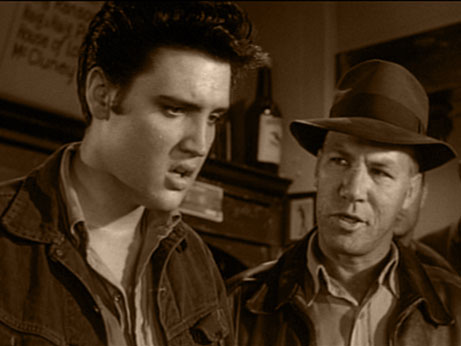
Elvis stars in Jailhouse Rock as Vince Everett, a tractor driver who has just received his weekly paycheck. As is his custom, he cashes the check at the neighborhood bar and then arm wrestles the proprietor. After losing, Vince good-naturedly buys a round of drinks for everyone at the bar. The film soon takes a dark turn when another patron roughs up a woman for talking to Vince. Vince tells him to leave her alone.

“Look, buster, you want some teeth knocked out? Just keep it up,” warns the man.

“You scare me,” says Vince. “Woman-beaters always scare me.”

This being an Elvis movie, a fistfight of course ensues.

Much like in Loving You, released earlier in 1957, the fight concludes with the Elvis character punching his opponent into a jukebox. In Loving You, the Presley Maneuver causes the jukebox to turn on. In Jailhouse Rock, it turns the jukebox off.

Unlike most Elvis movies, though, this fight turns out to have lethal consequences. When the woman-beater dies, Vince is convicted of manslaughter and sentenced to 1 to 10 years in the state penitentiary. If only he had cashed his check at a bank instead of a bar.

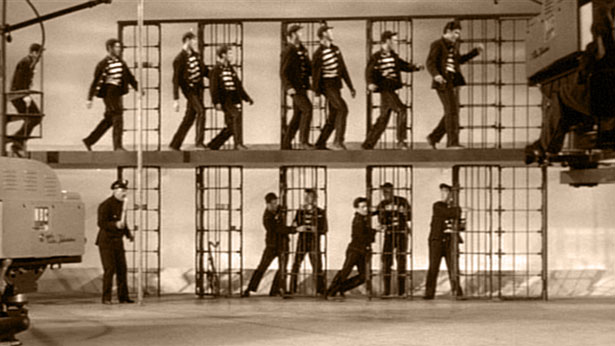
Before we go much further, I want to jump back for a moment to the credits. I love the opening theme of Jailhouse Rock, an overture of sorts that includes instrumental renditions of portions of “Baby, I Don’t Care,” “Jailhouse Rock,” and “Young And Beautiful.”

This jazzy version of “Jailhouse Rock” is quite a treat. I played trumpet in our middle school jazz band, and when I first saw the movie on TV as a teenager back then, the “Jailhouse Rock” instrumental reminded me of the arrangement we were using for the same song.

Mickey Shaughnessy is Hunk Houghton in 1957's JAILHOUSE ROCK (MGM)

Mickey Shaughnessy is Hunk Houghton in 1957’s JAILHOUSE ROCK (MGM)

Anyway, Vince shares a cell with Hunk Houghton (Mickey Shaughnessy), a washed-up country singer. Hunk is near the end of an 18-year term for robbing a bank. Despite some of the variances, Jailhouse Rock is still an Elvis movie, so Hunk of course has a guitar hanging on the prison cell wall that draws Vince’s attention. Though Hunk is annoyed at first, he softens and teaches Vince some chords. When Hunk tells him about his 10-year career, Vince says, “I never heard of anybody paying money to hear a guitar player” and Elvis seems barely able to hold a straight face delivering the line. He is, after all, the highest paid “guitar player” in the world by this point.

Elvis performs Vince’s early songs in Jailhouse Rock as intentionally flat and tentative, reflecting the character’s inexperience with singing. However, Hunk hears something in the young man and offers him a spot in Breath of a Nation, a nationwide television special he is producing for the warden. You see, a state inspection committee is coming to review prison conditions, and the warden wants the prisoners to put on a show as a smokescreen. Conditions at this prison must be pretty rough to require a national television special to cover things up.

Vince sings “I Want To Be Free” in his segment, and, unlike Hunk or anyone else, he receives a large bag full of fan mail from all over the country. Hunk sees to it that Vince does not learn of the mail, saving face with the mailroom workers by saying he made a mistake by giving Vince the best spot in the show. He soon offers Vince a partnership contract for the pair to perform together and split everything 50/50. Great shades of Colonel Parker!

“Alone, son, you’d be like a lamb in a pack of wolves,” Hunk tells him. Vince signs the contract, thinking that the deal is in his favor since Hunk is the established “star.”

The State Pen in 1957's JAILHOUSE ROCK (MGM)

The State Pen in 1957’s JAILHOUSE ROCK (MGM)

Soon thereafter, a food fight turned riot breaks out in the prison over the poor conditions. Hunk tries to get Vince back to their cell, but a guard roughly handles Vince. Having apparently not yet learned his lesson from the barroom brawl, Vince swings his fists. He is caught and whipped. Outtakes of this scene surfaced on the 1993 VHS Elvis In Hollywood: The 50s. The original Jailhouse Rock film trailer also shows a clip that did not make it to the final film where Vince lunges at the warden when the guards untie his hands after the whipping.

Back in their cell, Hunk states that he tried to pay off the guards to prevent Vince’s whipping but he didn’t have enough money. He emphasizes the importance of having money to Vince and also teaches him his twisted version of the Golden Rule: “Do unto others as they would do unto you, only do it first.”

Hunk still has 10 months to go, but Vince is released from prison after serving 14 months – including 2 extra months for the riot incident. The warden gives Vince his remaining pay from the state. He also gives him the large bag of fan mail from the television special 8 months earlier. Vince realizes that Hunk helped keep the letters secret.

Vince buys a guitar from a pawnshop and goes to a bar where Hunk has arranged a job for him with an old contact. There, he meets Peggy Van Alden (Judy Tyler), who looks at some indicators inside of a jukebox and makes notes. He is curious what she is up to, but she is not impressed at all that Vince is a singer. However, she does say she’ll tell him more about her job if he buys her a fresh drink.

“Buy your own drink,” Vince says, wryly – no doubt remembering that the last time he bought a woman a drink in a bar he ended up in prison.

Judy Tyler is Peggy Van Alden and Elvis Presley is Vince Everett in 1957's JAILHOUSE ROCK (MGM)

Judy Tyler is Peggy Van Alden and Elvis Presley is Vince Everett in 1957’s JAILHOUSE ROCK (MGM)

“Is yours the approved manner with ladies in the backwoods?” Peggy fires back at him, but then goes on to explain that she is an “exploitation man” in the record business. “I work for Mickey Alba, you’ve heard of him?”

“Word sometimes gets to the backwoods,” says Vince. Alba (Don Burnett with vocals by Bill Lee) is a popular singer along the lines of Pat Boone.

Vince meets the bar’s owner, thinking he is going to be hired on as a singer. However, it turns out the job Hunk secured for him is as a barboy, essentially a bartender’s helper (“make setups, bring ice”). Vince is disappointed and forces his way on stage. Hey, it’s Scotty Moore, Bill Black, and DJ Fontana! Elvis’ real band! And Mike Stoller (composer of “Jailhouse Rock” and many other Elvis classics) on piano. Vince sings, “Young And Beautiful.” The owner actually seems to like the song, but a guy keeps laughing and carrying on in the audience, distracting both him and Vince.

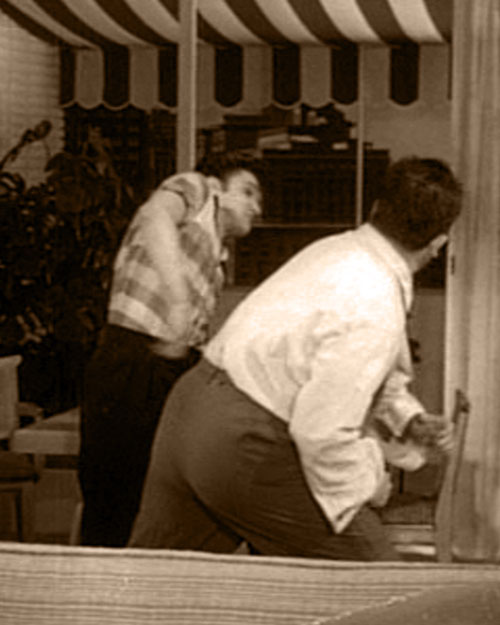
Finally, Vince jumps from the stage and smashes his guitar into the obnoxious patron’s table. However, he refrains from killing him. That’s called character development.

Vince storms out, with Peggy trailing. “Hey, you forgot something,” she calls.

“What?”

“Me!”

So, before this re-watch, it had been over a decade since I last saw Jailhouse Rock. While I’ve always liked it, in fact it’s one of my favorite Elvis movies, I never really saw much chemistry between Vince and Peggy. Watching it through this time, though, I disagree with my past self. Now I see it.

Anyway, Peggy suggests Vince make a recording of himself to discover what’s wrong with his singing. This is not as simple a task as it is these days. Vince rents out a recording studio for $20 to make a demonstration recording. Peggy supplies a borrowed guitar and the background musicians. It’s Scotty, Bill, DJ, and Mike again! I guess Peggy knew them from the bar.

Vince records a faltering version of “Don’t Leave Me Now.” However, Peggy loosens him up a bit, and he also decides to ditch the guitar. He tries again, and they decide the resulting demo is good enough to shop around to the record labels. Jack Lease (Peter Adams), Peggy’s contact at Geneva Records, which is Mickey Alba’s label, seems unimpressed, but he decides to borrow the tape to play over the phone to someone else in New York later.

After it turns out to be a rejection anyway, Vince shows up disgruntled and late for a dinner meeting with Peggy. Even when she tells him the good news that she has gotten them a deal with another label, Deltona Records, he is still rude to her. He just wants to brood. “When the money starts rolling in, then I’ll say I’m happy,” he says.

After a celebratory steak dinner, they head out to meet Peggy’s parents, who are having a party. They seem to know all about Vince, including that he sold his first record that day. However, Peggy has not told them about his stay in the state penitentiary. He expects this information to shock them, but it does not phase them. Instead, they start the record player and a technical discussion begins about jazz.

Another guest tries to involve Vince. “I say atonality is just a passing phase in jazz music. What do you think, Mr. Everett?”

Vince’s response is classic and one that I’ve had to bite my tongue not to use in various situations over the years: “Lady, I don’t know what the hell you talking about.”

Judy Tyler is Peggy Van Alden and Elvis Presley is Vince Everett in 1957's JAILHOUSE ROCK (MGM)

Judy Tyler is Peggy Van Alden and Elvis Presley is Vince Everett in 1957’s JAILHOUSE ROCK (MGM)

He storms out, and Peggy chases after him again. She is angry and embarrassed by his behavior – noting they were only trying to draw him into the conversation.

“They can shove their conversation,” he retorts. “I’m not even sure they were talking English!”

When Vince decides to walk home after their bickering, Peggy says, “I think I’m gonna just hate you.”

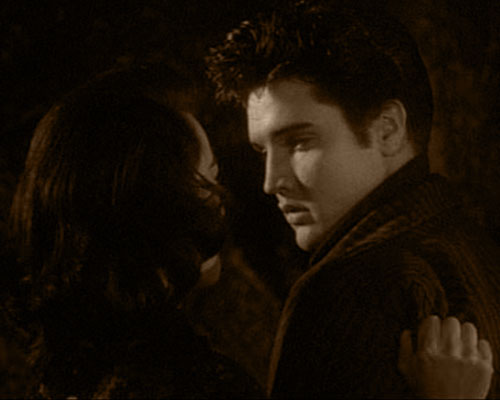
“You ain’t gonna hate me. I ain’t gonna let you hate me.” He grabs and kisses her.

“How dare you think such cheap tactics would work with me,” she exclaims. He kisses her again.

“That ain’t tactics, honey. That’s just the beast in me.”

On paper, the scene sounds creepy, but it is extremely well-executed by both performers – one of the best acted scenes in any Elvis movie.

Vince half-heartedly apologizes to Peggy on the way into the record store on the release day of “Don’t Leave Me Now.”

The girl at the cash register states that the record is flying off the shelves. Vince asks for a half dozen copies. Peggy looks alarmed when she sees the stack of records, and Vince looks over one curiously, reading aloud, “‘Don’t Leave Me Now’ by Mickey Alba? Geneva Record Company.” It turns out that Lease, the Geneva executive, only borrowed the tape so Alba could copy Vince’s arrangement and style. Vince’s record is gone – somehow squashed by Geneva.

Vince makes an unscheduled visit to Lease. “You’re a thievin’ rat” Vince exclaims and goes to punch him. However, seeing as how no jukebox is available to land the body on, he just slaps him a couple of times instead. “Go back under your rock, you snake!”

Later, he speaks of his time in prison to Peggy: “On the inside, they’re cub scouts compared to Jack Lease. If you make something, they might steal it from you, but they’d be too honorable to say they made it themselves.”

Vince suggests they start their own record company, and they form Laurel Records – splitting things 60/40. “I’m the artist, don’t forget,” Vince explains when Peggy at first objects to holding only 40%. After Peggy agrees to the deal, they have the following conversation – illustrating how they are both on different pages.

“This really calls for a celebration, Vince.”

“Do you know a lawyer? We need a good one. . .”

“Do you know how to dance?” asks Peggy.

“. . .A guy with an eye for a buck. Do you know a lawyer?”

Peggy is disappointed. “Yeah, I know a lawyer. Mr. Shores. . .”

After Vince makes it clear he is only interested in money, they form the record company. Vince records “Treat Me Nice,” which becomes a big hit. Vince makes reservations at a fancy restaurant to celebrate with Peggy but is disappointed when she points out that he failed to make reservations with her. She has a date, and states, “Vince, I will not be subject to your beck and call.” Go, Peggy! That’s a bold stance in 1957, especially in the male-dominated world of Jailhouse Rock.

Despite emotional setbacks, Vince’s career continues to skyrocket, including appearances in Las Vegas. After Vince agrees to do an NBC television special, Peggy shows up to ask him to record more records. Vince is rude to her, but reaches out right as she is leaving, almost like he wants to apologize or say something else – but his heart is still too hardened to get the words out. As Peggy exits, Hunk returns – fresh out of prison and looking for his spot in the TV special.

Elvis Presley is Vince Everett in 1957's JAILHOUSE ROCK (MGM)

Elvis Presley is Vince Everett in 1957’s JAILHOUSE ROCK (MGM)

The character of Vince is an unusual one in the Elvis cinematic universe. For most of the film, as many have pointed out over the years, Vince is a conceited jerk seemingly obsessed with money. Most of Elvis’ characters are likable guys cut from the same cloth. Vince is different, primarily due to his stay in prison, and offers a refreshing change of pace from the run-of-the-mill Elvis character. Vince should not be dismissed as a complete jerk, however. In several scenes, Elvis convincingly displays the emotional turmoil going on inside the man. He outwardly says he is all about the money, but you can also see that he loves Peggy and even Hunk.

In the music department, Jailhouse Rock is more than solid. The title song is a bonafide Elvis masterpiece. While the single version, one of Elvis’ greatest recordings, is used as the underlying track here in the film, the guitar riff opening of the song is unnecessarily hacked off. The screen version of the song is also hampered by awful overdubs of instruments and backing male vocals. Only the strength of Elvis’ underlying performance and the stellar production number save the tune. What were they thinking?

“Baby, I Don’t Care” and “Treat Me Nice” are also fantastic renditions. While “Young And Beautiful” is not quite up to the same par established by those three songs, it is still a lovely performance. “I Want To Be Free” and “Don’t Leave Me Now” serve their purposes well in the context of the film as does Mickey Shaughnessy’s “One More Day” — which is reminiscent of the classic folk song “Sixteen Tons.”

Vince Everett (Elvis Presley) sings "Baby, I Don't Care" at a pool party as a guitarist (Scotty Moore) plays along in the background in 1957's JAILHOUSE ROCK (MGM)

Vince Everett (Elvis Presley) sings “Baby, I Don’t Care” at a pool party as a guitarist (Scotty Moore) plays along in the background in 1957’s JAILHOUSE ROCK (MGM)

There is an oft-noted continuity error in Jailhouse Rock. During the “Baby, I Don’t Care” scene, guitarist Scotty Moore is shown wearing sunglasses in the wide shots but no eyewear in the closeups.

Vince Everett (Elvis Presley) sings "Baby, I Don't Care" at a pool party as a band (Bill Black, DJ Fontana, Scotty Moore, Mike Stoller) plays along in the background in 1957's JAILHOUSE ROCK (MGM)

Vince Everett (Elvis Presley) sings “Baby, I Don’t Care” at a pool party as a band (Bill Black, DJ Fontana, Scotty Moore, Mike Stoller) plays along in the background in 1957’s JAILHOUSE ROCK (MGM)

Another error is one I just noticed for the first time – a 1957 calendar is shown on the wall during a strikethrough sequence when Vince is in prison. When the calendar page is ripped down to show the next year, it is a 1957 calendar again. Talk about a life sentence! For the purposes of the Action File at the end of this post for Vince Everett, my conjecture is that the initial calendar was supposed to represent 1956 and that he was released in 1957.

One supposed error that is sometimes referenced with this film is that the prison ID number stamped on Vince’s shirt changes. Vince’s number is consistent during the penitentiary portions of the movie, however. Later, during the “Jailhouse Rock” production number, well after he has been released from actual prison, Vince wears a costume with a different number stamped on it. One was the character’s actual prison garb, the other was simply a costume. So calling it an error is . . . an error.

When Vince makes it to Hollywood, he takes his leading lady (played by Jennifer Holden) to Knott’s Berry Farm – a real amusement park in California that is still open to the public, including the “Old West” town represented in Jailhouse Rock.

A photographer prepares to take a souvenir picture of Vince Everett (Elvis Presley) and Sherry Wilson (Jennifer Holden) at Knott's Berry Farm in 1957's JAILHOUSE ROCK (MGM)

A photographer prepares to take a souvenir picture of Vince Everett (Elvis Presley) and Sherry Wilson (Jennifer Holden) at Knott’s Berry Farm in 1957’s JAILHOUSE ROCK (MGM)

Elvis released 33 movies during his lifetime, but Jailhouse Rock is one of only a small handful that is a serious contender as his very best. It was inducted into the US Library of Congress’ National Film Registry in 2004, the only Elvis movie to achieve this honor.

Just a few days after filming wrapped on Jailhouse Rock, actress Judy Tyler (Peggy) was killed at the age of 24 in a horrific car accident on July 3, 1957. Tyler’s husband and a passenger in another vehicle were also killed in the crash.

Elvis was devastated and according to many sources never watched the completed movie. Peter Guralnick & Ernst Jorgensen’s Elvis: Day By Day – The Definitive Record Of His Life And Music, however, notes that Elvis watched a special screening of the film with his parents on October 2, 1957. The book provides no further details, nor does Guralnick’s Last Train To Memphis: The Rise Of Elvis Presley, but perhaps Elvis was unable to finish the screening — thus validating both versions of the story.

Judy Tyler is Peggy Van Alden in 1957's JAILHOUSE ROCK (MGM)

Judy Tyler is Peggy Van Alden in 1957’s JAILHOUSE ROCK (MGM)

Jaihouse Rock was Tyler’s second and final movie. Her first, Bop Girl Goes Calypso, hit theaters only a couple of weeks after her death. While Jailhouse Rock, released in November 1957, carries no dedication to Tyler – I am not even sure that kind of thing was done back then – there is a moment in the closing scene during “Young And Beautiful” where the edit seems to linger on her more than it perhaps otherwise would have. In the magic of the movies, she will indeed remain forever young and beautiful.


Boldly Go

Multiple uncredited cast members from Jailhouse Rock went on to play roles in Star Trek.

K.L. Smith appears in the opening bar scene in Jailhouse Rock and appears as a Klingon in the Star Trek episode “Elaan Of Troyius” in 1968. Eagle-eyed readers will note that I also referenced Smith in a previous “Boldly Go” installment for his appearance in 1964’s Roustabout. Speaking of eagle eyes, thank you once again to Elvis movie superfan Gary Wells for pointing out where Smith shows up in Jailhouse Rock for me.

Elvis Presley and K.L. Smith in 1957's JAILHOUSE ROCK (MGM)

Elvis Presley and K.L. Smith in 1957’s JAILHOUSE ROCK (MGM)

K.L. Smith is a Klingon captain in the 1968 STAR TREK episode "Elaan Of Troyius" (Paramount)

K.L. Smith is a Klingon captain in the 1968 STAR TREK episode “Elaan Of Troyius” (Paramount)

Other cross-overs include:

  • Buzz Barbee [Jailhouse Rock: Apartment party guest | Star Trek: Ambassador Fox’s aide in “A Taste Of Armageddon” (1967) and maiden voyage official in Star Trek Generations (1994)]
  • Albert Cavens [Jailhouse Rock: Nightclub patron | Star Trek: Klingon crewmember in “Day Of The Dove” (1968) and fop 2 in “All Our Yesterdays” (1969)]
  • Noble “Kid” Chissell [Jailhouse Rock: Convict | Star Trek: Server in “The City On The Edge Of Forever” (1967)]
  • Richard Dial [Jailhouse Rock: Minor role | Star Trek: Sam in “The Devil In The Dark” (1967), Kaplan in “The Apple” (1967), security guard in “And The Children Shall Lead” (1968) and Fabrini guard in “For The World Is Hollow And I Have Touched The Sky” (1968)]
  • Shep Houghton [Jailhouse Rock: Nightclub patron | Star Trek: Cameraman in “Bread And Circuses” (1968)]
  • Arthur Tovey [Jailhouse Rock: Record shop owner in montage | Star Trek: Vulcan citizen in Star Trek: The Motion Picture (1979)]

Elvis Presley is Vince Everett and Mickey Shaughnessy is Hunk Houghton in 1957's JAILHOUSE ROCK (MGM)

Elvis Presley is Vince Everett and Mickey Shaughnessy is Hunk Houghton in 1957’s JAILHOUSE ROCK (MGM)

Jailhouse Rock Tote Board

  • Punches: 23
  • Songs: 15
  • Kisses: 12
  • Storm-Outs: 4
  • Slaps: 2

Songs In Jailhouse Rock

  1. Mickey Shaughnessy: “One More Day” (1957) [performed twice], written by Sid Tepper & Roy C. Bennett
  2. Elvis Presley: “Young And Beautiful” (1957) [performed 3 times], written by Abner Silver & Aaron Schroeder
  3. Elvis Presley: “I Want To Be Free” (1957), written by Jerry Leiber & Mike Stoller
  4. “Don’t Leave Me Now” (1957) [performed three times by Elvis Presley and once by Bill Lee], written by Aaron Schroeder & Ben Weisman
  5. Elvis Presley: “Treat Me Nice” (1957) [performed three times], written by Jerry Leiber & Mike Stoller
  6. Elvis Presley: “Jailhouse Rock” (1957), written by Jerry Leiber & Mike Stoller
  7. Elvis Presley: “Baby, I Don’t Care” (1957), written by Jerry Leiber & Mike Stoller

The Mystery Train’s Jailhouse Rock Scorecard

  • Story: 8 (out of 10)
  • Acting: 10
  • Entertainment Value: 8
  • Songs: 9
  • Overall: 9 (Must See)

Jailhouse Rock Around The Web


Click image for larger, color version


“But to you who are willing to listen, I say, love your enemies! Do good to those who hate you. Bless those who curse you. Pray for those who hurt you. If someone slaps you on one cheek, offer the other cheek also. If someone demands your coat, offer your shirt also. Give to anyone who asks; and when things are taken away from you, don’t try to get them back. Do to others as you would like them to do to you.”
Luke 6:27-31 NLT

Ramblings

One of our annual traditions this time of year on The Mystery Train Blog is that I make note of the fact that I haven’t posted in many months.

Indeed, it has been many months since I posted. Outside of a quick tribute to Elvis Presley in August, my last real post here was in April! I did have a seemingly strong start to 2023 as I began (but never finished) a multi-part review series of Sony’s then-new Elvis On Tour set. I also examined two more Elvis movies.

In the Elvis world, 2023 will be remembered with sadness due to the loss of Lisa Marie Presley on January 12. Nearly a year later, I still find it hard to believe. On a brighter note, Lisa’s daughter, Riley Keough, seems to have risen to the occasion as far as taking up the Presley mantle. Her mom would be proud.


A few tidbits when it comes to Elvis news since I last posted. While reviewing the top-notch Elvis On Tour set back in the first few months of 2023, I kept thinking, “If only Madison Square Garden would get a similar treatment.” I thought it would never happen, since that event had already been revisited as recently as 2012 with Sony’s excellent Prince From Another Planet set. Wow, did I underestimate the Elvis re-release machine. Indeed, the FTD collectors label for Elvis fans released new mixes of the Madison Square Garden concerts not long after I had that very thought.

On the main Sony label, a set containing new mixes of the 1973 Aloha From Hawaii concerts and related material on 3 CDs as well as a Blu-ray version of that event were also released. Sony’s 2023 Aloha From Hawaii release was slightly controversial, though, and rightly so.

FTD only a year before had already released 2 of the 3 CDs of new mixes at a premium price. The remaining CD of the 2022 FTD set used a vintage 2013 Sony mix – meaning that, Blu-ray aside, fans that already bought the 2022 FTD set but wanted all of the new mixes would still have to buy the 2023 Sony set for the 1 CD. Why Elvis’ music catalog continues to be treated in this haphazard manner is beyond me. Incompetence? Contempt? Greed? A little of all of these? Your guess is as good as mine.

While I originally intended not to touch Sony’s 2023 Aloha set until after I had listened to the “new” As Recorded At Madison Square Garden, I couldn’t help but watch the Aloha From Hawaii Blu-ray the night of August 16. I wanted to experience it as a fan rather than as a writer, so I did not take any notes or watch it from a critical or analytical perspective. I just sat back and immersed myself in the shows again. As I’ve mentioned many times on here, my mom was a first-generation Elvis fan who first started listening to him in 1956 when she was 12. For her, 1973’s Aloha From The Hawaii was the absolute pinnacle of Elvis. I miss seeing her watch it.

Elvis Presley conquers the world during the 1973 ELVIS: ALOHA FROM HAWAII VIA SATELLITE television special (NBC)

Elvis Presley conquers the world during the 1973 ELVIS: ALOHA FROM HAWAII VIA SATELLITE television special (NBC)

As for that FTD Madison Square Garden set, I still haven’t even opened it. So, I’m looking forward to listening to it in 2024.

There is also word that Baz Luhrmann, director of 2022’s very successful ELVIS movie, might be assembling a re-edit of “lost” footage from documentaries Elvis: That’s The Way It Is (1970) and Elvis On Tour (1972) – possibly as a streaming series à la Peter Jackson’s The Beatles: Get Back (2021). While intriguing, when it comes to any Warner Brothers project involving Elvis, I will believe it when I see it. I am very cautiously optimistic.


I still have a couple of posts to go in that review of Elvis On Tour. Will I ever finish them? I am not sure. Maybe. I will surely continue my re-watch of Elvis’ movies, Lord willing. My goal is to cover at least three Elvis movies in 2024. There is also at least one new-to-me book I would like to feature in a future post.

2023 has been a year full of blessings for me – more than I could ever begin to list here. Know that I count those of you who take the time to read my infrequent ramblings here to be among those blessings.

Thank you for reading. May your 2024 be full of joy.


“I pray that God, the Source of hope, will fill you completely with joy and peace because you trust in Him. Then you will overflow with confident hope through the power of the Holy Spirit.”
Romans 15:13