Steve Brogdon sets new record conquering Elvis Trivialities #5

The Mystery Train’s Night Riders have a new member. Setting a new record, Steve Brogdon correctly answered Elvis Trivialities #5 in only 17 minutes. In recognition of this outstanding achievement, Steve now has a brand-new set of bragging rights.

And the answer is…

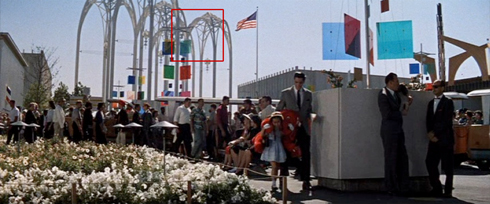
The Mystery Train Elvis Trivia 5

The above image slice is from the Elvis movie It Happened At The World’s Fair.

It Happened At The World's Fair (1963)

The real question should have been, what exactly happened at the world’s fair?

The 1963 film also starred Joan O’Brien and Gary Lockwood. Kurt Russell had a bit part in the movie as the boy who kicks Elvis. Russell went on to portray the singer in 1979’s Elvis, directed by John Carpenter. An homage to the scene appears in 2001’s 3,000 Miles To Graceland, which also starred Russell.

The 1979 Elvis movie was produced by Dick Clark. Now, stay with me, here’s some even stranger trivia for you. John Carpenter (best known for directing Halloween) shares his name with the character Elvis played in 1969’s Change Of Habit. Change Of Habit was directed by William A. Graham. Graham directed 1993’s Elvis & The Colonel: The Untold Story (one of the worst movies about Elvis, and that’s an accomplishment), which, get this, was also produced by Dick Clark! Confused yet?

Whew! Meanwhile, Gary Lockwood from It Happened At The World’s Fair went on to play Gary Mitchell in “Where No Man Has Gone Before,” the Star Trek pilot that sold the series. Yesterday, Star Trek celebrated its 45th anniversary. Lockwood is most known, however, for playing Dr. Frank Poole in 1968’s 2001: A Space Odyssey. Elvis, of course, went on to use “Also Sprach Zarathustra” as his opening theme in most of his 1971-1977 concerts. Richard Strauss’ 1896 composition was also used as the theme to 2001.

If you’re lookin’ for trivia, you came to the right place.

Meanwhile, you never know when I’ll post the next question. The best way to have a chance to win is to subscribe to The Mystery Train Elvis Blog using the feature in the menu bar to the right. Then, you’ll be notified by email whenever there is a new post.

Congratulations again to Steve!


The Mystery Train’s Night Riders

  • September 9, 2011: Steve Brogdon (0:17) <— Record time
  • August 6, 2011: Thomas (2:26)
  • July 9, 2011: Thomas (5:26)
  • June 23, 2011: Fred Wolfe (0:18)
  • June 22, 2011: [Ty stumps the train]

Review – ELVIS AND THE COLONEL: THE UNTOLD STORY (1993) [The Elvis Beat newsletter]

I was 18 when I wrote this review back in 1993 for The Elvis Beat #4, my official Elvis Presley Fan Club newsletter.


Elvis And The Colonel: The Untold Story (NBC), starring Beau Bridges, directed by William A. Graham, aired January 10, 1993.

Elvis And The Colonel: The Untold Story is a story that should have remained untold. Not only is this the worst movie ever made about Elvis, but this is also probably the worst movie ever.

The initial concept behind this television movie was actually a good idea – an examination of the well-documented mismanagement of Elvis’ career by Colonel Tom Parker. But the end result is an absolute failure.

Elvis And The Colonel is one big mistake after another. A listing of some of the many factual errors contained in this movie appears on page 5 of this newsletter.

The biggest mistake of all occurred in the casting department when Robb Youngblood was chosen to play “Elvis.” Youngblood does not bear the slightest resemblance to Elvis, so one can only assume that he was selected for his acting ability. The problem with that theory is that [. . .] at no time during the entire two-hour movie is he convincing as “Elvis.” [. . . .]

It is also obvious that no effort was made to make Youngblood look like Elvis. Throughout the 22 years of “Elvis”‘ life that this movie portrays, Youngblood wears basically the same hairstyle–even while in the Army. It looks awful and resembles none of the many different styles Elvis wore his hair in over the years.

Youngblood’s clothes in the movie look so cheap that even the local [discount store] would be embarrassed to sell them. Once again, they resemble nothing the real Elvis ever wore. The styles may have changed since his time, but Elvis never looked cheap the way Youngblood does.

All of these cosmetic problems could have been overlooked had Elvis And The Colonel been a good story but, as mentioned before, it is filled with errors. And even beyond those errors, the script is poorly written and the entire movie is poorly made. [. . . .]

Beau Bridges, who was obviously chosen only to draw more viewers, stars as “Colonel Parker” and does a poor job also, but in a different way than Youngblood. Bridges makes the Colonel appear too likable and too nice, defeating the purpose of the movie.

Youngblood seems to have accidentally studied Gomer Pyle videos instead of Elvis ones for his part, for he plays Elvis as an extremely stupid fool – which could not be further from the truth.

Appropriately, even the house that is supposed to be Graceland looks nothing like the real thing.

The ELVIS television special, or the ’68 Comeback Special as it has come to be known, featured Elvis in top form. Of course, this movie slaughters this as well. One of the most ludicrous moments in the movie, and there are many, occurs when Youngblood is shown standing in front of a series of waist-high letters that spell “ELVIS” in red lights. The real version was over two stories tall and looked much better.

One of the many myths that Elvis And The Colonel perpetuates is everyone’s old favorite: “Elvis” appears overweight throughout the 1970s in this movie while the real Elvis did not begin to experience significant weight problems until about two years before his death. Youngblood is shown obese by 1971, while the real Elvis at the time was in shape and would remain so for a few more years. Of course, in such an inaccurate movie, such mistakes are not surprising.

Half of the “Elvis” songs used in the movie were apparently taken from Ronnie McDowell’s work for the 1979 television movie Elvis, starring Kurt Russell, and not surprisingly, Youngblood does a poor job lip-synching to them. The rest of the songs were performed by Youngblood himself and are awful. One particularly bad scene uses a combination of McDowell’s and Youngblood’s vocal tracks.

The most surprising thing about this movie is that Dick Clark was its executive producer. Clark also executive produced the Kurt Russell Elvis movie, directed by John Carpenter, which is one of the better movies based on Elvis’ life.

With this new movie, Clark has gone wrong. He has stated his respect for Elvis in the past and his disdain for the Colonel, but this movie serves only to slam Elvis instead of its intended target.

Incidentally, Elvis And The Colonel was directed by William A. Graham, who directed the real Elvis in Change Of Habit, which was one of Elvis’ better films.

It is apparent that no one connected with this movie bothered to do any significant research about its topic. It is also apparent that the movie’s production was rushed, probably to have it ready in time to cash in on the free publicity of the Elvis stamp release two days prior to this movie airing. They need not have bothered, for The Carol Burnett Show: A Reunion special beat it soundly in the ratings.

The worst part about Elvis And The Colonel: The Untold Story is that some people, who knew nothing about Elvis, probably watched this irresponsible movie and now think that this is what Elvis was really like.

Songs include:

  • “Lawdy, Miss Clawdy”
  • “Rip It Up”
  • “Tutti Frutti”
  • “Long Tall Sally”
  • “Heartbreak Hotel”
  • “Trouble”
  • “Blue Moon Of Kentucky”
  • “Are You Lonesome Tonight”
  • “The Wonder Of You”
  • “Dixie/The Battle Hymn Of The Republic”

Rating: 1 out of 10

Elvis and the Colonel: The Way It Was [The Elvis Beat newsletter]

I was 18 when I wrote this article back in 1993 for The Elvis Beat #4, my official Elvis Presley Fan Club newsletter.


One mistake after another occurred in the NBC television movie Elvis and the Colonel: The Untold Story, which aired in January. On the rare occasions when the movie’s makers did decide to check their sources, it appears the only reference they bothered to use was the 1979 TV movie Elvis starring Kurt Russell and directed by John Carpenter.

Below is a listing of some of the many factual errors which appeared in Elvis and the Colonel:

  • “Elvis” is shown giving his mother a pink cadillac after they were already living at Graceland. In reality, Elvis gave her the car in 1956, while they did not move into Graceland until May 1957.
  • “Elvis” is shown in Elvis and the Colonel filming the movie Change of Habit in the 1950s. In actuality, Change of Habit was filmed in 1969 and was his last acting role.
  • “Colonel Parker” mentions that “Elvis”‘ gold cadillac could be toured while he was in the Army. The real Elvis did not even purchase the gold car until after his service in the Army.
  • Preparations for the taping of the 1968 ELVIS television special (now known as ELVIS: ’68 Comeback Special) are shown occurring in November of 1968. In reality, the special was taped in June of 1968.
  • The ELVIS special is a live broadcast in the movie. In actuality, ELVIS, as mentioned above, was taped in June 1968 and did not air until December of that year. It was the 1973 television special Elvis: Aloha From Hawaii that was broadcast live to some locations around the world.
  • “Elvis” is shown singing “Are You Lonesome Tonight” in a white, double-breasted suit during the ELVIS television special. In reality, “If I Can Dream” was the only song Elvis performed in the special wearing that suit.
  • “Heartbreak Hotel” in the movie concludes the ELVIS special. In actuality, “If I Can Dream” was the final song sung by Elvis in the special.
  • “Also Sprach Zarathustra” (theme from 2001: A Space Odyssey) opens “Elvis”‘ opening night performance in July 1969 at the Las Vegas International Hotel in the movie. The fact is, the real Elvis did not begin using “Also Sprach Zarathustra” until 1971.
  • “Elvis” wears a white jumpsuit for the July 1969 opening performance in the movie. In reality, Elvis wore a simple black outfit for his first concert in years. The jumpsuit worn by the actor is a distorted version of one worn by Elvis in the film Elvis: That’s The Way It Is, which was from an August 1970 performance.
  • “Elvis” sings “The Wonder Of You” at the 1969 concert in the movie, while the song was not really performed by Elvis until 1970.
  • “Elvis” is shown extremely overweight by September of 1971 in the movie, which escalates until a 1973 performance in which he appears obese. In reality, Elvis was at or near his ideal weight during these years, as proven by video and photographs.
  • “Elvis” is shown in the movie complaining to “Colonel Parker” about turning down A Star Is Born in August 1973. In actuality, Elvis had not yet been offered a role in this 1976 movie.
  • “Elvis” and “Priscilla” never divorce in the film! Despite the fact that the real couple divorced in October 1973, the movie “Elvis” tells of a nightmare in July 1976 in which he dreamed that “Priscilla” had left him. In a 1981 courtroom scene, the judge refers to “Elvis” as “Priscilla”‘s late “husband,” instead of “ex-husband.”