News From The Frontier: John Berkey; Elvis; Twilight Zone [The Film Frontier blog]

Artist John Berkey, 1932-2008
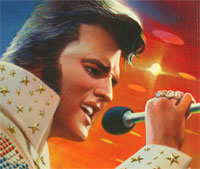
Berkey's Elvis Stamp BStarWars.com reported yesterday that artist John Berkey passed away on April 29. He was 75. Berkey painted the cover of the 1976 novelization of Star Wars, an image that continued to appear on early editions of the book. Berkey also painted a poster depicting a dogfight over the Death Star, used as an insert in the original Star Wars soundtrack LP.

The StarWars.com article includes a link to a gallery of ten Berkey Star Wars images. You can also find pictures of Berkey’s work in 2005’s The Star Wars Poster Book by Stephen J. Sansweet and Peter Vilmur. Though known for his science fiction and Star Wars art, Berkey was reportedly not a science fiction fan and never saw Star Wars.
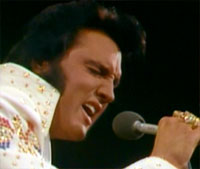
Elvis Presley, 1973For a 1992 US Postal Servicing stamp voting campaign, Berkey also painted “Elvis Stamp B” (above), which depicted Elvis Presley as he appeared in his historic 1973 Aloha From Hawaii TV special (right). Berkey’s image lost to Mark Stutzman’s “Elvis Stamp A,” which depicted Elvis in 1956, his first year of national fame. Stutzman’s 1950s Elvis image became an official US stamp the following year, while Berkey’s 1970s Elvis image was never issued.

I voted for Berkey’s Elvis stamp back in 1992 and never knew about his Star Wars connection until reading The Star Wars Poster Book a couple of years ago. Though, again, I had no idea who the artist was back then, I actually had several posters of Berkey’s science fiction and fantasy imagery hanging in my bedroom when I was growing up. He was a real talent and will be missed.

Elvis: That’s The Way It Is (FTD Classic Album Series) available this week
Follow That Dream (FTD) records, BMG’s Elvis Presley collectors label, is scheduled to release a 2-CD set of Elvis: That’s The Way It Is this week to the US as part of its “Classic Album Series.”

This 2008 edition of the 1970 album includes all of the original tracks, plus numerous alternate takes, a 20-page booklet, and other extras. The new Elvis: That’s The Way It Is CD set was first released in Europe last month.

Check out Thomas’ review, over at his Elvis Today blog, and Lex’s review, over at ElvisNews.com. To obtain FTD CDs, visit ShopElvis.com. Most FTD CDs are much more interesting than the mainstream “greatest hits”-style Elvis CDs you’ll find at your local store.

Twilight Zone graphic novels on the way for 50th anniversary
It is hard to believe that 2009 will mark the 50th anniversary of the television debut of Rod Serling’s The Twilight Zone. Next to the original Star Trek, The Twilight Zone is my favorite TV series. I grew up watching both of them, and still watch them now (yet another indication that, in fact, I never did grow up).

Publishers Weekly announced earlier this month that Walker & Co. will release a series of graphic novels based on Twilight Zone‘s original scripts, in conjunction with Rod Serling’s estate. There will be at least eight graphic novels in all. Look for the first to hit US stores in October.

“Colonel” Parker dies at age 87 [The Elvis Beat newsletter]

I was 22 when I wrote this article back in 1997 for The Elvis Beat #16, which turned out to be the final issue of my official Elvis Presley Fan Club newsletter.


“Colonel” Tom Parker, Elvis’ manager for over 20 years, died on January 21. He was 87 and lived in Las Vegas with his wife, Loanne.

Although not yet his manager, Parker began guiding Elvis’ career in mid-1955 while the singer was still on Memphis’ Sun Records label and slowly rising in popularity. He helped secure a contract for Elvis with RCA Records later that year.

Parker officially became Elvis’ manager in early 1956 for a 25 percent fee. Elvis would remain Parker’s sole client until Elvis’ death in 1977.

Parker’s innovative management style helped to transform Elvis from a relative unknown at the beginning of 1956 to an international celebrity with six number one hits, several million-sellers, and a starring role in a successful movie by the end of that same year.

Parker was often blamed for allowing Elvis’ movies to deteriorate into Grade C formula films in the 1960s. Parker once admitted that he didn’t even bother to read the scripts. “Anybody who’ll pay my boy a million dollars can make any kind of picture he wants,” Parker said. Despite the low quality of many of them, nearly all 33 of Elvis’ movies were box office successes.

In 1967, Parker renegotiated his contract with Elvis, increasing his own share to 50 percent with the argument that Elvis was his only client. [. . . .]

Parker negotiated lucrative deals for Elvis to appear in Las Vegas for extended engagements beginning in 1969. In the 1970s, Parker staged multi-city concert tours across the US for Elvis, who played 150 shows a year.

Parker orchestrated the 1973 Elvis: Aloha From Hawaii television special, which used satellite technology and drew millions of viewers.

Parker was born Andreas Cornelius van Kuijk in Holland on June 26, 1909. He immigrated to the US illegally in 1929, claiming West Virginia as his birthplace. He served in the US Army with the 64th Coast Artillery from 1929 to 1932. He married his first wife, Marie Ross, in 1932. A state governor made him an honorary Colonel in 1953.

In the 1950s, Parker became the promoter of singer Gene Austin and manager of country singers Eddy Arnold, from 1942 to 1951, and Hank Snow, from 1954 to 1956, before becoming Elvis’ manager.

In recent years, he was associated with country singer George Strait, negotiating for him to star in the movie Pure Country.

Joe Esposito, one of Elvis’ friends, said, “The bottom line is that Elvis would never have been so popular as he was without the Colonel’s brilliant management. Nor would the Colonel have had so much success with anyone else.”

New releases highlight Elvis in the 1970s [The Elvis Beat newsletter]

I was 21 when I wrote this article back in 1996 for The Elvis Beat #15, my official Elvis Presley Fan Club newsletter.


“It don’t take much to spark you guys off,” proclaims Elvis to the studio band in A Hundred Years From Now, a new CD of alternate takes from RCA.

The disc features 17 previously unreleased tracks, including new versions of “I’ve Lost You” and “Just Pretend.” Nearly all of the songs were recorded in 1970, one of Elvis’ most productive years, while the remainder are from 1971. The album represents the fourth volume in the Essential Elvis series. Previous entries focused on the 1950s.

New from Lightyear Entertainment is the home video release of Elvis: The Alternate Aloha Concert. This dress rehearsal concert was taped as a backup before an audience two days prior to 1973’s legendary Elvis: Aloha From Hawaii television special. Elvis is much more relaxed and seems more into the songs than the formal version. Elvis’ hair is also longer in the rehearsal, as he had it cut before the actual show two days later.

Twenty songs are performed, including “Suspicious Minds” and “What Now My Love.” The song selection is nearly identical to the official Aloha From Hawaii show, for which three songs were added. Audio for this one was first released in 1988 by RCA on The Alternate Aloha.

Elvis’ ALOHA cape comes full circle [The Elvis Beat newsletter]

I was 20 when I wrote this article back in 1995 for The Elvis Beat #13, my official Elvis Presley Fan Club newsletter.


Millions are watching live via satellite. It is the closing moment of the final song. Elvis reaches up to his collar, grabs the top of his beautiful American Eagle cape and hurls it into the audience. It is the climax of one of the highest points of his career.

It is January 14, 1973, and the event, of course, is Elvis: Aloha From Hawaii. [. . . .] Elvis gives a final salute to the crowd and leaves the stage. In the audience, the pandemonium is far from over.

Sportswriter Bruce Spinks is clutching most of the jeweled cape, while a fan behind him has a tight grip on a smaller portion of it. A security guard hurries over to settle the dispute, and Spinks ends up with the treasure.

Elvis fan Andrew Kern, 20, is one of those who watches the event on television. Like every fan, he also wants the cape. Eventually, he will buy it from Spinks for over three thousand dollars.

Kern was only ten when he met Elvis during location shooting of Viva Las Vegas, a decade before the Aloha From Hawaii cancer benefit concert. Kern would be a fan for the rest of his life, seeing Elvis in concert dozens of times while amassing an enormous collection.

The American Eagle cape became the most cherished part of that spectacular collection, which included original Sun records and items once owned by Elvis. Kern even turned down an offer of $50,000 for the cape alone.

Sadly, Kern died of cancer earlier this year at the age of 42. Shortly before his death, he asked that the cape be given to Graceland.

The American Eagle cape is now on exhibit alongside the Aloha From Hawaii jumpsuit in the Trophy Room at Graceland for fans from all over the world to enjoy.

It was generosity that caused Elvis to throw his cape into the ecstatic audience that night 22 years ago, and it was generosity that brought it back home. It’s one of the things Elvis taught us all.

Is the 70s stamp coming soon? [The Elvis Beat newsletter]

I was 19 when I wrote this article back in 1994 for The Elvis Beat #8, my official Elvis Presley Fan Club newsletter.


The 70s Elvis stamp may be released as soon as 1995 if a growing number of fans have their way with the US Postal Service. In April 1992, the stamp was defeated by a 3-to-1 margin in favor of the 50s Elvis stamp that was released in January 1993. The 70s stamp, also known as “Stamp B,” was painted by artist John Berkey and depicts Elvis as he appeared in 1973’s televised concert Aloha From Hawaii.

The stamp was severely criticized by the news media and others who unfairly called it the “Old, fat Elvis.” Berkey defended his stamp by stating, “I understand what happened, the negative feelings. But I painted the King. That other guy is the prince. The fanatical fans like the 70s one. And as a matter of fact he weighed 160 pounds and he was 38 years old (at the time of Aloha From Hawaii). That’s not fat, and that’s not old.” [. . . .]

A record 500,000 of the 50s Elvis stamps were printed and all were sold out in days, making them the most successful stamps in history. Since most of the stamps will be kept by fans or collectors and will never actually be used in the mail, the Postal Service has made an incredible profit from them.

Additionally, the Postal Service has profited from the marketing of the stamp image, which has appeared everywhere on hundreds of items for sale. Economically, the Postal Service could make millions more if another stamp were released so there probably is a fair chance it will happen as long as fans show support.

Over a quarter of a million people voted in favor of the 70s stamp, which artistically was a better representation of Elvis anyway. [. . . .]

ELVIS DOLLS [The Elvis Beat newsletter]

I was 18 when I wrote this piece back in 1994 for The Elvis Beat #7, my official Elvis Presley Fan Club newsletter.


There are six new Elvis dolls available from Hasbro, including “Jailhouse Rock,” “’68 Special,” and “Aloha From Hawaii.” The 12-inch dolls retail for $50 each.

Elvis and the Colonel: The Way It Was [The Elvis Beat newsletter]

I was 18 when I wrote this article back in 1993 for The Elvis Beat #4, my official Elvis Presley Fan Club newsletter.


One mistake after another occurred in the NBC television movie Elvis and the Colonel: The Untold Story, which aired in January. On the rare occasions when the movie’s makers did decide to check their sources, it appears the only reference they bothered to use was the 1979 TV movie Elvis starring Kurt Russell and directed by John Carpenter.

Below is a listing of some of the many factual errors which appeared in Elvis and the Colonel:

  • “Elvis” is shown giving his mother a pink cadillac after they were already living at Graceland. In reality, Elvis gave her the car in 1956, while they did not move into Graceland until May 1957.
  • “Elvis” is shown in Elvis and the Colonel filming the movie Change of Habit in the 1950s. In actuality, Change of Habit was filmed in 1969 and was his last acting role.
  • “Colonel Parker” mentions that “Elvis”‘ gold cadillac could be toured while he was in the Army. The real Elvis did not even purchase the gold car until after his service in the Army.
  • Preparations for the taping of the 1968 ELVIS television special (now known as ELVIS: ’68 Comeback Special) are shown occurring in November of 1968. In reality, the special was taped in June of 1968.
  • The ELVIS special is a live broadcast in the movie. In actuality, ELVIS, as mentioned above, was taped in June 1968 and did not air until December of that year. It was the 1973 television special Elvis: Aloha From Hawaii that was broadcast live to some locations around the world.
  • “Elvis” is shown singing “Are You Lonesome Tonight” in a white, double-breasted suit during the ELVIS television special. In reality, “If I Can Dream” was the only song Elvis performed in the special wearing that suit.
  • “Heartbreak Hotel” in the movie concludes the ELVIS special. In actuality, “If I Can Dream” was the final song sung by Elvis in the special.
  • “Also Sprach Zarathustra” (theme from 2001: A Space Odyssey) opens “Elvis”‘ opening night performance in July 1969 at the Las Vegas International Hotel in the movie. The fact is, the real Elvis did not begin using “Also Sprach Zarathustra” until 1971.
  • “Elvis” wears a white jumpsuit for the July 1969 opening performance in the movie. In reality, Elvis wore a simple black outfit for his first concert in years. The jumpsuit worn by the actor is a distorted version of one worn by Elvis in the film Elvis: That’s The Way It Is, which was from an August 1970 performance.
  • “Elvis” sings “The Wonder Of You” at the 1969 concert in the movie, while the song was not really performed by Elvis until 1970.
  • “Elvis” is shown extremely overweight by September of 1971 in the movie, which escalates until a 1973 performance in which he appears obese. In reality, Elvis was at or near his ideal weight during these years, as proven by video and photographs.
  • “Elvis” is shown in the movie complaining to “Colonel Parker” about turning down A Star Is Born in August 1973. In actuality, Elvis had not yet been offered a role in this 1976 movie.
  • “Elvis” and “Priscilla” never divorce in the film! Despite the fact that the real couple divorced in October 1973, the movie “Elvis” tells of a nightmare in July 1976 in which he dreamed that “Priscilla” had left him. In a 1981 courtroom scene, the judge refers to “Elvis” as “Priscilla”‘s late “husband,” instead of “ex-husband.”