As Recorded At Hampton Coliseum: ELVIS ON TOUR – First Reactions

Some Elvis Presley fans have been waiting over 50 years for his record label to release an extensive collection of audio from MGM’s 1972 concert documentary Elvis On Tour. Though there have been some scattered releases over the years, a comprehensive, six-volume set for Elvis On Tour audio finally appeared last month on digital and this week on CD. It’s been only about 30 years of waiting for me, though, as I wasn’t aware of the amount of Elvis On Tour recordings until the early 1990s.

While much of this material has been bootlegged in varying degrees of quality, the vast majority of it has not been officially released. As I tend to avoid bootleg releases, it appears my patience is finally being rewarded.

I don’t really feel like doing a formal review as I did for 2014’s similar That’s The Way It Is: Deluxe Edition, which covered MGM’s 1970 documentary of the same name. While there is less material here, I also have far less time and energy than I did back then. Instead, I am going to write in a “live” stream-of-consciousness type way. I hope you don’t mind. I plan to cover one CD in this first post.

I am cutting the packing tape off the outer shipping box now. I am really not into unboxing videos, but I’m sure you can find one from someone else out there. The packaging wasn’t the best. The outer case of the actual CD set is slightly bulged out on the top. However, it’s acceptable to me. I am liable to mar it myself at some point anyway. So, I’m proceeding to remove the shrink wrap. Otherwise, this would have been the shortest post ever as I arranged a return and exchange.

ELVIS ON TOUR (Sony, 2023) | Credit: Sony

The box art isn’t bad. I like the vintage style logos. Elvis has always looked a little “off” in Elvis On Tour to me, and that is reflected in many of the related photos.

It’s the music I care about, though, so on with Disc 1. I don’t even know which show is up first! Let’s see…

Well, the disc doesn’t even bother to say. Let me check the booklet.

Disc 1 is the Hampton Coliseum in Virginia, April 9, 1972. This concert formed the bulk of the Elvis On Tour movie, for which the four concerts included in this set were recorded and filmed. Outside of the film footage itself, only “An American Trilogy” from this Hampton show has been officially released on audio until now.

Let me hook up my headphones. I don’t want to blast the family out of the house.

The show is over 66 minutes – pretty long for an Elvis concert. He usually kept them at about an hour, probably due to the influence of his Las Vegas stints on his tour shows. The hotel’s priority in Vegas was to get the audience back out into the casino to gamble, so management did not like when his show lasted over an hour. While that wouldn’t have been a consideration as he criss-crossed the country on multiple tours throughout the 1970s, Elvis was definitely a creature of habit.

Also Sprach Zarathustra: Best known as the theme to MGM’s 1968 movie 2001: A Space Odyssey, “Also Sprach Zarathustra” is an exciting way to begin a concert – perfect for Elvis, despite having been written in 1896! It’s unfortunate that a “sound-alike” piece was used in the film itself in lieu of “Also Sprach Zarathustra” due to rights issues with the composition. The inferior piece, called “2001 Alternate,” was re-used in 1981’s This Is Elvis as well. As proven here, Elvis concerts used the real version, not the one you hear in the Elvis On Tour and This Is Elvis movies.

See See Rider: Right off the bat, Elvis sounds a little off. I know this is a good show, though, based on the movie, so I’m not too concerned. This song was used in the 1972 film.

I Got A Woman: This track has audio issues on Elvis’ vocals. He is in the background only. A disappointing way to start the set, I have to say. This song is used in the movie without these kinds of issues. Okay, about a minute or so in, Elvis is now fully audible. Why wouldn’t they fix this? Some fans have done so, taking minutes. Why not a company with the resources of Sony? I will never understand these kinds of missteps on Elvis releases. Well, no matter, it’s just a minute, and on a lesser song at that.

“I’d like to tell you it’s a pleasure to be here in West Virginia,” Elvis jokes. And then we’re on to the next song.

Never Been To Spain: In the realm of useless trivia, former racecar driver Dale Earnhardt, Jr.’s favorite song is Elvis’ version of “Never Been To Spain” (presumably from the As Recorded At Madison Square Garden album). Here in Hampton, this is a decent version. James Burton on electric guitar is a highlight.

You Gave Me A Mountain: Oh, Elvis, it’s too early in the set for such a downer song. But here we go. Just a few weeks into his separation from his wife Priscilla, this is where Elvis was at this time in his life, and I respect that he was attempting to heal through his music. “You Gave Me A Mountain” has never been a huge favorite of mine, but this is certainly a decent and committed version. You can hear the pain in his voice as he sings, “My woman got tired of the heartaches.” This rendition appears in the film.

Okay, I got bored during “You Gave Me A Mountain” and looked up what day of the week this concert was held. It was a Sunday.

Until It’s Time For You To Go: Elvis keeps the pace slow. This was one of his singles in 1972, and it wasn’t a good choice. His voice sure is pretty on it, though. I wasn’t even born when Elvis performed this show, but how I wish I could have somehow been there. I was only two when Elvis died, so never had the chance to see him in concert. In some ways, you could say my intense fandom of Elvis Presley is due to him being ripped away from the world too soon… and this has all been my quest to experience what it would have been like to witness Elvis first-hand.

Polk Salad Annie: Here we go! Elvis picks the pace back up. This song is a showcase for Jerry Scheff on bass. You’ll recognize this performance from the movie, too. It is great to hear the Sweet Inspirations – as this is a showcase song at times for them as well.

“I’d like to do a few oldies but goodies for you, ladies and gentlemen,” Elvis says before launching into “Love Me.” I believe this is the first time I’ve heard Elvis use that phrase – and about his own classic songs at that.

Love Me: It’s a typical 1972 version. In the recent past, he did it much better in 1970.

All Shook Up: The video of this one made its debut on Elvis: The Lost Performances VHS in 1992. This is its first official audio release. It’s really not that notable, however.

Teddy Bear/Don’t Be Cruel: Also from Elvis: The Lost Performances, Elvis has fun with Glen D. Hardin by making him begin the song on piano multiple times before finally singing. This medley isn’t a favorite, but it’s a decent version. Unfortunately, the audio of the “Don’t Be Cruel” part of this performance was later used in the 2010 DVD & Blu-ray release of Elvis On Tour to replace “Johnny B. Goode” over the opening credits due to rights issues. New old stock of that release was included in the physical version of this Elvis On Tour set – i.e., the Blu-ray included in this 2023 set has the butchered opening from 2010. The real selling points of this release are the CDs. I see the Blu-ray as a free bonus disc. Best used as a drink coaster. For the proper opening, I recommend watching the movie by buying/renting a digital version or streaming it. Or catch it during a TV broadcast, of course (how quaint!).

Are You Lonesome Tonight: A beautiful rendition of one of my favorite songs. Featured in The Lost Performances, I’m thrilled finally to have this rendition in my collection.

“Please ‘Release Me,’ baby,” Elvis says, but Glen instead launches into “I Can’t Stop Loving You.” Getting Elvis back for that “Teddy Bear” fun?

I Can’t Stop Loving You: Okay, so I guess the whole segment from “All Shook Up” to “I Can’t Stop Loving You” was in The Lost Performances. Between that release and Elvis On Tour itself, we have most of this concert available in video form. I never thought it would take over 30 years for this audio from The Lost Performances to be released – much less 50 for the audio from the film proper.

Hound Dog: This has the “bluesy” intro, as later featured on the As Recorded At Madison Square Garden album (June 10, 1972). I practically grew up on that album, so I like it. This Hampton version has a little too much “scatting” from Elvis for my taste, though.

Bridge Over Trouble Water: Elvis absolutely conquered this song in 1970. By 1972, it just wasn’t the same, though. Elvis had an unfortunate tendency to speed up a song over time. I guess to fit as much into those 60 minutes as possible.

Suspicious Minds: Wow, this feels way too early in the show for this song. This is a fast version, but he sounds good. His best versions are from 1969 and 1970, but if you can put that aside, the 1972 and 1973 versions are good on their own terms. Oh, to have been there! “Suspicious Minds” is one of those songs I always look forward to on a new-to-me concert. This one was a slight let-down due to Elvis playing around a bit with the audience, but still good. This was my Mom’s favorite song (specifically the Alternate Aloha version).

For The Good Times: Better than the sleepy version later recorded at Madison Square Garden.

Comin’ Home, Baby/Introductions By Elvis

An American Trilogy: Dixie/Battle Hymn Of The Republic/All My Trials – The video and audio from this first appeared in 1981’s This Is Elvis movie and album, albeit with additional instrumental overdubs added after Elvis’ 1977 death. That version is by far my favorite of “An American Trilogy.” The more authentic version here is unfortunately disappointing by comparison. The prominent scream from an audience member prior to the reprise of “Battle Hymn Of The Republic” is still there, at least (I used to wonder if that was overdubbed as well).

I mean, it’s still a great version, but it loses something. Maybe due to not having the overdubs. Anyway, it’s wonderful finally to have it in the context of the full show. A version of this song recorded during a February Las Vegas show was another 1972 single for Elvis. While a powerful and dramatic song in concert, this didn’t make for a great single choice, either.

Love Me Tender: Not a bad version until ruined by Elvis joking near the end of the song.

A Big Hunk O’ Love: By 1972, Elvis wasn’t treating many of his “oldies but goodies” with very much respect. This one is an exception. Fantastic version. This appears in the movie.

How Great Thou Art: Stunning. Probably his best live version. The highlight of this show so far. This can also be viewed on The Lost Performances.

Sweet, Sweet Spirit (J.D. Sumner And The Stamps): I didn’t really “get” this song and thought it was a waste of time in Elvis On Tour until I finally saw the movie on the big screen in 2010. Watching Elvis become lost in the moment while hearing his backing vocalists perform this gospel song at his request was really something special, particularly while being part of the theater audience – and I wasn’t even saved yet at that point of my life.

Lawdy, Miss Clawdy: Oh no, based on what I remember from the movie, the show is nearing its end. No, Elvis, we want more! This is a great version for the 1970s. Probably the best one from that decade, at least of the ones I’ve heard, of course. This one appears in the movie.

Can’t Help Falling In Love: Noooo, the show is indeed ending! This rendition appears in the movie. What a terrific concert. Songs from throughout his career. Different styles. A strong voice.

All in all, a wonderful start to exploring the Elvis On Tour set.

Elvis Presley performing at the Hampton Coliseum on Sunday, April 9, 1972 (MGM)


“After his baptism, as Jesus came up out of the water, the heavens were opened and he saw the Spirit of God descending like a dove and settling on him.”
Matthew 3:16

Tragedy

I don’t know what to write. Friends, as you’ve probably heard by now, Lisa Marie Presley died unexpectedly yesterday. I still can’t believe it. Her father in 1977 died too young (42). Her only son, Benjamin Keough, died far too young in 2020 (27) – before his life even really got started. And now Lisa is gone too soon, too, less than 3 weeks shy of her 55th birthday.

Lisa Marie Presley: February 1, 1968—January 12, 2023 (Photo Credit: Harpo, 2005)

I started writing about Elvis Presley back in 1992, and I was writing about his beloved daughter Lisa Marie way back then, too. I wrote in 1992 about the birth of Benjamin for The Elvis Beat, a fan newsletter with a minuscule circulation that I published in paper format. I wrote about the first time she addressed her father’s fans in 1993. I wrote that year also about how she was pursuing a music career (it would be another decade before her debut album, To Whom It May Concern). I wrote about her marriage to Michael Jackson in 1994. I wrote about her divorce from Jackson in 1996.

Years later, here on The Mystery Train, I wrote in 2010 about Lisa Marie leading the Elvis Presley Charitable Foundation, which she had helped reinvigorate in 2001.

In 2013, over on Kees Mouwen’s Elvis Day By Day site, I wrote about Lisa Marie’s third (and now final) album, Storm & Grace. I also wrote in that same piece about her favorite Elvis songs. Her favorite was 1970’s “Just Pretend,” an album track that, at least outside of the Elvis world, is a deep cut. I consider it one of his masterpieces as well.

For Lisa, here it is.

“Just Pretend,” studio version, That’s The Way It Is | Credit: Elvis Presley – Topic channel (YouTube)

“Yes, I’ll come flying to you again. All the crying is through. I will hold you and love you again, but, until then, we’ll just pretend.”
–From “Just Pretend” by Guy Fletcher & Doug Flett; Elvis Presley song, 1970

She no longer has to pretend.

I’m praying for Lisa’s daughters, her mom, and everyone else who loved her.

I still don’t know what to write.


“He will wipe every tear from their eyes, and there will be no more death or sorrow or crying or pain. All these things are gone forever.”
Revelation 21:4


“Where No One Stands Alone,” Elvis Presley & Lisa Marie Presley, 2018 | Credit: Elvis Presley channel (YouTube)

Another Elvis Song of the Year (2022)

Happy 2023, friends. I know I haven’t posted in a few months, but I’m still out here listening to Elvis Presley sing frequent, energetic, and loud. His music is certainly one of the many blessings of my life.

The Mystery Train will continue to lumber on this year. Look for my re-watch of Elvis Movies to continue. Though extremely time-consuming, I had a lot of fun with those posts last year.

I’ll of course continue to examine Elvis’ music as well – perhaps including at some point a look at the long-awaited Elvis On Tour boxed set, which Sony released digitally at the end of 2022 while delaying the physical release until sometime early this year. After avoiding the related bootleg recordings for decades, I’m holding out for the CD version rather than plunging in with the digital-only version.

There’ll probably be some other posts scattered across the year as well, including topics I haven’t even thought of yet. As for maintaining a proper posting schedule, my only consistency is to be inconsistent. The Mystery Train does not adhere to a timetable, therefore it is never late.

One area where I am relatively consistent, though, is my first post of each year. I like to indulge my analytical side and look at my music listening trends for the previous year.

I have been tracking these numbers annually since 2010 (except, apparently, for 2017, for which I inexplicably have no data). There was a huge change in 2022 in one aspect compared to every previous year. I backed up no new Elvis tracks to my digital collection on iTunes, primarily because I bought no Elvis music in 2022. I continue to have exactly 5,000 Elvis tracks.

Have I finally reached a point where I have all the Elvis I need?

Wellll, I wouldn’t go that far just yet. After all, I have pre-ordered that Elvis On Tour set.

On with the numbers. Drumroll, please.

Out of those 5,000 Elvis tracks, the one I played most often in 2022 across all devices was…

Credit: Vevo’s Elvis Presley channel (YouTube)

…the legendary “Jailhouse Rock” from 1957. It took the prize for my most-played song of the year with 17 plays.

Second place went to another killer track, 1972’s “Burning Love” with 16 plays.

I listened to 2,023 unique Elvis tracks on my devices in 2022 (meaning 2,977 Elvis tracks went unplayed all year). Including duplicate plays, I listened to 5,306 Elvis songs on my devices during the year. That is about 15 Elvis songs a day on average.

Out of 6,638 non-Elvis tracks in my collection, my most played song overall in 2022 was for KING & COUNTRY’s “The Proof Of Your Love” from the album Crave (2012). This recording played 7 times on my various devices, putting it in 50th place.

Credit: For KING & COUNTRY channel (YouTube)

The number of non-Elvis songs in my collection has declined – due to various digital deletions I made in 2022 when I donated the associated physical CDs to a thrift store. I only purchased one new album last year (for KING & COUNTRY’s What Are We Waiting For?), so my music spending was down significantly due to focusing on other financial priorities.

Overall, I listened to 6,692 recordings using my digital devices last year (including duplicate plays). That works out to 18 songs a day. I listened to 3,098 unique tracks during the year.

While a slight increase from 2021’s 17 songs a day, my music listening remains down compared to the 2010s. For instance, in 2019, I listened to 35 songs a day. I expected a more significant increase in 2022, as after 2 years of being fully remote, I returned to working in person a few days a week — and thus, had more car time for music during my commute.

In any event, Elvis dominated my listening in 2022 – leaving room for only about 3 non-Elvis songs a day! My listening is normally not that out of balance, but it was definitely an Elvis year.

Thank you for reading and for indulging me in my analytical diversion.

Jesus answered many prayers for me in 2022, filling my life with blessings. May He do the same for you in 2023.

TY


“God will generously provide all you need. Then you will always have everything you need and plenty left over to share with others.”
2 Corinthians 9:8

Lonely Rivers Cry

Elvis Aaron Presley: January 8, 1935—August 16, 1977

Elvis Aaron Presley: January 8, 1935—August 16, 1977

“I’ll be coming Home. Wait for me.”
–From “Unchained Melody” by Alex North & Hy Zaret; Elvis Presley song, 1977


“Then Jesus said, ‘Come to me, all of you who are weary and carry heavy burdens, and I will give you rest.'”
Matthew 11:28

July 19 Represents a Beginning and an End for Elvis Presley

Portions of this post were first published on one of my pop-culture blogs, now retired.


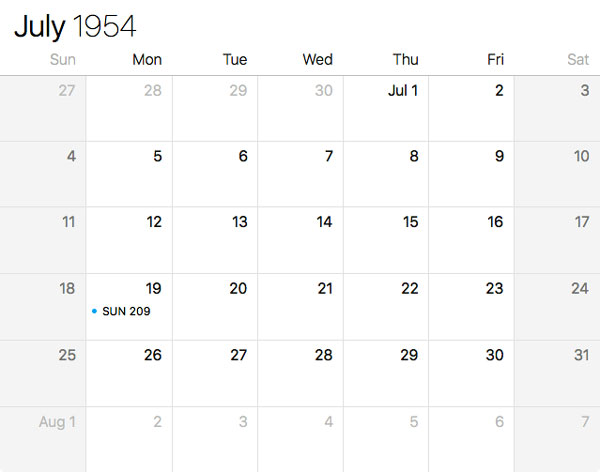
July 19, 1954

The date is July 19, 1954, and Sun releases the debut record of 19-year-old Elvis Presley. Produced by Sam Phillips, the single consists of “That’s All Right” backed with “Blue Moon of Kentucky.” Elvis, who in childhood dreamed of being “the hero of the comic book,” begins his adventure.

The years come and go. In many ways, Elvis accomplishes far more than he could have possibly dreamed, including becoming a musical hero throughout the world. As they do for everyone, though, some of his dreams still manage to slip away from him.

The date is July 19, 1977, and RCA releases Moody Blue, an album that proves to be the final Elvis record before his death exactly four weeks later at the age of 42. An unprecedented level of fame helped Elvis place himself on a path that brought his earthly journey to a tragic end.

Only 23 years, a mere blink of history’s eye, separate the release of the last Elvis record from the first.

More time passes. Other heroes come and go, yet Elvis somehow remains. As some fans fade away, others take their places.

The date is now July 19, 2022, but those 23 years continue to resonate.

Journey with The Mystery Train Elvis Blog today to the beginning and the end with two editions of Vinyl Elvis:

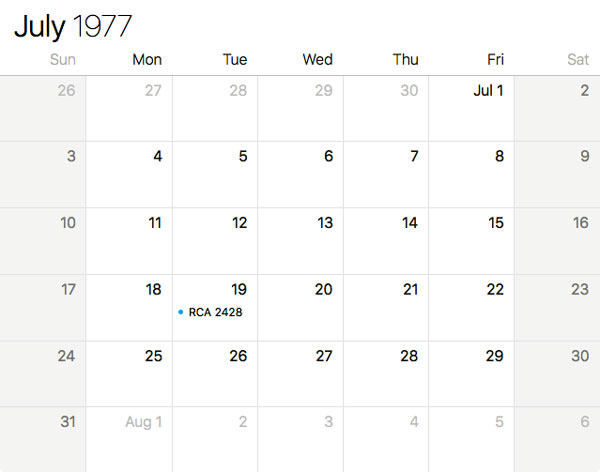
July 19, 1977


“Sing to the LORD, for he has done wonderful things. Make known his praise around the world.”
Isaiah 12:5

Vinyl Elvis #5: MOODY BLUE (1977)

Portions of this post were first published on one of my pop-culture blogs, now retired.


Today marks the 45th anniversary of the July 19, 1977, release of Moody Blue, an album that turned out to be the last Elvis Presley record before his death four weeks later.

MOODY BLUE (RCA, 1977; from Tygrrius’ collection)

MOODY BLUE (RCA, 1977; from Tygrrius’ collection)

Moody Blue
Label: RCA
Catalog Number: AFL1-2428
Recorded: 1974-1977 | Memphis, TN; Ann Arbor, Michigan; Kalamazoo, Michigan
Released: 1977

Before I had Elvis records of my own, I remember checking out a couple of his albums from the public library. I must have been about ten-years-old.

The two records I took home that day in 1985, which I believe represented the entirety of the library’s Elvis music collection, were The Sun Sessions and Moody Blue. The fact that I had borrowed both his very last record and a compilation of his very first records escaped me.

I enjoyed both albums, but the one that really drew me in was Moody Blue. For one thing, the record was pressed on blue vinyl. I had never seen anything like that. Plus, I just loved the sound of the album — particularly “Way Down,” which I played over and over.

I played “Way Down” for my older brother later that day to show off knowing a “new” Elvis song, only for him to inform me that he had his very own copy of Moody Blue.

At that time, I was not allowed to touch my brother’s records (and rightly so, as I was often unintentionally destructive of his things). Today, as he generously gave me all of his Elvis records several years ago, his copy of Moody Blue is mine.

Side A of MOODY BLUE (RCA, 1977; from Tygrrius’ collection)

Side A of MOODY BLUE (RCA, 1977; from Tygrrius’ collection)

Side A

  1. Unchained Melody (1977)
    A compelling live version of “Unchained Melody” leads off the record. I normally prefer to open with a rocker, but this choice works perfectly for Moody Blue. Incidentally, this is my beloved bride’s favorite Elvis song she has heard so far, and she notes Elvis’ emphasis on the word “God” versus versions of this song by others. Indeed, in Elvis’ hands, the lyric “God speed your love to me” can be heard as “God, speed Your love to me.” Similarly, “I’ll be coming home, wait for me,” can be interpreted as “I’ll be coming Home, wait for me” in Elvis’ version. Elvis seems to be calling out not to a lost love, but to God.
  2. If You Love Me (Let Me Know) (1977)
    When I was listening to the library’s copy as a 10-year-old, I distinctly remember recognizing this live song from the Elvis In Concert album and wondering why this one sounded better. Part of the reason was that it was actually recorded a couple of months earlier than the version on Elvis In Concert. Some debate whether this song, made popular by Olivia Newton-John, should have been in his setlist. No matter, this is his best version of a song that obviously spoke to him.
  3. Little Darlin’ (1977)
    Next up is another live recording, Elvis’ fun take on the 1950s classic, “Little Darlin'”, which also provides a much-needed change in tempo. I love his ad-lib of “To hold in mine…your little foot…uh, hand!”
  4. He’ll Have to Go (1976)
    The tempo slows back down for “He’ll Have To Go,” the last studio recording ever made by Elvis. In addition to the resonance of the Elvis vocals, I love the guitar work of James Burton here. Six of the songs on this album were recorded at Graceland in 1976 in an effort to make the artist feel more comfortable, as Elvis in later years had become reluctant to record in a formal studio setting. Two sessions at a makeshift studio in his den resulted in sixteen songs, ten of which had already been used on the From Elvis Presley Boulevard album by the time RCA was assembling Moody Blue.
  5. Let Me Be There (1974)
    In early 1977, Elvis backed out of a planned session in Nashville to finish the Moody Blue album. Instead, a few live performances were recorded that April. Only three suitable songs were captured, however, which brought the album’s total to nine. In desperation, RCA re-released “Let Me Be There” from 1974’s Recorded Live On Stage In Memphis album to round out Side A of Moody Blue. Another Olivia Newton-John hit, “Let Me Be There” fits well on Moody Blue, despite being slightly older than the other recordings. In addition to the Newton-John connection tying it to “If You Love Me,” it was also recorded in Memphis like the majority of the other songs on this album.

Side B

Side B of MOODY BLUE (RCA, 1977; from Tygrrius’ collection)

Side B of MOODY BLUE (RCA, 1977; from Tygrrius’ collection)

  1. Way Down (1976)
    All of the songs on Side B of Moody Blue were recorded at Graceland. I probably have the master of “Way Down” on at least a half dozen CDs. None of them sound as incredible as listening to this record. Is it all in my head? Possibly, but if it is, do not tell me. “Way Down” really rocks, making it an appropriate A-side for what turned out to be Elvis’ last single before his death.
  2. Pledging My Love (1976)
    “Pledging My Love” is another terrific performance by Elvis. He might have lost much of the joy in his life by this point, but you can still hear it on this song.
  3. Moody Blue (1976)
    I find it cool that the album’s title song is buried in the middle of Side B. “Moody Blue,” another great song, almost sounds like disco. Compare the guitar licks on “Moody Blue” with Kool & the Gang’s “Celebration” (1980), for instance.
  4. She Thinks I Still Care (1976)
    Elvis recorded many country songs, particularly in the 1970s. “She Thinks I Still Care” is a stellar performance. At the end, he just will not let the song go, either.
  5. It’s Easy For You (1976)
    “It’s Easy For You” was written by Broadway legends Andrew Lloyd Webber and Tim Rice, bringing to a close an album that was almost as varied as Elvis’ entire career: Adult Contemporary, Country, and Rock ‘n’ Roll. It is hard to ask for more in an Elvis album, and I still consider Moody Blue one of his best. A fun bit of trivia: Note the misspelling of Webber’s name on the Moody Blue Side B label in the image above. Proofreading has apparently never been a strong point for Elvis’ music label.

I mentioned that my brother did not let me touch his records when I was young. This turned out to be a good thing for me, as Moody Blue sounds flawless. Not a crackle or a pop to be heard on either side.

Back cover of MOODY BLUE (RCA, 1977; from Tygrrius’ collection)

Back cover of MOODY BLUE (RCA, 1977; from Tygrrius’ collection)

The interesting thing about Moody Blue is that such a fantastic album could result from not only a hodgepodge of recordings but also such a low point in Elvis’ life. “You don’t have to face the music, you don’t have to face the crowd,” he laments on “It’s Easy For You.” Depression, loneliness, and various personal demons were consuming his life by this point. Years of prescription drug addiction and abuse were beginning to take a public toll.

Part of the credit for the unlikely strength of Moody Blue must go to producer Felton Jarvis. While he occasionally went too far with overdubs on previous Elvis projects, Moody Blue is all the better for his extra work and attention to detail–particularly on the 1977 live recordings. Credit must also go to the musicians and vocalists who worked with Elvis on the album. On occasion, they carry Elvis. Finally, credit is due to Elvis as well, who managed to pull these performances from somewhere inside himself, despite not being in the right frame of mind to record.

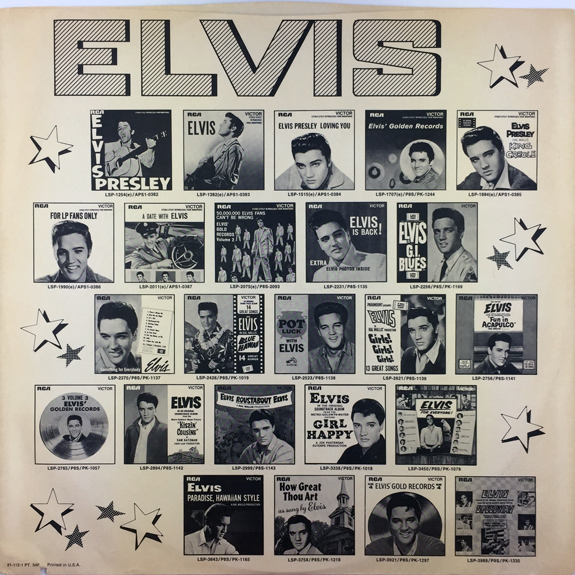
Inner sleeve (front) from MOODY BLUE (RCA, 1977; from Tygrrius’ collection)

Inner sleeve (front) from MOODY BLUE (RCA, 1977; from Tygrrius’ collection)

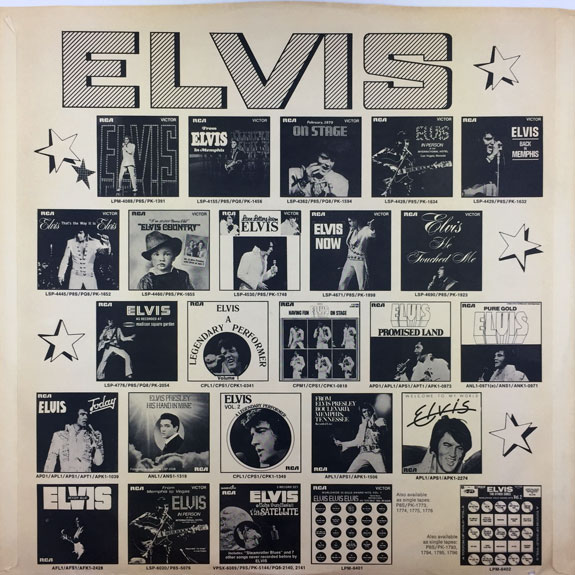
I love the inner sleeves on vintage Elvis albums. Check out the ads for other albums, which must have acted as combination check lists and wish lists for fans of the time. In some cases, it was also a way to see some alternate cover designs. For example, note the Moody Blue concept artwork in the bottom left of the image below.

Inner sleeve (back) from MOODY BLUE (RCA, 1977; from Tygrrius’ collection)

The fall of the curtain came much too early for Elvis, but Moody Blue certainly made for an impressive last act. If you collect Elvis on vinyl, this one is a must.


“Anyone who believes in Me may come and drink! For the Scriptures declare, ‘Rivers of living water will flow from His heart.'”
John 7:38

Vinyl Elvis #4: THAT’S ALL RIGHT/BLUE MOON OF KENTUCKY (1954)

Portions of this post were first published on one of my pop-culture blogs, now retired.


Today marks the 68th anniversary of the release of Elvis Presley’s first record on July 19, 1954.

I have two near-mint copies of That’s All Right/Blue Moon of Kentucky.

By far, they would be the most financially valuable pieces of my entire record collection or of all of my collections of anything, for that matter, except that they were both pressed in 2009, rather than 1954. Oh well. It’s not about the money, it’s about the music. Always has been.

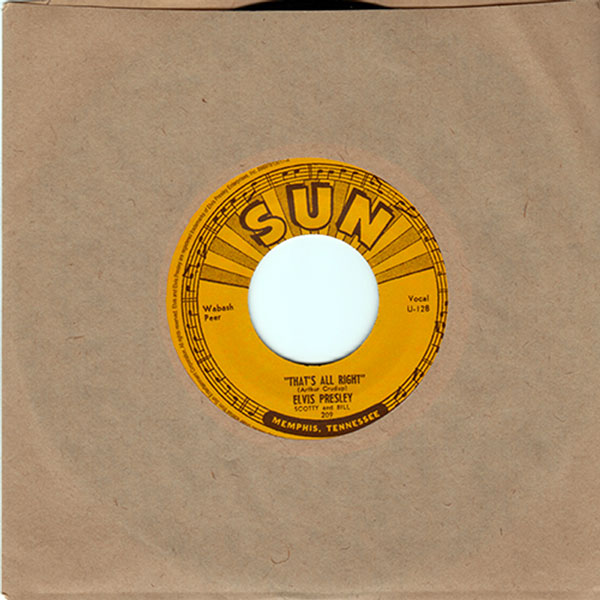
THAT'S ALL RIGHT/BLUE MOON OF KENTUCKY (Single; Sun, 1954; Reissue: Sony RCA/Legacy 2009--included as bonus with the Franklin Mint's ELVIS: THE COMPLETE MASTERS COLLECTION CD set; from Tygrrius' collection)

THAT’S ALL RIGHT/BLUE MOON OF KENTUCKY (Single; Sun, 1954; Reissue: Sony RCA/Legacy 2009–included as bonus with the Franklin Mint’s ELVIS: THE COMPLETE MASTERS COLLECTION CD set; from Tygrrius’ collection)

That’s All Right/Blue Moon of Kentucky (Single)
Label: Sun [Reissue: Sony RCA/Legacy]
Catalog Number: 209 [Reissue: 88697613017 (Label) / 88697673597 (2010 Outer Sleeve)]
Recorded: 1954 | Memphis, TN
Released: 1954 [Reissue: 2009]

Packaged in a plain, brown sleeve much like the original, my first copy of the record was included with Franklin Mint’s Elvis: The Complete Masters Collection CD set from 2009. A few years ago, I acquired a second copy of That’s All Right/Blue Moon of Kentucky, which Sony had released back in April 2010 for Record Store Day. Unlike the simple brown sleeve, this one included a gaudy cover, but I was surprised to discover that the record contained within is actually identical to the one that shipped with the Franklin Mint set. Sony must have been thinking ahead and pressed extra copies for the Record Store Day promotion.

Side A

Side A of THAT'S ALL RIGHT/BLUE MOON OF KENTUCKY (Single; Sun, 1954; Reissue: Sony RCA/Legacy 2009; from Tygrrius' collection)

Side A of THAT’S ALL RIGHT/BLUE MOON OF KENTUCKY (Single; Sun, 1954; Reissue: Sony RCA/Legacy 2009; from Tygrrius’ collection)

“That’s All Right” (1954)
One of the endearing aspects of this performance of “That’s All Right” is the sheer joy in the voice of Elvis as he sings. He finally has his opportunity in the studio, and he is making the most of it.

Elvis in 1970 reflected on his style, stating that it was “a combination of country music and gospel and rhythm & blues […]. That’s what it really was. As a child, I was influenced by all that.”

He added, “Of course, the Grand Ole Opry is the first thing I ever heard, probably, but I liked the blues, and I liked the gospel music–gospel quartets–and all that.”

On this first single, the blues and country influences are as clear as they ever would be. Some credit That’s All Right/Blue Moon of Kentucky as the first rock ‘n’ roll record, but to say Elvis invented the style is to make a false assumption that any one person actually did.

Rock ‘n’ roll evolved from the very sources that Elvis himself described. Besides, “Rocket 88,” “Rock Around the Clock,” and other potential contenders pre-date Elvis’ version of “That’s All Right.”

What Elvis did with his early records for Sun and RCA, though, was ignite the smoldering evolution of rock ‘n’ roll into a full-blown blaze. By melding country into the blues of “That’s All Right,” Elvis in 1954 unleashed a sound that not only built upon the foundation established by Arthur “Big Boy” Crudup‘s original 1946 recording, but took the song in a new direction. Absorbing the music of his youth, Elvis knew instinctively that blues and country explore many of the same themes, which allowed him to re-interpret these kinds of songs in a unique way.

Unfortunately, despite what the beautiful record label would have you believe, this reissue actually contains an RCA mastering of “That’s All Right,” rather than the original Sun mastering. It is the same 1954 recording, but RCA added echo to its versions not present on the Sun original.

A few years after this 2009 reissue of SUN 209, the “dry” version of “That’s All Right” finally became available again via FTD’s A Boy From Tupelo boxed set in 2012. Sony RCA/Legacy re-released A Boy From Tupelo in a much more affordable package for mainstream retail in 2017.

The dry version of “That’s All Right” is superior, though it takes some getting used to because the echo versions were used in every official release of the song from December 1955 through 2011. Unless, of course, you have been spinning a Sun original.

Side B

Side B of THAT'S ALL RIGHT/BLUE MOON OF KENTUCKY (Single; Sun, 1954; Reissue: Sony RCA/Legacy 2009; from Tygrrius' collection)

Side B of THAT’S ALL RIGHT/BLUE MOON OF KENTUCKY (Single; Sun, 1954; Reissue: Sony RCA/Legacy 2009; from Tygrrius’ collection)

Blue Moon of Kentucky (1954)
While Elvis added country to the blues of “That’s All Right,” he created a literal flip side by melding rhythm & blues into the country bluegrass of “Blue Moon of Kentucky.” Again, the sound is markedly different from Bill Monroe’s 1946 original. Again, there is that joy in Elvis’ voice.

A fun tidbit is That’s All Right/Blue Moon of Kentucky contains only three musicians: Elvis on acoustic guitar, Scotty Moore on electric guitar, and Bill Black on the upright bass.

One of the earliest rock ‘n’ roll records, and no drummer to be heard. Credit goes to Black, whose bass makes it sound like there must be a drummer.

A drummer did not join the group in the studio until the early 1955 session that produced “I’m Left, You’re Right, She’s Gone,” the flip side of Elvis’ fourth record for Sun.

“That’s All Right” and “Blue Moon of Kentucky” became regional hits for Elvis. He would follow-up the single with four more records on the Sun label before signing with RCA in late 1955.


“History merely repeats itself. It has all been done before. Nothing under the sun is truly new.”
Ecclesiastes 1:9