Elvis 1967: The Once And Future Album (The Edge Of Reality #3)

There are infinite universes, beyond that which is known to man. Imagine, if you will, one such alternate dimension in which an entertainer named Elvis Aaron Presley set a slightly different course for his life. In that universe, one of the entertainer’s fans was also born thirty years sooner. This allowed him to document what happened when the entertainer took a stand in 1967. Submitted for your approval is this brief glance into… the edge of reality.

The Mystery Train Elvis Newsletter (November 1967)

The Mystery Train Elvis Newsletter (November 1967)

THE MYSTERY TRAIN ELVIS NEWSLETTER
Volume XII, Issue 4, Number 48
November 1967
– Page 2 –

Hitchhike all the way down to Memphis with Big El
A review of Elvis Sings Guitar Man by Ty.

Word has it that Elvis had a major blow-up with RCA Records over Elvis Sings Guitar Man, which hit record stores last week. RCA originally planned to issue some of these songs on a soundtrack record for the new Clambake movie, which will be playing at a theater near you later this month.

Elvis insisted on an album with no movie songs, though. If the rumors are true, he apparently even threatened to fire his long-time manager over the debacle until the Colonel worked it out with RCA. Meanwhile, Elvis’ newly hired personal attorney is still reviewing management and recording contracts he signed earlier this year. With two cancelled movie soundtrack albums in as many years, could major shakeups be on the way? Stay tuned.

Ironically, the similarly-titled Elvis Sings Memphis, Tennessee came about due to similar circumstances back in 1963. As you probably recall, the legend goes that Elvis nearly fired the Colonel back then, too. Seems the Colonel wanted to replace that album’s release with a new installment of the Golden Records series. Elvis’ instincts proved right back then, for the platinum-selling Memphis, Tennessee album made it to number three on the charts.

In any event, with the Clambake songs shelved for now, we Elvis fans get this album instead. Was he right to take the same stand for Guitar Man as he did for Memphis, Tennessee? Let’s find out.

SIDE 1

Guitar Man: Elvis has gone Country & Western? That’s what this first song tells us. Musically, this is much better than anything on the Double Trouble LP and the Easy Come, Easy Go EP from earlier this year. In terms of Elvis’ commitment, this is more on par with the How Great Thou Art LP Gospel album that kicked off this year. Can the whole album live up to this first song, though?

Tomorrow Is A Long Time: While writer Bob Dylan has not released this song himself, Folk music fans may have heard it on the Odetta Sings Dylan album that she put out a couple years ago. I must admit, I never expected Elvis to sing Dylan, though! Even more so than “Guitar Man,” this is a very unusual song compared to what we are used to from him. I like it as something different, but hope the entire album isn’t like this.

Big Boss Man: Some people think that Country & Western is about as far apart from the Blues as you can get. Apparently not Elvis, who delivers yet another fine performance. This time, it is a Blues song done in what is almost a Country & Western style. It was combining different styles of music that helped Elvis to create Rock ‘n’ Roll back in the old days anyway. Be sure to listen out for a slight change to the words. Instead of “I want a little drink of water, but you won’t let Jimmy stop,” he sings, “I want a little drink of water, but you won’t let Big El stop.” I like the sound of that. I think I’ll call him that from now on. Of note, RCA originally planned this for release on 45 in the fall. They even put out ads for it, but the single was held back – probably while waiting for the various parties to resolve the whole Clambake album controversy.

Love Letters: After such a start, this is a ballad for the ladies. Not as strong as “Can’t Help Falling In Love,” but more along the lines of “Ask Me.” You might remember that Big El had a bit of a hit last year with this on 45 RPM.

Indescribably Blue: We know this one already, too. It was a 45 earlier this year. Though it didn’t do very well, I still say it is one of his best records. Sounds a lot like a modern take on his early days. I don’t mind hearing it again in the context of what is starting to sound like, dare I think it, his finest album in years.

Fools Fall In Love: Now the B-side of the above single. I didn’t like this one as much. Stick with the Drifters for this one. From the sound of things, Big El might have thought this one was for a movie. Most albums have a little filler, though.

High Heel Sneakers: Finally, back to new songs. Big El takes the Blues head on here and triumphs. A real treat!

SIDE 2

Down In The Alley: Big El starts Side 2 in much the same way that he ended Side 1, with a Blues number. Not as effective as “High Heel Sneakers” and a little whiney for my tastes, but still an enjoyable performance. At least he sounds like he cares about these songs.

Come What May: This was the flip side to the “Love Letters” 45. Big El’s version is a little faster than Clyde McPhatter’s from ten years ago. Much like “Fools Fall In Love,” the arrangement here sounds like a movie song. He has to be more careful not to let that sound carry over into his “real” music. After taking his stand against RCA, would he have been better served to demand another recording session to properly finish this album? Maybe that’s expecting too much at once.

Mine: Here we are on the very next song and Big El makes up for “Come What May” and then some. “Mine” is a beautiful song, one of his very best love songs – right up there with “Can’t Help Falling In Love.” Way better than “Love Me Tender.”

Just Call Me Lonesome: And now the album turns Country & Western again! You can’t say you’re not getting variety here. Only Big El could pull off making all of these styles work as one album.

You Don’t Know Me: Ever since I first heard the Ray Charles version of this Eddy Arnold Country & Western song a few years ago, I always wondered what an Elvis version would sound like. Now, I no longer have to wonder. Big El turns in a somber performance that truly conveys the heartache of the lyrics. This is Elvis at his best. Look for a version of this when you go see Clambake. Is it possible that the rest of the Clambake songs were this good? I have a hard time believing that, but I guess we’ll know when the movie comes out.

Singing Tree: Big El stays in the Country & Western neighborhood for this one. While it does not compare to “Mine” or “You Don’t Know Me,” this song about lost love is still interesting and a fine performance.

I’ll Remember You: This one is another surprise, sounding like a cross between “Tomorrow Is A Long Time” from Side 1 and the Blue Hawaii soundtrack. With a little Country & Western thrown in. I’m not kidding! Again, only Big El could pull this off. Another beautiful song.

* * *

I don’t know in what insane universe RCA would waste these songs as filler on movie soundtracks, but I’m sure glad it’s not ours. 1967 has certainly been a year of change for Elvis. As covered in our previous newsletter, he married his longtime sweetheart just a few months ago. Early next year, he and Ann-Margret are expecting their first child (see article on page 1 of this issue). Let’s hope that How Great Thou Art and Elvis Sings Guitar Man mean more good things are on the way in 1968.

So, I know the completists among you are wondering about the songs recorded for the Clambake movie. Will we ever get to hear them on record? Word around the rumor mill (which sure has been busy this year) is that they might be combined with songs from last year’s cancelled Spinout soundtrack album to make an Elvis Double Feature album. Stranger things have happened.

Thanks for reading, everyone. Have a Happy Thanksgiving, a Merry Christmas, and a Happy New Year! See you in 1968!

A fairytale? A fantasy? A careless product of wild imagination? You can believe or disbelieve, accept or reject; but if this isn’t real, then we’re all condemned to… the edge of reality.

[With apologies to Serling.]


Throughout 2011, The Mystery Train is commemorating the 44th anniversary of 1967. Find out why here.
Where Elvis never stood alone

I enjoy exploring all different areas of Elvis’ career. With Follow That Dream’s recent announcement that Amarillo ’77 will be among its June CD releases, I thought this would be a good time to take a look back at the 1977 recordings officially available to this point.

Not including the post-midnight tracks on FTD’s New Year’s Eve audience recording, there have been three key official releases of 1977 concert material in the years since the death of Elvis:

  • Unchained Melody (2007, FTD, covering February)
  • Spring Tours 77 (2002, FTD, covering March through May)
  • Elvis In Concert (1977, RCA, covering June; serves as soundtrack to TV special of same name)

All three of these releases have something to offer fans who are willing to listen.

Unchained Melody contains one of my favorite Elvis performances from any time, a stirring rendition of “Where No One Stands Alone,” with Elvis leading the way on piano. Recorded February 16 in Montgomery, Alabama, this marks the only known instance of Elvis performing this song live.

I actually prefer this nearly heart-wrenching version over his 1966 studio master of the song, recorded for How Great Thou Art. After hearing the raw emotions of this live version, the studio version sounds almost antiseptic – as if in 1966 Elvis had not really lived enough to fully convey the song compared to eleven years later.

Just a few days later, on February 21 in Charlotte, North Carolina, Elvis pulls out a blues number that he seemed to always have ready in his back pocket – “Reconsider Baby.”

Though Elvis formally recorded the song in 1960 for Elvis Is Back!, a 1956 version of the song from “The Million Dollar Quartet” jam at Sun Records made its debut on The King of Rock ‘n’ Roll in 1992. Live versions from 1961, 1969, and 1972 have also been released, all of which, like this 1977 track and its predecessor on New Year’s Eve, feature a committed Elvis. Lowell Fulson first recorded the song in 1954, around the same time that Elvis recorded “Good Rockin’ Tonight.” In Charlotte, “Reconsider Baby” is a good performance. Elvis never lost his feel for the blues.

At that same February 21, concert, Elvis also performs the only known live version of “Moody Blue” (outside of giving up after a false start in the same city the night before). This is another good performance. It is sometimes amazing how well Elvis could sing a song that he admittedly did not know. It is also a testament to the work of the TCB Band, that they could carry him when all he had was a lyric sheet. Lyric sheet or not, this is still a worthy listen.

At a Valentine’s Day show in St. Petersburg, Elvis takes over the piano momentarily from Tony Brown to show him how to play the intro to “Blueberry Hill.” What follows is a fantastic, though all too brief, take on the song – which Elvis first recorded in 1957.

A February 18 performance of “Release Me” in Columbia, South Carolina, is another highlight. For the briefest of moments, it sounds like it could be 1970 – but only a moment.

The highlight of Spring Tours 77 is beyond a doubt his March 26 performance of “Blue Christmas” in Norman, Oklahoma. The song takes on a different tone here than his bluesier 1968 live versions or his 1957 studio version. He sounds desperately sad, which is only underscored by our knowledge that he has already celebrated his final Christmas by this point. While I like the performance, this is not something I’ve added to my normal Christmas rotation. It’s just too sad.

The often-underrated Elvis In Concert contains a number of fine performances, including one of his best ever versions of “My Way” on June 21 in Rapid City. A brief snippet of “I Really Don’t Want To Know” from that same show also illustrates that he could still tap into his power. Even Omaha on June 19, sometimes described by others as one of his worst concerts, offers up a decent version of “How Great Thou Art” and an entertaining performance of “And I Love You So.”

My original intent in all of this was not to go through track-by-track highlights of 1977, but to point out that even one of Elvis’ lesser years can still hold magic. It is a mistake to focus only on certain aspects of Elvis’ career and to ignore the rest. While 1968-1971 may indeed be my personal favorite span, I would not want that to be the only Elvis I ever hear.

It is also unfair to use peak moments like 1968-1972 or 1954-1958 as the measuring sticks for everything else. Of course, everything is going to pale in comparison to those very special times in his life, but that does not mean that it lacks value. 1977 should not be ignored, not by Elvis Presley Enterprises, not by Sony & FTD, and most of all, not by us – his fans. I commend FTD for deciding to release Amarillo ’77.

So, pull out those 1977 recordings and give them a spin. He was on that stage for his fans, and he left these and other recordings as part of his legacy. They are an essential part of understanding the whole Elvis.

* * *

The Amarillo ’77 concert took place on March 24, 1977. Below is the track listing:

01 That’s All Right
02 Are You Lonesome Tonight
03 Reconsider Baby (intro only)
04 Love Me
05 If You Love Me
06 You Gave Me a Mountain
07 Jailhouse Rock
08 O Sole Mio/It’s Now or Never
09 Little Sister
10 Teddy Bear/Don’t Be Cruel
11 My Way
12 Band Introductions/Early Mornin’ Rain
13 What’d I Say/Johnny B. Goode
14 Band Introductions
15 School Days
16 Hurt
17 Hound Dog
18 Can’t Help Falling in Love
Bonus Tracks
19 And I Love You So
20 Fever
21 Love Me Tender
22 Blue Suede Shoes
23 Steamroller Blues
24 Help Me
25 Why Me, Lord
26 Bosom of Abraham
27 You Better Run
28 How Great Thou Art
29 Trying to Get to You

Pieces of our lives: A look at modern Elvis fans

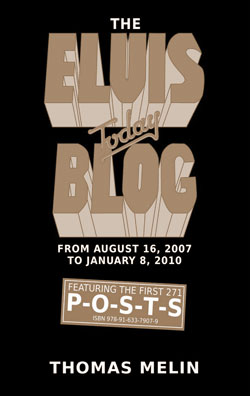
The Elvis Today Blog (book)
By Thomas Melin
274 pp. Blurb. $9.95

The Elvis Today Blog (2011)

The Elvis Today Blog (2011)

Full Disclosure: I wrote a guest post for the Elvis Today Blog back in 2009, and it appears in this book (p. 224). The last thing I want to do is start reviewing my own material, though, so the following review covers the other 99% of this compilation.

Don’t let the title of this book fool you. The Elvis Today Blog is not a book about an Elvis site. Without a doubt, The Elvis Today Blog is a book about Elvis.

However, it turns out that The Elvis Today Blog is also a book about us – modern Elvis fans.

By relating his personal experiences, author Thomas Melin crafts a unique volume that follows the triumphs and trials of being an Elvis fan in the post-1977 era.

“Sometimes it just hits me how much I love Elvis music and what a great feeling I get from listening to it,” writes Melin in “The Wonder Of Elvis” (p. 56), one of his best entries. “On the highway I put the fourth CD from the Today, Tomorrow & Forever box set in the car stereo and there was ‘See See Rider’ from February 1970 blasting through the speakers. It’s hard to explain what I felt, but I remember thinking ‘Man, I’m gonna listen to Elvis and his music until the very day I die,'” he states.

A major contribution of The Elvis Today Blog is the “Special Moments With FTD” series, Melin’s focus on specific songs released on Sony’s Follow That Dream collectors label for Elvis fans:

  • “Love Me Tender,” Dixieland Rocks (1975) – p. 65
  • “The Sound Of Your Cry,” The Nashville Marathon (1970) – p. 78
  • “You’ll Never Walk Alone,” So High (1967) – p. 92
  • “Mexico,” Out In Hollywood (1963) – p. 107
  • “It’s Easy For You,” The Jungle Room Sessions (1976) – p. 116
  • “Hey Little Girl,” Out In Hollywood (1965) – p. 182
  • “I Just Can’t Help Believin’,” One Night In Vegas (1970) – p. 182
  • “My Boy,” Dixieland Rocks (1975) – p. 183
  • “Young And Beautiful,” Elvis On Tour: The Rehearsals (1972) – p. 238
  • “Suspicious Minds,” Memphis Sessions (1969) – p. 265

Most notable of the above entries are those dealing with “You’ll Never Walk Alone,” “It’s Easy For You,” and “Suspicious Minds,” where the author uses powerful descriptions to take you inside the various studios to watch Elvis at work.

Modern Elvis fans aren’t just listening to records and CDs, though. They also enjoy listening to Elvis on their iPods or other portable music devices. “I too like buying and collecting CD’s, reading the liner notes and listening to the tracks on my stereo. But that doesn’t stop me from downloading the music into my iPod and taking it with me whenever I’m traveling somewhere. To me, that’s the real benefit of owning an iPod, that I always have access to the Elvis Presley catalog, wherever I happen to be,” Melin says (“Ku-u-i-pod,” p. 37).

I don’t normally comment on cover design and page layout of books (unless they are awful), but these elements by Staffan Melin, a brother of the author, warrant special mention. The cover is a creative take-off of the 1975 Elvis Today album cover. The interior page layout makes for easy reading, featuring the Deja Vu Serif Condensed font. Kudos to the designer.

It’s no secret that I’m a huge fan of the web version of the Elvis Today Blog. In fact, I often find inspiration there, and the Mystery Train Elvis Blog would probably not exist in its present form without the Elvis Today Blog’s influence. It has been a joy rediscovering favorite or forgotten posts as I read them in book format.

Needless to say, I’m hoping that Melin releases additional volumes of his Elvis works. One enhancement suggestion I have for the next volume would be to include an index, to make it easier to find all of the references to certain topics. If that could not be done on a large scale, it seems that at least the Labels feature in use on the web version could be converted into a short index for the book version.

Another way to enhance future volumes would be if Melin included supplemental information that was not part of the original blog posts. Using an example from this book, he mentions meeting drummer DJ Fontana (p. 28), who shared some Elvis stories with him. Maybe one or two of those stories could be noted as bonus content.

Those are just minor suggestions, though. The Elvis Today Blog is not only a great book about Elvis, but an essential examination of contemporary Elvis fandom. Highly recommended.

And all four speakers were blaring Elvis

The latest FTD release, Live In Vegas: August 26, 1969 Dinner Show, arrived at my house yesterday. I resisted the urge to give it a quick listen last night so that I can give it proper attention this weekend. I’ll be reviewing this one soon, and I can’t wait to hear it. I wonder if my neighbors would mind if I blared an Elvis concert at 6:30 in the morning? Of course, it wouldn’t be the first time.

* * *

Came across a nice little Elvis mention courtesy of Google News while web surfing last night. I started to post a link here, but was too sleepy to type coherently. I’m definitely a morning person, you see. Anyway, over on JSOnline, the web site of the Milwaukee Journal Sentinel, someone wrote the following comment and question to “Mr. Music:”

I know the peak time for quadraphonic albums is around 1975. But the first quad LP I bought was ‘Aloha From Hawaii via Satellite,’ the soundtrack of Elvis Presley’s 1973 Honolulu concert. Since this came out before quad’s heyday, is it the first quad album? I’ll bet it is the top-selling quad release. Also, did anyone ever make quad singles?”- Jeremy Norbert, Milwaukee

Quadraphonic sound was an early consumer version of what we now call surround sound. In stereo sound, the audio is separated into two distinct channels. In quadraphonic sound, the audio was separated into four distinct channels – meaning you would listen with four speakers. Though it was indeed used for Aloha From Hawaii via Satellite, the format did not catch on.

I didn’t even notice this last night, but another perusal of the article just now reveals that “Mr. Music” is none other than renowned record collecting and Elvis expert/author Jerry Osborne. No wonder I was so impressed with his response. I was surprised last night that a “mainstream media” member could give such a knowledgable reply without tossing in snide comments or jokes about Elvis in the 70s. Now it all makes sense.

Check out Osborne’s reply: “Elvis in Hawaii helped take sound to a new level” — JSOnline. I’ll definitely be keeping an eye on Osborne’s Mr. Music column in the future.

An updated version of Osborne’s Elvis: Like Any Other Soldier book is available now. You can find out more information about his publications over at Jerry Osborne’s site.

FTD to release Elvis Sings Guitar Man

Just learned terrific news. The next Follow That Dream Records release is going to be the “imaginary album” Elvis Sings Guitar Man, filling in its Classic Album series with songs recorded in Nashville in 1966 and 1967 (“Elvis Sings Guitar Man” — Elvis Today). These songs originally found their homes as bonuses on various movie soundtracks. This 2-CD set will fit in perfectly with The Mystery Train’s ongoing tribute to Elvis events of the year 1967.

The CD is due out in April. From ElvisNews.com, here’s the tracklisting:

DISC 1

01) Guitar Man 2:22
02) Tomorrow Is A Long Time 5:24
03) Big Boss Man 2:54
04) Love Letters 2:52
05) Indescribably Blue 2:50
06) Fools Fall In Love 2:08
07) Hi-Heel Sneakers 2:48
08) Down In The Alley 2:54
09) Come What May 2:03
10) Mine 2:39
11) Just Call Me Lonesome 2:08
12) You Don’t Know Me 2:32
13) Singing Tree 2:22
14) I’ll Remember You 2:48

Bonus Song
15) Beyond The Reef (overdubbed version)

First Takes
16) Guitar Man – takes 1,2,5 4:22
17) Tomorrow Is A Long Time – takes 1,2 6:15
18) Big Boss Man – take 2 3:35
19) Love Letters –take 2 2:53
20) Fools Fall In Love – takes 1,4 2:40
21) Hi-Heel Sneakers – take 5 4:58
22) Down In The Alley – take 1 3:13
23) Come What May – take 2 2:12
24) Singing Tree – take 1 3:11
25) I’ll Remember You – vocal overdub take 2 4:14

DISC 2

May 1966 Sessions
01) Down In The Alley – takes 2,3,4 2:18
02) Down In The Alley – take 6 2:51
03) Love Letters – takes 3,4,5,7 4:39
04) Love Letters – take 8 3:12
05) Beyond The Reef – takes 1,2 (undubbed master) 5:42
06) Come What May – takes 3,4 2:27
07) Come What May – take 6 2:07
08) Come What May – take 7 – 2:21

June 1966 Sessions
09) Indescribably – (vocal overdub) take 1 2:55
10) I’ll Remember You – (unedited master) vocal overdub 1 4:10

1967 Sessions
11) Guitar Man – takes 7,9 2:52
12) Guitar Man – take 10 2:55
13) Guitar Man – takes 11, 12 (unedited/undubbed master) 4:02
14) Big Boss Man – takes 1,3,4,5 3:19
15) Big Boss Man – takes 7, 9 3:48
16) Singing Tree – takes 2,4 3:28
17) Singing Tree – take 8 3:03
18) Singing Tree – takes 10,13 3:44
19) Just Call Me Lonesome – takes 3,4 2:55
20) Just Call Me Lonesome – takes 5,6 2:31
21) Hi-Heel Sneakers – takes 1,6 2:51
22) Hi-Heel Sneakers – take 7 – (unedited master) 4:57
23) You Don’t Know Me – take 2 2:57
24) Singing Tree – (remake) takes 1,2,3 3:21

FTD is Sony’s collectors label for Elvis fans. The releases are available from various online stores. Since they originate in Denmark and then ship to retailers, there is sometimes a two or three week delay after the “release date” before the CDs arrive for those of us in the United States.

By Any Other Name

A couple of weeks ago, I told you about the forthcoming Follow That Dream Records release White Knight In Vegas. FTD, which is Sony’s collectors label for Elvis fans, announced yesterday that the CD has been retitled to Live In Vegas: August 26, 1969 Dinner Show. Content is the same as previously reported. The February 15 release date is apparently unaffected, though I would not be surprised if there turns out to be a slight delay.

One of the best music blogs around is The Second Disc, which I visit daily. It focuses on catalog releases across a full spectrum of genres. Though I am not likely to create a blog devoted to anyone else, my music tastes go far beyond Elvis, and I always find something of interest there.

The Second Disc also does a good job of covering Elvis’ Sony releases. I was glad to see earlier this week that FTD is now on their radar as well, with a story about the then-titled White Knight In Vegas release.

It’s always good to see Elvis releases covered on sites that are not specifically about him. For other artists, I find out about and purchase many releases I would not otherwise know about due to The Second Disc, and the same may hold true for more casual Elvis listeners who visit that site.

Does every FTD release warrant such exposure? No, but Live In Vegas certainly does, as well as titles in the FTD Classic Album series, which features reissues of original albums with tons of outtakes.

Last month, FTD completed its Classic Album coverage of the November 1957 Jailhouse Rock Extended Play album with the two-disc Jailhouse Rock, Volume 2. Between the two volumes, this means that FTD devoted four CDs to what was originally a five-song EP. Now, that’s what I call a collectors label!

FTD’s next Classic Album entry has not yet been announced, but I’m hoping for coverage of the January 1975 LP album Promised Land (recorded in 1973).

The FTD label began in 1999 and has released nearly 100 titles so far, more albums in eleven years than Elvis released during his entire twenty-three year career. FTD releases are available from ShopElvis.com and other online Elvis retailers. Since they originate in Denmark and then ship to retailers, there is usually a two or three week delay after the “release date” before the CDs arrive for those of us in the United States – though that delay seems to be less lately. FTD releases are usually worth the wait.

Elvis Is Back! Legacy Edition coming in March

The Second Disc yesterday posted a write-up and track listing for the forthcoming Sony Legacy Edition of Elvis Is Back! (“‘Elvis is Back’ is back” — The Second Disc). The Legacy Edition is a 2-CD set containing the LP albums Elvis Is Back! (1960) and Something For Everybody (1961). Also included are the associated singles from those albums. Singles were often left off of Elvis’ main LP releases during that time because they were saved instead for the Golden Records compilation LP series.

Recorded just after his return from the Army, Elvis Is Back! represents one of Elvis’ all-time greatest albums. I haven’t covered the Elvis Is Back! Legacy Edition here until now because both featured albums have already received separate two-CD deluxe set treatments on Sony’s Follow That Dream Elvis collectors label.

The FTD editions contained tons of alternate takes and the like in addition to the master takes, while the Legacy Edition sticks only to the master takes. Hardcore fans will want the FTD releases instead, but the Sony Legacy edition looks to be perfect for more mainstream fans, or perhaps those who are just starting to explore Elvis’ catalog beyond the typical greatest hits collections.

Previous Legacy Edition releases for Elvis were From Elvis In Memphis (coupled with Back In Memphis) and On Stage-February 1970 (coupled with Elvis In Person). Elvis Is Back! Legacy Edition (coupled with Something For Everybody) hits stores on March 1.

If you are interested in the Sony Follow That Dream editions instead, you can look for them at ShopElvis.com and other online Elvis retailers.