Elvis: It’s Only Live [Pastimescapes blog]

Elvis Presley's 1972 RCA single version of "An American Trilogy." (From the author's collection.)

Elvis Presley’s 1972 RCA single version of “An American Trilogy.” (From the author’s collection.)

I thought it might be interesting to start a list of live Elvis Presley songs officially released for which no formal studio recordings are available. It turned out longer than I expected – over 50 songs so far, and that is not including any that I might have missed.

  • Hearts Of Stone
  • Tweedlee Dee
  • Little Mama
  • Maybellene
  • Flip, Flop & Fly
  • Baby, What You Want Me To Do
  • Tiger Man [according to legend, Elvis recorded a studio version at SUN but it has yet to surface]
  • Yesterday
  • Runaway
  • My Babe
  • I Can’t Stop Loving You
  • Johnny B. Goode
  • Words
  • Proud Mary
  • Let It Be Me
  • Walk A Mile In My Shoes
  • Sweet Caroline
  • Polk Salad Annie
  • See See Rider
  • Release Me
  • The Wonder Of You
  • I Just Can’t Help Believin’
  • Something
  • You’ve Lost That Lovin’ Feelin’
  • When The Snow Is On The Roses
  • The Impossible Dream
  • An American Trilogy
  • Never Been To Spain
  • You Gave Me A Mountain
  • It’s Impossible
  • It’s Over
  • What Now My Love
  • I’m So Lonesome I Could Cry
  • Welcome To My World
  • Steamroller Blues
  • Mama Don’t Dance
  • Softly, As I Leave You
  • Why Me, Lord
  • Let Me Be There
  • You Can Have Her
  • Turn Around And Look At Me
  • Aubrey
  • Alright, Okay, You Win
  • You’re The Reason I’m Living
  • If You Love Me
  • Little Darlin’
  • Jambalaya
  • School Days
  • America The Beautiful [“studio” version recorded in Graceland den, but only a small fragment survives]
  • O Sole Mio
  • Auld Lang Syne
  • Unchained Melody
  • You Better Run

Note that many of these songs have non-live versions available – including rehearsals that are similar to formal recordings. For example, “Never Been To Spain” appears on Elvis On Tour: The Rehearsals, which was actually recorded at RCA’s Hollywood studio. However, I still consider the recording to be of an informal nature for the purposes of this list.


You've just crossed over into... the edge of reality. (With apologies to Serling.)

You’ve just crossed over into… the edge of reality. (With apologies to Serling.)

Most of the above songs actually work best for Elvis in a live context, but there are about a dozen for which I wish he had made formal studio recordings as well.

From the edge of reality, here is the track listing for an imaginary album of my picks.

Elvis: What Does It Matter

Side A

  1. Johnny B. Goode
  2. Baby, What You Want Me To Do
  3. Never Been To Spain
  4. I Just Can’t Help Believin’
  5. Walk A Mile In My Shoes
  6. When The Snow Is On The Roses

Side B

  1. I’m So Lonesome I Could Cry
  2. Maybellene
  3. My Babe
  4. I Can’t Stop Loving You
  5. Tiger Man
  6. Unchained Melody

How about you? From his live recordings, which do you feel Elvis should have tackled in the studio?


Thanks to reader Michel Cornec for inspiring this topic as well as performing some of the initial research.

Which “Jungle Room” Elvis CD Should You Buy? [Pastimescapes blog]

[Side Note: Introducing the new look of Pastimescapes, which now leverages the Expound theme. Look for more tweaks in the coming days.]
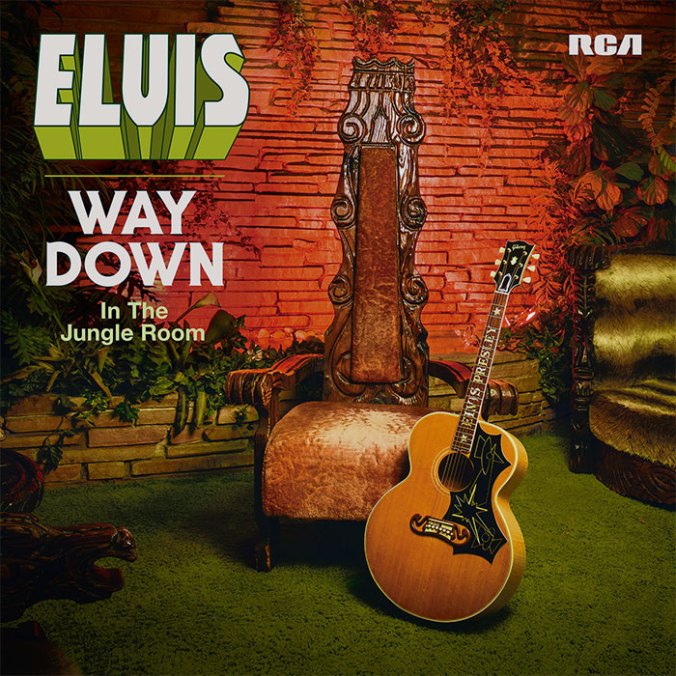
Cover of WAY DOWN IN THE JUNGLE ROOM (2016, Sony)

Cover of WAY DOWN IN THE JUNGLE ROOM (2016, Sony)

Memphis. When it comes to Elvis Presley, there is something magical about the music he created in his adopted hometown.

That magic is tangible, no matter if we are talking about his early SUN sides of 1954-1955, the American Sound sessions of 1969, the Stax recordings of 1973, the Mid-South Coliseum concerts of 1974, or the Graceland sessions of 1976 – where his home’s den was converted into a makeshift recording studio.

Those Graceland sessions, which proved to be the last “studio” recordings of Elvis’ career, initially resulted in two albums: From Elvis Presley Boulevard, Memphis, Tennessee, and the bulk of Moody Blue.

Since then, of course, alternates and outtakes from the Graceland sessions have appeared on numerous releases. The Jungle Room Sessions, for instance, is reportedly one of the best-selling CDs ever released by the Follow That Dream (FTD) collectors label for Elvis fans. The disc is so-named for the nickname given after Elvis’ death to Graceland’s uniquely decorated den.

Earlier this month, Sony released the latest compilation of these songs, Way Down In The Jungle Room. The release contains all of the Graceland master recordings on Disc 1 and selected alternates/outtakes on Disc 2.

Due to already having all of the material from both discs, I had actually planned to skip Way Down In The Jungle Room. I then found out more information about Disc 2 by reading Bob Mehr’s Memphis Commercial Appeal article on the project.

Thanks to the article, I did not skip it, and I can now highly recommend Way Down In The Jungle Room due to the incredible sound of Disc 2’s alternate/outtake versions – newly mixed by Matt Ross-Spang at Sam Phillips Recording Service.

However, my purpose today is not so much to review Way Down In The Jungle Room, but to expand upon an answer to a question I recently received from Wellsy – a Pastimescapes reader and longtime Elvis fan. A frequent commenter, he even wrote a guest post on The Mystery Train a few years back for me.

Wellsy emailed me on vacation from Memphis about some CDs he was considering purchasing. Somewhere in the course of our ongoing exchange, he asked, “What is the difference between FTD’s The Jungle Room Sessions and Sony’s Way Down In The Jungle Room?”
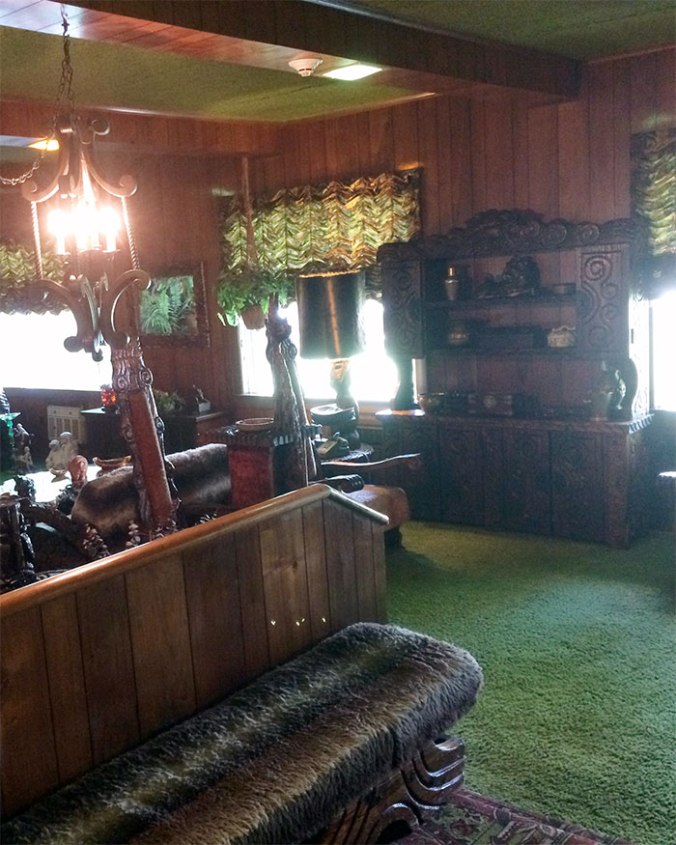
Frozen In Time: Graceland's den in 2016 essentially looks the same as it did in 1977. According to legend, Elvis bought the Witco furnishings after his father commented that it was ugliest furniture he had ever seen. (Photo by Wellsy.)

Frozen In Time: Graceland’s den in 2016 essentially looks the same as it did in 1977. According to legend, Elvis bought the Witco furnishings after his father commented that it was ugliest furniture he had ever seen. (Photo by Wellsy.)

If you are interested in the Graceland sessions, the underlying question is which of the Elvis releases covering this material should you buy? In addition to Way Down In The Jungle Room, there have been quite a few, including:

  • From Elvis Presley Boulevard (RCA): Masters from the February 1976 Graceland sessions (#19 on my recent “50 Greatest Elvis Albums” list)
  • Moody Blue (RCA): Remaining masters from the February and October 1976 Graceland sessions, supplemented with live recordings from 1974 and 1977 (#7 on my list)
  • The Jungle Room Sessions (FTD): Alternates/outtakes from the 1976 Graceland sessions
  • From Elvis Presley Boulevard (FTD Classic Album Edition): Masters and alternates/outtakes from the original RCA album, including relevant portions of The Jungle Room Sessions in improved sound quality and some previously unreleased tracks
  • Moody Blue (FTD Classic Album Edition): Masters and alternates/outtakes from the original RCA album, including relevant portions of The Jungle Room Sessions in improved sound quality and some previously unreleased tracks

People who know me offline, and I am sure some online have picked up on this as well, understand that I am a very analytical person. Sometimes to the point of annoyance, but, hey, it pays the bills. Anyway, I thought it might be interesting to compare some of the releases covering the Graceland sessions in a more visual fashion.

The below chart captures the master and other complete takes for each of the songs recorded at the Graceland sessions that have been officially released to date. In an attempt to keep this to a manageable size, I left out things like rehearsals, false starts, and FTD-generated splices.
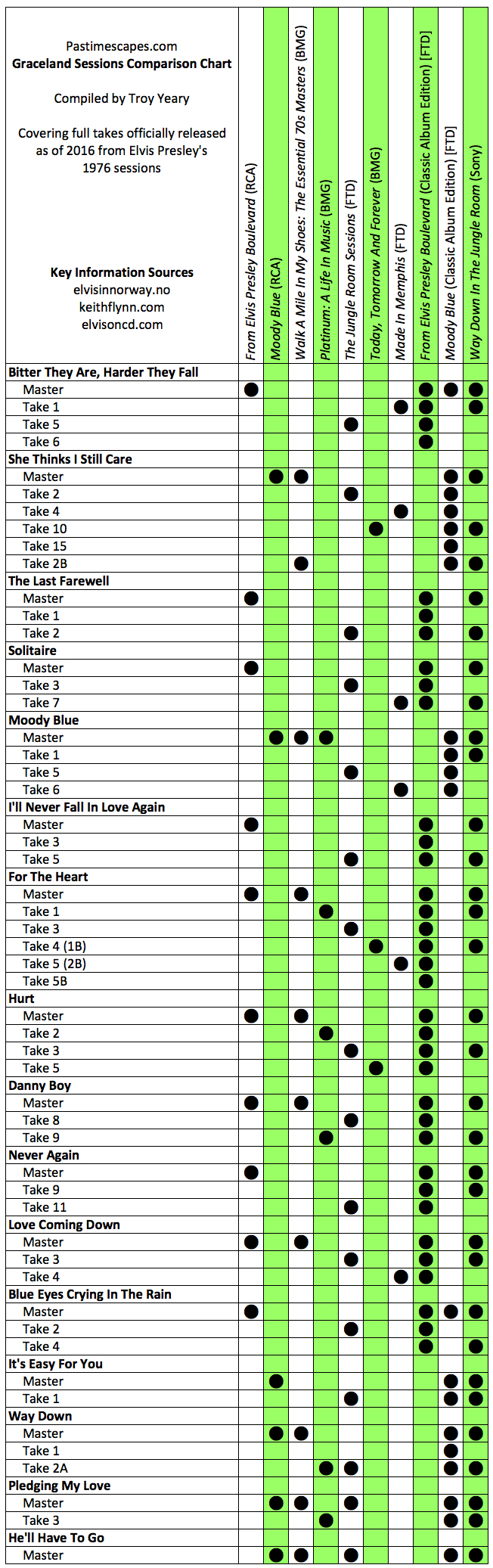
Graceland Sessions Comparison Chart

As noted in the graphic, my key information sources for the above were:

Any mistakes you might find, though, were entirely of my own making.

So, which one should you buy?

For typical, casual, new, or would-be Elvis fans, I recommend you buy Way Down In The Jungle Room. It gives you all of the master takes as well as a manageable number of alternates in great sound quality. This 2-CD set is a real value at less than US $15. Incidentally, there is also an LP vinyl version, but it does not include the masters.

For “totally insane” Elvis fans (like me), who enjoy listening to multiple alternates of the same song, I recommend you buy the FTD “Classic Album” editions of From Elvis Presley Boulevard and Moody Blue. Each of these 2-CD sets will run you around US $30, but they are more than worth it to experience the making of these albums. However, you will probably want to pick up the seemingly redundant Way Down In The Jungle Room as well at some point – simply for the sound experience on Disc 2.

No matter which you choose, settle back and enjoy some Memphis magic, courtesy of Elvis.


Thanks to Wellsy for inspiring this topic as well as giving permission to use his photo of Graceland’s den.


We can solve the mystery if we try

Frequent commenter Ray Faithfull recently emailed me the following mystery:

I watched a clip posted on facebook for the song “We Can Make The Morning”….then it dawned on me that it was longer than the Now album release and the FTD release by almost 30 seconds..I figured you would be the person to go to for some insight as to how many takes of this song were actually done and what and where have they been released??

Was take 1 the master take that went for over 4:30 and was simply faded at 3:48 for the final cut ??

I have included the link to the video i am referring to with the version i had not heard or at least not completely?? http://www.youtube.com/watch?v=GGIMKq-qwOM

Though I did not know the answer right off the top of my head, Ray had obviously placed a lot of faith in me (no pun intended . . . I think), so I felt compelled to research this for him.

First, I checked iTunes, where I have meticulously cataloged every unique Elvis track I own. To my surprise, the only version of “We Can Make The Morning” I have is the master recording, as released on Elvis Now.  My iTunes version of the 1971 track, sourced from the circa-2007 Vic Anesini remastering effort as released on Elvis: The Complete Masters Collection, clocks in at 3:59. However, the last five seconds of that are silence.

"We Can Make The Morning" on iTunes

“We Can Make The Morning” on iTunes

I pulled out my vintage 1972 vinyl edition of the Elvis Now album, and it indicated a run time of 3:54 for “We Can Make The Morning.” So, I had approximately six seconds more song than Ray’s 3:48 source, but nowhere near the 4:44 of the YouTube video. Though I am fairly obsessive about obtaining alternate takes of songs that Elvis formally recorded between 1969 and 1976, I certainly do not own every Elvis release. Perhaps this extended version was on an album I did not have.

Checks of the Elvis Now FTD edition liner notes and Ernst Jorgensen’s essential Elvis Presley: A Life In Music – The Complete Recording Sessions book provided no useful information in this case. Next, I went to my favorite source for alternate take information, the incredible Elvis Recording Data/Session Notes section of the Elvis In Norway site. There, I also found only one entry for “We Can Make The Morning,” the master recording (B-side single), with time listed as 3:54.

I only collect official releases, so my next thought was that the 4:44 version might be from a bootleg. Elvis In Norway’s Session Notes section fortunately does not muddy the water by including those, so I went to another reliable source that does incorporate bootleg information, the Recording Sessions section of Keith Flynn’s Elvis Presley Pages site.

There I found three matches for “We Can Make The Morning”:

A note on the May 20 / 21 page indicates, “Tape reel #2 from this session is missing, and this is the reel that would have included […] the outtakes of We Can Make The Morning,” so that effectively ruled out an alternate take of the song.

The undubbed master has apparently never been released, nor has the May 25 string overdubs version. Only the completed June 21 version, with overdubbed brass and strings, has been released (i.e., the one from Elvis Now).

However, the site lists the track as 4:11. That’s 17 seconds closer to 4:44, but still not enough. The 4:11 version of the song was released on the bootleg Unedited Masters: Nashville 1971 by the Venus label. There, “We Can Make The Morning” is listed as the “unedited, overdubbed master.” I do not have the album to verify whether the track fades at the end but, assuming the Venus information is correct, that leaves at least 33 unaccounted seconds that are in the video.

After all of this, I finally decided to take a listen to the YouTube video, which had been created by a fan. The visual imagery, interspersing photos of Elvis in life with photos of fans at candlelight vigils in the years after his death, was not to my liking, so I stopped paying attention to the video and just listened to the audio. Not only did it go to 4:44, but the song had not even fully faded at that point.

What was going on here? Though I did not detect anything the first time through, my guess was that a portion of the song had been re-looped somewhere (i.e., a part of the recording had been replayed to artificially make the song longer). On my second listen to the 4:44 video, I played the Elvis Now version at the same time. Whatever potential monkey business had occurred within the song was definitely happening near the end.

My third and fourth listens revealed that 3:28 in the video is a repeat of 2:48. For example, listen how Elvis draws out “night” at 3:33, which is an exact duplicate of how he sings it at 2:53 in the video.

Essentially, someone has artificially added at least 40 seconds to the audio track on the “We Can Make The Morning” YouTube video by repeating a portion of the song – most likely to suit the purposes of the photo montage. Other than the abrupt ending, the audio editing is actually quite seamless. However, I will stick with the original version.

Thanks for the great question, Ray, and for inspiring today’s post.

Case closed.

Close-up of ELVIS NOW back cover (1972)

Close-up of ELVIS NOW back cover (1972)
