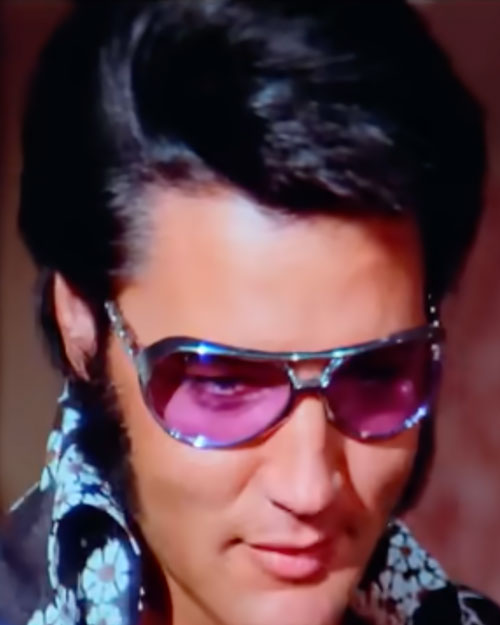
The Look

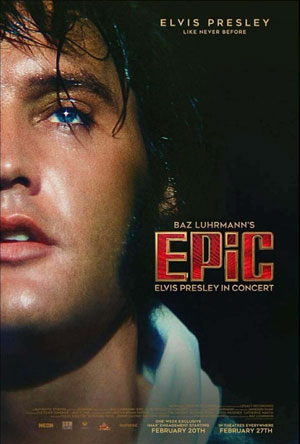
Last month, NEON released the official teaser trailer for Bazz Luhrmann’s latest project, EPiC: Elvis Presley in Concert. Check it out over on YouTube.

As Elvis Presley fans we could say a lot of things about that trailer, couldn’t we? We could quibble over dates, for instance, or debate the definition of “lost.”

None of that matters.

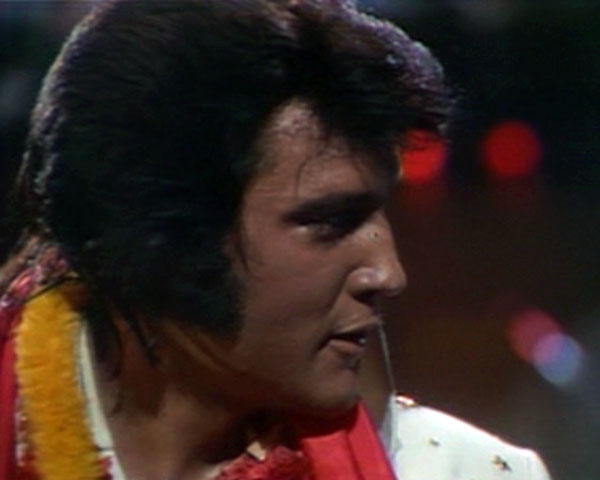
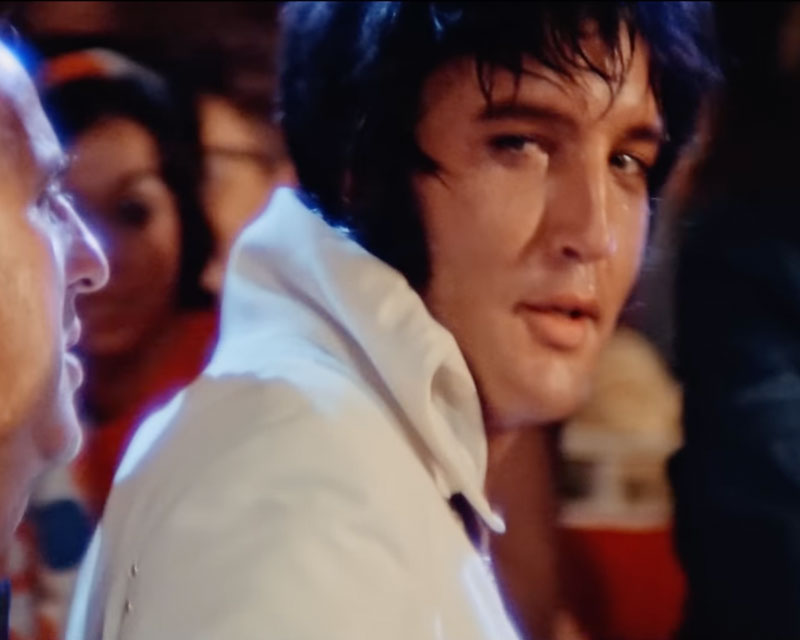
There’s a blink-and-you-miss-it moment in the trailer that clinches EPiC for me. Watching Elvis over the years, you become familiar with a certain look in his eyes. It’s a quick glance. Sometimes directly to fans. Sometimes to cameras. He seems to say, “You’re in on this with me, aren’t you?”

In the EPiC teaser, it occurs at 0:58. Here it is:

Elvis Presley in 1970, from the EPiC: Elvis Presley in Concert teaser, 2025, NEON

Elvis Presley in 1970, from the EPiC: Elvis Presley in Concert teaser (2025, NEON)

The film hits IMAX theaters worldwide on February 20, with early access showings beginning on February 18, and then expands to wide release on February 27 globally.
While there have been limited-run screenings over the years, EPiC represents the first wide release of an Elvis documentary in cinemas since 1981’s This Is Elvis.

We’ve lost many first generation Elvis fans since that time. For many second (and beyond) generation fans, like myself, events like EPiC are the closest we’ll ever come to experiencing Elvis in person.

EPiC allows Elvis to tell his own story, using audio from multiple sources. It also features fully restored video of previously released and unreleased content. Most of the footage used was originally filmed for the documentaries Elvis: That’s The Way It Is (1970) and Elvis On Tour (1972).

The film left stellar reviews in its wake after the world premiere at the Toronto International Film Festival in September last year, the European premiere at the Zurich Film Festival in September and October, and the United States premiere in Memphis at the TCB Showroom on January 8, the 91st anniversary of Elvis’ birth.

Footage from other eras is also featured to help round out the narrative. Most notably, color footage of Elvis performing in Hawaii in 1957 is included–30 seconds of which was first released by Graceland with little fanfare on the Aloha From Hawaii: 40th Anniversary Edition DVD (2013).

Sony on January 8 announced plans for the EPiC soundtrack, which will be available February 20 on digital and CD and April 24 on vinyl.

You can preview one of the songs on YouTube here: “Wearin’ That Night Life Look.”

This mashup combines elements from “Wearin’ That Loved-On Look,” “Night Life,” “Let Yourself Go,” and “I, John.” On paper it sounds like a mess, but it manages to work. I love it. As Elvis says, “Just play the hell out of it!”

Luhrmann produced and directed EPiC. He also co-produced, co-wrote, and directed ELVIS (2022), a fictionalized account of the singer’s life that starred Austin Butler (Elvis Presley), Tom Hanks (“Colonel” Tom Parker), and Olivia DeJonge (Priscilla Presley). That film earned nearly $300 million worldwide in its box office run. Butler won a Golden Globe for his portrayal and the movie earned eight Academy Award nominations, including Best Picture and Best Actor (Butler).

That the editor of the teaser trailer included “the look” gives me confidence that EPiC will do Elvis justice. We need to experience and support this one at our local theaters. Don’t make the mistake of waiting to watch it at home. Find it at a theater near you.

And, yes, we’re still in on it with you, Elvis.

Lost and Found and Lost and Found and Lost and Found

Presented without comment.


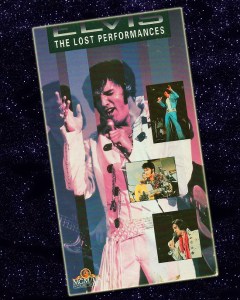
From Elvis: The Lost Performances (1992, MGM/UA Home Video, Turner Entertainment Co.):

“The performances you are about to see were rescued from discarded outtakes MGM had stored in an underground salt mine in Kansas.

“They were taken from two of Elvis’ live concert movies, ‘Elvis—That’s The Way It Is,’ and ‘Elvis On Tour,’ produced in 1970 and 1972, respectively.

“Also included in this program is a rehearsal that Elvis did on the MGM lot in 1970.

“None of these performances have ever been seen by the public except, of course, by those who were present when they happened.”


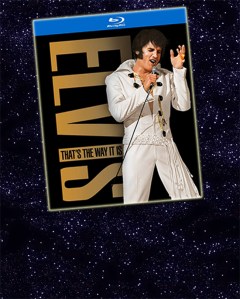
From Elvis: That’s The Way It Is – Special Edition (2001, Warner Home Video, Turner Entertainment Co.):

“In November 1970 MGM released the documentary film ‘Elvis: That’s The Way It Is,’ directed by Denis Sanders. It chronicled Elvis Presley as he returned to the live performances he had abandoned while making movies in Hollywood during the sixties.

“Most of the footage shot was unused in the final film and remained lost in studio vaults.

“Until Now.”


From EPiC: Elvis Presley In Concert Official Teaser (2025, NEON, Universal):

“In 1969, Elvis returned to the stage to begin a legendary residency in Las Vegas.

“For 40 years there have been rumors of lost footage.

“During the production of Baz Luhrmann’s ELVIS, it was found.

“This is more than a documentary.

“This is more than a concert film.

“This is Baz Luhrmann’s EPiC: Elvis Presley In Concert.”


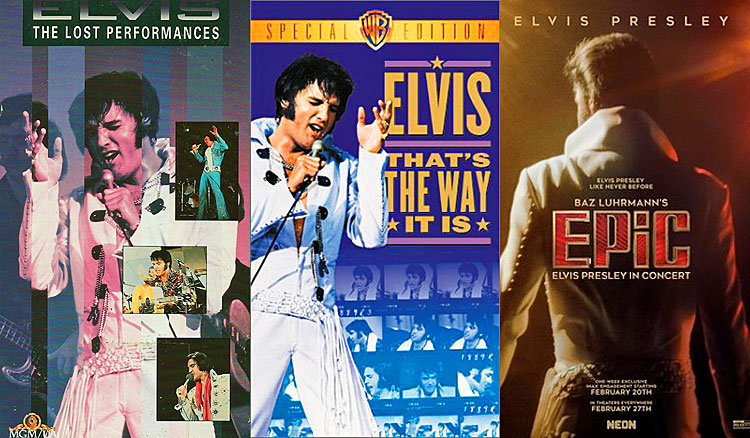
VHS covers for ELVIS: THE LOST PERFORMANCES (1992) and ELVIS: THAT'S THE WAY IT IS - SPECIAL EDITION (2001); teaser poster for EPiC: ELVIS PRESLEY IN CONCERT (2025)

VHS covers for ELVIS: THE LOST PERFORMANCES (1992) and ELVIS: THAT’S THE WAY IT IS – SPECIAL EDITION (2001); teaser poster for EPiC: ELVIS PRESLEY IN CONCERT (2025)

Ramblings

One of our annual traditions this time of year on The Mystery Train Blog is that I make note of the fact that I haven’t posted in many months.

Indeed, it has been many months since I posted. Outside of a quick tribute to Elvis Presley in August, my last real post here was in April! I did have a seemingly strong start to 2023 as I began (but never finished) a multi-part review series of Sony’s then-new Elvis On Tour set. I also examined two more Elvis movies.

In the Elvis world, 2023 will be remembered with sadness due to the loss of Lisa Marie Presley on January 12. Nearly a year later, I still find it hard to believe. On a brighter note, Lisa’s daughter, Riley Keough, seems to have risen to the occasion as far as taking up the Presley mantle. Her mom would be proud.


A few tidbits when it comes to Elvis news since I last posted. While reviewing the top-notch Elvis On Tour set back in the first few months of 2023, I kept thinking, “If only Madison Square Garden would get a similar treatment.” I thought it would never happen, since that event had already been revisited as recently as 2012 with Sony’s excellent Prince From Another Planet set. Wow, did I underestimate the Elvis re-release machine. Indeed, the FTD collectors label for Elvis fans released new mixes of the Madison Square Garden concerts not long after I had that very thought.

On the main Sony label, a set containing new mixes of the 1973 Aloha From Hawaii concerts and related material on 3 CDs as well as a Blu-ray version of that event were also released. Sony’s 2023 Aloha From Hawaii release was slightly controversial, though, and rightly so.

FTD only a year before had already released 2 of the 3 CDs of new mixes at a premium price. The remaining CD of the 2022 FTD set used a vintage 2013 Sony mix – meaning that, Blu-ray aside, fans that already bought the 2022 FTD set but wanted all of the new mixes would still have to buy the 2023 Sony set for the 1 CD. Why Elvis’ music catalog continues to be treated in this haphazard manner is beyond me. Incompetence? Contempt? Greed? A little of all of these? Your guess is as good as mine.

While I originally intended not to touch Sony’s 2023 Aloha set until after I had listened to the “new” As Recorded At Madison Square Garden, I couldn’t help but watch the Aloha From Hawaii Blu-ray the night of August 16. I wanted to experience it as a fan rather than as a writer, so I did not take any notes or watch it from a critical or analytical perspective. I just sat back and immersed myself in the shows again. As I’ve mentioned many times on here, my mom was a first-generation Elvis fan who first started listening to him in 1956 when she was 12. For her, 1973’s Aloha From The Hawaii was the absolute pinnacle of Elvis. I miss seeing her watch it.

Elvis Presley conquers the world during the 1973 ELVIS: ALOHA FROM HAWAII VIA SATELLITE television special (NBC)

Elvis Presley conquers the world during the 1973 ELVIS: ALOHA FROM HAWAII VIA SATELLITE television special (NBC)

As for that FTD Madison Square Garden set, I still haven’t even opened it. So, I’m looking forward to listening to it in 2024.

There is also word that Baz Luhrmann, director of 2022’s very successful ELVIS movie, might be assembling a re-edit of “lost” footage from documentaries Elvis: That’s The Way It Is (1970) and Elvis On Tour (1972) – possibly as a streaming series à la Peter Jackson’s The Beatles: Get Back (2021). While intriguing, when it comes to any Warner Brothers project involving Elvis, I will believe it when I see it. I am very cautiously optimistic.


I still have a couple of posts to go in that review of Elvis On Tour. Will I ever finish them? I am not sure. Maybe. I will surely continue my re-watch of Elvis’ movies, Lord willing. My goal is to cover at least three Elvis movies in 2024. There is also at least one new-to-me book I would like to feature in a future post.

2023 has been a year full of blessings for me – more than I could ever begin to list here. Know that I count those of you who take the time to read my infrequent ramblings here to be among those blessings.

Thank you for reading. May your 2024 be full of joy.


“I pray that God, the Source of hope, will fill you completely with joy and peace because you trust in Him. Then you will overflow with confident hope through the power of the Holy Spirit.”
Romans 15:13

As Recorded At Greensboro Coliseum: ELVIS ON TOUR – First (or Second) Reactions

I really struggled during my first run-through of CD 3 of Elvis On Tour, as I initially found it disappointing. I decided to give it another try about a week later, so this consolidated review actually represents impressions from both my first and second listens of the show.


I’ve been enjoying the new Elvis On Tour boxed set, so I’m continuing my informal, off-the-cuff reviews. This time, I’ll be listening to CD 3, which captures Elvis Presley’s concert on Friday, April 14, 1972, at the Greensboro Coliseum in North Carolina. Though this show is previously unreleased, it does have 3 songs that appear in the actual movie.

Elvis Presley performing at the Greensboro Coliseum on Friday, April 14, 1972 (MGM)

Also Sprach Zarathustra (Theme from 2001: A Space Odyssey)

See See Rider: Though nothing really distinguishes it, this is a fine 1972 version of “See See Rider.”

Proud Mary: This is a rockin’ version but, much like “See See Rider,” nothing really distinguishes this one from other fine performances of this tune in 1972.

Never Been To Spain: This is an okay version of this song on Elvis’ part, with nothing standing out. “We’ll get the ending right one day,” he notes after completing it.

I must admit, I’m disappointed in this concert so far. I’d been looking forward to it. Hopefully things will pick up. I’m also hoping for a surprise or two in terms of the setlist (I have not read the accompanying booklet yet, which includes the track listing).

You Gave Me A Mountain: I’ve mentioned in previous reviews that this is a poor spot in the setlist to downshift to slow songs. “Polk Salad Annie” right here would be so much better. I love slow songs, but this should be a little later in the show. This is not an especially good version of “You Gave Me A Mountain,” either.

Until It’s Time For You To Go

Polk Salad Annie: The Greensboro crowd reacts loudly as “Polk Salad Annie” begins. I love the wild Jerry Scheff bass guitar solos on the 1972 versions of the song, and this one is no exception.

Love Me: The crowd is definitely enthusiastic in Greensboro. Way to go, North Carolina!

All Shook Up: Elvis offers up a surprisingly spirited version. At least he doesn’t seem bored like he often does on this song.

Teddy Bear/Don’t Be Cruel: I usually don’t enjoy the “oldies” section of the show in 1972, but Elvis again seems enthusiastic on this medley.

Hound Dog: Well, that all just went out the window. Elvis really should have retired “Hound Dog” after 1970. This is a rather poor version.

Heartbreak Hotel: I normally like 1972 versions of “Heartbreak Hotel.” This one is good, though he gets distracted.

A Big Hunk O’ Love: Here we go! “A Big Hunk O’ Love” really takes off! Elvis says, “It’s your big chance, man” during Glen Hardin’s piano solo. I love how this song has two instrumental breaks, one for Glen and the other for James Burton on lead guitar. This should have happened more often. I love this song! So awesome!

Bridge Over Troubled Water: This version of “Bridge Over Troubled Water” appeared in the Elvis On Tour movie. I know some fans consider it Elvis’ best version ever, but I can’t grasp how they can think that when 1970 exists. In any event, it’s fun to hear a 1972 version of this song. As a teen, I remember being surprised to see this in Elvis On Tour when I watched it for the first time. I associated the song with 1970, for it was such a climactic moment in Elvis: That’s The Way It Is, and I didn’t realize he continued performing it after that year.

Suspicious Minds: All right, let’s do it right, Elvis! The start is fairly strong, for 1972. Overall, a decent version. It’s probably the best version of the three I’ve heard so far on this set – which isn’t necessarily a huge compliment. Why did Elvis allow his most recent #1 hit to become almost a throwaway?

As the band begins “Comin’ Home Baby” for the introductions portion of the show, Elvis says, “My first movie, ladies and gentlemen, was Love Me Tender. I’d like to sing that for you,” and the band quickly shifts into “Love Me Tender” instead.

Love Me Tender: A short but fine version. Includes the ad-lib, “You have made my suit turn blue, and I love you so.”

Elvis Presley performing at the Greensboro Coliseum on Friday, April 14, 1972 (MGM)

Comin’ Home Baby/Introductions By Elvis

For The Good Times: I really enjoyed the multiple attempts of “For The Good Times” on the Hollywood Studio CDs of this set. While I prefer studio versions of this song, this live version is still good. Possibly my favorite live version of this song.

An American Trilogy: Dixie/Battle Hymn Of The Republic/All My Trials – This appeared in the Elvis On Tour movie. It’s a great version. I like the Hampton Roads version better, but I can see why they went with this one for the movie – it’s visually better than Hampton. This makes me want to watch the movie again. It’s been a few years.

Burning Love: Oh, cool! Elvis debuts his soon to be hit song, recorded only a couple of weeks earlier. You’ve gotta crank the sound up on this one. Go Elvis! Who cares if some of the words are wrong? It’s the feel of the song. That’s always been the case when listening to Elvis. This Greensboro version of “Burning Love” is possibly my second favorite live version, after San Antonio.

Release Me: This one appeared in the excellent Elvis: The Lost Performances VHS video in 1992. It’s a good version of “Release Me,” but certainly anticlimactic after “Burning Love.”

Funny How Time Slips Away: This is a good 1972 version of “Funny How Time Slips Away.” It will probably be my go-to version for that year. This performance appears in Elvis On Tour. I love finally hearing these songs in context of the full shows. When multiple police officers pull a fan away after trying to reach Elvis on the stage, he says “Let her have that, let her have that, man,” to one of them, handing the officer a scarf to give to the overzealous fan. How cool.

Generally, this song indicates the show is almost over (because time is slipping away). I am hoping he squeezes in at least one more song before the “Can’t Help Falling In Love” finale, though. “Let me drink a little Gatorade, and I’ll sing another song for you,” he says. Maybe!

Can’t Help Falling In Love: Well, darn. The show is just about over. 1972 versions of “Can’t Help Falling In Love” are way too fast, but he does sound good here.

I really wish the show was a bit longer. Most Elvis concerts are around 60 minutes. This one clocks in at 62 minutes. For some reason, it feels shorter than that. The overall Greensboro experience feels unsatisfying compared to Hampton and San Antonio.

Well, 51 years later, I guess I shouldn’t complain since at least I get to hear this show at all. The first listen was definitely disappointing, but I enjoyed it more the second time through, including multiple highlights noted above.


“May the mountains yield prosperity for all, and may the hills be fruitful.”
Psalm 72:3

As Recorded At Hampton Coliseum: ELVIS ON TOUR – First Reactions

Some Elvis Presley fans have been waiting over 50 years for his record label to release an extensive collection of audio from MGM’s 1972 concert documentary Elvis On Tour. Though there have been some scattered releases over the years, a comprehensive, six-volume set for Elvis On Tour audio finally appeared last month on digital and this week on CD. It’s been only about 30 years of waiting for me, though, as I wasn’t aware of the amount of Elvis On Tour recordings until the early 1990s.

While much of this material has been bootlegged in varying degrees of quality, the vast majority of it has not been officially released. As I tend to avoid bootleg releases, it appears my patience is finally being rewarded.

I don’t really feel like doing a formal review as I did for 2014’s similar That’s The Way It Is: Deluxe Edition, which covered MGM’s 1970 documentary of the same name. While there is less material here, I also have far less time and energy than I did back then. Instead, I am going to write in a “live” stream-of-consciousness type way. I hope you don’t mind. I plan to cover one CD in this first post.

I am cutting the packing tape off the outer shipping box now. I am really not into unboxing videos, but I’m sure you can find one from someone else out there. The packaging wasn’t the best. The outer case of the actual CD set is slightly bulged out on the top. However, it’s acceptable to me. I am liable to mar it myself at some point anyway. So, I’m proceeding to remove the shrink wrap. Otherwise, this would have been the shortest post ever as I arranged a return and exchange.

ELVIS ON TOUR (Sony, 2023) | Credit: Sony

The box art isn’t bad. I like the vintage style logos. Elvis has always looked a little “off” in Elvis On Tour to me, and that is reflected in many of the related photos.

It’s the music I care about, though, so on with Disc 1. I don’t even know which show is up first! Let’s see…

Well, the disc doesn’t even bother to say. Let me check the booklet.

Disc 1 is the Hampton Coliseum in Virginia, April 9, 1972. This concert formed the bulk of the Elvis On Tour movie, for which the four concerts included in this set were recorded and filmed. Outside of the film footage itself, only “An American Trilogy” from this Hampton show has been officially released on audio until now.

Let me hook up my headphones. I don’t want to blast the family out of the house.

The show is over 66 minutes – pretty long for an Elvis concert. He usually kept them at about an hour, probably due to the influence of his Las Vegas stints on his tour shows. The hotel’s priority in Vegas was to get the audience back out into the casino to gamble, so management did not like when his show lasted over an hour. While that wouldn’t have been a consideration as he criss-crossed the country on multiple tours throughout the 1970s, Elvis was definitely a creature of habit.

Also Sprach Zarathustra: Best known as the theme to MGM’s 1968 movie 2001: A Space Odyssey, “Also Sprach Zarathustra” is an exciting way to begin a concert – perfect for Elvis, despite having been written in 1896! It’s unfortunate that a “sound-alike” piece was used in the film itself in lieu of “Also Sprach Zarathustra” due to rights issues with the composition. The inferior piece, called “2001 Alternate,” was re-used in 1981’s This Is Elvis as well. As proven here, Elvis concerts used the real version, not the one you hear in the Elvis On Tour and This Is Elvis movies.

See See Rider: Right off the bat, Elvis sounds a little off. I know this is a good show, though, based on the movie, so I’m not too concerned. This song was used in the 1972 film.

I Got A Woman: This track has audio issues on Elvis’ vocals. He is in the background only. A disappointing way to start the set, I have to say. This song is used in the movie without these kinds of issues. Okay, about a minute or so in, Elvis is now fully audible. Why wouldn’t they fix this? Some fans have done so, taking minutes. Why not a company with the resources of Sony? I will never understand these kinds of missteps on Elvis releases. Well, no matter, it’s just a minute, and on a lesser song at that.

“I’d like to tell you it’s a pleasure to be here in West Virginia,” Elvis jokes. And then we’re on to the next song.

Never Been To Spain: In the realm of useless trivia, former racecar driver Dale Earnhardt, Jr.’s favorite song is Elvis’ version of “Never Been To Spain” (presumably from the As Recorded At Madison Square Garden album). Here in Hampton, this is a decent version. James Burton on electric guitar is a highlight.

You Gave Me A Mountain: Oh, Elvis, it’s too early in the set for such a downer song. But here we go. Just a few weeks into his separation from his wife Priscilla, this is where Elvis was at this time in his life, and I respect that he was attempting to heal through his music. “You Gave Me A Mountain” has never been a huge favorite of mine, but this is certainly a decent and committed version. You can hear the pain in his voice as he sings, “My woman got tired of the heartaches.” This rendition appears in the film.

Okay, I got bored during “You Gave Me A Mountain” and looked up what day of the week this concert was held. It was a Sunday.

Until It’s Time For You To Go: Elvis keeps the pace slow. This was one of his singles in 1972, and it wasn’t a good choice. His voice sure is pretty on it, though. I wasn’t even born when Elvis performed this show, but how I wish I could have somehow been there. I was only two when Elvis died, so never had the chance to see him in concert. In some ways, you could say my intense fandom of Elvis Presley is due to him being ripped away from the world too soon… and this has all been my quest to experience what it would have been like to witness Elvis first-hand.

Polk Salad Annie: Here we go! Elvis picks the pace back up. This song is a showcase for Jerry Scheff on bass. You’ll recognize this performance from the movie, too. It is great to hear the Sweet Inspirations – as this is a showcase song at times for them as well.

“I’d like to do a few oldies but goodies for you, ladies and gentlemen,” Elvis says before launching into “Love Me.” I believe this is the first time I’ve heard Elvis use that phrase – and about his own classic songs at that.

Love Me: It’s a typical 1972 version. In the recent past, he did it much better in 1970.

All Shook Up: The video of this one made its debut on Elvis: The Lost Performances VHS in 1992. This is its first official audio release. It’s really not that notable, however.

Teddy Bear/Don’t Be Cruel: Also from Elvis: The Lost Performances, Elvis has fun with Glen D. Hardin by making him begin the song on piano multiple times before finally singing. This medley isn’t a favorite, but it’s a decent version. Unfortunately, the audio of the “Don’t Be Cruel” part of this performance was later used in the 2010 DVD & Blu-ray release of Elvis On Tour to replace “Johnny B. Goode” over the opening credits due to rights issues. New old stock of that release was included in the physical version of this Elvis On Tour set – i.e., the Blu-ray included in this 2023 set has the butchered opening from 2010. The real selling points of this release are the CDs. I see the Blu-ray as a free bonus disc. Best used as a drink coaster. For the proper opening, I recommend watching the movie by buying/renting a digital version or streaming it. Or catch it during a TV broadcast, of course (how quaint!).

Are You Lonesome Tonight: A beautiful rendition of one of my favorite songs. Featured in The Lost Performances, I’m thrilled finally to have this rendition in my collection.

“Please ‘Release Me,’ baby,” Elvis says, but Glen instead launches into “I Can’t Stop Loving You.” Getting Elvis back for that “Teddy Bear” fun?

I Can’t Stop Loving You: Okay, so I guess the whole segment from “All Shook Up” to “I Can’t Stop Loving You” was in The Lost Performances. Between that release and Elvis On Tour itself, we have most of this concert available in video form. I never thought it would take over 30 years for this audio from The Lost Performances to be released – much less 50 for the audio from the film proper.

Hound Dog: This has the “bluesy” intro, as later featured on the As Recorded At Madison Square Garden album (June 10, 1972). I practically grew up on that album, so I like it. This Hampton version has a little too much “scatting” from Elvis for my taste, though.

Bridge Over Trouble Water: Elvis absolutely conquered this song in 1970. By 1972, it just wasn’t the same, though. Elvis had an unfortunate tendency to speed up a song over time. I guess to fit as much into those 60 minutes as possible.

Suspicious Minds: Wow, this feels way too early in the show for this song. This is a fast version, but he sounds good. His best versions are from 1969 and 1970, but if you can put that aside, the 1972 and 1973 versions are good on their own terms. Oh, to have been there! “Suspicious Minds” is one of those songs I always look forward to on a new-to-me concert. This one was a slight let-down due to Elvis playing around a bit with the audience, but still good. This was my Mom’s favorite song (specifically the Alternate Aloha version).

For The Good Times: Better than the sleepy version later recorded at Madison Square Garden.

Comin’ Home, Baby/Introductions By Elvis

An American Trilogy: Dixie/Battle Hymn Of The Republic/All My Trials – The video and audio from this first appeared in 1981’s This Is Elvis movie and album, albeit with additional instrumental overdubs added after Elvis’ 1977 death. That version is by far my favorite of “An American Trilogy.” The more authentic version here is unfortunately disappointing by comparison. The prominent scream from an audience member prior to the reprise of “Battle Hymn Of The Republic” is still there, at least (I used to wonder if that was overdubbed as well).

I mean, it’s still a great version, but it loses something. Maybe due to not having the overdubs. Anyway, it’s wonderful finally to have it in the context of the full show. A version of this song recorded during a February Las Vegas show was another 1972 single for Elvis. While a powerful and dramatic song in concert, this didn’t make for a great single choice, either.

Love Me Tender: Not a bad version until ruined by Elvis joking near the end of the song.

A Big Hunk O’ Love: By 1972, Elvis wasn’t treating many of his “oldies but goodies” with very much respect. This one is an exception. Fantastic version. This appears in the movie.

How Great Thou Art: Stunning. Probably his best live version. The highlight of this show so far. This can also be viewed on The Lost Performances.

Sweet, Sweet Spirit (J.D. Sumner And The Stamps): I didn’t really “get” this song and thought it was a waste of time in Elvis On Tour until I finally saw the movie on the big screen in 2010. Watching Elvis become lost in the moment while hearing his backing vocalists perform this gospel song at his request was really something special, particularly while being part of the theater audience – and I wasn’t even saved yet at that point of my life.

Lawdy, Miss Clawdy: Oh no, based on what I remember from the movie, the show is nearing its end. No, Elvis, we want more! This is a great version for the 1970s. Probably the best one from that decade, at least of the ones I’ve heard, of course. This one appears in the movie.

Can’t Help Falling In Love: Noooo, the show is indeed ending! This rendition appears in the movie. What a terrific concert. Songs from throughout his career. Different styles. A strong voice.

All in all, a wonderful start to exploring the Elvis On Tour set.

Elvis Presley performing at the Hampton Coliseum on Sunday, April 9, 1972 (MGM)


“After his baptism, as Jesus came up out of the water, the heavens were opened and he saw the Spirit of God descending like a dove and settling on him.”
Matthew 3:16

AXS TV to feature Elvis documentaries in August [Pastimescapes blog]

Elvis Presley on stage in 1970. (Image courtesy of AXS TV, used with permission.)

Elvis Presley on stage in 1970. (Image courtesy of AXS TV, used with permission.)

North American television network AXS TV will feature multiple Elvis Presley documentaries next month, including the 2000 “Special Edition” version of Elvis: That’s The Way It Is (1970) as well as Elvis On Tour (1972).

Providing a glimpse of the real Elvis, That’s The Way It Is features the singer in rehearsals and on stage for his third concert series at the International Hotel in Las Vegas. Highlights of this must-see film include killer renditions of “Suspicious Minds” and “Polk Salad Annie.” The documentary was Elvis’ 32nd movie, and it airs Tuesday, August 1, at 10 PM Eastern.

Less than two years later, the cameras rolled again for Elvis’ 33rd and final movie, Elvis On Tour. A concert at the Hampton Coliseum in Virginia provides the bulk of the live performances, with other cities including Greensboro, North Carolina and San Antonio, Texas. Studio work, rehearsals, and other behind-the-scenes action demonstrate a hectic yet repetitive schedule. Elvis On Tour airs Tuesday, August 22, at 10 PM.

Though both movies are an important part of the Elvis legacy, the difference between the vibrant performer of That’s The Way It Is and his subdued counterpart in Elvis On Tour is striking. Elvis On Tour certainly has its moments, though, picking up steam in the last half.

The 1981 documentary This Is Elvis mixed archival Elvis footage with reenactments by “actors.” The Elvis footage more than makes up for nauseating, voice-over narration by Ral Donner as “Elvis.” The documentary does a decent job recounting Elvis’ life and career. An updated version, sans imitations, was released as The Great Performances in 1990. The concept is in sore need of updating again, but This Is Elvis is certainly worth a watch. It airs on Tuesday, August 8, at 10 PM.

Wednesday, August 16, marks the 40th anniversary of Elvis’ death. At 9 PM, AXS TV goes back to the early years with the 2001 documentary Classic Albums: Elvis Presley, a look at his 1956 debut album.

AXS TV also serves up Clambake (1967), one of the worst Elvis movies. Check out his 25th film on Tuesday, August 29, at 10 PM, if you dare.

A 2016 fictional movie about “Elvis” (Jonathan Nation) going undercover holds no interest for me. Elvis Lives! airs on Tuesday, August 15, and Wednesday, August 16, at 10 PM if you are into that kind of thing.

Here is the full schedule (all times Eastern):

  • August 1, 10 PM: Elvis: That’s The Way It Is – Special Edition (1970/2000)
  • August 8, 10 PM: This Is Elvis (1981)
  • August 15, 10 PM: Elvis Lives! (2016)
  • August 16, 9 PM: Classic Albums: Elvis Presley (2001)
  • August 16, 10 PM: Elvis Lives! (2016)
  • August 22, 10 PM: Elvis On Tour (1972)
  • August 29, 10 PM: Clambake (1967)
Elvis Presley as he appeared in 1972's ELVIS ON TOUR. (Image courtesy of AXS TV, used with permission.)

Elvis Presley as he appeared in 1972’s ELVIS ON TOUR. (Image courtesy of AXS TV, used with permission.)


UPDATE: August 12, 2017

HDNET MOVIES, sister network of AXS TV, will broadcast an Elvis movie marathon the night of Wednesday, August 16. The marathon will include two of the best (Elvis: That’s That’s The Way It Is and Elvis On Tour) and two of the worst (Paradise, Hawaiian Style and Clambake). At least all of them feature the real Elvis. None of this Elvis Lives! business.

Here is the August 16-17 HDNET MOVIES Elvis schedule (all times Eastern):

  • August 16, 8:30 AM: This Is Elvis (1981)
  • 7:00 PM: Frankie And Johnny (1966)
  • 8:30 PM: Paradise, Hawaiian Style (1966)
  • 10:05 PM: Elvis: That’s The Way It Is – Special Edition (1970/2000)
  • 11:45 PM: Clambake (1967)
  • August 17, 1:35 AM: Elvis On Tour (1972)
  • 3:20 AM: This Is Elvis (1981)
  • 5:10 AM: Paradise, Hawaiian Style (1966)
  • 6:45 AM: Frankie And Johnny (1966)
  • 8:15 AM: Clambake (1967)

Many of the same films will run again throughout the rest of August.

Dreams You Won’t Recapture: A journey through Sony’s 10-disc THAT’S THE WAY IT IS: DELUXE EDITION

Introduction: Woven In My Soul

Three months–June, July, and August 1970–contain, for me, the very best of Elvis Presley. It is the Elvis of 1970, specifically of That’s The Way It Is, that my mind normally conjures up first when thinking of him.

Not the Elvis of 1956, 1960, 1968, 1969, or any other Elvis.

1970. That is my Elvis. That is the Elvis I connect to more than any other Elvis. Scratch that, more than any other entertainer, period. Even though I was not on this planet for nearly another five years after the events of That’s The Way It Is. Even though I did not make it to three-years-old before Elvis was gone, and the universe had robbed me, like most of my generation, from ever having the privilege of seeing the man in person.

His voice remained with us, though, on countless recordings. The universe granted that much, at least.

Released on August 5, the eight CDs of Sony’s That’s The Way It Is: Deluxe Edition include almost nine hours of music recorded by Elvis Presley during those three months.

The set also contains two DVDs of material filmed for the 1970 documentary Elvis: That’s The Way It Is and an 80-page book. All of this is packaged in a 12×12 box that harkens back to the days of vinyl LPs from which the album in question originally sprang.

Released at the same time is That’s The Way It Is: Legacy Edition, a more economical option that features two of the same CDs.

Three months. One might be tempted to think that the eight CDs of the Deluxe Edition are surely enough to contain the entire recorded output of Elvis in the timeframe covered by this set. The truth is, it would take more than eight CDs. A lot more. In terms of professional recordings made, when accounting for formal studio sessions, rehearsals, and live performances, this is the most-documented three-month span of his life.

Three months. Take them away, and I am not as big of an Elvis fan as I am today. I would not say that about losing any other three-month span of his career.

I state all of this by way of introduction, to lay my cards right out on the table for you, patient reader, that this boxed set means something to me. This is not just another Elvis release for me, and this is not just another review for my little blog.

That’s The Way It Is: Deluxe Edition is a boxed set 44-years in the making. His record label has tried to capture this period many times in the past, yet never quite achieved the last word on the potential of this material.

In the latest and most expansive attempt, has Sony made that definitive statement? Has Sony at last made a release that honors the brilliance of this material?

Settle back for a long journey, and we’ll find out together. Don’t want all the details? Then skip straight to the Final Verdict.

Disc One [CD]

[Also Disc One of That’s The Way It Is: Legacy Edition]
That's The Way It Is (1970)
The original That’s The Way It Is album makes up the first twelve tracks of this CD. My favorite album released during Elvis’s lifetime is That’s The Way It Is, but it could have been so much better.

Unfortunately, That’s The Way It Is tries to be two things at once–a live album and a studio album. While this hybrid approach combining Nashville studio masters from June with Las Vegas live masters from August brings variety to the listening experience, it ultimately detracts from the overall album.

The compiler of the original album passed over strong studio cuts of “I’ve Lost You” and “Patch It Up” in favor of inferior live versions. While the live versions were certainly a bonus to fans that collected the songs in 45-RPM format via their studio singles, the album as a whole suffered from an artistic standpoint because of this decision.

To make matters worse, RCA overdubbed applause at the end of Elvis’s incredible studio version of “Bridge Over Troubled Water” in order to bookend the album with “live” songs. RCA did not release a clean version of the song until nearly 25 years later.

My ideal That’s The Way It Is album would present the songs in a different sequence (10, 8, 3, 6, 12, 1; 7, 2, 9, 11, 5, 7), use the studio versions of “I’ve Lost You” and “Patch It Up” instead, and not include overdubbed applause on the studio version of “Bridge Over Troubled Water.”

Forty-four years later, of course, the original album is what it is, and it opens the Deluxe Edition as the historical foundation for the remainder of the set. The album is presented in its vintage mix and, no matter the sequence, you will find some of Elvis’s finest music here.

The pinnacles of the album are studio cuts “How The Web Was Woven” and “Just Pretend,” as well as a live reinvention of “You’ve Lost That Lovin’ Feelin'” that destroys all other versions by Elvis or anyone else.

Also strong are Winfield Scott’s “Stranger In The Crowd,” which brings the often slower-paced album some much-needed rhythm, and “Twenty Days And Twenty Nights,” which features beautiful guitar work and an exquisite vocal.

Alleviating some of my criticisms of the original presentation, the CD continues with the singles associated with the album. While the live versions are still present, the studio versions of “I’ve Lost You” and “Patch It Up” are now represented.

Though Elvis began recording in true stereo upon his return from the Army in 1960, most of his singles through 1971 featured dedicated mono mixes. In modern times, Elvis album compilers tend to favor the stereo mixes of these songs–even if identified as a “single”–so many of these mono versions have yet to be released on CD.

It was a listening pleasure to hear the true single mixes of “I’ve Lost You,” “The Next Step Is Love,” “You Don’t Have To Say You Love Me,” and “Patch It Up” in glorious mono. The standouts here are “Patch It Up,” which completely rocks, and “I’ve Lost You,” which is just a tremendous song no matter in stereo or mono.

The first CD concludes with early studio takes of a few songs from the June Nashville session. These alternate takes and accompanying studio chatter provide some insight into the making of the album and singles. The absolute highlight is take 1 of “How The Web Was Woven,” though take 1 of “Patch It Up” also shines.

The sound of his voice in 1970 was just so . . . comforting. There was nothing quite like it in his previous or subsequent years.

Since much of the material on this set is previously released, I decided to randomly choose a track from each CD to compare to a previous release. For the comparisons to be fair, I volume-matched the tracks.

Keep in mind, however, that I am neither an audiophile nor a musician. I also do not own reference grade audio equipment. There are probably subtle, or even some not-so-subtle, audio nuances that I missed. I can only present you my humble opinions as a lifelong Elvis fan.

For Disc One, I chose Track 20, take 1 of “Patch It Up,” and compared it with the same take on the 2008 FTD edition of That’s The Way It Is. No differences noted.

While all of the material on Disc One is previously released, it is extremely well-compiled. This makes for a perfect opening to the set.

Disc Two: August 10 – Opening Night [CD]

August 10, 1970, Opening Show

After an absence of several years, Elvis had returned to performing live in 1969. From July 31 to August 28 of that year, he performed 57 concerts at the International Hotel in Las Vegas. This yielded the Elvis In Person portion of the From Memphis To Vegas/From Vegas To Memphis double album. The set lists from these concerts focused primarily on newly energized versions of his hits.

Just a few months later, he returned to Vegas for another 57-show engagement from January 26 through February 23, 1970. The album On Stage resulted from this series, whose set lists focused primarily on interpreting the hits of others.

MGM’s camera crews were rolling for the Elvis: That’s The Way It Is documentary as he began his third engagement at the International on August 10, 1970. Marketed as the “Elvis Summer Festival,” this one ran through September 8 and included 59 shows.

While MGM stuck around to film visuals through August 15, RCA apparently only recorded audio of the first six concerts–concluding with the August 13 Dinner Show. These six shows make up the majority of That’s The Way It Is: Deluxe Edition.

All six concerts feature new mixes by Steven Rosenthal and Kabir Hernon. The vintage That’s The Way It Is era mixes presumably approved by Elvis appear on tracks 1 through 16 of Disc One, so I have absolutely no issues with new mixes being applied to these concerts. Sometimes, it is nice to hear something a little different–particularly since the majority of this set’s content has been released before anyway.

For the six That’s The Way It Is concerts, Elvis assembled ideal set lists that combined highlights from the first two engagements, material from his recent studio sessions, and a few surprises.

Disc Two presents the full August 10 Opening Show, previously released in 2000 on the FTD One Night In Vegas. This 2014 release includes an introductions segment cut in 2000, however.

The concert begins in dramatic fashion with Ronnie Tutt pounding away on his drums–and I suppose Eddie Graham on the kettle drums, too–as a signal that Elvis is about to take the stage. The drums sound tight, and the new mix is impressive right from the start.

The opening numbers are thrilling. Elvis launches into a rocking version of “That’s All Right,” his very first single, and then moves quickly into the “Mystery Train/Tiger Man” medley. For me, there is no better opening sequence for an Elvis concert than this particular 1-2 punch.

While Elvis delivers a fine version of “I Can’t Stop Loving You,” it feels out of place as the next number and takes away from the momentum created by the previous songs.

After “Love Me Tender,” the remainder of the concert until the “Can’t Help Falling In Love” close focuses on new songs from the Nashville session and recent From Memphis To Vegas/From Vegas To Memphis and On Stage albums. Elvis also debuts his versions of “I Just Can’t Help Believin’,” “Something,” and “You’ve Lost That Lovin’ Feelin’.”

The microphone feedback problems that plagued this show are no longer as prevalent. It makes for a much more enjoyable listening experience.

Regarding individual performances, the concert features fantastic versions of many songs. This might be Elvis’s best version of “Something,” and it is certainly his best live version of “Patch It Up.” “Polk Salad Annie” benefits as being the least jokey version on this set, though renditions from the earlier 1970 engagement are superior. “Bridge Over Troubled Water” is stunning, and even “I’ve Lost You” stands out despite some mistakes near the end.

Among the six shows, “The Next Step Is Love” is unique to this one. This is one case where I prefer the live version over the studio cut.

I can’t say enough about the sound quality. It is as if Glen Hardin is playing piano in my living room as “Can’t Help Falling In Love” launches.

Is the sound really that different, though? Or am I just fooling myself?

For Disc Two, I decided to compare “I’ve Lost You” (Track 14) against the 2000 One Night In Vegas edition. The 2014 mix favors the piano, and the drums have a lot more punch than on the 2000 mix. The biggest difference is notable at the instrumental break at 1:30, when the 2014 edition brings the orchestral strings up in the mix. Beautiful.

However, taken as a whole, there is something unfulfilling about the Opening Show as a concert experience. As much as I love the new material, I think the lack of previous hits makes this concert feel less than stellar. Even “Suspicious Minds,” a number one hit just a year before, is notably missing. While I am glad that Elvis never turned his concerts into “Oldies Acts,” I prefer a better sprinkling of his past glories than present here.

Disc Three: August 11 – Dinner Show [CD]

August 11, 1970, Dinner Show

Again, the drums knock you back as Ronnie Tutt pounds the opening riff. They are really tight! Disc Three marks the first “complete” release of the August 11 Dinner Show. Elvis immediately kicks into high gear with “That’s All Right.”

“I Got A Woman” is strong, though I definitely miss “Mystery Train/Tiger Man” as the second song.

A breakneck version of “Hound Dog” follows. Despite the speed, this is actually a strong version. From the recordings I have heard, this appears to be the last concert series where “Hound Dog” was not a complete throwaway (yes, even the 1972 versions). For me, “Hound Dog” does not work well as the third song, either, though. Though more suitable than “I Can’t Stop Loving You,” it still seems out-of-place.

“Heartbreak Hotel” is next, which I think Elvis should have traded positions in the set with “Hound Dog.” Then again, who am I to question the likes of Elvis? I like the bluesy “Well, well, well” beginning on this version, and the crowd obviously loves the song once he gets going on it. “Love Me Tender” is an okay version.

“I’ve Lost You” and “I Just Can’t Help Believin'” from this concert were used for the live masters on the original album. It is significant to have them in proper context without overdubbed applause.

The alternate mixes continue to impress. This set seems to be “saving” the live versions of “I’ve Lost You” for me, as I have long ignored them in favor of the studio version. “I Just Can’t Help Believin'” is another alluring version. The funny thing is, I used to dislike this song – but it has very much grown on me over the years.

After a typical version of “Something,” Elvis says, “Forget ‘Patch It Up,’ let’s do ‘Can’t Stop Loving You.'” After a brief reprise of “Something” and clowning around with the band a bit, he launches into an outstanding version of “I Can’t Stop Loving You.”

“Sweet Caroline” is good, very energetic. Microphone feedback near the beginning of “You’ve Lost That Lovin’ Feelin'” causes Elvis to restart the song. It is fortunate he did not do that on the Opening Show or he never would have finished the concert. “That squealing just ruined our mood completely,” he says.

Sony chooses to correct a minor lyric flub on “You’ve Lost That Lovin’ Feelin’,” despite the fact that it can still be heard in the accompanying DVDs. The unaltered version is also available on CD One of FTD’s Writing For The King.

He plays around at the beginning of “Polk Salad Annie” but ultimately delivers a decent version.

“When I first came to Las Vegas, I was like 19-years-old, and I played the New Frontier, or the Last Frontier, whatever you call it, and I bombed, boy, you wouldn’t believe how I bombed, really” Elvis notes after introducing the band.

This is the only time I can recall Elvis discussing his May 1956 Vegas engagement at the New Frontier Hotel (he was actually 21)–the last show of which can be heard on a number of releases, including Elvis Aron Presley, ELVIS: The King of Rock ‘n’ Roll – The Complete 50s Masters, and Live In Las Vegas. This was one of the few misfires of Elvis’s early career.

Elvis turns in another wonderful rendition of “Bridge Over Troubled Water,” certainly a contender for his greatest live version. The power of his 1970 voice is ideal for his take on this song.

“Suspicious Minds” is another winner, second only to the August 12 Midnight Show for this engagement. It definitely makes for a more compelling conclusion to the concert versus the Opening Show.

After all of that, “Can’t Help Falling In Love” disappoints by being only an okay version. It is certainly better than subsequent years, but not as strong as on some of the other shows represented on the Deluxe Edition.

I compared Disc Three’s “Bridge Over Troubled Water” (Track 14) to its original release on Platinum: A Life In Music from 1997.

The most obvious difference is that the piano is now in the left channel instead of the right. This standardizes the recording to where the piano was placed on stage, so this makes sense.

Elvis also sounds slightly left of center in the Platinum version, while here his vocals sound more centered to me.

I lean towards the 2014 mix, but there really are not striking differences beyond the placement of the piano and, possibly, Elvis.

Overall, this is a very enjoyable show. Offering no unique performances, it is essentially the “standard” That’s The Way It Is show, which I do not intend as an insult since I love these concerts.

Disc Four: August 11 – Midnight Show [CD]

August 11, 1970, Midnight Show

I always seem to gravitate towards Elvis’s Midnight Shows over his Dinner Shows, and this engagement is no exception. I assume it is because, as a night owl, Elvis truly seemed to come alive during the later shows.

First released on the Live In Las Vegas boxed set, the August 11 Midnight Show represented here on Disc Four is easily the finest of the three That’s The Way It Is shows recorded to that point.

“That’s All Right” and “I Got A Woman” are both magnificent. Elvis is obviously very much engaged in both songs. Up next is another super-fast but entertaining version of “Hound Dog.”

In the first nod to his upcoming Elvis Country album, recorded at the same session as the That’s The Way It Is studio tracks, Elvis sings “There Goes My Everything.”

This show features the greatest live version of “Just Pretend.” It is right up there with the studio version. One of my all-time favorite Elvis songs.

Before singing Joe South’s “Walk A Mile In My Shoes,” which Elvis had introduced in his On Stage album, he recites from the song “Men With Broken Hearts,” first recorded by Hank Williams, Sr., under the name of Luke the Drifter.

Elvis states, “There was a guy who said one time, he said, ‘You never stood in that man’s shoes or saw things through his eyes; or stood and watched with helpless hands while the heart inside you dies. So, help your brother along the way, no matter where he starts, for the same God that made you made him, too–these men with broken hearts.’ I’d like to sing a song along the same line–‘Walk a Mile.'”

I love that Elvis makes this thematic connection between a 1969 rock number and a 1950 country song. The sound of his voice during the recitation is inspiring. Even when talking, there was sometimes this musical quality. The first time I heard this portion was on 1992’s Elvis: The Lost Performances video – which I credit as making me the obsessive Elvis fan I am today. Sure, I was an Elvis fan before that video, but everything was different after that.

Unfortunately, the version of “Walk A Mile In My Shoes” that follows is abbreviated compared to the February version, but it is still enjoyable.

“Okay, we’re gonna get dirty now,” Elvis says, which cues the band into “Polk Salad Annie.” He keeps the introductory joking to a minimum, so this turns out to be a solid version–definitely among the top three of these six shows.

“We start doing those, man, we’ll be up here all night,” says Elvis after a loose version of “One Night.” He then launches into an acceptable version of “Don’t Be Cruel,” which would all too soon become a throwaway.

Next up is “Love Me,” which Elvis introduces as one of his favorite songs. In this engagement, I tend to believe him. In future years, he unfortunately put less effort into this song. Outstanding version here, though.

Elvis performs another quality version of “Heartbreak Hotel” to close out this segment of the show. As the audience continues to shout requests, he even makes a brief reference to “U.S. Male,” his 1968 single.

This show finishes in spectacular fashion, with top-notch versions of “Bridge Over Troubled Water,” “Suspicious Minds,” and “Can’t Help Falling In Love.”

I compared “I Just Can’t Help Believin'” from Disc Four (Track 7) against the version on 2001’s Live In Las Vegas. One difference right away is that there is a buzzing sound while Elvis is introducing the song on the 2001 version, whereas the 2014 edition has eliminated this.

As far as the actual song, the main difference is that Charlie Hodge’s harmony vocals have been either eliminated or significantly reduced on the 2014 mix. The 2001 mix also seems to feature Elvis’s vocal ever-so-slightly higher in the mix. I prefer the 2001 mix for this performance, but it is a close call.

Unique to this show among the six are the “Men With Broken Hearts” recitation and “Don’t Be Cruel.”

You can’t ask for a better concert than this, yet . . . Elvis still had more to give for That’s The Way It Is.

Disc Five: August 12 – Dinner Show [CD]

[Also Disc Two of That’s The Way It Is: Legacy Edition]

August 12, 1970, Dinner Show

This set also marks the debut of the “complete” August 12 Dinner Show. Things get off to a rousing start and then they stop. The opening riff begins with the jungle rhythm, the band kicks into “That’s All Right,” but Elvis does not join in.

Are there audio problems? Is Elvis late coming to the stage? Sony does not bother to provide answers, never mentioning the incident in the accompanying book.

Eventually, a shortened version of the opening riff begins again and Elvis jokingly starts to sing “Love Me Tender” before tearing into “That’s All Right.” A bizarre start to the show and this is the one Sony chose as Disc Two of the Legacy Edition–meaning more mainstream/general public audiences will hear this, rather than just the obsessive types like me.

As for me, I enjoy having a stand-alone version of the opening riff. It is a fun novelty, and one that could be used to re-create in a fashion the original That’s The Way It Is documentary ending–which featured a reprise of the riff shortly after “Can’t Help Falling In Love.” It did not reflect how the shows actually ended back then, but was still pretty cool.

“I Got A Woman” is an okay version. He lowers the pitch and then raises it near the end, and while it is an interesting approach, the song loses something.

“Hound Dog” is another fast version, though maybe not quite as fast as the previous two concerts. Elvis plays around a bit after the song, and whatever is going on makes the audience laugh.

A satisfactory version of “Heartbreak Hotel” eventually follows. Sony then edits out the wireless microphone issues that occurred prior to “Love Me Tender.” Given that the previous joking segment was left in, this is a strange choice.

First, though the moment certainly works more in a visual context, it would have been very evident from the audio that there were microphone issues.

Second, the moment is captured on the 1970 theatrical version of That’s The Way It Is, presented on DVD as Disc Ten of this very set. People who watch the movie might wonder why they do not hear this humorous moment in any of the “complete” shows included here.

After “Heartbreak Hotel,” Sony picks back up with Elvis quipping, “I made my first movie . . . I’m gonna bring in the Supremes tomorrow night, you know, with Mahalia Jackson singing lead with them,” to the Sweet Inspirations who were laughing at him for holding two microphones.

Anyway, “Love Me Tender” turns out to be a pretty exciting version in the sense that the audience is going absolutely wild. Unfortunately, it has been edited to remove Elvis in the crowd. Portions of this can be seen in the Special Edition of the That’s The Way It Is movie, included in this set as Disc Nine–so it is certainly yet another odd decision to cut it. While I am sure the intent was to make for a better listening experience, there are other overly long tracks on this release. Why not truly make this a “complete” show, especially on the Deluxe Edition?

“How do you like it so far?” asks Elvis of the audience as the piano intro of his latest record, “I’ve Lost You,” begins. It is nice finally to have this particular version on CD, which is well-known from the 1970 documentary.

After “I’ve Lost You,” Elvis acknowledges a group in the audience. “Before I go any further,” he says, “I’d like to say hello to all the people from the Ford Company with us here tonight. I understand there’s about 400 of you out there. Thank you for coming in, thank you. I expect a new Lincoln outside of my thing tomorrow.”

He then sings a beautiful version of “I Just Can’t Help Believin'” that makes the set for me. I love the portion of the instrumental break that begins at about 2:30, featuring orchestral strings higher in the mix than normal. Then, there is the ending with Elvis whisper-singing along with the Sweet Inspirations, which is nothing short of astonishing. Listen to this with headphones, and it is as if Elvis is whispering right in your ears. How could this have gone unreleased for 44 years?

Next is the version of “Patch It Up” that was used for the live master on the original album. Here, of course, it has an alternate mix. The audio is very clear, and Elvis pulls off another fine version of this lightweight number.

“I gotta explain to you something,” says Elvis after a “Twenty Days And Twenty Nights” false start, “We had to learn like 50 songs for this show. We were supposed to learn 50 songs; we only learned 5. So, we were short about 45 songs. Anyway, this is one of them that we don’t know.” This is another moment that I loved from The Lost Performances video, and on homemade concert compilations, this often crops up as song number six. Though Elvis jokes that he doesn’t “really particularly dig singing it,” I sure dig hearing it. Among the six shows, it is unique to this concert.

Up next is a nice “in the groove” version of “You’ve Lost That Lovin’ Feelin’.” “Polk Salad Annie” is one of the “hup two three four” joking versions. Presumably, Elvis was starting to get bored with the opening narration of this song. He would eventually drop the narration all together in favor of a new arrangement. While this is not the strongest version, it is still enjoyable. “Polk Salad Annie” is just a likable song, particularly in 1970.

Elvis improvises “don’t you step on my white glove shoe” when singing a lackluster “Blue Suede Shoes.” There is not much time for reminiscing at this show, though, for he then kicks right into “You Don’t Have To Say You Love Me.” I enjoy the 1970 live versions of this song more than the studio cut.

Elvis turns in another strong “Bridge Over Troubled Water” then revs up the pace with another killer version of “Suspicious Minds.” Unfortunately, “Can’t Help Falling In Love” is unremarkable, for he sounds distracted.

Though noted as previously released on FTD’s The Way It Was, this version of “Bridge Over Troubled Water” is actually previously unreleased. The flip side of Sony’s mistake, though, is that, though noted as previously unreleased, this version of “Blue Suede Shoes” was actually previously released on The Way It Was.

I compared Disc Five’s “Twenty Days And Twenty Nights” (Track 9) to the version found on 2000’s That’s The Way It Is: Special Edition CD set. While Elvis is introducing the song, as well as a bit during the song, there is a buzzing sound on the 2000 edition, which the 2014 edition has resolved.

Individual components–Elvis, the bass guitar, the Sweet Inspirations, etc.–sound crisper on the 2014 mix. The bass guitar is much more prominent than in 2000. Charlie Hodge’s harmony vocals are now lower in the mix, though still there. The orchestra also seems a bit lower in the mix for 2014. Overall, I prefer the 2014 mix, though the orchestra could be a tad louder for my tastes.

Either of the two previously unreleased concerts would have worked as Disc Two of the Legacy Edition. I am sure Sony chose this one because it had more unreleased songs than the other had. The main drawback of this one being presented to mainstream audiences is the aforementioned false start on the opening song. Considering the other questionable edits on this set, that is one that probably should have been edited–at least for the Legacy Edition, if not for the Deluxe Edition. Kudos to Sony, by the way, for providing one of the two unreleased concerts in the economical Legacy Edition to fans unable or unwilling to splurge on the Deluxe Edition. Classy move.

Disc Six: August 12 – Midnight Show [CD]

August 12, 1970, Midnight Show

Elvis had now performed four strong shows, captured by both MGM and RCA. If That’s The Way It Is had ended right here, it would still have been an excellent project.

Elvis was not done yet, though. For the August 12 Midnight Show, first released in audio form on the 3-CD set That’s The Way It Is: Special Edition in 2000, Elvis performed what I consider the greatest concert of his career.

For this show, after another heart-pounding opening with “That’s All Right,” Elvis returns to the “Mystery Train/Tiger Man” medley for the last time among the That’s The Way It Is shows. Outstanding version. Unfortunately, he never quite did either song justice again after this engagement.

“Welcome to the International, my name is Fats Domino,” Elvis says before launching into just a half-line of “Blueberry Hill.”

Not long after another lightning-fast “Hound Dog,” an irritating audience member begins growling a request to Elvis for “Trouble.” The growling man can be heard making this demand between most songs of this show, in fact.

Elvis eventually deals with him, though, and not by singing “Trouble.”

The ultimate version of “You’ve Lost That Lovin’ Feelin'” is found on this show. RCA wisely used it as the That’s The Way It Is album master, but here it also contains a nice reprise. This was a wonderful surprise back in 2000, and I am glad that it remains intact here.

While he messes around on the opening, “Polk Salad Annie” is Elvis’s best rendition of this engagement. Incidentally, the “authentic” opening (“What are you looking at back there, huh?”) makes its CD debut on this Deluxe Edition, as the 2000 edition used a few seconds from the Opening Show (“Yeah, lord!”) instead.

After “Polk Salad Annie,” Sony cuts out a long segment with Elvis in the crowd. Though I would have preferred at least an edited version of this be included, I will not fault them too much on this one since there would not have been enough space on the CD to include the complete crowd walk.

Instead, Sony skips straight to the introductions, which also made their CD debut here after having been unnecessarily left out of the 2000 version. After calling himself “Fats Domino” earlier, Elvis accordingly makes up new names for some of the band on this one, so it is definitely worth a listen.

Elvis now begins the nostalgic portion of the show with “Heartbreak Hotel.” A sensational performance and the sound is so crisp. The “off-the-cuff” feel for this segment is what makes it work so well. The band had to be ready to play whatever came to Elvis’s mind.

On “One Night,” the band and Elvis sound much tighter than when attempting the song the previous night. This is the top version of “One Night” of the 1970s. 1957 and 1968 versions are untouchable, though.

Check out James Burton on “Blue Suede Shoes,” he really rocks it.

Though not evident on the audio, by the time he has finished “All Shook Up,” Elvis appears absolutely exhausted on film. He still seems to be recovering from his grueling “Polk Salad Annie” workout as well as his walk through the crowd.

To this point, it has been a top-notch show – though not necessarily anything above and beyond the previous night’s Midnight Show, as captured on Disc Four.

If this had been any other That’s The Way It Is show, Elvis would have started closing out the concert by going into “Bridge Over Troubled Water,” “Suspicious Minds,” and, finally, “Can’t Help Falling In Love.”

Elvis does not do this, though, for this is not just any other show. This is not just any other night.

Instead, he says, “Get my little stool over here for a second.” While Charlie Hodge helps get things in place, Elvis picks up his electric guitar and takes a seat as the audience applauds.

He strums the guitar, but it is barely audible. “It’s not loud enough, Charlie,” he says. Meanwhile, he introduces “Little Sister” as the next song, but his electric guitar is still barely audible. “No volume on it, man. . . No, it’s up there,” Elvis says, trying to help Charlie.

Charlie makes the proper adjustment, and then, Elvis strums a loud chord.

“Hot damn, boy, there it is!” he exclaims and launches into a medley of “Little Sister” combined effortlessly with “Get Back.” It is an incredible version, never matched by him again.

Continuing to play the guitar, he moves into “I Was The One,” the flip-side of “Heartbreak Hotel” in 1956. He forgets some of the words, but the lyrics are not the point by now. He is having a wonderful time.

Still not done with the guitar, he then performs his best 1970s version of “Love Me.”

Continuing to play the guitar while sitting on his little stool, Elvis next tries out “Are You Lonesome Tonight,” even including the “Do you gaze at your bald head and wish you had hair?” ad-lib that had helped throw him into fits of laughter on the very same stage just a year before. Tonight, he keeps his composure, though, turning in a short but fun version.

Finally, he is done with his mini jam session. “Well, we got that out of the way, now we can go on with the show,” he says, either being humble or not realizing what he had just achieved.

He also mentions that there are about 26 songs that he has forgotten to sing.

“Do ‘Trouble’!” insists the ever-present growling man. Even back then, Elvis fans could be demanding and feel entitled.

“Punt! We’ll punt is what we’ll do,” Elvis tells him, once and for all silencing the growling man.

Meanwhile, Elvis treats the rest of the audience to “Bridge Over Trouble Water.” This is possibly the ideal live version, though it is really hard to make that distinction because of how solid all five versions have been to this point in the engagement.

Without a doubt, though, Elvis next performs his greatest 1970s versions of “Suspicious Minds” and “Can’t Help Falling In Love.”

It was, in many ways, the perfect show, and much of it was captured on film.

This time, I decided to compare “Heartbreak Hotel” (Track 13) from Disc Six of this 2014 That’s The Way It Is: Deluxe Edition set against the 2000 That’s The Way It Is: Special Edition CD set.

The 2014 mix has now placed the piano in the left channel and the lead guitar in the right channel, whereas they were reversed in 2000. This, again, matches how the band was arranged if facing the stage, so I support this change. Other than that, sound quality is about the same.

Overall, this concert runs about five minutes longer than the previous edition. About half of the extra time is the introductions track, but the other half is made up of additional dialogue scattered throughout the show. Though still not quite unedited, it is at least closer than before.

Unique to this show among the six concerts are “Little Sister/Get Back,” “I Was The One,” and “Are You Lonesome Tonight.”

I call this concert his “greatest,” but of course, a caveat is that it the best for which I have heard audio. Perhaps he performed even better shows at other times, but I can only base it on what I have heard. For the record, here is my current top five:

#1 August 12, 1970 Midnight Show, Las Vegas
#2 June 27, 1968 6 PM Show, Burbank
#3 December 15, 1956, Shreveport
#4 August 25, 1969 Midnight Show, Las Vegas
#5 February 23, 1970 Closing Show, Las Vegas

Disc Seven: August 13 – Dinner Show [CD]

August 13, 1970, Dinner Show

It’s another high-octane opening as the drums sound and Elvis arrives. Now, I have already stated that the previous concert was the greatest of his career, so, of course, this one is not up to that par.

This show, first released in full on FTD’s The Wonder Of You, still has much to offer, though, including a few songs not present on the other five concerts.

Though each is a complete version, Elvis performs “Don’t Cry Daddy” in a medley with “In The Ghetto”–the common threads being both were written by Mac Davis and hits for Elvis that he recorded in 1969 at American Sound Studio in Memphis. The sound quality is impressive here, and the mix features some different instruments.

Though it does not reach the heights of the studio version, “Stranger In The Crowd” is an exciting live performance that Elvis should have kept in his repertoire.

Elvis mentions his upcoming country album before singing a heartfelt rendition of “Make The World Go Away.”

“You’ve Lost That Lovin’ Feelin'” sounds nice, even if he does sing the wrong words.

Be sure to listen through the introductions track to hear Elvis introduce television legend Art Carney (The Honeymooners) in the audience.

Elvis had released a live version of “The Wonder Of You” as a single in April, which had risen into the Top Ten. Here, just four months later, he introduces it as, “I had a record out last year that–this year . . . this year, wasn’t it–that did pretty good for me. I’d like to sing it for you.” Not as powerful as the single version from the previous engagement, but definitely a treat to have. It is surprising, actually, that he did not perform this one at any of the other five shows.

The nostalgic segment of the show is mostly disappointing this time, with “Blue Suede Shoes” being a particularly poor version. “One Night” stands out, though, in a slightly slower version.

The audience cheers when Elvis tells them, “We’ve only got 42 more to go.” He quickly follows this up with, “Not really!”

Elvis closes out the show with adequate versions of “Suspicious Minds” and “Can’t Help Falling In Love.”

Among the six shows, “Don’t Cry Daddy/In The Ghetto,” “Stranger In The Crowd,” “Make The World Go Away,” and “The Wonder Of You” are all unique to this concert.

For Disc Seven, I decided to compare “Stranger In The Crowd” (Track 8) against one of its previous releases on FTD’s The Wonder Of You. This 2009 CD was actually the most recent full release of a That’s The Way It Is concert.

The drums are in the left channel on the 2009 release, reflecting a vintage style, but are centered in the 2014 release, reflecting their approximate stage position. One of the guitars has switched from the right channel to the left channel. The horns are more prevalent in the 2014 mix during James Burton’s guitar solo about two-thirds of the way through the song than the 2009 edition. With only about a minute to go, additional guitar work is much more prevalent in the 2014 edition than the 2009 edition. Overall, the 2014 release has a “fuller” sound. For my listening preferences, it manages to be much improved over what I already considered a quality mix.

Vocally, Elvis is not nearly as powerful during this concert as the previous ones. He had truly given all during the August 12 Midnight Show, and he still seems to be recovering. Of course, the show has to go on, and he does a commendable job. The rarities also add something special to this concert.

Upon first hearing it in full a few years ago, I actually considered this the second-best show of That’s The Way It Is. Opinions change, of course, and I also believe some of my previous enthusiasm for this concert was built on hearing the rarities in context.

Hearing all six shows so close together and in comparable sound quality now, though, reveals that this show overall is weaker than the others. Ask me again in a few years and I might tell you different, but as I write this, I would rank them:

#1 August 12 Midnight Show (Disc Six)
#2 August 11 Midnight Show (Disc Four)
#3 August 12 Dinner Show (Disc Five)
#4 August 11 Dinner Show (Disc Three)
#5 August 10 Opening Show (Disc Two)
#6 August 13 Dinner Show (Disc Seven)

All six concerts are amazing, though, so it is not really worth debating the order.

In the course of only 3 days, Elvis had performed live 36 different songs in 106 individual versions. For those who mistakenly believe that the set lists are too similar on a collection like this, Elvis performed only the following at all six of the shows:

  • That’s All Right
  • Love Me Tender
  • You’ve Lost That Lovin’ Feelin’
  • Polk Salad Annie
  • Bridge Over Troubled Water
  • Can’t Help Falling In Love

[2021 Update: Read further analysis of Elvis’ That’s The Way It Is setlists here.]

Listen out after “Can’t Help Falling In Love” on Disc Seven and you’ll hear Elvis yelling, “Bye!” An appropriate way to end the live portion of this Deluxe Edition.

Disc Eight: The Rehearsals [CD]

August 4, 1970, Rehearsal

Just five weeks after Elvis’s marathon studio sessions in Nashville, filming began for That’s The Way It Is on July 14. At their Culver City studios in California, MGM captured Elvis in rehearsal with his band. The film crew was also on hand for rehearsals there on July 15 and 29. Away from the MGM cameras, Elvis also rehearsed on July 24 at RCA’s studio in Hollywood.

On July 31, Elvis took a chartered jet to Las Vegas, where rehearsals continued at the International Hotel’s Convention Center on August 4, with background vocalists now joining in–also captured by MGM.

On August 7, MGM’s cameras were still rolling as Elvis conducted a rehearsal on stage of the Showroom Internationale, where the actual concerts would soon take place. The stage rehearsals included the orchestra, now led by Joe Guercio for the first time. All elements of the Elvis Presley Show were in place.

About three hours worth of That’s The Way It Is rehearsal material has been officially released on audio to this point. Based upon lists of recorded songs, there is probably about three more hours of material still sitting in the vaults.

For this Deluxe Edition, Sony chose to release no new rehearsal material. In addition, this rehearsal CD contains only 50 minutes of the previously available material. A full 30 minutes of capacity remained on this CD in which either new or more interesting performances should have been included.

Sony selected most of the tracks here not because they represent the cream of the crop of rehearsals previously released, but simply because they are different songs than already represented on Discs One through Seven.

As far as what Sony deigned to actually give us, despite my misgivings, the jam quality of “Alla En El Rancho Grande” going into “Ghost Riders In The Sky” actually works as an amusing way to start Disc Eight, which would have been better named as “Foolin’ Around” than “The Rehearsals.”

Any momentum is lost by including “Cotton Fields” as the next track. Other than showing what Elvis could achieve with subpar or outdated material, why does this belong on yet another boxed set?

“Cotton Fields” seems like gold in comparison to the next track, though. “Froggy Went A-Courtin’”, one of the much-heralded “new songs” of 1995’s ELVIS: Walk A Mile In My Shoes – The Essential 70s Masters, makes an extremely unfortunate appearance here as well. It is okay for a single listen, and made sense for warming up the band, but this is one of the few Elvis tracks that I detest. Incidentally, the end of the “Froggy” track includes an uncredited instance of “The Cattle Call.”

Things finally get going with “Baby, Let’s Play House” as Elvis performs a string of his hits and other recordings on July 29. The effect is still more of a jam than a rehearsal, but at least the material is quality. I love hearing Elvis review his career in his 1970 voice. The lyrics are half-remembered, but it is a treat–perhaps even more so than if he had did “proper” versions.

A poor run-through of “Yesterday” from July 15 is unfortunately inserted in the middle of the July 29 jam, though, likely to tie in with part of the medley on the next track. It appears that Elvis’s only decent version of “Yesterday” was the 1969 live master released for On Stage. At least Elvis does not tag “Hey Jude” at the end of the song here as he did on his 1969 live versions.

The highlight of Disc Eight is the “Little Sister/Get Back” medley from July 29. It is awesome! Clocking in at nearly six minutes, the full jam is included. This is even better than the shorter version that he would perform at the August 12 Midnight Show.

For some reason, 15-seconds of “Don’t It Make You Wanna Go Home” earns a separate track this time out, while it was uncredited at the end of the “Little Sister/Get Back” track on 2000’s That’s The Way It Is: Special Edition CD set. Perhaps this was to pad out the overall number of song titles on this Deluxe Edition set or to pad out the number of tracks on Disc Eight.

“Stranger In My Own Home Town” is still edited for language, while “Farther Along” still features all of the acoustic quality of a tape recording made in a restroom. While the performance is of interest, the poor sound just takes away from it.

I enjoy “Oh Happy Day,” and it is too bad he never introduced it during one of the six shows, but I sure wish it were in improved sound quality here.

For Disc Eight, I compared “Little Sister/Get Back” (Track 14) against its previous CD release on 2000’s That’s The Way It Is: Special Edition. No differences noted.

Overall, this disc is a missed opportunity. Even if limiting to previously released performances, a longer and better disc could have easily been made. For example, here is a compilation I might have assembled in that scenario:

Disc Eight (Imaginary Version)

Foolin’ Around
01. Johnny B. Goode [July 24, Hollywood]
02. That’s All Right [July 15, Culver City]
03. Baby, Let’s Play House [July 29, Culver City]
04. Money Honey [July 29, Culver City]
05. I Was The One [July 29, Culver City]
06. Love Me [July 15, Culver City]
07. Don’t [July 29, Culver City]
08. A Fool Such As I [July 29, Culver City]
09. Little Sister/Get Back [July 29, Culver City]
10. What’d I Say [July 29, Culver City]
11. Ghost Riders In The Sky [July 15, Culver City]
12. I Washed My Hands In Muddy Water [July 29, Culver City]
13. Stranger In My Own Home Town [July 24, Hollywood]
Rehearsing
14. I’ve Lost You [July 24, Hollywood]
15. Just Pretend [July 24, Hollywood]
16. I Can’t Stop Loving You [July 15, Culver City]
17. I Just Can’t Help Believin’ [July 29, Culver City]
18. Twenty Days And Twenty Nights [August 4, Las Vegas]
19. Oh Happy Day [August 7, Las Vegas]
20. Words [August 4, Las Vegas]
21. Polk Salad Annie [August 7, Las Vegas]
22. You Don’t Have To Say You Love Me [August 10, Las Vegas (Version 1)]
23. You’ve Lost That Lovin’ Feelin’ [August 10, Las Vegas]
24. Bridge Over Troubled Water [August 10, Las Vegas]

Disc Nine: 2001 Special Edition [DVD]

Elvis: That's The Way It Is - Special Edition (2000)

Other than the disc art, this DVD is the same as Disc One of the Warner Brothers 2007 re-issue–which was the same as the 2001 stand-alone disc.

Disc Ten: 1970 Original Theatrical Version [DVD]

Elvis: That's The Way It Is (1970)

Other than the disc art, this DVD is the same as Disc Two of the Warner Brothers 2007 re-issue.

Inclusion of the 2007 DVDs on this set is of questionable value, though I still suspect there is a behind-the-scenes negotiation reason between Sony and Warner Brothers that resulted in adding the Warner Brothers movies to this Sony audio set. I will say that I bought That’s The Way It Is: Deluxe Edition only for the eight CDs, so having backup copies of the DVDs was simply a bonus to me.

Book

The main reasons I love the 80-page Elvis: That’s The Way It Is softcover book included with the set are the pictures. While I had seen many of the Elvis photos before, there were still quite a few that were new to me. In addition, it is nice having even familiar photos together in one place. The images of vintage That’s The Way It Is memorabilia and record sleeves from all over the world also contribute immensely to the book, and most of these items I had not seen before.

Another highlight of the book is hearing from Denis Sanders (1929-1987), director of the Elvis: That’s The Way It Is documentary. A September 1970 interview of Sanders by Ann Moses is included, as well as a 1970 promotional piece called “What’s Elvis All About?” that was written by Sanders. From his interview with Moses, here are some of the director’s thoughts on Elvis:

“Every time the cameras were rolling [Elvis] knew it. He’s very suave about it. He’s made too many movies to not know whether the camera is on or off. […] I think he’s fantastic [as a performer]. I knew he was fantastic the very first time I saw him in rehearsal. I knew where he was. From then on I knew what I wanted to go after. He’s got what Brando had at that perfect moment in his career where you couldn’t anticipate Brando as an actor. That’s what Presley has. The audience can’t anticipate him. […] To the extent that I’m ever a fan, I’d say, yes, I am [an Elvis] fan. […] I’m a professional fan. He moves me as a member of an audience. I admire his great sense of theatrics, and so I’m a fan in that sense. But I don’t fall in love with entertainers.”

The book also contains more contemporary quotes from members of Elvis’s band and writers of many of the key That’s The Way It Is songs. All of this serves to provide more insight into the material presented within the set.

An opening essay by Ernst Jorgensen and Roger Semon places the material within the context of Elvis’s overall comeback. The book’s primary essay, by Warren Zanes, offers little of value until near the end, where Zanes gives some personal thoughts on why That’s The Way It Is might seem so special and different from much of Elvis’s other work.

The book ambitiously includes song lists for the complete rehearsals and concerts captured for the documentary and album. The That’s The Way It Is portions of the Nashville sessions are also covered. When applicable, the first audio and visual release for each performance is noted.

The full track listing for each CD is also included, where the first audio release is noted again for each performance.

While I did not fact-check these sections closely, some errors jumped out at a glance. For instance, the “Introductions” tracks on the August 10 Opening Show and the August 12 Midnight Show are actually previously unreleased, yet the book notes they first appeared on One Night In Vegas and That’s The Way It Is: Special Edition respectively. Is it a big deal? No, but I would prefer the information be correct in a book of this nature. As it is, it is an absorbing picture book but a questionable reference book.

Art Design & Packaging

With art design by Amy Knowles of Peacock, That’s The Way It Is: Deluxe Edition represents, at long last, an Elvis boxed set for the 1970s that looks as cool as what I consider the “gold standard” of Elvis releases in terms of art design–the vinyl LP version of 1992’s ELVIS: The King of Rock ‘n’ Roll – The Complete 50s Masters. It seems the 1970s always gets shafted in terms of art design, but this time, they got it right.

With a striking cover and excellent art design throughout–including the book, the CD holder, the CDs, and the DVD holder–the overall Deluxe Edition package is stunning.

I do wish Sony could find a better way to protect the actual discs on these multi-disc sets, though, but that is my only complaint about the packaging.

Final Verdict: Closer Than We’ve Ever Been

There is no question that Sony has lived up to the title of “deluxe” in the 10-disc That’s The Way It Is: Deluxe Edition. However, is this the definitive release?

When it comes to the live concerts, this release finally offers a definitive examination. While I would have preferred that each show be truly “complete” and that a lyric flub by Elvis on the August 11 Dinner Show version of “You’ve Lost That Lovin’ Feelin'” not be edited, the presentation is otherwise flawless.

Sound quality is phenomenal and uniform across the six shows, and they will each become my “go-to” versions. I especially love how the drums and bass sound on each concert, evident right from the start on the opening riffs of each show.

The rehearsals disc unfortunately fails to be definitive, even within the acknowledged confines of a single disc. The liner notes indicate that priority was given to rarity of performance, but perhaps some other criteria should have been used. The disc does not feel representative of what it pretends to portray.

The studio masters are presented as pristine as the day they first rolled off the record plant in 1970. Given the space constraints, the studio outtakes are well-selected and as definitive as can be. For this Deluxe Edition, though, I regret that more space was not available for exploring the That’s The Way It Is portions of the June session. I would have preferred a second disc devoted to this, for instance, over the half-baked rehearsals disc.

Both versions of the documentary are included on the two DVD discs, so the film portion of this set can certainly be viewed as definitive–even if I would have preferred high-definition Blu-ray presentations for both films and a third Blu-ray full of high-quality outtakes. Unfortunately, we are at the mercy of Warner Brothers on the documentary footage, so I am not going to waste more space on this review of what is primarily a Sony product complaining about the inadequacies of Warner Brothers when it comes to handling Elvis.

The Deluxe Edition may not be perfect, but it delivers where it counts. The original album and singles are finally given the spotlight they deserve as artistic achievements. The six concerts, including some of the best of his career, shine in their new mixes.

I now have the That’s The Way It Is set that I have longed for since first discovering this material in the late 1980s. This one makes up for the shortcomings of the past.

For a number of reasons, Elvis was never quite the same after the events of That’s The Way It Is. It is only a fortunate twist of fate that June, July, and August 1970 were documented in such a comprehensive way.

What really conspired to erode away the absolute exuberance Elvis took in making music and touching his fans, as documented by That’s The Way It Is?

“Softly, without pain, the joy is over, though why it’s gone, we neither of us know,” Elvis once sang.

Maybe that is the only answer we will ever have.

Cover of THAT'S THE WAY IT IS: DELUXE EDITION (2014)

For additional analysis of this release by Elvis fans from all over the world, be sure to check out the “That’s The Way It Is 8 CD (SONY) Box Set” thread on the For Elvis CD Collectors Forum.

Tracks for Elvis: That’s The Way It Is – Deluxe Edition

Disc One [CD]

The Original Album
01. I Just Can’t Help Believin’
02. Twenty Days And Twenty Nights
03. How The Web Was Woven
04. Patch It Up
05. Mary In The Morning
06. You Don’t Have To Say You Love Me
07. You’ve Lost That Lovin’ Feelin’
08. I’ve Lost You
09. Just Pretend
10. Stranger In The Crowd
11. The Next Step Is Love
12. Bridge Over Troubled Water
The Original Singles
13. I’ve Lost You (single version)
14. The Next Step Is Love (single version)
15. You Don’t Have To Say You Love Me (single version)
16. Patch It Up (single version)
The Outtakes
17. How The Web Was Woven (take 1)
18. I’ve Lost You (take 1)
19. You Don’t Have To Say You Love Me (take 2)
20. Patch It Up (take 1)
21. Bridge Over Troubled Water (take 1)

Disc Two [CD]

August 10 – Opening Night
01. That’s All Right
02. Mystery Train/Tiger Man
03. I Can’t Stop Loving You
04. Love Me Tender
05. The Next Step Is Love
06. Words
07. I Just Can’t Help Believin’
08. Something
09. Sweet Caroline
10. You’ve Lost That Lovin’ Feelin’
11. You Don’t Have To Say You Love Me
12. Polk Salad Annie
13. Introductions *
14. I’ve Lost You
15. Bridge Over Troubled Water
16. Patch It Up
17. Can’t Help Falling In Love

Disc Three [CD]

August 11 – Dinner Show
01. That’s All Right
02. I Got A Woman *
03. Hound Dog
04. Heartbreak Hotel
05. Love Me Tender *
06. I’ve Lost You
07. I Just Can’t Help Believin’
08. Something
09. I Can’t Stop Loving You *
10. Sweet Caroline *
11. You’ve Lost That Lovin’ Feelin’
12. Polk Salad Annie *
13. Introductions *
14. Bridge Over Troubled Water
15. Suspicious Minds *
16. Can’t Help Falling In Love *

Disc Four [CD]

August 11 – Midnight Show
01. That’s All Right
02. I Got A Woman
03. Hound Dog
04. Love Me Tender
05. There Goes My Everything
06. Just Pretend
07. I Just Can’t Help Believin’
08. Something
09. Men With Broken Hearts
10. Walk A Mile In My Shoes
11. You’ve Lost That Lovin’ Feelin’
12. Polk Salad Annie
13. One Night
14. Don’t Be Cruel
15. Love Me
16. Instrumental Vamp
17. Heartbreak Hotel
18. Introductions
19. Bridge Over Troubled Water
20. Suspicious Minds
21. Can’t Help Falling In Love

Disc Five [CD]

August 12 – Dinner Show
01. That’s All Right *
02. I Got A Woman *
03. Hound Dog *
04. Heartbreak Hotel *
05. Love Me Tender *
06. I’ve Lost You *
07. I Just Can’t Help Believin’ *
08. Patch It Up
09. Twenty Days And Twenty Nights
10. You’ve Lost That Lovin’ Feelin’ *
11. Polk Salad Annie *
12. Introductions *
13. Blue Suede Shoes
14. You Don’t Have To Say You Love Me
15. Bridge Over Troubled Water *
16. Suspicious Minds *
17. Can’t Help Falling In Love *

Disc Six [CD]

August 12 – Midnight Show
01. That’s All Right
02. Mystery Train/Tiger Man
03. Hound Dog
04. Love Me Tender
05. Just Pretend
06. Walk A Mile In My Shoes
07. There Goes My Everything
08. Words
09. Sweet Caroline
10. You’ve Lost That Lovin’ Feelin’
11. Polk Salad Annie
12. Introductions *
13. Heartbreak Hotel
14. One Night
15. Blue Suede Shoes
16. All Shook Up
17. Little Sister/Get Back
18. I Was The One
19. Love Me
20. Are You Lonesome Tonight?
21. Bridge Over Troubled Water
22. Suspicious Minds
23. Can’t Help Falling In Love

Disc Seven [CD]

August 13 – Dinner Show
01. That’s All Right
02. I Got A Woman
03. Hound Dog
04. Love Me Tender
05. Don’t Cry Daddy/
06. In The Ghetto
07. I Just Can’t Help Believin’
08. Stranger In The Crowd
09. Make The World Go Away
10. Sweet Caroline
11. You’ve Lost That Lovin’ Feelin’
12. Polk Salad Annie
13. Introductions
14. The Wonder Of You
15. Heartbreak Hotel
16. Blue Suede Shoes
17. One Night
18. All Shook Up
19. Bridge Over Troubled Water
20. Suspicious Minds
21. Can’t Help Falling In Love

Disc Eight [CD]

The Rehearsals
01. Alla En El Rancho Grande [July 15, Culver City]
02. Ghost Riders In The Sky [July 15, Culver City]
03. Cotton Fields [July 15, Culver City]
04. Froggy Went A-Courtin’ [July 29, Culver City]
05. Baby Let’s Play House [July 29, Culver City]
06. I Was The One [July 29, Culver City]
07. Money Honey [July 29, Culver City]
08. Don’t [July 29, Culver City]
09. (Now And Then There’s) A Fool Such As I [July 29, Culver City]
10. Such A Night [July 29, Culver City]
11. It’s Now Or Never [July 29, Culver City]
12. What’d I Say [July 29, Culver City]
13. Yesterday [July 15, Culver City]
14. Little Sister/Get Back [July 29, Culver City]
15. Don’t It Make You Wanna Go Home [July 29, Culver City]
16. I Washed My Hands In Muddy Water [July 29, Culver City]
17. Stranger In My Own Home Town [July 24, Culver City]
18. Farther Along [August 4, Las Vegas]
19. Santa Claus Is Back In Town [August 4, Las Vegas]
20. Oh Happy Day [August 7, Las Vegas]

Disc Nine [DVD]

2001 Special Edition
Restoration Featurette: Patch It Up
Presley Career Highlights
Director / Restorer Filmographies
Theatrical Trailer

Disc Ten [DVD]

1970 Original Theatrical Version
Outtakes

* Previously unreleased

ELVIS: THAT’S THE WAY IT IS – DELUXE EDITION (2014)