Where Elvis never stood alone

I enjoy exploring all different areas of Elvis’ career. With Follow That Dream’s recent announcement that Amarillo ’77 will be among its June CD releases, I thought this would be a good time to take a look back at the 1977 recordings officially available to this point.

Not including the post-midnight tracks on FTD’s New Year’s Eve audience recording, there have been three key official releases of 1977 concert material in the years since the death of Elvis:

  • Unchained Melody (2007, FTD, covering February)
  • Spring Tours 77 (2002, FTD, covering March through May)
  • Elvis In Concert (1977, RCA, covering June; serves as soundtrack to TV special of same name)

All three of these releases have something to offer fans who are willing to listen.

Unchained Melody contains one of my favorite Elvis performances from any time, a stirring rendition of “Where No One Stands Alone,” with Elvis leading the way on piano. Recorded February 16 in Montgomery, Alabama, this marks the only known instance of Elvis performing this song live.

I actually prefer this nearly heart-wrenching version over his 1966 studio master of the song, recorded for How Great Thou Art. After hearing the raw emotions of this live version, the studio version sounds almost antiseptic – as if in 1966 Elvis had not really lived enough to fully convey the song compared to eleven years later.

Just a few days later, on February 21 in Charlotte, North Carolina, Elvis pulls out a blues number that he seemed to always have ready in his back pocket – “Reconsider Baby.”

Though Elvis formally recorded the song in 1960 for Elvis Is Back!, a 1956 version of the song from “The Million Dollar Quartet” jam at Sun Records made its debut on The King of Rock ‘n’ Roll in 1992. Live versions from 1961, 1969, and 1972 have also been released, all of which, like this 1977 track and its predecessor on New Year’s Eve, feature a committed Elvis. Lowell Fulson first recorded the song in 1954, around the same time that Elvis recorded “Good Rockin’ Tonight.” In Charlotte, “Reconsider Baby” is a good performance. Elvis never lost his feel for the blues.

At that same February 21, concert, Elvis also performs the only known live version of “Moody Blue” (outside of giving up after a false start in the same city the night before). This is another good performance. It is sometimes amazing how well Elvis could sing a song that he admittedly did not know. It is also a testament to the work of the TCB Band, that they could carry him when all he had was a lyric sheet. Lyric sheet or not, this is still a worthy listen.

At a Valentine’s Day show in St. Petersburg, Elvis takes over the piano momentarily from Tony Brown to show him how to play the intro to “Blueberry Hill.” What follows is a fantastic, though all too brief, take on the song – which Elvis first recorded in 1957.

A February 18 performance of “Release Me” in Columbia, South Carolina, is another highlight. For the briefest of moments, it sounds like it could be 1970 – but only a moment.

The highlight of Spring Tours 77 is beyond a doubt his March 26 performance of “Blue Christmas” in Norman, Oklahoma. The song takes on a different tone here than his bluesier 1968 live versions or his 1957 studio version. He sounds desperately sad, which is only underscored by our knowledge that he has already celebrated his final Christmas by this point. While I like the performance, this is not something I’ve added to my normal Christmas rotation. It’s just too sad.

The often-underrated Elvis In Concert contains a number of fine performances, including one of his best ever versions of “My Way” on June 21 in Rapid City. A brief snippet of “I Really Don’t Want To Know” from that same show also illustrates that he could still tap into his power. Even Omaha on June 19, sometimes described by others as one of his worst concerts, offers up a decent version of “How Great Thou Art” and an entertaining performance of “And I Love You So.”

My original intent in all of this was not to go through track-by-track highlights of 1977, but to point out that even one of Elvis’ lesser years can still hold magic. It is a mistake to focus only on certain aspects of Elvis’ career and to ignore the rest. While 1968-1971 may indeed be my personal favorite span, I would not want that to be the only Elvis I ever hear.

It is also unfair to use peak moments like 1968-1972 or 1954-1958 as the measuring sticks for everything else. Of course, everything is going to pale in comparison to those very special times in his life, but that does not mean that it lacks value. 1977 should not be ignored, not by Elvis Presley Enterprises, not by Sony & FTD, and most of all, not by us – his fans. I commend FTD for deciding to release Amarillo ’77.

So, pull out those 1977 recordings and give them a spin. He was on that stage for his fans, and he left these and other recordings as part of his legacy. They are an essential part of understanding the whole Elvis.

* * *

The Amarillo ’77 concert took place on March 24, 1977. Below is the track listing:

01 That’s All Right
02 Are You Lonesome Tonight
03 Reconsider Baby (intro only)
04 Love Me
05 If You Love Me
06 You Gave Me a Mountain
07 Jailhouse Rock
08 O Sole Mio/It’s Now or Never
09 Little Sister
10 Teddy Bear/Don’t Be Cruel
11 My Way
12 Band Introductions/Early Mornin’ Rain
13 What’d I Say/Johnny B. Goode
14 Band Introductions
15 School Days
16 Hurt
17 Hound Dog
18 Can’t Help Falling in Love
Bonus Tracks
19 And I Love You So
20 Fever
21 Love Me Tender
22 Blue Suede Shoes
23 Steamroller Blues
24 Help Me
25 Why Me, Lord
26 Bosom of Abraham
27 You Better Run
28 How Great Thou Art
29 Trying to Get to You
“Before you abuse, criticize, and accuse…”

“Now your whole world you see around you is just a reflection,
And the law of karma says you’re gonna reap just what you sow, yes you do,
So unless you’ve lived a life of total perfection,
You’d better be careful of every stone that you should throw.”

–From “Walk A Mile In My Shoes” by Joe South, 1969,
Don’t It Make You Want To Go Home

Why do some Elvis fans feel the need to rip apart others in the entertainment industry? This is not all fans, of course, but the ones who do it tend to be very vocal – especially out here in Internetland.

For example, any time one of Elvis’ old records is broken, some fans are there to insult whoever happened to break that record. “Who will remember them in twenty years?” is a common phrase in the comments section of Elvis sites whenever this happens.

The great irony, of course, is that other people said the same kinds of things about Elvis throughout his life and even at his death. Elvis fans should know better.

My sister emailed me a link to a nice story in which highly respected talk show host Oprah Winfrey speaks about people she would have liked to interview. Oprah has been in the news lately due to stepping down from her show after 25 years to launch a television network.

“Who got away was Elvis Presley,” she states. “When I was a kid, I always wanted to talk to Elvis. Another was Jackie Onassis” (Elvis Was “Interview that Got Away” for Oprah — Elvis.com). A brief, innocuous, quote, right?

Not in the Elvis world, of course. Predictably, in the public comments posted beneath the story, that certain subset of fans instead criticized Oprah for apparently daring to think she was good enough to interview Elvis. After all, Elvis did his charitable works in private while Oprah’s are all done in public, seemed to be part of their twisted logic.

Let’s look at reality, though. While it is true that Elvis kept a lot of his charitable work private, I point to the Aloha From Hawaii television special, which benefited cancer research, as an example of a very public work of charity on Elvis’ part. As far as Oprah not keeping her charitable works private, how are we to know what she does privately since, by definition, that information would not be public?

Of those who feel that only charity kept private is genuine, I wonder how many deduct their own charitable donations from their income taxes each year? It is easy to target the rich, but harder to examine our own hearts.

In any event, this incessant need to tear down other successful people does not increase Elvis’ stature. It just makes Elvis fans look bad.

Pieces of our lives: A look at modern Elvis fans

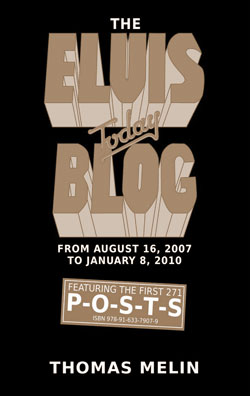
The Elvis Today Blog (book)
By Thomas Melin
274 pp. Blurb. $9.95

The Elvis Today Blog (2011)

The Elvis Today Blog (2011)

Full Disclosure: I wrote a guest post for the Elvis Today Blog back in 2009, and it appears in this book (p. 224). The last thing I want to do is start reviewing my own material, though, so the following review covers the other 99% of this compilation.

Don’t let the title of this book fool you. The Elvis Today Blog is not a book about an Elvis site. Without a doubt, The Elvis Today Blog is a book about Elvis.

However, it turns out that The Elvis Today Blog is also a book about us – modern Elvis fans.

By relating his personal experiences, author Thomas Melin crafts a unique volume that follows the triumphs and trials of being an Elvis fan in the post-1977 era.

“Sometimes it just hits me how much I love Elvis music and what a great feeling I get from listening to it,” writes Melin in “The Wonder Of Elvis” (p. 56), one of his best entries. “On the highway I put the fourth CD from the Today, Tomorrow & Forever box set in the car stereo and there was ‘See See Rider’ from February 1970 blasting through the speakers. It’s hard to explain what I felt, but I remember thinking ‘Man, I’m gonna listen to Elvis and his music until the very day I die,'” he states.

A major contribution of The Elvis Today Blog is the “Special Moments With FTD” series, Melin’s focus on specific songs released on Sony’s Follow That Dream collectors label for Elvis fans:

  • “Love Me Tender,” Dixieland Rocks (1975) – p. 65
  • “The Sound Of Your Cry,” The Nashville Marathon (1970) – p. 78
  • “You’ll Never Walk Alone,” So High (1967) – p. 92
  • “Mexico,” Out In Hollywood (1963) – p. 107
  • “It’s Easy For You,” The Jungle Room Sessions (1976) – p. 116
  • “Hey Little Girl,” Out In Hollywood (1965) – p. 182
  • “I Just Can’t Help Believin’,” One Night In Vegas (1970) – p. 182
  • “My Boy,” Dixieland Rocks (1975) – p. 183
  • “Young And Beautiful,” Elvis On Tour: The Rehearsals (1972) – p. 238
  • “Suspicious Minds,” Memphis Sessions (1969) – p. 265

Most notable of the above entries are those dealing with “You’ll Never Walk Alone,” “It’s Easy For You,” and “Suspicious Minds,” where the author uses powerful descriptions to take you inside the various studios to watch Elvis at work.

Modern Elvis fans aren’t just listening to records and CDs, though. They also enjoy listening to Elvis on their iPods or other portable music devices. “I too like buying and collecting CD’s, reading the liner notes and listening to the tracks on my stereo. But that doesn’t stop me from downloading the music into my iPod and taking it with me whenever I’m traveling somewhere. To me, that’s the real benefit of owning an iPod, that I always have access to the Elvis Presley catalog, wherever I happen to be,” Melin says (“Ku-u-i-pod,” p. 37).

I don’t normally comment on cover design and page layout of books (unless they are awful), but these elements by Staffan Melin, a brother of the author, warrant special mention. The cover is a creative take-off of the 1975 Elvis Today album cover. The interior page layout makes for easy reading, featuring the Deja Vu Serif Condensed font. Kudos to the designer.

It’s no secret that I’m a huge fan of the web version of the Elvis Today Blog. In fact, I often find inspiration there, and the Mystery Train Elvis Blog would probably not exist in its present form without the Elvis Today Blog’s influence. It has been a joy rediscovering favorite or forgotten posts as I read them in book format.

Needless to say, I’m hoping that Melin releases additional volumes of his Elvis works. One enhancement suggestion I have for the next volume would be to include an index, to make it easier to find all of the references to certain topics. If that could not be done on a large scale, it seems that at least the Labels feature in use on the web version could be converted into a short index for the book version.

Another way to enhance future volumes would be if Melin included supplemental information that was not part of the original blog posts. Using an example from this book, he mentions meeting drummer DJ Fontana (p. 28), who shared some Elvis stories with him. Maybe one or two of those stories could be noted as bonus content.

Those are just minor suggestions, though. The Elvis Today Blog is not only a great book about Elvis, but an essential examination of contemporary Elvis fandom. Highly recommended.

Unraveling the Elvis web

If you spend much time looking for Elvis information on the web, you unfortunately run into some tasteless things. This is not unique to Elvis, of course. Pick any topic, and someone has put some garbage out there about it. That’s fine. Some people like viewing that kind of stuff. They find it “humorous” or “fun.”

Rather than dwell on that, I want to focus today on some of the sites that really get it right when it comes to Elvis.

Elvis Today Blog: This blog was the first to cover Elvis with a personal perspective. No one does it better.

Elvis Session Notes: I’ve wanted to highlight this recording data section of Oven Egeland’s excellent Elvis In Norway site for quite some time. It may very well be the Elvis reference I use most often. A page exists for every year that Elvis recorded. On each of those pages, every officially released take or live version of every song recorded that year is listed alphabetically. Recording location, date, and first release are listed for each track. Seemingly updated almost as soon as each new release becomes available, it’s obvious that this site is a true labor of love. I consult it all the time, especially to enter track information on my Elvis songs in iTunes. I don’t know Egeland, but I’d like to say thanks for providing this valuable service to Elvis fans.

Scotty Moore – The Official Website: Learn more about both Scotty Moore and Elvis on this well-researched site. Be sure to check out the “Guitars” and “Venues” sections in particular.

For Elvis CD Collectors Forum: Learn about and discuss anything and everything Elvis-related – and beyond. The wealth of information provided by some participants is astounding. [Update: Of course, like any open forum, garbage can appear on FECC as well. I included it here because the good far outweighs the bad.]

Speaking of time, I am once again running out of it. Believe it or not, I actually have two reviews in progress, one for a book and the other for a CD. Whichever I finish first will be my next post. TCB.

Memphis! Elvis no stranger to hometown hits

Of those released during his lifetime, Elvis recorded over 100 songs in his adopted hometown of Memphis, Tennessee. Though this represented only 15% of his total output, there is no doubt that many of his greatest recordings originated from Memphis. Below is my personal ranking of his best Memphis songs.

#1 Suspicious Minds (1969)
Worldwide 50 Gold Award Hits, Volume 1

#2 Mystery Train (1955)
For LP Fans Only

#3 Baby, Let’s Play House (1955)
A Date With Elvis

#4 Kentucky Rain (1969)
Worldwide 50 Gold Award Hits, Volume 1

#5 Promised Land (1973)
Promised Land

#6 Good Rockin’ Tonight (1954)
A Date With Elvis

#7 That’s All Right (1954)
For LP Fans Only

#8 In The Ghetto (1969)
From Elvis In Memphis

#9 Any Day Now (1969)
From Elvis In Memphis

#10 Pledging My Love (1976)
Moody Blue

#11 Don’t Cry Daddy (1969)
Worldwide 50 Gold Award Hits, Volume 1

#12 After Loving You (1969)
From Elvis In Memphis

#13 Stranger In My Own Home Town (1969)
From Memphis To Vegas/From Vegas To Memphis [Back In Memphis]

#14 Wearin’ That Loved-On Look (1969)
From Elvis In Memphis

#15 Power Of My Love (1969)
From Elvis In Memphis

#16 Rubberneckin’ (1969)
Almost In Love

#17 Your Love’s Been A Long Time Coming (1973)
Promised Land

#18 Good Time Charlie’s Got The Blues (1973)
Good Times

#19 Way Down (1976)
Moody Blue

#20 It’s Midnight (1973)
Promised Land

#21 Blue Moon (1954)
Elvis Presley

#22 Long Black Limousine (1969)
From Elvis In Memphis

#23 Moody Blue (1976)
Moody Blue

#24 You Asked Me To (1973)
Promised Land

#25 Thinking About You (1973)
Promised Land

Besides being recorded in Memphis, another thing that most of these songs have in common is that their associated albums have not yet received the Classic Albums treatment by Sony’s Follow That Dream collectors label.

In fact, it was wishing for albums such as Promised Land, Moody Blue, From Elvis Presley Boulevard, The Sun Sessions, and From Elvis In Memphis that inspired me to create this list in the first place.

So, if not Memphis, where did Elvis record the most?

Some might guess Nashville, but it turns out that Elvis recorded most often in Hollywood, representing about 275 songs released during his lifetime (around 38% of his total output).

A last bit of trivia, Elvis recorded the song “Memphis, Tennessee” in Nashville, rather than Memphis, so it fails to even qualify for consideration on today’s Memphis list.

Elvis 1967: How Great Thou Art album

How Great Thou Art became Elvis’ first album release of 1967 when it hit record stores that February. The LP, recorded May 1966 in Nashville, featured the following songs:

SIDE 1

  • How Great Thou Art
  • In The Garden
  • Somebody Bigger Than You And I
  • Farther Along
  • Stand By Me
  • Without Him

SIDE 2

  • So High
  • Where Could I Go But To The Lord
  • By And By
  • If The Lord Wasn’t Walking By My Side
  • Run On
  • Where No One Stands Alone
  • Crying In The Chapel (October 1960)

Though he had been nominated ten times in the past, Elvis went on to earn his first Grammy award for the How Great Thou Art album, which won for Best Sacred Performance of 1967. By March 1968, How Great Thou Art had also sold enough copies to earn a gold record.

Billboard article, March 30, 1968

Billboard article, March 30, 1968

After the lean years of 1964 and 1965, arguably the low points of his entire recording career, Elvis fired the opening salvos of what eventually became his comeback during that May 1966 session. How Great Thou Art features many moving performances, perhaps none more so than the title song. It also showcases the raucous energy of “Run On,” a song that rocked more than any of his recent secular efforts.

* * *
Research Sources

  • Elvis Presley: A Life In Music – The Complete Recording Sessions by Ernst Jorgensen, St. Martin’s Press, New York, 1998.
  • Billboard, Vol. 80, No. 13, Billboard Publications, Inc., March 30, 1968.
  • ELVIS: His Life From A To Z by Fred Worth and Steve Tamerius, Wings Books, New York, 1992.

Throughout 2011, The Mystery Train is commemorating the 44th anniversary of 1967. Why? Riders of this train love exploring Elvis’ entire career, not just the 1950s. Find out more here.

The Pacific War Memorial Commission Proudly Presents In Person: Elvis Presley

Today marks the 50th anniversary of Elvis’ benefit concert in Hawaii for the Pearl Harbor USS Arizona Memorial. Below is a repost of a feature I wrote last year about this event.


Elvis was nervous at the start of the show, but the screaming audience has since calmed his fears. Truth is, he learned to use his nervous energy to his advantage on stage years ago. Despite all that has changed in his life, the fuel that powers him continues to be his fans.

This concert is a little different from most of the others, though. This time, he is in Hawaii to raise money for a cause that is very important to him. Colonel has worked out most of the details, of course, including talks with NBC to have the concert aired on TV.

A few songs in now, Elvis glances at his hastily scribbled list to see what is up next. It turns out to be one of his favorites, one sure to get a reaction from the crowd. “Treat me like a fool,” he begins and is met with more yells of approval. He still knows his audience, no matter what anybody says.

After introducing the band and backup singers, it is time for another song. He first heard this Drifters number back in 1954, but didn’t get to record it until he was out of the Army. “It was a night, ooh what a night it was, it really was such a night,” he sings into the microphone.

This time, the audience is a little quiet at first. They don’t know this one as well. No problem, Elvis throws a little leg into it and is instantly rewarded with more cheers. Secretly, he is glad Colonel’s deal fell through and those NBC cameras aren’t here after all. No need to tone this show down.

The year is 1961, and Elvis is in Hawaii to help raise money for the USS Arizona memorial. Just over seven months from now will mark the twentieth anniversary of the December 7, 1941, Japanese sneak attack on Pearl Harbor that plunged the United States into the middle of World War II.

That attack sunk the mighty Arizona, forever entombing over 1,000 officers and crew below the water in the battleship. Yet, a memorial commission established in 1949 is still having trouble finding the money to start construction on a proper tribute to the fallen.

* * *

Though NBC ended up not filming the show, fortunately at least the audio was captured and preserved for us to still hear today. It appears on the 1980 “Silver” boxed set Elvis Aron Presley, which received a CD release in 1998. The sound quality is not great, but it is certainly listenable.

I pulled this set out for the first time in years yesterday and loved hearing this top-notch and exciting concert. It also reminded me that quite some time ago I had set aside a related book for later reading. As is often the case, by the time “later” came, I had forgotten about it.

Elvis In Hawaii by Jerry Hopkins (author of Elvis: A Biography and Elvis: The Final Years) is an oversized book filled with text and photos about Elvis’ various excursions to Hawaii, including this 1961 concert. One of the cool pieces of memorabilia in the book is Elvis’ handwritten set list for the show, which helped inspire today’s post. Interestingly, he originally planned to sing “Doin’ The Best I Can,” a 1960 album cut from G.I. Blues, before scratching it out and replacing it with his 1956 hit “Don’t Be Cruel.”

Of course, Elvis would return to Hawaii a number of times after this show, including the 1973 cancer fund benefit for which the television cameras of NBC and the world were present, Aloha From Hawaii.

USS Arizona Memorial in 2006

USS Arizona Memorial in 2006

The 1961 USS Arizona benefit raised over $50,000 for the memorial as well as turned a spotlight on the issue to encourage contributions from others, including the US Congress. On Memorial Day 1962, the memorial was finally dedicated.

Though no one knew it at the time, the show also marked Elvis’ last live appearance for over seven years until the studio audience tapings of the 1968 ELVIS television special and his full-fledged 1969 Las Vegas shows. Instead, for better or worse, most of the rest of his 1960s career would focus on making movies.

* * *

Elvis knows he could stay on all night and they would stay, but the show is winding down now. He won’t be leaving Hawaii yet, though.

In just a couple of days, he has to start filming a new movie, Blue Hawaii. Though Mr. Wallis once told him it was to be a “drama,” Elvis is no longer so sure of that after reading the script and recording over a dozen songs for the soundtrack back in Hollywood just a few days ago.

Being on stage in Hawaii is a lot better than that stuffy recording studio. “We’d like to do a spiritual song for you, ladies and gentlemen, from our religious album called His Hand In Mine,” he says. “It goes something like this.”

He launches into “Swing Down, Sweet Chariot.” For that moment on stage, all is right in his world.