iTunes Speedway: Race for the Elvis Cup

Elvis Presley is Steve Grayson in SPEEDWAY (1968)

Elvis Presley is Steve Grayson in SPEEDWAY (1968, MGM)

On the iTunes Speedway

Ever since I finished backing up all of my Elvis music to iTunes, I have been wanting to do some number-crunching. I usually rate a song when I first place it on iTunes, using the built-in star ratings of 1-5 (I reserve 0 stars to mean “not yet rated”). I then update the rating, if necessary, whenever the track plays.

For updates, I only allow myself to move the song one star rating in either direction per play. That way, if I am in an extremely bad or good mood, it will not overly influence the rating of a given song.

I now have nearly five years worth of data about how I really feel about the songs within my Elvis collection. This will allow me to determine which individual years and multi-year spans are truly my favorites, at least according to the numbers.

My Picks

Before crunching those numbers, though, I used my heart to answer some basic questions. I thought this would make for an interesting comparison against the iTunes race results.

Favorite Elvis Year: 1970
Top Five Elvis Years: 1970, 1968, 1969, 1957, 1955
Favorite 5-year Elvis Span: 1968-1972
Elvis Decade Ranking: 1970s, 1950s, 1960s

Race for the Elvis Cup: The Rules

For this analysis, I eliminated any years for which I had less than 40 Elvis tracks. This resulted in the removal of 1953 (2 tracks) and 1959 (19 tracks). I also eliminated all non-musical tracks (e.g., “Introductions By Elvis,” “Elvis Talks”).

For each of the remaining 23 years, I determined the average star rating for all applicable tracks. I also determined the percentage of tracks from that year that earned a perfect 5-star rating. For instance, the results for 1956 were:

1956
Total Tracks: 164
Average Rating: 3.91 (out of 5)
Perfect 5-star Tracks: 40.24%

The year with the highest average rating received 23 points on down to the year with the lowest average rating, which received 1 point. I then applied this same logic down the line by year for the percentage rankings for perfect 5-star tracks.

This gave each year a score ranging from a low of 2 to a high of 46. However, there were several ties down the line. The tie-breakers were:

1.) Average Rating (i.e., the tied year with the highest average rating wins the position)
2.) (If necessary) Perfect 5-Star Tracks (i.e., the year with the highest 5-star tracks percentage wins the position)

Victory Lane

The results were interesting. Leading the pack was the year 1968, with a perfect score of 46 points.

Nearly 85% of the Elvis tracks I had from 1968 were connected to the ELVIS television special project in some way, so that definitely helped stack the deck. Among them were “If I Can Dream,” one of my all-time favorite songs, and other tracks from Memories: The ’68 Comeback Special, a stellar album that includes the full June 27, 6 PM “Sit Down” show.

Top Five Elvis Years
#1 1968 (46 points)
#2 1970 (43 points, wins 2nd position over 1969 on Average Rating tie-breaker)
#3 1969 (43 points)
#4 1967 (38 points)
#5 1955 (37 points, wins 5th position over 1957 on Average Rating tie-breaker)

The real surprise for me was 1967 making the Top Five. Highlights for 1967 included the September sessions in Nashville that produced standouts like “Guitar Man,” “You’ll Never Walk Alone,” and “You Don’t Know Me.” In fact, alternate takes from that session, many of which are collected on FTD’s Elvis Sings Guitar Man, helped propel 1967 ahead due to the number of five-star ratings.

1965 came in last place, with a minimal score of 2 points (no surprise there). I was surprised that 1977 (5 points) was not able to overtake 1964 (8 points) and wound up as Elvis’ second-worst year.

5-Year Mission

I was also interested in determining my favorite 5-year span. As noted above, I usually say my favorite Elvis time period is 1968-1972, with 1954-1958 running a close second. How did the numbers match against my picks?

To my surprise, it turned out that my favorite 5-year Elvis span was actually 1966-1970, which came in at a whopping 198 points. 1968-1972 earned a collective 183 points, while 1954-1958 came in at 146 points. In other words, this race was not even close.

I often state that the opening salvos of Elvis’ comeback were actually fired in 1966 during the How Great Thou Art sessions, so perhaps I should have seen this coming. 1969 included the Memphis sessions that produced “Suspicious Minds,” “Kentucky Rain,” and “In The Ghetto,” his return to live performances, and even a strong soundtrack on the Change of Habit film. 1970 featured the That’s The Way It Is project, including the Nashville sessions, the summer rehearsals, and the August live performances.

The five-year span that earned the least points was 1961-1965, with a combined total of only 50, barely more than the single year of 1968.

Elvis Decades

Now, to answer that age-old question, what is your favorite Elvis decade? Though 1964 and 1965 are hard to love, I otherwise enjoy Elvis’ entire career. When pressed, however, I state that my favorite decade is the 1970s. What did the numbers say?

Again, they proved me wrong. The 1950s won out, with an average of 29.2 points. Second place was the 1970s, well behind at an average of 22.88 points. This barely edged out the 1960s, which had an average of 22.3 points.

Elvis professionally recorded during only five years in the 1950s, and the quality of his output was much more consistent in that time than in the 1960s and 1970s. The 1970s were brought way down by outliers like 1977 (5 points) and 1974 (10 points), while the same occurred for the 1960s with 1965 (2 points), 1962 (8 points), and 1964 (8 points). However, even the 1950s had its own outlier of 1958 (10 points).

Awarding the Elvis Cup

The analytical side of my personality loved reviewing these numbers. The emotional side of me, though, still believes that 1970 is my favorite Elvis year, no matter what iTunes says.

For me, feelings always rule out in the end, so the Elvis Cup is hereby awarded to 1970, the reigning champion.

We can solve the mystery if we try

Frequent commenter Ray Faithfull recently emailed me the following mystery:

I watched a clip posted on facebook for the song “We Can Make The Morning”….then it dawned on me that it was longer than the Now album release and the FTD release by almost 30 seconds..I figured you would be the person to go to for some insight as to how many takes of this song were actually done and what and where have they been released??

Was take 1 the master take that went for over 4:30 and was simply faded at 3:48 for the final cut ??

I have included the link to the video i am referring to with the version i had not heard or at least not completely?? http://www.youtube.com/watch?v=GGIMKq-qwOM

Though I did not know the answer right off the top of my head, Ray had obviously placed a lot of faith in me (no pun intended . . . I think), so I felt compelled to research this for him.

First, I checked iTunes, where I have meticulously cataloged every unique Elvis track I own. To my surprise, the only version of “We Can Make The Morning” I have is the master recording, as released on Elvis Now.  My iTunes version of the 1971 track, sourced from the circa-2007 Vic Anesini remastering effort as released on Elvis: The Complete Masters Collection, clocks in at 3:59. However, the last five seconds of that are silence.

"We Can Make The Morning" on iTunes

“We Can Make The Morning” on iTunes

I pulled out my vintage 1972 vinyl edition of the Elvis Now album, and it indicated a run time of 3:54 for “We Can Make The Morning.” So, I had approximately six seconds more song than Ray’s 3:48 source, but nowhere near the 4:44 of the YouTube video. Though I am fairly obsessive about obtaining alternate takes of songs that Elvis formally recorded between 1969 and 1976, I certainly do not own every Elvis release. Perhaps this extended version was on an album I did not have.

Checks of the Elvis Now FTD edition liner notes and Ernst Jorgensen’s essential Elvis Presley: A Life In Music – The Complete Recording Sessions book provided no useful information in this case. Next, I went to my favorite source for alternate take information, the incredible Elvis Recording Data/Session Notes section of the Elvis In Norway site. There, I also found only one entry for “We Can Make The Morning,” the master recording (B-side single), with time listed as 3:54.

I only collect official releases, so my next thought was that the 4:44 version might be from a bootleg. Elvis In Norway’s Session Notes section fortunately does not muddy the water by including those, so I went to another reliable source that does incorporate bootleg information, the Recording Sessions section of Keith Flynn’s Elvis Presley Pages site.

There I found three matches for “We Can Make The Morning”:

A note on the May 20 / 21 page indicates, “Tape reel #2 from this session is missing, and this is the reel that would have included […] the outtakes of We Can Make The Morning,” so that effectively ruled out an alternate take of the song.

The undubbed master has apparently never been released, nor has the May 25 string overdubs version. Only the completed June 21 version, with overdubbed brass and strings, has been released (i.e., the one from Elvis Now).

However, the site lists the track as 4:11. That’s 17 seconds closer to 4:44, but still not enough. The 4:11 version of the song was released on the bootleg Unedited Masters: Nashville 1971 by the Venus label. There, “We Can Make The Morning” is listed as the “unedited, overdubbed master.” I do not have the album to verify whether the track fades at the end but, assuming the Venus information is correct, that leaves at least 33 unaccounted seconds that are in the video.

After all of this, I finally decided to take a listen to the YouTube video, which had been created by a fan. The visual imagery, interspersing photos of Elvis in life with photos of fans at candlelight vigils in the years after his death, was not to my liking, so I stopped paying attention to the video and just listened to the audio. Not only did it go to 4:44, but the song had not even fully faded at that point.

What was going on here? Though I did not detect anything the first time through, my guess was that a portion of the song had been re-looped somewhere (i.e., a part of the recording had been replayed to artificially make the song longer). On my second listen to the 4:44 video, I played the Elvis Now version at the same time. Whatever potential monkey business had occurred within the song was definitely happening near the end.

My third and fourth listens revealed that 3:28 in the video is a repeat of 2:48. For example, listen how Elvis draws out “night” at 3:33, which is an exact duplicate of how he sings it at 2:53 in the video.

Essentially, someone has artificially added at least 40 seconds to the audio track on the “We Can Make The Morning” YouTube video by repeating a portion of the song – most likely to suit the purposes of the photo montage. Other than the abrupt ending, the audio editing is actually quite seamless. However, I will stick with the original version.

Thanks for the great question, Ray, and for inspiring today’s post.

Case closed.

Close-up of ELVIS NOW back cover (1972)

Close-up of ELVIS NOW back cover (1972)

REVIEW: Elvis – The Complete Masters Collection (Part 6)

This is Part 6 of an occasional series reviewing Elvis: The Complete Masters Collection. Read Part 5.


CD Vol. 8: Country Roots

This volume of The Franklin Mint‘s 36-disc Elvis: The Complete Masters Collection (mastered by Vic Anesini) presents songs that the booklet describes as follows:

“Elvis’ renditions of some of the biggest country songs ever. His tribute to country music and the legends who created it: Hank Williams, Red Foley, and many others.”

This sounds like a potential winner to me, but let’s see how it plays out.

Elvis: The Complete Masters Collection - Volume 8

Elvis: The Complete Masters Collection – Volume 8

01. I Love You Because: Of the 21 songs that make up this CD, the compiler could not have made a choice worse than “I Love You Because” to use as the lead-off track. When Elvis Presley made this recording at SUN Records in 1954, owner and producer Sam Phillips wisely rejected it. Shortly thereafter, Elvis, bassist Bill Black, and guitarist Scotty Moore “stumbled upon” the rock ‘n’ roll sound when horsing around with “That’s All Right.” Unfortunately, RCA Records – beginning a trend that would last for the rest of Elvis’ life – dug “I Love You Because” out of the rejects pile and issued a spliced version in 1956 not only on the Elvis Presley LP but as the A-Side of a single! The single failed to chart, and this recording is of interest only as a historical curiosity. (Recorded: 1954)

02. Blue Moon Of Kentucky: “Blue Moon Of Kentucky,” on the other hand, is a perfect representation of “Elvis Country.” A rhytym & blues-infused take on a country/bluegrass song, “Blue Moon Of Kentucky” served well as the B-Side of “That’s All Right” (a country-infused take on a rhythm & blues number). In some markets, “Blue Moon Of Kentucky” was more popular than the A-Side – likely because the song was a little more conventional for those audiences than the comparatively wild “That’s All Right.” (Recorded: 1954)

03. I’ll Never Let You Go: “I’ll Never Let You Go” is another 1954 SUN reject that RCA issued in 1956 on the Elvis Presley LP and as an A-Side single. While not stellar, this one is far more listenable than “I Love You Because.” This one features a slow start before eventually speeding up – a precursor of what Elvis would do not only on “Milkcow Blues Boogie” later that year, but also on live versions of “Hound Dog” years later in 1972. (Recorded: 1954)

04. How’s The World Treating You: “How’s The World Treating You” is a decent recording by Elvis. This one is slow and sleepy, as with the beginning of “I’ll Never Let You Go.” Unlike that track, however, this one stays slow and sleepy. (Recorded: 1956)

05. Old Shep: Elvis had been singing Red Foley’s “Old Shep” since childhood before he formally recorded it in September 1956. As a dog-lover, I find this melodramatic yet effective song hard to listen to at certain points in my life – depending on how my dog is doing at the time. I take these things to heart. A great, classic Elvis recording. (Recorded: 1956)

06. Your Cheatin’ Heart: I love Elvis’ take on Hank Williams’ “Your Cheatin’ Heart,” though I slightly prefer a more enthusiastic alternate take over this master. It would be years before Elvis made such an overtly country recording again. (Recorded: 1958)

07. A Fool Such As I: There is very little country left in Elvis’ iconic version of “A Fool Such As I,” a song that had been previously recorded by Hank Snow. (Recorded: 1958)

08. It’s A Sin: “It’s A Sin” was first recorded by Eddy Arnold in 1947. Elvis’ version is pretty, but a little lethargic for my tastes. (Recorded: 1961)

09. Just Call Me Lonesome: In addition to the How Great Thou Art sessions, another early sign of the comeback was Elvis returning to country music. “Just Call Me Lonesome” is a great representative of that return. What I love about “Elvis Country” is that instead of whining sounds sometimes associated with the genre, Elvis usually provides velvet vocals. (Recorded: 1967)

10. You Don’t Know Me: Elvis’ moving rendition of Eddy Arnold’s “You Don’t Know Me” was unfortunately buried on the Clambake soundtrack album. The first version I ever heard of “You Don’t Know Me” was actually by Ray Charles. The first time I heard it, in the original theatrical cut of Groundhog Day, I remember wishing that Elvis had recorded it. I was pleasantly surprised a few years later when the unknown-to-me Elvis recording surfaced on From Nashville To Memphis: The Complete 60s Masters I. Incidentally, Elvis also recorded a different version of “You Don’t Know Me” for the Clambake movie, but it is far inferior to this re-recording and was not released until after his death (other than in the actual movie). (Recorded: 1967)

11. I’m Movin’ On: Next up are some songs recorded at American Sound Studios in Memphis in early 1969, not long after the successful airing of the ELVIS television special. At first, “I’m Movin’ On” sounds a little too country, but then Elvis rocks into it to produce a spectacular version. (Recorded: 1969)

12. I’ll Hold You In My Heart (Till I Can Hold You In My Arms): “I’ll Hold You In My Heart” is an appealing little song that Elvis sings into the ground, ultimately going nowhere. (Recorded: 1969)

13. After Loving You: One of the huge highlights of the American sessions, “After Loving You” features the “new” Elvis at his best. Elvis had been playing around with this song at home for years, even taking a stab at piano on an earlier take at this session before giving up the keys. One of the best recordings of his career. (Recorded: 1969)

14. It Keeps Right On A-Hurtin’: “It Keeps Right On A-Hurtin'” is another pretty song that really does little to stand out among Elvis’ stellar 1969 recordings. (Recorded: 1969)

15. Little Cabin On The Hill: Versions of the next five songs were featured on the 1971 album I’m 10,000 Years Old: Elvis Country, often considered one of his finest. However, these mixes and edits are actually from the 1995 Walk A Mile In My Shoes boxed set. They do not match the original masters from Elvis Country. Here, Elvis launches into a Bill Monroe impersonation he had been fooling around with since at least 1956, as evidenced by the Million Dollar Quartet jam session. Good stuff. (Recorded: 1970)

16. I Really Don’t Want To Know: Elvis owns “I Really Don’t Want To Know,” one of the best on Elvis Country or any of his other albums. I love the piano work on this one by David Briggs. (Recorded: 1970)

17. Faded Love: I much prefer the shorter edit of “Faded Love” as released during Elvis’ lifetime than this overly long 1995 version. Anyway, Elvis does a fine, if forgettable, job on the Bob Wills classic. (Recorded: 1970)

18. Tomorrow Never Comes: Elvis delivers one of his most powerful performances on “Tomorrow Never Comes.” The song starts softly and slowly builds into a breathtaking, accusatory crescendo that Elvis actually had to re-record as an insert. Again, one of the very best songs of his career. (Recorded: 1970)

19. Make The World Go Away: I love hearing Elvis’ version of well-known songs, and “Make The World Go Away” is no exception. That voice. You gotta listen to James Burton on guitar on this one, too. Burton helped define the sound of Elvis’ final decade, and it is no wonder Elvis was reluctant to take the stage without him. (Recorded: 1970)

20. Green, Green Grass Of Home: I first heard Elvis’ version of “Green, Green Grass Of Home” on an RCA cassette tape I had in the 1980s called Elvis Country, one of two tapes by that name I owned – both of which had completely different lineups from each other as well as his 1971 album of the same name. Though recorded five years later for the Today sessions, this song would have fit in well on the real Elvis Country album as well. As with the much-maligned “My Boy,” this is the kind of dramatic song that often spoke to Elvis and that I, for one, enjoy hearing him sing. (Recorded: 1975)

21. Are You Sincere: Coming right after “Green, Green Grass Of Home,” Elvis’ voice sounds comparatively weaker on “Are You Sincere.” This goes against conventional Elvis wisdom, as this one was recorded two years earlier. They were recorded in different studios with different equipment, so any number of factors could be involved. Still, “Are You Sincere” is a worthy performance, first released on his 1973 album Raised On Rock. (Recorded: 1973)

While it contains a number of terrific country songs, the individual parts of this CD do not add up to a high-quality whole. Whether due to kicking off with the lackluster “I Love You Because” or the uneveness of the remaining selections, Country Roots never takes off as a compilation. Instead, it feels more random than anything else.

[Read Part 7.]


New and upcoming Elvis releases focus on slices of a diverse career

Get those sound systems (and wallets) ready, folks, new Elvis releases are on the way.

Stay Away, Joe

Stay Away, Joe (concept cover art)

May 2013

Follow That Dream Records, Sony’s collectors label for Elvis fans, is releasing this month:

  • From Elvis In Memphis (2-CD): One of Elvis’ best albums finally receives the FTD Classic Album treatment. This should make an excellent companion to the recent Back In Memphis release. Surely an “imaginary album” will be in the works at some point to feature the rest of the recordings from the 1969 American Sound Studio sessions.
  • Stay Away, Joe (CD): Speaking of imaginary albums, here is one that compiles October 1967 and January 1968 sessions. In addition to the Stay Away, Joe soundtrack, it includes “Too Much Monkey Business” and “US Male.” The January session features Jerry Reed on guitar, which is why I consider this a follow-up of sorts to the fantastic Elvis Sings Guitar Man.
  • On Stage-February 1970 (2-LP): This vinyl release includes the original On Stage-February 1970 album, recorded live in 1969 and 1970, as well as additional material Elvis recorded during his early 1970 Las Vegas engagement.
  • Summer of ’61 (Book & CD): In conjunction with Flaming Star publications, this book primarily focuses on the making of the movie Follow That Dream. A brief CD containing previously released Elvis tracks and two demos for “What A Wonderful Life” is also included.

June 2013

FTD has scheduled the following for release in June:

  • Sold Out! (2-CD): The ambiguous title of this one could refer to almost any Elvis concert from 1956 and beyond. [May 19, 2013, Update: The concerts on this release will be March 1, 1974, Tulsa, Oklahoma and June 21, 1974, Cleveland, Ohio.] This one is from the creative team behind Forty-Eight Hours To Memphis: Recorded Live On Stage In Richmond, Virginia – March 18, 1974 and 3000 South Paradise Road, so a quality presentation is expected.
  • Hot August Night (CD): This one features the August 25, 1969, Midnight Show in Las Vegas. The 1969 shows are all must-haves. Portions of this one contributed to the From Memphis To Vegas/From Vegas To Memphis (Elvis In Person) release in 1969. Many tracks are previously unreleased, however.
  • Elvis Recorded Live On Stage In Memphis (2-LP): This vinyl release features the complete March 20, 1974, Memphis concert, from which selections made up the original 1974 version of this album. I have to admit, I enjoy the truncated version of this show more than the full version. Other than “Steamroller Blues,” the songs edited out of the 1974 1-LP release featured some disappointing performances by Elvis.
  • Best of British: The HMV Years (Book): This is a reprint of the popular book exploring Elvis’ 1956-1958 releases on the HMV label in Great Britain, which sold out upon release in February. Though not noted in the press release, presumably the two CDs of previously released Elvis material from the original printing are also included.

The only physical store in the US authorized to sell FTD releases is Good Rockin’ Tonight, a Graceland gift shop in Memphis. However, FTD products may be obtained online from a variety of other Elvis stores, including Graceland’s ShopElvis.com.

August 2013

Sony has scheduled Elvis At Stax: Deluxe Edition, a 3-CD boxed set, as a main label, wide release in August. The set will include all of the masters Elvis recorded in Memphis at Stax Recording Studio in July and December of 1973. It will also include alternate takes of many of the songs. Here is the track listing:

DISC 1: The R&B and Country Sessions – The Outtakes

1. I Got A Feelin’ In My Body – take 1
2. Find Out What’s Happening – take 8/7
3. Promised Land – take 4
4. For Ol’ Times Sake – take 4
5. I’ve Got A Thing About You, Baby – take 14
6. It’s Midnight – take 7
7. If You Talk In Your Sleep – take 5
8. Loving Arms – take 2
9. You Asked Me To – take 3A
10. Good Time Charlie’s Got The Blues – take 8
11. Talk About The Good Times – take 3
12. There’s A Honky Tonk Angel – take 1
13. She Wears My Ring – take 8
14. Three Corn Patches – take 14
15. I Got A Feelin’ In My Body – take 4
16. If You Don’t Come Back – take 3
17. Promised Land – take 5

DISC 2

Part 1 – The Pop Sessions – The Outtakes

1. Mr. Songman – take 2
2. Your Love’s Been A Long Time Coming – take 4
3. Spanish Eyes – take 2
4. Take Good Care Of Her – takes 1,2,3
5. It’s Diff’rent Now (unfinished recording)
6. Thinking About You – take 4
7. My Boy – take 1
8. Girl Of Mine – take 9
9. Love Song Of The Year – take 1
10. If That Isn’t Love – take 1

Part 2 – The July 1973 Masters

11. Raised On Rock
12. For Ol’ Time Sake
13. I’ve Got A Thing About You, Baby
14. Take Good Care Of Her
15. If You Don’t Come Back
16. Three Corn Patches
17. Girl Of Mine
18. Just A Little Bit
19. Find Out What’s Happening
20. Sweet Angeline

DISC 3: The December 1973 Masters

1. Promised Land
2. It’s Midnight
3. If You Talk In Your Sleep
4. Help Me
5. My Boy
6. Thinking About You
7. Mr. Songman
8. I Got A Feelin’ In My Body
9. Loving Arms
10. Good Time Charlie’s Got The Blues
11. You Asked Me To
12. There’s A Honky Tonk Angel
13. Talk About The Good Times
14. She Wears My Ring
15. Your Love’s Been A Long Time Coming
16. Love Song Of The Year
17. Spanish Eyes
18. If That Isn’t Love

I have mixed feelings on this release. I think it is wonderful for the main label to focus on an overlooked period in the recording career of Elvis Presley. For those fans who do not already have the corresponding FTD Classic Album 2-CD sets (Raised On Rock, Good Times, and Promised Land), this is an excellent, budget-conscious alternative to hear highlights of this material.

However, the first thing I noticed is that Sony really blew the sequencing of these tracks. Why, oh, why would the compiler of this collection choose to kick things off with the dreadful “I Got A Feelin’ In My Body”? Especially when “Promised Land” is sitting there, practically begging to begin this set in the right manner?

Short of starting from scratch, one simple alternative that I can suggest would be the following:

  • Swap Disc 1 with Disc 3
  • Swap Disc 2 – Part 1 with Disc 2 – Part 2

Just making the simple changes above would result in a much better listening experience from start to finish. Again, it is great to see a release focusing on 1973, but it should not just be grudgingly thrown together. While Sony’s Elvis team may disagree, some of us love this material. Treat it right.

Sony is also releasing in August a 1-CD version and a 2-LP version collecting some of the above Stax material.

3,510: An Elvis Obsession

In 2008, I obtained my first iPod. I didn’t think much would come of it because I mostly listened to CDs. Once I had that iPod in my hands, though, an obsession slowly took hold. I found that listening to Elvis in shuffled mode gave me a much broader view of his career than simply relying on whatever CD I happened to spin. Over time, it also allowed me to rediscover songs from CDs that I otherwise did not play very often.

I have been collecting Elvis music since 1987 and have purchased hundreds of his CDs. The iPod has allowed me to truly experience the power of that collection, rather than just having it sit on a shelf.

In iTunes, I created a series of smart playlists to make various shuffle themes for my iPod. I think of these as my own private radio stations. They are not completely random, as I build out the smart playlists with certain rules.

For example, one of the rules in my Elvis Mix avoids 1-star songs. I only want to hear those in the context of their original albums.

In my Best Mix, I have Elvis set to play about 10% of the time. Otherwise, he would dominate that list due to how many Elvis songs I have. I also control the percentages of songs in certain genres that play. I tweaked this through the years until I made a Best Mix shuffle that suits my quirky taste.

Over time, I slowly began backing up more of my Elvis collection to iTunes. By May 2010, I had over 1,200 Elvis songs in iTunes for my iPod. This included the 711 masters released during his lifetime. At that point, rather than continuing to pick and choose from my CDs, I decided to go back and back up every unique track from every Elvis CD I owned.

I began on June 1, 2010, and figured I would be finished by the end of that year.

I finished yesterday, March 15, 2013.

This extended time period was not due to lack of diligence on my part. In fact, if anything, I have been too diligent. With only a few breaks, this has consumed more of my spare time over the last few years than I care to admit. Other things that I could have been doing, such as writing, have suffered.

So, why did it take me so long? For one thing, it turns out that I have many more Elvis songs than I realized.

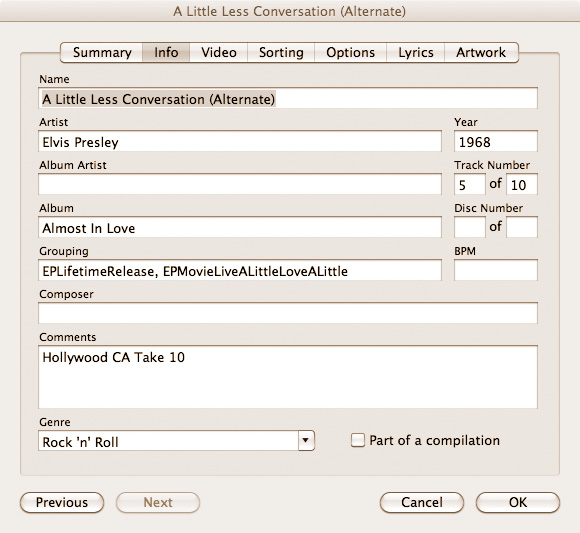
I also did not simply throw in each CD, allow iTunes to look up the track names, and be done with it. If only it had been that easy. The first feature I turned off was the auto-look-up of track names, because I found this often had errors or formatting inconsistencies. Instead, I hand-typed all of that stuff in. If there were going to be errors, at least they would be my errors.

iTunes "Get Info" window

iTunes “Get Info” window

For each song, I researched its first album appearance and other tidbits, such as recording location and take number. For this, I primarily used the comprehensive Elvis Recording Data/Session Notes section of the Elvis In Norway site.

For live songs and other tracks without clean breaks in between, I added fade-ups and fade-downs. I also removed any uninteresting “false starts” and chatter from studio outtake/alternate tracks. When a false start proved to be of interest, I split it out to its own separate track.

Along the way, I also replaced those 711 core masters with new versions in better sound quality.

After all of that, I have 3,510 unique Elvis tracks, representing nearly 160 hours of music.

In an amazing coincidence that I really cannot believe, it turns out that I also have exactly 3,511 non-Elvis tracks backed up to iTunes, representing 208 more hours of music. I have often said Elvis represents about half of the tracks on my iPod, but I had no idea that was so precise. Over time, the non-Elvis tracks will likely grow at a faster rate now than the Elvis ones, though. [However, I am not going to start a similar project for my non-Elvis CDs. Never again.]

To keep my smart playlists working the way I like, I also rated each track. The analytical side of me has all kinds of number-crunching ideas around this, but here is a fun breakdown for starters:

  • 5 Stars: 938 tracks (27%) [example: “Always On My Mind” (1972)]
  • 4 Stars: 909 tracks (26%) [example: “It’s Now Or Never” (1960)]
  • 3 Stars: 853 tracks (24%) [example: “Love Me Tender” (1956)]
  • 2 Stars: 556 tracks (16%) [example: “Wear My Ring Around Your Neck” (1958)]
  • 1 Star: 254 tracks (7%) [example: “A Dog’s Life” (1966)]

It astonishes me that, thanks to my iPod, I can now fit the entirety of my Elvis music collection in the palm of my hand. I can literally take it with me anywhere and listen to any song at any time.

Elvis in iTunes

Elvis in iTunes

With those 3,510 tracks, I could listen to Elvis for six days straight, without sleeping, and never hear a repeated track.

I would never do that, though. I am not that obsessive of a person.

The fact that my next post will be coming out in about six days is a complete coincidence.

Honest.

Elvis Live Wire: Ernst Jorgensen acquires “I Forgot To Remember To Forget”

Silvertone wire recording of Elvis Presley

Silvertone wire recording of Elvis singing “I Forgot To Remember To Forget”

One of the feel-good Elvis stories of 2012 will have an encore after all. Audio collector amberola1b, who discovered a 1955 live recording of Elvis singing “I Forgot To Remember To Forget” on the Louisiana Hayride radio program, recently remarked that he has sold the recording to Ernst Jorgensen. Jorgensen heads up Sony Music’s Elvis team and helms their Follow That Dream collectors label. This means, at some point, there will undoubtedly be an official release of this incredible find.

Last July, amberola1b caused a sensation among Elvis fans when he briefly posted the recording on YouTube, without being aware that it was so unique. Sourced from a Silvertone wire recording, the performance had never been heard by the public since the original broadcast.

Elvis appeared on the Hayride about fifty times from 1954 to 1956. Though similar to Nashville’s Grand Ole Opry, the show was more receptive to new talent – including Elvis’ groundbreaking style. Compared to most of the other Hayride recordings released in the past, the audio quality on “I Forgot To Remember To Forget” was stunning.

The discovery made headlines on the eve of the release of the Elvis masterpiece A Boy From Tupelo: The Complete 1953-1955 Recordings, Ernst Jorgensen’s book and music project covering the SUN years. A Boy From Tupelo included several other recordings from the Louisiana Hayride, but “I Forgot To Remember To Forget” was found too late for consideration. “Wow – it’s unbelievably beautiful. I’m still trying to recover from the shock,” Jorgensen said at the time.

Audio grabs of amberola1b’s YouTube video have appeared on a couple of “gray market” releases, but a professional transfer from the wire, properly mastered, should yield much more impressive sound quality.

On January 12, amberola1b posted the following comments on YouTube about his interaction with Jorgensen:

“I did sell the rights to him but the way it went was that I didn’t even know Ernst and was directed to him thru other utubers that were Elvis fans. I didn’t even know there was a big anniversary album or book being put together about The King, I just merely decided at that moment in time to do the utube video, and just happen to post it during the summer. If luck had been on my side and I had known about what was being planned […] I would have made the video months before, and it would have been included in the album that was included in the book ‘A Boy From Tupelo’. But as it turned out he sent me a copy of the book and it just blew my mind to see all the wonderful pictures that had been compiled of Elvis and the stories written about him.”

[Thank you to Greg1995 on the For Elvis CD Collectors Forum, who first posted about amberola1b’s recent confirmation of the sale.]


I only listened to the live “I Forgot To Remember To Forget” once. It was so incredible, I knew I wanted to wait for an official release. Out of respect for amberola1b, I also never posted links to the multiple copies of this video that showed up after his original post (I made an exception for the copied version in the story linked above, since that is where he chose to post his comments).

I’m thrilled that Jorgensen has acquired this fantastic discovery. So, to amberola1b: Thank you for making a deal that will allow Elvis fans to hear this recording in the best sound quality possible for generations to come.

So, the question is, what should Jorgensen do with this recording now that he has it?

Ideally, this would be a terrific opportunity for Sony to release a mainstream version of A Boy From Tupelo, which was a limited run on the FTD collectors label. Every Elvis and rock ‘n’ roll fan should have the opportunity to own A Boy From Tupelo – one of the most important Elvis releases since his death in 1977. Scooting the two interviews over to the end of Disc 2 would free up enough space for “I Forgot To Remember To Forget” to join the other Hayride performances on Disc 3.

If a full-blown re-release of A Boy From Tupelo is not possible for some reason, I think 2013 or 2014 would be the perfect time for a 2-CD set on the main Sony label covering 1953-1955. After all, 2013 marks the 60th anniversary of Elvis paying to record his first demo (“My Happiness” b/w “That’s When Your Heartaches Begin”), while 2014 marks the 60th anniversary of his first professional release (“That’s All Right” b/w “Blue Moon Of Kentucky”).

For fun, here’s how I would approach such a 2-CD set.

Elvis Begins: The 1953-1955 Recordings

Disc 1

  1. That’s All Right (45 RPM SUN single version)
  2. Blue Moon Of Kentucky (45 RPM SUN single version)
  3. Good Rockin’ Tonight
  4. I Don’t Care If The Sun Don’t Shine
  5. Milkcow Blues Boogie (78 RPM SUN single version)
  6. You’re A Heartbreaker (78 RPM SUN single version)
  7. Baby, Let’s Play House
  8. I’m Left, You’re Right, She’s Gone
  9. I Forgot To Remember To Forget
  10. Mystery Train
  11. Harbor Lights
  12. I Love You Because
  13. Blue Moon
  14. I’ll Never Let You Go
  15. Just Because
  16. Tryin’ To Get To You
  17. My Happiness (Demo)
  18. That’s When Your Heartaches Begin (Demo)
  19. I’ll Never Stand In Your Way (Demo)
  20. It Wouldn’t Be The Same Without You (Demo)
  21. Harbor Lights (Take 7)
  22. I Love You Because (Take 3)
  23. I Love You Because (Take 5)
  24. That’s All Right (Takes 1, 2)
  25. That’s All Right (Take 3)
  26. Blue Moon Of Kentucky (Take 3)
  27. Blue Moon (Take 4)
  28. Blue Moon (Take 5)
  29. Blue Moon (Take 8)
  30. Tomorrow Night (Undubbed/unedited version)
  31. That’s All Right (Live-Shreveport, LA-October 16, 1954)
  32. Blue Moon Of Kentucky (Live-Shreveport, LA-October 16, 1954)

Disc 2

  1. I’m Left, You’re Right, She’s Gone (Slow version, Take 1)
  2. I’m Left, You’re Right, She’s Gone (Slow version, Take 2)
  3. I’m Left, You’re Right, She’s Gone (Slow version, Take 3)
  4. I’m Left, You’re Right, She’s Gone (Slow version, Take 5)
  5. I’m Left, You’re Right, She’s Gone (Slow version, Take 6)
  6. Shake, Rattle & Roll (Demo-Lubbock, TX-January 6, 1955)
  7. Fool, Fool, Fool (Demo-Lubbock, TX-January 6, 1955)
  8. Hearts Of Stone (Live-Shreveport, LA-January 15, 1955)
  9. That’s All Right (Live-Shreveport, LA-January 15, 1955)
  10. Tweedlee Dee (Live-Shreveport, LA-January 15, 1955)
  11. Money Honey (Live-Shreveport, LA-January 22, 1955)
  12. Blue Moon Of Kentucky (Live-Shreveport, LA-January 22, 1955)
  13. I Don’t Care If The Sun Don’t Shine (Live-Shreveport, LA-January 22, 1955)
  14. That’s All Right (Live-Shreveport, LA-January 22, 1955)
  15. Tweedlee Dee (Live-Shreveport, LA-March 5, 1955)
  16. Money Honey (Live-Shreveport, LA-March 5, 1955)
  17. Hearts Of Stone (Live-Shreveport, LA-March 5, 1955)
  18. Shake, Rattle & Roll (Live-Shreveport, LA-March 5, 1955)
  19. Little Mama (Live-Shreveport, LA-March 5, 1955)
  20. You’re A Heartbreaker (Live-Shreveport, LA-March 5, 1955)
  21. Good Rockin’ Tonight (Live-Houston, TX-March 19, 1955)
  22. Baby, Let’s Play House (Live-Houston, TX-March 19, 1955)
  23. Blue Moon Of Kentucky (Live-Houston, TX-March 19, 1955)
  24. I Got A Woman (Live-Houston, TX-March 19, 1955)
  25. That’s All Right (Live-Houston, TX-March 19, 1955)
  26. How Do You Think I Feel (1955 version, Take 1)
  27. Tweedlee Dee (Live-Gladewater, TX-April 30, 1955)
  28. That’s All Right (Live-Meridian, MS-May 26, 1955)
  29. I’m Left, You’re Right, She’s Gone (Live-Shreveport, LA-July 2, 1955)
  30. Baby, Let’s Play House (Live-Shreveport, LA-August 20, 1955)
  31. Maybellene (Live-Shreveport, LA-August 20, 1955)
  32. That’s All Right (Live-Shreveport, LA-August 20, 1955)
  33. I Forgot To Remember To Forget (Live-Shreveport, LA-October 1, 1955)
  34. When It Rains, It Really Pours (1955 version, Take 5)
  35. When It Rains, It Really Pours (1955 version, Take 8)

FTD elevates Back In Memphis to essential status

Last month, Sony’s Follow That Dream collectors label for Elvis fans released its Classic Album version of Back In Memphis. With the holidays over, I’ve finally had some time to listen to this 2-CD set.

Back In Memphis, 2012 FTD Edition

Back In Memphis, 2012 FTD Edition

Original Album

Elvis loved Memphis, and no matter which of his eras you reference, he made some of his best music there.

The original Back In Memphis album was actually a 1970 re-release of Record 2 of the 1969 2-LP set From Memphis To Vegas/From Vegas To Memphis. Record 1 of that set was also re-released in 1970, as Elvis In Person.

Back In Memphis was a follow-up to the impeccable From Elvis In Memphis, recorded during the same 1969 sessions at American Sound Studio in Memphis. Unfortunately, the results were not nearly as strong.

In fact, Back In Memphis was one of the only disappointments I encountered in my first few years of collecting Elvis music. I was a huge fan of The Memphis Record, a 1987 retrospective album for the American sessions – compiling the entirety of From Elvis In Memphis, most of the singles, and selections from Back In Memphis.

While sound quality has come a long way since then, The Memphis Record was definitely a huge influence on me becoming the borderline obsessive Elvis fan I am today. I couldn’t wait to hear the remaining songs when RCA re-released Back In Memphis in the early 1990s on CD.

It turned out, though, that every “new-to-me” song on the album (i.e., those that weren’t on The Memphis Record) bordered on horrible. A bad Elvis CD, and from 1969 at that… I was shocked. I rarely played it.

Since that time, I’ve come to appreciate at least one of those Back In Memphis recordings that I initially hated: “Do You Know Who I Am,” which is a beautiful song.

If I play Back In Memphis these days, I prefer to kick it off by playing Elvis In Person. To me, Back In Memphis holds up better as Record 2 of a 2-LP set than it does as a stand-alone title. Elvis In Person, on the other hand, is powerful enough on its own.

Back In Memphis begins with “Inherit The Wind,” a great song written by Eddie Rabbitt – who also wrote “Kentucky Rain.” While I enjoy “Inherit The Wind,” I do not believe it was a good choice for first song.

Up next is “This Is The Story,” which sounds like a leftover – leading to an abysmal feeling for the beginning of Back In Memphis.

Fortunately, “Stranger In My Own Home Town” revs things into high gear. This is one of Elvis’ best performances from the American sessions, and it should have been the lead-off song for Back In Memphis. In fact, RCA wisely used it to kick off The Memphis Record. Say what you will about the sound, The Memphis Record had flawless sequencing.

Back In Memphis downshifts into low gear again with “Just A Little Bit Of Green.” Though better than “This Is The Story,” this is still lesser material. Elvis’ performance, as with just about everything he touched in 1969, is commendable, but the song itself is simply not worthwhile.

“Side 1” of the original album closes out with a real stinker, Neil Diamond’s “And The Grass Won’t Pay No Mind.” This is one of the few Elvis songs that I find nearly unlistenable. Keep in mind that this is coming from a guy who is a fan of “Old MacDonald.” To say that I give Elvis songs the benefit of the doubt is an understatement. This one is horrible, by far the worst on the album.

“Side 2” kicks off with “Do You Know Who I Am,” a very moving performance that always gets to me when I take the time to feel the words.

“I remember you said that you had to forget about me and be free. Do you know who I am, or have you forgot about me?”

Then we are back to sub-mediocre material with “From A Jack To A King.” Perhaps better than a typical movie song, but not by much.

Back In Memphis finishes strong, though. “The Fair’s Moving On,” “You’ll Think Of Me,” and, to a lesser extent, “Without Love” are all terrific songs.

All in all, it makes for an uneven album that pales in comparison to From Elvis In Memphis.

Bonus Song

As a bonus, FTD includes the stereo version of “Suspicious Minds,” which was not released until a few years after Elvis’ death. The original single released in 1969 was mono and can be found on the 2009 Legacy Edition of From Elvis In Memphis.

What else can be said about “Suspicious Minds” beyond that it is one of Elvis Presley’s true masterpieces?

Some have argued that RCA should have included it on the original Back In Memphis, but that would have been problematic because a live version of “Suspicious Minds” was included on the Elvis In Person portion of the original release.

Instead, RCA should have considered using “Don’t Cry Daddy,” “Rubberneckin'”, “Kentucky Rain,” and even “My Little Friend” to bolster this lackluster album. The problem with those, however, is that they had not yet been released as singles prior to From Memphis To Vegas/From Vegas To Memphis hitting stores.

Anyway, the “Suspicious Minds” bonus song is welcome here, particularly since it allows the meat of this 2-CD edition to include every take of this classic.

Sound quality on this release is amazing, by the way. I probably don’t mention that enough anymore, because I have gotten used to this level of quality over the last few years of Elvis releases.

First Takes

Inherit The Wind (Take 1; rehearsal; Take 4/master with vocal overdub #1): Take 1 and the rehearsal are instrumental only, both short. Vocal overdub #1 that Elvis performed against Take 4 is a gem. This is one of those where it is so clear that it sounds as if he is standing in your living room while performing the song. I’m thrilled to add this one to my collection. Previously unreleased.

A Little Bit Of Green (Take 1): Elvis sounds great here, of course, but I still don’t care very much for the song. This is a previously unreleased take. I think I like it better than the master, though that may just be the fact that it is “new” compared to that one. It is possible that this take could make the song grow on me. I like the stripped-down nature of it.

And The Grass Won’t Pay No Mind (Takes 1-3; 5): This is a collection of previously unreleased false starts that did not change my opinion of this awful song.

Do You Know Who I Am (Take 1): This is a nice alternate, though I prefer the master. Previously released on Memphis Sessions.

From A Jack To A King (Takes 1-3): Takes 1 and 2 are false starts. Take 3 is worse than the master. Previously released on Memphis Sessions.

You’ll Think Of Me (Takes 1-6): Takes 1 through 5 are false starts. Take 6 is pleasant, but feels somewhat plodding at times compared to the master. Previously unreleased.

Without Love (Take 1): This alternate, which is very similar to the master, was previously released on Suspicious Minds.

Suspicious Minds (Takes 1-4; rehearsal; Take 5; rehearsal): This one track is the reason I had to have this CD upon release, rather than picking it up at some point down the road in 2013. Here are Elvis Presley’s first five attempts at “Suspicious Minds,” all blown takes. Elvis swears on some of his mistakes, and FTD has not edited his language. I commend this decision, since this is a collectors label. Anyway, I love hearing “Suspicious Minds” start to come together. Other than parts of the rehearsal segments, most of this track is previously unreleased.

Suspicious Minds (Take 6): This track begins with two more previously unreleased false starts before Elvis finally nails a complete take – as previously released on ELVIS: From Nashville To Memphis – The Essential 60s Masters I.

Back In Memphis - FTD Booklet Cover

Back In Memphis – FTD Booklet Cover

Rehearsals

For some reason, FTD includes the undubbed “Stranger In My Home Town” master in this rehearsal section. This version was available before on Reconsider Baby and Memphis Sessions. “Stranger In My Own Home Town” is a song where I strongly prefer the dubbed version.

There is also a true rehearsal of “A Little Bit Of Green.” Elvis sings it very slow at first but eventually moves it closer to the familiar speed. I like this previously unreleased informal version better than the master.

January Outtakes

Up next are three takes of “You’ll Think Of Me.” Take 8, though previously released on Made In Memphis, is new to me. Take 14 was previously released on Memphis Sessions. Take 16 was previously released on Suspicious Minds. All three takes are enjoyable.

Then, it’s back to “A Little Bit Of Green” for takes 2 and 3. Take 2 consists of a couple of false starts, while take 3 is actually the undubbed master with Elvis’ original vocals (he re-recorded his vocals to the song at a September session later that year in Nashville). He struggles with it in the January session. Fascinating, and exactly the kind of previously unreleased track that a collectors label should provide.

The previously unreleased vocal overdub #2 for “Inherit The Wind” proves interesting because Elvis spends part of it joking around, including use of his mock country voice.

Two false starts of “Without Love” are followed by Take 4 – previously released on Memphis Sessions. It’s a decent take, but this song wears on me after awhile. Too much style, not enough substance.

Take 7 of “Suspicious Minds” quickly re-energizes me, though. How I love this song. This take was previously released on Platinum: A Life In Music, though there are some extra talking bits before and after the song here.

February Outtakes

Up first is the master Take 6 of “And The Grass Won’t Pay No Mind”, undubbed except for Elvis vocal repairs. While I still detest the underlying song, I do find this version better than the master.

Take 4 of “Do You Know Who I Am” was first released on Made In Memphis, but it is new to me and, thus, a highlight of this release. Elvis seems really into the song. He begins to clown around at the end and states afterwards, “You’re gonna save that last take, aren’t you? Because the first part of the take was pretty good.”

Unfinished Masters

“This Is The Story” kicks off with a false start Take 1, followed by the undubbed Take 2 – previously released in shorter form on Memphis Sessions. This simpler version is far preferable to the master. I also enjoy the live version (Collectors Gold) due to Elvis injecting some humor into this melodramatic piece.

More “You’ll Think Of Me”, this time the undubbed master Take 23. This is a terrific track.

Back to “A Little Bit Of Green.” This time, it is master Take 3 with Elvis’ vocal overdub replacement, but without the other dubs. Accordingly, Elvis sounds much stronger here than in the “January Outtakes” instance of this track. Also, the song is admittedly much improved in its simpler form without the other overdubs. Oh what confusing webs ensnare Elvis fans.

Two false starts from Take 4 kick off “From A Jack To A King,” followed by the undubbed and unedited master Take 5 – previously unreleased. I prefer it over the released master, though this still won’t be a favorite. I may play it a little more often, though.

Next is the undubbed master (Take 5) of “Without Love,” previously unreleased and mostly unremarkable.

Here, at last, is the undubbed/unedited master Take 8 of “Suspicious Minds.” Boy, was it worth the wait. You’ll want to crank this one up and wake up your neighbors, folks. Wow. It is incredible to hear this song in its stripped-down form. While it is not better than the official master, I believe it will stand right alongside it for me. There are plenty of other great tracks on FTD’s Back In Memphis, but this one alone is worth the cost of admission.

From “Suspicious Minds” to “And The Grass Won’t Pay No Mind” (master Take 6 with vocal overdub). Maybe this illustrates as well as any other two examples of the contradictory nature of Elvis’ career. So much incredible talent that is alternatively poured into a treasured work or into utter dreck. Yet, in both cases, the talent is always there.

Further proving my point, after “And The Grass Won’t Pay No Mind” comes another great track, Take 7 (master, with vocal overdub) of “Do You Know Who I Am”. I love this one, too – including more fooling around by Elvis near the end. I can’t wait to go back and listen again to all of these “Do You Know Who I Am” takes.

Finally, “The Fair’s Moving On” (Take 1 master, with vocal overdub) provides an approriate album closer as Elvis sings, “Yes, the fair’s moving on, and I’ll soon be gone…” Another delightful track.

Cover & Booklet

As when FTD released Elvis In Person in the Classic Album series, the front cover art duplicates the reissue version of Back In Memphis, leaving out the From Vegas To Memphis title. At least they were consistent, but I would have preferred both use the From Memphis To Vegas/From Vegas To Memphis cover variants, as the odds of the original 2-LP version getting a re-release on its own are slim to none.

From Memphis To Vegas/From Vegas To Memphis actually would have made a great Legacy Edition release, but both Elvis In Person and Back In Memphis have already been part of separate releases in that series as supporting titles for On Stage and From Elvis In Memphis respectively.

The Back In Memphis FTD booklet cover is fantastic. I like to think of these as the album covers for the FTD editions, and this is one of their best alternate designs – right up there with the booklet cover for That’s The Way It Is FTD Classic Album edition.

The liner notes reveal no new information and often sound awkward. For example:

“One of the new songs Elvis performed at his shows was an extended seven-minutes plus arrangement of a yet to be released song from the Memphis Sessions, a Mark James penned song about the break-up of a relationship titled ‘Suspicious Minds’.”

I also wish the “In And Outtakes” notes had been more informative about the various takes, overdubs, etc. Instead, I had to use the Elvis Presley Recording Sessions section of the excellent Keith Flynn’s Elvis Presley Pages to unravel some of my personal confusion when compiling this review. Compared to initial releases, FTD has come a long way in the amount of information provided – but there is still room to grow.


When I first heard the original Back In Memphis, over twenty years ago, I was surprised by my disappointment. After listening to this expanded FTD release of the album, I am surprised yet again. Not by disappointment this time, but by how much I enjoyed it.

Verdict: 10 (out of 10)