Storming The Mountain

You’re entering a fantastic land of imagination . . . the edge of reality.

You are alone in the Mystery Train Diner.

The lights are out. The jukebox is dead.

In the empty restaurant, you hear only silence. Not even the noise of the train interrupts the stillness.

There is nothing.

A world without Elvis.

* * *

In the darkness, you slowly realize I am once more sitting in front of you.

“Nobody will ever know who it was,” I whisper, “But out there somewhere, somebody became the first person to play an Elvis song again after he died. The music was too strong to be silenced.”

Without warning, lightning flashes outside and illuminates the restaurant.

The Memphis Flash - Artwork created for The Mystery Train with assistance from ChatGPT

“The Memphis Flash” (Artwork created for The Mystery Train with assistance from ChatGPT)

As the train rumbles with the thunder, the diner and the jukebox hum back to life. You hear a simple but familiar melody begin with an acoustic guitar followed by an upright bass.

Listen along on Spotify.


The Elvis Odyssey

Part III: Storming The Mountain

On Monday, July 5, 1954, at Sun Studio in Memphis, producer Sam Phillips gives young Elvis Presley, a truck driver for Crown Electric, a chance to prove himself. Nothing clicks until Elvis and bassist Bill Black start having fun with a blues song by Arthur “Big Boy” Crudup. Guitarist Scotty Moore soon joins in. . . .

#95 That’s All Right (1954)
That’s All Right (Single)
Memphis, TN

Elvis had actually made his first recording about a year earlier, an informal demonstration record at Phillips’ Memphis Recording Service, located within Sun Studio, as a surprise for his mother.

Elvis: “I started out when I was just out of high school. I was driving a truck, and I was training to be an electrician, and I got wired the wrong way, baby. That’s what happened to me. . . . One day on my lunch break I went into a . . . record company to make a record for my own use. I really wasn’t trying to get into the business.”Q

Elvis: “I made the record. In fact, we’ve still got the record at home. It’s so thin, you can’t play it now. The record I made was ‘My Happiness’ and one of the Ink Spots’ numbers. . . . I had a little $20 guitar. It sounded like somebody beating on a bucket lid or something.”R

Marion Keisker, who worked at Memphis Recording Service, made a note of the singer who paid to record the My Happiness/That’s When Your Heartaches Begin acetate, but nothing came of it at first. Elvis came back a few months later and recorded another acetate demo, apparently hoping to get Phillips’ attention. His persistence eventually paid off in the formal session that resulted in “That’s All Right.”

Impressed by the singer’s take on “That’s All Right,” Phillips signs Elvis to the Sun label about a week later. Elvis’ first single, That’s All Right/Blue Moon Of Kentucky, becomes a regional hit, slowly spreading from Memphis.

Elvis: “My very first appearance after I started recording, I was on a show in Memphis . . . as an extra added singer, a big jamboree in an outdoor theater, outdoor auditorium.

“I came out on stage, and I was scared stiff. It was my first big appearance in front of an audience. I came out, and I was doing a fast-type tune, one of my first records. Everybody was hollering, and I didn’t know what they were hollering at.

“Everybody was screaming and everything, and then I came off stage and my manager told me that they was hollering because I was wiggling my legs. I was unaware of what I was doing. Bob Neal was my manager.

“And so I went back out for an encore and kinda did a little more, and the more I did, the wilder they went.”S

#96 Blue Moon (1954)
A Boy From Tupelo: The Complete 1953-55 Recordings
Memphis, TN Take 9 [master, alternate source]

A few weeks later, Elvis is back at Sun Studio experimenting. He records a haunting version of “Blue Moon,” but Phillips decides against releasing it. The recording eventually shows up in 1956 on his debut album, Elvis Presley.

#97 Good Rockin’ Tonight (1954)
Good Rockin’ Tonight (Single)
Memphis, TN

Elvis: “My daddy had seen a lot of people who played the guitar and stuff who didn’t work, so he said, ‘Make up your mind about either being an electrician or playing the guitar. I never saw a guitar player that was worth a damn!'”T

By late 1954, even Billboard is taking notice of Elvis with a positive review of his third single, Milkcow Blues Boogie/You’re A Heartbreaker. Music promoter “Colonel” Tom Parker, currently managing Hank Snow, also starts paying attention around this time and slowly begins working his way into the singer’s life.

#98 Baby, Let’s Play House (1955)
Baby, Let’s Play House (Single)
Memphis, TN

#99 I’m Left, You’re Right, She’s Gone (Alternate-1955)
A Boy From Tupelo: The Complete 1953-55 Recordings
Memphis, TN Take 5 (AKA “My Baby’s Gone”)

#100 Mystery Train (1955)
I Forgot To Remember To Forget (Single)
Memphis, TN

I don’t know that Elvis ever quite achieved another performance like his studio version of “Mystery Train” in terms of mood. I’m hard-pressed to think of one. Maybe the studio version of “Are You Lonesome Tonight,” which, of course is a whole different genre. Or “Blue Moon,” mentioned earlier. In any event, there’s something dark and contemplative about the 1955 “Mystery Train” that I love to my core.

#101 Tryin’ To Get To You (1955)
A Boy From Tupelo: The Complete 1953-55 Recordings
Memphis, TN

Over time, Parker lures Elvis away from Phillips and Sun Records by orchestrating a lucrative deal with RCA Records. Under Parker’s deal, Phillips sells Elvis’ recording contract and tapes to RCA Records in November 1955 for $35,000 (over $400,000 in 2025).

In January 1956, Elvis records in RCA’s Nashville studio for the first time.

#102 Heartbreak Hotel (1956)
Heartbreak Hotel (Single)
Nashville, TN

“Heartbreak Hotel” becomes Elvis’ first number one hit.14

From here at “Heartbreak Hotel” through “Lawdy, Miss Clawdy” is one of my favorite stretches of songs on the entire Elvis Odyssey.

#103 Money Honey (1956)
Elvis Presley
Nashville, TN

#104 I Was The One (1956)
Heartbreak Hotel (Single)
Nashville, TN

#105 Blue Suede Shoes (1956)
Elvis Presley
New York, NY

#106 My Baby Left Me (1956)
I Want You, I Need You, I Love You (Single)
New York, NY

#107 Lawdy, Miss Clawdy (1956)
Shake, Rattle And Roll (Single)
New York, NY

In March, Parker officially becomes Elvis’ manager. Around this time, Parker also parts ways with Snow. Parker eventually commands a 50% fee from Elvis, his sole client. Among other deals, Parker begins shopping Elvis around to the major movie studios.

Elvis: “I’ve had people ask me was I gonna sing in the movies. I’m not, I mean as far as I know, because I took strictly an acting test, and I wouldn’t care too much about singing in the movies.”U

#108 I Want You, I Need You, I Love You (1956)
I Want You, I Need You, I Love You (Single)
Nashville, TN

“I Want You, I Need You, I Love You” becomes Elvis’ second number one hit.

In the first six months of 1956, Elvis appears on national television eight times, with six appearances on Jackie Gleason’s Stage Show (CBS), hosted by the Dorsey Brothers, and two appearances on the Milton Berle Show (NBC).

Elvis: “It happened very fast to all of us–my mother, my father and all of us. Everything happened overnight and so we had to adjust to a lot of things very quickly. A lot of good things, I might say.”V

Elvis’ June appearance on the Milton Berle Show includes a wild performance of “Hound Dog,” which he has not yet formally recorded.

Elvis: “At that particular time, there was a lot of controversy. You didn’t see people moving out in public. They were getting it on in the back rooms, but you didn’t see it out in public too much.”W

It was really a toss-up for me to include Elvis’ live version of “Hound Dog” from the Berle show versus his studio master. I eventually went with the studio version because of its iconic status, but it’s another track that I could just as easily swap out next week.

On July 1, Elvis appears on the Steve Allen Show (NBC) and sings “Hound Dog” again. This performance is more subdued, but only adds to the legend.

Elvis: “They were going to tame me down, so they had me dressed in a tuxedo, had me singing to a dog on a stool.”X

Later in the evening, after the Steve Allen Show, a weary Elvis appears on a New York NBC affiliate’s Hy Gardner Calling interview program and is asked to address the controversy surrounding his music:

Elvis: “I don’t see that any type of a music would have any bad influence on people, when it’s only a music, I mean. I can’t figure it out. In a lot of the papers, they say rock ‘n’ roll is a big influence on juvenile delinquency. I don’t think that it is. . . . I don’t see how music would have anything to do with it at all.”Y

The next day, Elvis steps into RCA’s New York studio and records one of the biggest singles of his career.

#109 Hound Dog (1956)
Don’t Be Cruel (Single)
New York, NY

#110 Don’t Be Cruel (1956)
Don’t Be Cruel (Single)
New York, NY

Both sides of Don’t Be Cruel/Hound Dog become number one hits as controversy continues to follow the singer.

Elvis: “The police filmed the show one time in Florida because the PTA, the YMCA, or somebody, they thought I was something. They said, ‘Man, he’s gotta be crazy.’ So, the police came out, and they filmed the show. So, I couldn’t move. I had to stand still. The only thing I’d move was my little finger, like that.”Z

Meanwhile, the movie deal that has been percolating for some time comes to fruition.

Elvis: “My next move was Hollywood. That’s how it happens: You get a record, and you get on television, then you go to Hollywood. I wasn’t ready for that town, and they wadn’t15 ready for me.”AA

Elvis’ first movie, The Reno Brothers, goes into production in August.

Despite Elvis’ early belief to the contrary, there was no way the movie studios were going to feature the chart-topping star solely as an actor. That same month, he records the soundtrack to The Reno Brothers: Three awful songs that The Elvis Odyssey will skip and one with new lyrics set to the traditional tune of “Aura Lee.”

#111 Love Me Tender (1956)
Love Me Tender (Single)
Hollywood, CA

“Love Me Tender” becomes another number one hit for Elvis, with sales so strong that The Reno Brothers is renamed Love Me Tender prior to the film’s release. As for the film itself, Elvis is not happy with how it turns out.

Elvis: “They wanted to put me in a movie real quick. Love Me Tender, the first one, almost finished me off in the business. Well, it almost killed me. It was a rush deal. They rushed me in the thing just to get my name. . . . So, they did, and the picture wasn’t all that good of a picture. It was an old picture, I mean story-wise, and I shouldn’t have been in it from the beginning. And I started trying to act in it. I was trying to act in it, and the minute you start trying to act on the screen, you’re dead.”AA1

#112 Love Me (1956)
Elvis
Hollywood, CA

Though not released as a single, “Love Me” climbs to #2 on the charts on the strength of radio airplay and sales of the Elvis Vol. 1 Extended Play (EP) on which it features.

#113 Too Much (1956)
Too Much (Single)
Hollywood, CA

“Too Much” becomes a number one hit.

Elvis: “Then I went to the Ed Sullivan Show. . . . They photographed me from the waist up. And Sullivan’s standing over there saying, ‘Sumbitch.’ So, I said, ‘Thank you, Ed, thank you.’ I didn’t know what he was calling me at the time. . . . I did the Sullivan Show two or three times.”AB

On his third and final Ed Sullivan Show (CBS) appearance, television cameras show Elvis only from the waist up. Once again, an attempt to undermine the controversial singer only adds to his legend.

“Don’t Be Cruel” from that January 1957 Sullivan appearance is one of my favorite live recordings of that song. Though I defaulted to the 1956 studio master for this iteration of The Elvis Odyssey, this 1957 version, inspired by Jackie Wilson’s Las Vegas imitation of Elvis that the latter happened to see, is just as strong.

#114 All Shook Up (1957)
All Shook Up (Single)
Hollywood, CA

“All Shook Up” becomes a number one hit.

#115 Loving You (1957)
Teddy Bear (Single)
Hollywood, CA

#116 Teddy Bear (1957)
Teddy Bear (Single)
Hollywood, CA

Featured in Loving You, Elvis’ second movie, “Teddy Bear” becomes a number one hit.

#117 Is It So Strange (1957)
A Date With Elvis
Hollywood, CA

#118 I Beg Of You (1957)
Don’t (Single)
Hollywood, CA

“I Beg Of You” peaks at #8.

#119 One Night (1957)
One Night (Single)
Hollywood, CA

“One Night” peaks at #4.

I consider “One Night” to be one of the greatest of all Elvis songs, so it’s funny to see that it peaked at “only” number four. This is partially explained by the fact that, though recorded in 1957, it wasn’t actually released until Elvis was months into his U.S. Army service in late 1958. It could also just be my taste differs from typical listeners of 1958.

#120 When It Rains, It Really Pours (1957)
Elvis For Everyone!
Hollywood, CA

This fine 1957 recording of “When It Rains, It Really Pours” was held back even longer than “One Night,” not escaping from the vaults until it became an album cut in 1965. Elvis had also tried out the same song while at Sun in 1955. That early recording did not see the light of day until 1983.

After struggling to find privacy for him and his parents at various residences, Elvis buys a 1939 home in Memphis, called “Graceland” by its former owners, in March 1957 for $102,500 (over $1 million in 2025). He then spends another $500,000 renovating it (over $6 million in 2025). The property includes over 13 acres.

#121 Jailhouse Rock (1957)
Jailhouse Rock (Single)
Hollywood, CA

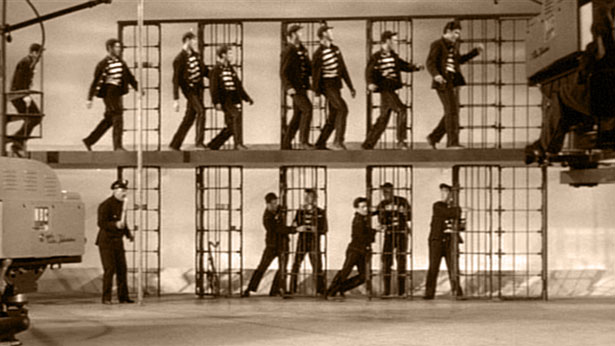
The title song of Elvis’ third movie, “Jailhouse Rock” is perhaps the best rock ‘n’ roll performance of his career.

“Jailhouse Rock” becomes a number one hit.

#122 Baby, I Don’t Care (1957)
A Date With Elvis
Hollywood, CA

Be sure to listen out for Elvis playing electric bass on “Baby, I Don’t Care.” I never realized this was him until reading Peter Guralnick’s liner notes to The King of Rock ‘n’ Roll: The Complete 50s Masters (1992) as a teen.

#123 Treat Me Nice (1957)
Jailhouse Rock (Single)
Hollywood, CA

#124 Don’t (1957)
Don’t (Single)
Hollywood, CA

“Don’t” becomes a number one hit.

#125 King Creole (1958)
King Creole
Hollywood, CA

#126 Hard Headed Woman (1958)
Hard Headed Woman (Single)
Hollywood, CA

Michael Curtiz, best known for 1942’s Casablanca, directs Elvis in his fourth movie, King Creole. Though the bulk of the song will be cut from the 1958 film, “Hard Headed Woman” becomes a number one hit.

#127 Trouble (1958)
King Creole
Hollywood, CA

#128 As Long As I Have You (1958)
King Creole
Hollywood, CA

Elvis: “I did four pictures, and I was getting used to the movie star bit. . . . I had a pair of sunglasses and riding in the back of a Cadillac, my feet up on the seat, saying, ‘I’m a movie star!’ . . . I was livin’ it up, eating hamburgers and drinking Pepsis. And then, I got drafted. So overnight, it all changed.”AC

Elvis is inducted into the U.S. Army in March 1958. He undergoes basic training at Fort Hood, Texas.

#129 A Big Hunk O’ Love (1958)
A Big Hunk O’ Love (Single)
Nashville, TN

During a short furlough after basic training, Elvis records a few songs in RCA’s Nashville studio at a one night session in June 1958. This is his only recording session while in the Army.

“A Big Hunk O’ Love” becomes a number one hit.

#130 A Fool Such As I (1958)
A Fool Such As I (Single)
Nashville, TN

“A Fool Such As I” peaks at #2.

Elvis’ mother, Gladys, passes away in August 1958 at the age of 46.

Elvis: “My mother, I suppose since I was an only child, that we might have been a little closer. Everyone loves their mother, but I was an only child, and Mother was always right with me, all my life.

“It wasn’t only like losing a mother, it was like losing a friend, a companion, someone to talk to. I could wake her up any hour of the night, and if I was worried or troubled about something, she’d get up and try to help me.”AD

Shortly after his mother’s death, Elvis is transferred to Germany, where he will spend the remaining 18 months of his military service.

Elvis: “At first, in the service, the guys just watched me to see what I was gonna do. . . . They saw I was doing the same thing that they were. They started to come around and talk, and everything went okay.

“I’ve had people ask me was it harder on me or was it easier or so forth. It was about the same. They didn’t make it any harder or any easier on me. I was just like everybody else.”AE

While his manager and record label do a good job of issuing singles from vault material while he is serving in the Army, Elvis returns from his two years of military service in March 1960 and almost immediately goes into the Nashville studio to close the nine-month gap since his last single release. He also records a new album. The sessions are his first in true stereo.

#131 Make Me Know It (1960)
Elvis Is Back!
Nashville, TN

#132 Stuck On You (1960)
Stuck On You (Single)
Nashville, TN

Elvis’ first single after the Army, “Stuck On You” hits number one.

#133 A Mess Of Blues (1960)
It’s Now Or Never (Single)
Nashville, TN

#134 Like A Baby (1960)
Elvis Is Back!
Nashville, TN

#135 It’s Now Or Never (1960)
It’s Now Or Never (Single)
Nashville, TN

“It’s Now Or Never,” which offers new lyrics to the tune of “O Sole Mio,” becomes a number one hit and Elvis’ biggest seller.

#136 Such A Night (Alternate-1960)
Fame And Fortune
Nashville, TN Take 1

#137 Are You Lonesome Tonight (1960)
Are You Lonesome Tonight (Single)
Nashville, TN

“Are You Lonesome Tonight” tops the chart.

Comparing the stellar recordings of “Are You Lonesome Tonight” or “Can’t Help Falling In Love” (1961) against “Love Me Tender” (1956) illustrate how much Elvis’ voice had matured by the early 1960s.

#138 Reconsider Baby (1960)
Elvis Is Back!
Nashville, TN

Either “Reconsider Baby” or “Santa Claus Is Back In Town” (1957) is Elvis’ best blues number. Here, he is aided by Boots Randolph on saxophone. A perfect track.

With a solid album, several successful singles, and a brief television appearance on The Frank Sinatra-Timex Show (ABC) under his belt, Elvis is back in Hollywood and in uniform for the comedy G.I. Blues.

#139 Doin’ The Best I Can (Alternate-1960)
Close Up
Hollywood, CA Take 12

Compared to his other top-notch 1960 albums, Elvis Is Back! and His Hand In Mine, the G.I. Blues soundtrack is a mixed bag of often mediocre or worse material. It is also the biggest seller of the three, proving Parker’s concept that the soundtracks would promote the movies while the movies would promote the soundtracks. It sets an unfortunate precedent that will recur multiple times in the 1960s.

#140 Pocketful Of Rainbows (1960)
G.I. Blues
Hollywood, CA

Don Siegel (Invasion of the Body Snatchers [1956], Dirty Harry [1971]) directs Elvis in his second movie of 1960, Flaming Star. The western, which includes minimal singing, features Elvis as a half-Native American, half-white character. Compared to G.I. Blues, the drama finds only moderate success at the box office.

In 1963, artist Andy Warhol would make a series of popular works based on a publicity still from Flaming Star, including Triple Elvis.

#141 Surrender (1960)
Surrender (Single)
Nashville, TN

“Surrender” becomes a number one hit.

#142 Crying In The Chapel (1960)
Crying In The Chapel (Single)
Nashville, TN

Elvis records “Crying In The Chapel” for His Hand In Mine, but it is left off the 1960 album. Though not released until 1965, “Crying In The Chapel” peaks at #3.

#143 Working On The Building (1960)
His Hand In Mine
Nashville, TN

#144 Lonely Man (Alternate-1960)
Today, Tomorrow & Forever
Hollywood, CA Solo-Take 1

From “Lonely Man”: “Searching, always searching for something he can’t find.”

In only six years, including two spent in the Army, Elvis has climbed from humble truck driver to the very top of the entertainment world—an ascent almost impossible to imagine.

Elvis Presley will return in The Elvis Odyssey Part IV: Valley Of Echoes.


Assorted Rambles

14While my posts for The Elvis Odyssey primarily look at the pop charts, an RCA reissue of “I Forgot To Remember To Forget” actually hit number one on the country & western charts prior to the success of “Heartbreak Hotel.”

I should also note that the (perhaps dubious) source I am using primarily for chart information is the 1987 double LP The Top Ten Hits, which is largely for nostalgic reasons. Though not made clear, I believe this album uses a combination of Billboard pop charts for its reference tables on the back cover.

If other charts are considered, such as Cashbox, Elvis’ hit total expands even further. However, I’m choosing to draw the line with The Top Ten Hits because it was a favorite of my teen years.↩︎

15That’s Southern for “wasn’t” or, in this case, “weren’t.”↩︎


Sources for Elvis Quotes

QAugust 24, 1969, Dinner Show, Las Vegas, NV↩︎

RMarch 24, 1956, Interview, New York, NY↩︎

SAugust 6, 1956, Interview, Lakeland, FL↩︎

Tca. July 1972 Interview↩︎

UApril 15, 1956, Interview, San Antonio, TX↩︎

VJune 9, 1972, Press Conference, New York, NY↩︎

WAugust 24, 1969, Dinner Show, Las Vegas, NV↩︎

XAugust 24, 1969, Dinner Show, Las Vegas, NV↩︎

YJuly 1, 1956, Interview, New York, NY↩︎

ZJune 27, 1968, 6 PM Show, Burbank, CA↩︎

AAAugust 24, 1969, Dinner Show, Las Vegas, NV↩︎

AA1ca. Late 1956, Phone Interview with “Buddy”↩︎

ABAugust 24, 1969, Dinner Show, Las Vegas, NV↩︎

ACAugust 24, 1969, Dinner Show, Las Vegas, NV↩︎

ADSeptember 22, 1958, Interview, New York, NY↩︎

AEAugust 24, 1969, Dinner Show, Las Vegas, NV↩︎


“Even in darkness light dawns for the upright, for those who are gracious and compassionate and righteous.”
Psalm 112:4
Elvis Movies: JAILHOUSE ROCK

Hey folks, I didn’t expect it to be this long between posts but here I am. It’s been over a year since the last entry in my random rewatch of Elvis Presley movies. It sure doesn’t feel that long ago. As a great philosopher once asked, “Ain’t it funny how time slips away?”

Elvis’ 3rd movie was called Jailhouse Rock. It is the 2nd of 3 Elvis movies shot in black & white, which certainly adds to the gritty tone.


“Elvis in Action as Never Before!”

Jailhouse Rock, now playing at a train near you

Jailhouse Rock (MGM)
Wide Release: November 8, 1957 (United States)
Starring: Elvis Presley, Judy Tyler, Mickey Shaughnessy
Screen Play By: Guy Trosper
Story By: Ned Young
Music Supervised By: Jeff Alexander
Produced By: Pandro S. Berman
Directed By: Richard Thorpe
Running Time: 96 Minutes


Elvis Presley stars in 1957's JAILHOUSE ROCK (MGM)

Elvis Presley stars in 1957’s JAILHOUSE ROCK (MGM)

Elvis stars in Jailhouse Rock as Vince Everett, a tractor driver who has just received his weekly paycheck. As is his custom, he cashes the check at the neighborhood bar and then arm wrestles the proprietor. After losing, Vince good-naturedly buys a round of drinks for everyone at the bar. The film soon takes a dark turn when another patron roughs up a woman for talking to Vince. Vince tells him to leave her alone.

“Look, buster, you want some teeth knocked out? Just keep it up,” warns the man.

“You scare me,” says Vince. “Woman-beaters always scare me.”

This being an Elvis movie, a fistfight of course ensues.

Much like in Loving You, released earlier in 1957, the fight concludes with the Elvis character punching his opponent into a jukebox. In Loving You, the Presley Maneuver causes the jukebox to turn on. In Jailhouse Rock, it turns the jukebox off.

Unlike most Elvis movies, though, this fight turns out to have lethal consequences. When the woman-beater dies, Vince is convicted of manslaughter and sentenced to 1 to 10 years in the state penitentiary. If only he had cashed his check at a bank instead of a bar.

Before we go much further, I want to jump back for a moment to the credits. I love the opening theme of Jailhouse Rock, an overture of sorts that includes instrumental renditions of portions of “Baby, I Don’t Care,” “Jailhouse Rock,” and “Young And Beautiful.”

This jazzy version of “Jailhouse Rock” is quite a treat. I played trumpet in our middle school jazz band, and when I first saw the movie on TV as a teenager back then, the “Jailhouse Rock” instrumental reminded me of the arrangement we were using for the same song.

Mickey Shaughnessy is Hunk Houghton in 1957's JAILHOUSE ROCK (MGM)

Mickey Shaughnessy is Hunk Houghton in 1957’s JAILHOUSE ROCK (MGM)

Anyway, Vince shares a cell with Hunk Houghton (Mickey Shaughnessy), a washed-up country singer. Hunk is near the end of an 18-year term for robbing a bank. Despite some of the variances, Jailhouse Rock is still an Elvis movie, so Hunk of course has a guitar hanging on the prison cell wall that draws Vince’s attention. Though Hunk is annoyed at first, he softens and teaches Vince some chords. When Hunk tells him about his 10-year career, Vince says, “I never heard of anybody paying money to hear a guitar player” and Elvis seems barely able to hold a straight face delivering the line. He is, after all, the highest paid “guitar player” in the world by this point.

Elvis performs Vince’s early songs in Jailhouse Rock as intentionally flat and tentative, reflecting the character’s inexperience with singing. However, Hunk hears something in the young man and offers him a spot in Breath of a Nation, a nationwide television special he is producing for the warden. You see, a state inspection committee is coming to review prison conditions, and the warden wants the prisoners to put on a show as a smokescreen. Conditions at this prison must be pretty rough to require a national television special to cover things up.

Vince sings “I Want To Be Free” in his segment, and, unlike Hunk or anyone else, he receives a large bag full of fan mail from all over the country. Hunk sees to it that Vince does not learn of the mail, saving face with the mailroom workers by saying he made a mistake by giving Vince the best spot in the show. He soon offers Vince a partnership contract for the pair to perform together and split everything 50/50. Great shades of Colonel Parker!

“Alone, son, you’d be like a lamb in a pack of wolves,” Hunk tells him. Vince signs the contract, thinking that the deal is in his favor since Hunk is the established “star.”

The State Pen in 1957's JAILHOUSE ROCK (MGM)

The State Pen in 1957’s JAILHOUSE ROCK (MGM)

Soon thereafter, a food fight turned riot breaks out in the prison over the poor conditions. Hunk tries to get Vince back to their cell, but a guard roughly handles Vince. Having apparently not yet learned his lesson from the barroom brawl, Vince swings his fists. He is caught and whipped. Outtakes of this scene surfaced on the 1993 VHS Elvis In Hollywood: The 50s. The original Jailhouse Rock film trailer also shows a clip that did not make it to the final film where Vince lunges at the warden when the guards untie his hands after the whipping.

Back in their cell, Hunk states that he tried to pay off the guards to prevent Vince’s whipping but he didn’t have enough money. He emphasizes the importance of having money to Vince and also teaches him his twisted version of the Golden Rule: “Do unto others as they would do unto you, only do it first.”

Hunk still has 10 months to go, but Vince is released from prison after serving 14 months – including 2 extra months for the riot incident. The warden gives Vince his remaining pay from the state. He also gives him the large bag of fan mail from the television special 8 months earlier. Vince realizes that Hunk helped keep the letters secret.

Vince buys a guitar from a pawnshop and goes to a bar where Hunk has arranged a job for him with an old contact. There, he meets Peggy Van Alden (Judy Tyler), who looks at some indicators inside of a jukebox and makes notes. He is curious what she is up to, but she is not impressed at all that Vince is a singer. However, she does say she’ll tell him more about her job if he buys her a fresh drink.

“Buy your own drink,” Vince says, wryly – no doubt remembering that the last time he bought a woman a drink in a bar he ended up in prison.

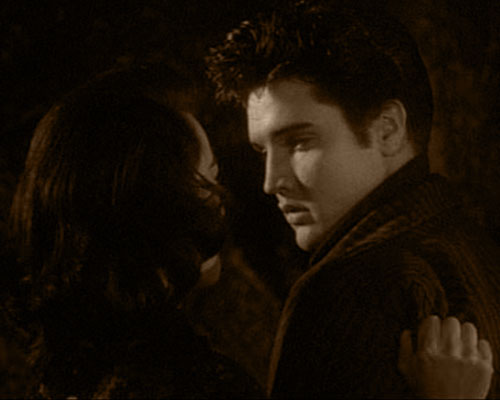
Judy Tyler is Peggy Van Alden and Elvis Presley is Vince Everett in 1957's JAILHOUSE ROCK (MGM)

Judy Tyler is Peggy Van Alden and Elvis Presley is Vince Everett in 1957’s JAILHOUSE ROCK (MGM)

“Is yours the approved manner with ladies in the backwoods?” Peggy fires back at him, but then goes on to explain that she is an “exploitation man” in the record business. “I work for Mickey Alba, you’ve heard of him?”

“Word sometimes gets to the backwoods,” says Vince. Alba (Don Burnett with vocals by Bill Lee) is a popular singer along the lines of Pat Boone.

Vince meets the bar’s owner, thinking he is going to be hired on as a singer. However, it turns out the job Hunk secured for him is as a barboy, essentially a bartender’s helper (“make setups, bring ice”). Vince is disappointed and forces his way on stage. Hey, it’s Scotty Moore, Bill Black, and DJ Fontana! Elvis’ real band! And Mike Stoller (composer of “Jailhouse Rock” and many other Elvis classics) on piano. Vince sings, “Young And Beautiful.” The owner actually seems to like the song, but a guy keeps laughing and carrying on in the audience, distracting both him and Vince.

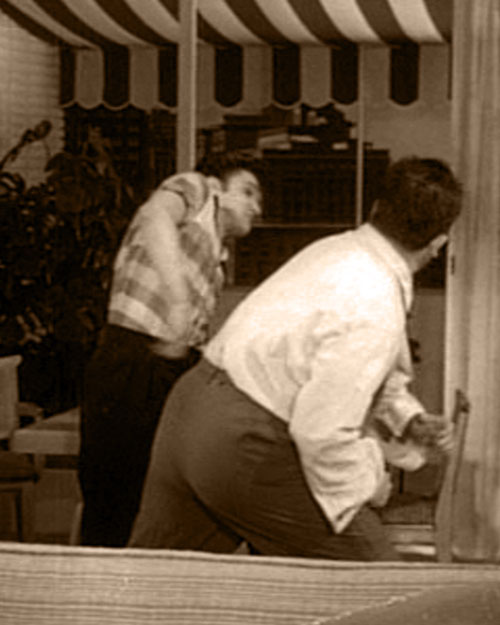
Finally, Vince jumps from the stage and smashes his guitar into the obnoxious patron’s table. However, he refrains from killing him. That’s called character development.

Vince storms out, with Peggy trailing. “Hey, you forgot something,” she calls.

“What?”

“Me!”

So, before this re-watch, it had been over a decade since I last saw Jailhouse Rock. While I’ve always liked it, in fact it’s one of my favorite Elvis movies, I never really saw much chemistry between Vince and Peggy. Watching it through this time, though, I disagree with my past self. Now I see it.

Anyway, Peggy suggests Vince make a recording of himself to discover what’s wrong with his singing. This is not as simple a task as it is these days. Vince rents out a recording studio for $20 to make a demonstration recording. Peggy supplies a borrowed guitar and the background musicians. It’s Scotty, Bill, DJ, and Mike again! I guess Peggy knew them from the bar.

Vince records a faltering version of “Don’t Leave Me Now.” However, Peggy loosens him up a bit, and he also decides to ditch the guitar. He tries again, and they decide the resulting demo is good enough to shop around to the record labels. Jack Lease (Peter Adams), Peggy’s contact at Geneva Records, which is Mickey Alba’s label, seems unimpressed, but he decides to borrow the tape to play over the phone to someone else in New York later.

After it turns out to be a rejection anyway, Vince shows up disgruntled and late for a dinner meeting with Peggy. Even when she tells him the good news that she has gotten them a deal with another label, Deltona Records, he is still rude to her. He just wants to brood. “When the money starts rolling in, then I’ll say I’m happy,” he says.

After a celebratory steak dinner, they head out to meet Peggy’s parents, who are having a party. They seem to know all about Vince, including that he sold his first record that day. However, Peggy has not told them about his stay in the state penitentiary. He expects this information to shock them, but it does not phase them. Instead, they start the record player and a technical discussion begins about jazz.

Another guest tries to involve Vince. “I say atonality is just a passing phase in jazz music. What do you think, Mr. Everett?”

Vince’s response is classic and one that I’ve had to bite my tongue not to use in various situations over the years: “Lady, I don’t know what the hell you talking about.”

Judy Tyler is Peggy Van Alden and Elvis Presley is Vince Everett in 1957's JAILHOUSE ROCK (MGM)

Judy Tyler is Peggy Van Alden and Elvis Presley is Vince Everett in 1957’s JAILHOUSE ROCK (MGM)

He storms out, and Peggy chases after him again. She is angry and embarrassed by his behavior – noting they were only trying to draw him into the conversation.

“They can shove their conversation,” he retorts. “I’m not even sure they were talking English!”

When Vince decides to walk home after their bickering, Peggy says, “I think I’m gonna just hate you.”

“You ain’t gonna hate me. I ain’t gonna let you hate me.” He grabs and kisses her.

“How dare you think such cheap tactics would work with me,” she exclaims. He kisses her again.

“That ain’t tactics, honey. That’s just the beast in me.”

On paper, the scene sounds creepy, but it is extremely well-executed by both performers – one of the best acted scenes in any Elvis movie.

Vince half-heartedly apologizes to Peggy on the way into the record store on the release day of “Don’t Leave Me Now.”

The girl at the cash register states that the record is flying off the shelves. Vince asks for a half dozen copies. Peggy looks alarmed when she sees the stack of records, and Vince looks over one curiously, reading aloud, “‘Don’t Leave Me Now’ by Mickey Alba? Geneva Record Company.” It turns out that Lease, the Geneva executive, only borrowed the tape so Alba could copy Vince’s arrangement and style. Vince’s record is gone – somehow squashed by Geneva.

Vince makes an unscheduled visit to Lease. “You’re a thievin’ rat” Vince exclaims and goes to punch him. However, seeing as how no jukebox is available to land the body on, he just slaps him a couple of times instead. “Go back under your rock, you snake!”

Later, he speaks of his time in prison to Peggy: “On the inside, they’re cub scouts compared to Jack Lease. If you make something, they might steal it from you, but they’d be too honorable to say they made it themselves.”

Vince suggests they start their own record company, and they form Laurel Records – splitting things 60/40. “I’m the artist, don’t forget,” Vince explains when Peggy at first objects to holding only 40%. After Peggy agrees to the deal, they have the following conversation – illustrating how they are both on different pages.

“This really calls for a celebration, Vince.”

“Do you know a lawyer? We need a good one. . .”

“Do you know how to dance?” asks Peggy.

“. . .A guy with an eye for a buck. Do you know a lawyer?”

Peggy is disappointed. “Yeah, I know a lawyer. Mr. Shores. . .”

After Vince makes it clear he is only interested in money, they form the record company. Vince records “Treat Me Nice,” which becomes a big hit. Vince makes reservations at a fancy restaurant to celebrate with Peggy but is disappointed when she points out that he failed to make reservations with her. She has a date, and states, “Vince, I will not be subject to your beck and call.” Go, Peggy! That’s a bold stance in 1957, especially in the male-dominated world of Jailhouse Rock.

Despite emotional setbacks, Vince’s career continues to skyrocket, including appearances in Las Vegas. After Vince agrees to do an NBC television special, Peggy shows up to ask him to record more records. Vince is rude to her, but reaches out right as she is leaving, almost like he wants to apologize or say something else – but his heart is still too hardened to get the words out. As Peggy exits, Hunk returns – fresh out of prison and looking for his spot in the TV special.

Elvis Presley is Vince Everett in 1957's JAILHOUSE ROCK (MGM)

Elvis Presley is Vince Everett in 1957’s JAILHOUSE ROCK (MGM)

The character of Vince is an unusual one in the Elvis cinematic universe. For most of the film, as many have pointed out over the years, Vince is a conceited jerk seemingly obsessed with money. Most of Elvis’ characters are likable guys cut from the same cloth. Vince is different, primarily due to his stay in prison, and offers a refreshing change of pace from the run-of-the-mill Elvis character. Vince should not be dismissed as a complete jerk, however. In several scenes, Elvis convincingly displays the emotional turmoil going on inside the man. He outwardly says he is all about the money, but you can also see that he loves Peggy and even Hunk.

In the music department, Jailhouse Rock is more than solid. The title song is a bonafide Elvis masterpiece. While the single version, one of Elvis’ greatest recordings, is used as the underlying track here in the film, the guitar riff opening of the song is unnecessarily hacked off. The screen version of the song is also hampered by awful overdubs of instruments and backing male vocals. Only the strength of Elvis’ underlying performance and the stellar production number save the tune. What were they thinking?

“Baby, I Don’t Care” and “Treat Me Nice” are also fantastic renditions. While “Young And Beautiful” is not quite up to the same par established by those three songs, it is still a lovely performance. “I Want To Be Free” and “Don’t Leave Me Now” serve their purposes well in the context of the film as does Mickey Shaughnessy’s “One More Day” — which is reminiscent of the classic folk song “Sixteen Tons.”

Vince Everett (Elvis Presley) sings "Baby, I Don't Care" at a pool party as a guitarist (Scotty Moore) plays along in the background in 1957's JAILHOUSE ROCK (MGM)

Vince Everett (Elvis Presley) sings “Baby, I Don’t Care” at a pool party as a guitarist (Scotty Moore) plays along in the background in 1957’s JAILHOUSE ROCK (MGM)

There is an oft-noted continuity error in Jailhouse Rock. During the “Baby, I Don’t Care” scene, guitarist Scotty Moore is shown wearing sunglasses in the wide shots but no eyewear in the closeups.

Vince Everett (Elvis Presley) sings "Baby, I Don't Care" at a pool party as a band (Bill Black, DJ Fontana, Scotty Moore, Mike Stoller) plays along in the background in 1957's JAILHOUSE ROCK (MGM)

Vince Everett (Elvis Presley) sings “Baby, I Don’t Care” at a pool party as a band (Bill Black, DJ Fontana, Scotty Moore, Mike Stoller) plays along in the background in 1957’s JAILHOUSE ROCK (MGM)

Another error is one I just noticed for the first time – a 1957 calendar is shown on the wall during a strikethrough sequence when Vince is in prison. When the calendar page is ripped down to show the next year, it is a 1957 calendar again. Talk about a life sentence! For the purposes of the Action File at the end of this post for Vince Everett, my conjecture is that the initial calendar was supposed to represent 1956 and that he was released in 1957.

One supposed error that is sometimes referenced with this film is that the prison ID number stamped on Vince’s shirt changes. Vince’s number is consistent during the penitentiary portions of the movie, however. Later, during the “Jailhouse Rock” production number, well after he has been released from actual prison, Vince wears a costume with a different number stamped on it. One was the character’s actual prison garb, the other was simply a costume. So calling it an error is . . . an error.

When Vince makes it to Hollywood, he takes his leading lady (played by Jennifer Holden) to Knott’s Berry Farm – a real amusement park in California that is still open to the public, including the “Old West” town represented in Jailhouse Rock.

A photographer prepares to take a souvenir picture of Vince Everett (Elvis Presley) and Sherry Wilson (Jennifer Holden) at Knott's Berry Farm in 1957's JAILHOUSE ROCK (MGM)

A photographer prepares to take a souvenir picture of Vince Everett (Elvis Presley) and Sherry Wilson (Jennifer Holden) at Knott’s Berry Farm in 1957’s JAILHOUSE ROCK (MGM)

Elvis released 33 movies during his lifetime, but Jailhouse Rock is one of only a small handful that is a serious contender as his very best. It was inducted into the US Library of Congress’ National Film Registry in 2004, the only Elvis movie to achieve this honor.

Just a few days after filming wrapped on Jailhouse Rock, actress Judy Tyler (Peggy) was killed at the age of 24 in a horrific car accident on July 3, 1957. Tyler’s husband and a passenger in another vehicle were also killed in the crash.

Elvis was devastated and according to many sources never watched the completed movie. Peter Guralnick & Ernst Jorgensen’s Elvis: Day By Day – The Definitive Record Of His Life And Music, however, notes that Elvis watched a special screening of the film with his parents on October 2, 1957. The book provides no further details, nor does Guralnick’s Last Train To Memphis: The Rise Of Elvis Presley, but perhaps Elvis was unable to finish the screening — thus validating both versions of the story.

Judy Tyler is Peggy Van Alden in 1957's JAILHOUSE ROCK (MGM)

Judy Tyler is Peggy Van Alden in 1957’s JAILHOUSE ROCK (MGM)

Jaihouse Rock was Tyler’s second and final movie. Her first, Bop Girl Goes Calypso, hit theaters only a couple of weeks after her death. While Jailhouse Rock, released in November 1957, carries no dedication to Tyler – I am not even sure that kind of thing was done back then – there is a moment in the closing scene during “Young And Beautiful” where the edit seems to linger on her more than it perhaps otherwise would have. In the magic of the movies, she will indeed remain forever young and beautiful.


Boldly Go

Multiple uncredited cast members from Jailhouse Rock went on to play roles in Star Trek.

K.L. Smith appears in the opening bar scene in Jailhouse Rock and appears as a Klingon in the Star Trek episode “Elaan Of Troyius” in 1968. Eagle-eyed readers will note that I also referenced Smith in a previous “Boldly Go” installment for his appearance in 1964’s Roustabout. Speaking of eagle eyes, thank you once again to Elvis movie superfan Gary Wells for pointing out where Smith shows up in Jailhouse Rock for me.

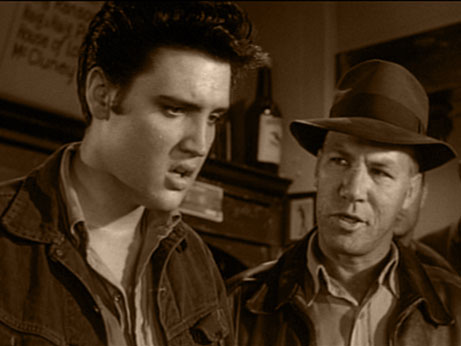
Elvis Presley and K.L. Smith in 1957's JAILHOUSE ROCK (MGM)

Elvis Presley and K.L. Smith in 1957’s JAILHOUSE ROCK (MGM)

K.L. Smith is a Klingon captain in the 1968 STAR TREK episode "Elaan Of Troyius" (Paramount)

K.L. Smith is a Klingon captain in the 1968 STAR TREK episode “Elaan Of Troyius” (Paramount)

Other cross-overs include:

  • Buzz Barbee [Jailhouse Rock: Apartment party guest | Star Trek: Ambassador Fox’s aide in “A Taste Of Armageddon” (1967) and maiden voyage official in Star Trek Generations (1994)]
  • Albert Cavens [Jailhouse Rock: Nightclub patron | Star Trek: Klingon crewmember in “Day Of The Dove” (1968) and fop 2 in “All Our Yesterdays” (1969)]
  • Noble “Kid” Chissell [Jailhouse Rock: Convict | Star Trek: Server in “The City On The Edge Of Forever” (1967)]
  • Richard Dial [Jailhouse Rock: Minor role | Star Trek: Sam in “The Devil In The Dark” (1967), Kaplan in “The Apple” (1967), security guard in “And The Children Shall Lead” (1968) and Fabrini guard in “For The World Is Hollow And I Have Touched The Sky” (1968)]
  • Shep Houghton [Jailhouse Rock: Nightclub patron | Star Trek: Cameraman in “Bread And Circuses” (1968)]
  • Arthur Tovey [Jailhouse Rock: Record shop owner in montage | Star Trek: Vulcan citizen in Star Trek: The Motion Picture (1979)]

Elvis Presley is Vince Everett and Mickey Shaughnessy is Hunk Houghton in 1957's JAILHOUSE ROCK (MGM)

Elvis Presley is Vince Everett and Mickey Shaughnessy is Hunk Houghton in 1957’s JAILHOUSE ROCK (MGM)

Jailhouse Rock Tote Board

  • Punches: 23
  • Songs: 15
  • Kisses: 12
  • Storm-Outs: 4
  • Slaps: 2

Songs In Jailhouse Rock

  1. Mickey Shaughnessy: “One More Day” (1957) [performed twice], written by Sid Tepper & Roy C. Bennett
  2. Elvis Presley: “Young And Beautiful” (1957) [performed 3 times], written by Abner Silver & Aaron Schroeder
  3. Elvis Presley: “I Want To Be Free” (1957), written by Jerry Leiber & Mike Stoller
  4. “Don’t Leave Me Now” (1957) [performed three times by Elvis Presley and once by Bill Lee], written by Aaron Schroeder & Ben Weisman
  5. Elvis Presley: “Treat Me Nice” (1957) [performed three times], written by Jerry Leiber & Mike Stoller
  6. Elvis Presley: “Jailhouse Rock” (1957), written by Jerry Leiber & Mike Stoller
  7. Elvis Presley: “Baby, I Don’t Care” (1957), written by Jerry Leiber & Mike Stoller

The Mystery Train’s Jailhouse Rock Scorecard

  • Story: 8 (out of 10)
  • Acting: 10
  • Entertainment Value: 8
  • Songs: 9
  • Overall: 9 (Must See)

Jailhouse Rock Around The Web


Click image for larger, color version


“But to you who are willing to listen, I say, love your enemies! Do good to those who hate you. Bless those who curse you. Pray for those who hurt you. If someone slaps you on one cheek, offer the other cheek also. If someone demands your coat, offer your shirt also. Give to anyone who asks; and when things are taken away from you, don’t try to get them back. Do to others as you would like them to do to you.”
Luke 6:27-31 NLT

Vinyl Elvis #4: THAT’S ALL RIGHT/BLUE MOON OF KENTUCKY (1954)

Portions of this post were first published on one of my pop-culture blogs, now retired.


Today marks the 68th anniversary of the release of Elvis Presley’s first record on July 19, 1954.

I have two near-mint copies of That’s All Right/Blue Moon of Kentucky.

By far, they would be the most financially valuable pieces of my entire record collection or of all of my collections of anything, for that matter, except that they were both pressed in 2009, rather than 1954. Oh well. It’s not about the money, it’s about the music. Always has been.

THAT'S ALL RIGHT/BLUE MOON OF KENTUCKY (Single; Sun, 1954; Reissue: Sony RCA/Legacy 2009--included as bonus with the Franklin Mint's ELVIS: THE COMPLETE MASTERS COLLECTION CD set; from Tygrrius' collection)

THAT’S ALL RIGHT/BLUE MOON OF KENTUCKY (Single; Sun, 1954; Reissue: Sony RCA/Legacy 2009–included as bonus with the Franklin Mint’s ELVIS: THE COMPLETE MASTERS COLLECTION CD set; from Tygrrius’ collection)

That’s All Right/Blue Moon of Kentucky (Single)
Label: Sun [Reissue: Sony RCA/Legacy]
Catalog Number: 209 [Reissue: 88697613017 (Label) / 88697673597 (2010 Outer Sleeve)]
Recorded: 1954 | Memphis, TN
Released: 1954 [Reissue: 2009]

Packaged in a plain, brown sleeve much like the original, my first copy of the record was included with Franklin Mint’s Elvis: The Complete Masters Collection CD set from 2009. A few years ago, I acquired a second copy of That’s All Right/Blue Moon of Kentucky, which Sony had released back in April 2010 for Record Store Day. Unlike the simple brown sleeve, this one included a gaudy cover, but I was surprised to discover that the record contained within is actually identical to the one that shipped with the Franklin Mint set. Sony must have been thinking ahead and pressed extra copies for the Record Store Day promotion.

Side A

Side A of THAT'S ALL RIGHT/BLUE MOON OF KENTUCKY (Single; Sun, 1954; Reissue: Sony RCA/Legacy 2009; from Tygrrius' collection)

Side A of THAT’S ALL RIGHT/BLUE MOON OF KENTUCKY (Single; Sun, 1954; Reissue: Sony RCA/Legacy 2009; from Tygrrius’ collection)

“That’s All Right” (1954)
One of the endearing aspects of this performance of “That’s All Right” is the sheer joy in the voice of Elvis as he sings. He finally has his opportunity in the studio, and he is making the most of it.

Elvis in 1970 reflected on his style, stating that it was “a combination of country music and gospel and rhythm & blues […]. That’s what it really was. As a child, I was influenced by all that.”

He added, “Of course, the Grand Ole Opry is the first thing I ever heard, probably, but I liked the blues, and I liked the gospel music–gospel quartets–and all that.”

On this first single, the blues and country influences are as clear as they ever would be. Some credit That’s All Right/Blue Moon of Kentucky as the first rock ‘n’ roll record, but to say Elvis invented the style is to make a false assumption that any one person actually did.

Rock ‘n’ roll evolved from the very sources that Elvis himself described. Besides, “Rocket 88,” “Rock Around the Clock,” and other potential contenders pre-date Elvis’ version of “That’s All Right.”

What Elvis did with his early records for Sun and RCA, though, was ignite the smoldering evolution of rock ‘n’ roll into a full-blown blaze. By melding country into the blues of “That’s All Right,” Elvis in 1954 unleashed a sound that not only built upon the foundation established by Arthur “Big Boy” Crudup‘s original 1946 recording, but took the song in a new direction. Absorbing the music of his youth, Elvis knew instinctively that blues and country explore many of the same themes, which allowed him to re-interpret these kinds of songs in a unique way.

Unfortunately, despite what the beautiful record label would have you believe, this reissue actually contains an RCA mastering of “That’s All Right,” rather than the original Sun mastering. It is the same 1954 recording, but RCA added echo to its versions not present on the Sun original.

A few years after this 2009 reissue of SUN 209, the “dry” version of “That’s All Right” finally became available again via FTD’s A Boy From Tupelo boxed set in 2012. Sony RCA/Legacy re-released A Boy From Tupelo in a much more affordable package for mainstream retail in 2017.

The dry version of “That’s All Right” is superior, though it takes some getting used to because the echo versions were used in every official release of the song from December 1955 through 2011. Unless, of course, you have been spinning a Sun original.

Side B

Side B of THAT'S ALL RIGHT/BLUE MOON OF KENTUCKY (Single; Sun, 1954; Reissue: Sony RCA/Legacy 2009; from Tygrrius' collection)

Side B of THAT’S ALL RIGHT/BLUE MOON OF KENTUCKY (Single; Sun, 1954; Reissue: Sony RCA/Legacy 2009; from Tygrrius’ collection)

Blue Moon of Kentucky (1954)
While Elvis added country to the blues of “That’s All Right,” he created a literal flip side by melding rhythm & blues into the country bluegrass of “Blue Moon of Kentucky.” Again, the sound is markedly different from Bill Monroe’s 1946 original. Again, there is that joy in Elvis’ voice.

A fun tidbit is That’s All Right/Blue Moon of Kentucky contains only three musicians: Elvis on acoustic guitar, Scotty Moore on electric guitar, and Bill Black on the upright bass.

One of the earliest rock ‘n’ roll records, and no drummer to be heard. Credit goes to Black, whose bass makes it sound like there must be a drummer.

A drummer did not join the group in the studio until the early 1955 session that produced “I’m Left, You’re Right, She’s Gone,” the flip side of Elvis’ fourth record for Sun.

“That’s All Right” and “Blue Moon of Kentucky” became regional hits for Elvis. He would follow-up the single with four more records on the Sun label before signing with RCA in late 1955.


“History merely repeats itself. It has all been done before. Nothing under the sun is truly new.”
Ecclesiastes 1:9

Gospel Elvis: “I Believe”

Today, I am beginning Gospel Elvis, a new, occasional series on The Mystery Train Blog. Gospel Elvis will examine songs of faith and inspiration that Elvis released during his lifetime. To be clear, each song won’t necessarily be “strictly” Gospel, but “Gospel Elvis” has a better ring to it than “Songs of Faith and Inspiration Elvis.” While I decided to start in 1957 for this first post, we won’t necessarily go in chronological order, either.


Elvis Presley in LOVING YOU (1957, Paramount)

Kicking off his first session of the new year, Elvis Presley recorded “I Believe” on January 12, 1957, at Radio Recorders in Hollywood. It was his first formal recording of a song of faith. The same session also produced the smash hit “All Shook Up,” which ruled atop the Billboard Top 100 chart for eight weeks to become the number one single of 1957.

RCA first released “I Believe” on the Peace In The Valley Extended Play (EP) album in April 1957. The song made its Long Play (LP) album debut on Elvis’ Christmas Album six months later. In October 1970, RCA released a reconfigured version of Elvis’ Christmas Album on its budget Camden label, leaving out “I Believe.” Instead, a reissue of “I Believe” appeared on the March 1971 Camden LP You’ll Never Walk Alone – one of the best of the Elvis budget releases.

Take a listen to Elvis’ recording of “I Believe” below or over on Youtube.

Credit: Vevo’s Elvis Presley channel (YouTube)

Ervin Drake, Irvin Graham, Jimmy Shirl, and Al Stillman wrote “I Believe” in 1952 for singer/actress Jane Froman. The most popular version, however, belongs to Frankie Laine‘s 1953 recording.

Elvis’ interpretation of the song did not seem to draw from Laine, however. Elvis named Roy Hamilton among his influences, and he no doubt had Hamilton’s 1955 version of “I Believe” in mind when he recorded it. Check it out on Youtube or below.

Credit: Roy Hamilton – Topic channel (YouTube)

What strikes me when listening to Hamilton’s sublime recording is that I can hear not only the influence on Elvis’ “I Believe” in particular, but also on Elvis’ vocals in general. Elvis had many influences, but most of them I do not hear as directly as that of Hamilton.

Now that we have heard two versions of “I Believe,” I want to attempt personally to interpret a couple lines of the lyrics within a Biblical context.

“I believe for everyone who goes astray, Someone will come to show the way.”

The truth is, as humans, all of us go astray. Jesus died so that our sins would be forgiven, however, and Heaven would still be available to us. He already paid for all of our sins, but our contribution to the admission ticket to Paradise is belief in Him (see John 3:16), for Jesus is literally the “way” to Heaven.

“Jesus told him, ‘I am the way, the truth, and the life. No one can come to the Father except through me.'”
John 14:6 NLT

Early Christians were even called “followers of the Way,” including in Acts of the Apostles in the New Testament.

“I believe above the storm the smallest prayer can still be heard.”

I was surprised to discover in the course of research for this post that there is actually some debate among Biblical scholars about whether God truly hears every prayer. To be clear, I do not claim to be a Bible expert. Though I have read it cover-to-cover four times, and currently working on two more read-throughs, the Bible is a dense work. However, in my humble opinion, there is no debate here. Of course God hears every prayer. He’s God! He’s omniscient. Does he grant every request? Of course not, but that’s a whole other discussion.

[Side Note: An interesting oddity about the Elvis version of “I Believe” is that he sings “the smallest prayer can still be heard” whereas the other half dozen or so versions I listened to by various singers for this post, including Hamilton, sing, “the smallest prayer will still be heard.” As this is The Mystery Train, I naturally used the Elvis version of the lyrics.]

One of the wonderful aspects of prayer is that you need not shout for God to hear you. He does, indeed, hear the quietest voice. In fact, you need not speak your prayer at all. You can think to God at any time, and He hears you. For believers, this is taken even a step further. If we can’t pray or don’t know what to pray, the Holy Spirit even steps in and prays for us (Romans 8:26-27).

In life, all of us encounter many storms. As a follower of Jesus, I now find comfort in Him through any such disturbances. I went through multiple life-changing events last year, for instance, many of which could have turned into tumultuous storms, but I approached each of them with much prayer, and Jesus brought me peace (John 14:27) and calm.

“The ropes of death entangled me; floods of destruction swept over me. The grave wrapped its ropes around me; death laid a trap in my path. But in my distress I cried out to the LORD; yes, I prayed to my God for help. He heard me from his sanctuary; my cry to him reached his ears.”
Psalm 18:4-6 NLT

My first exposure to “I Believe” was probably Elvis’ You’ll Never Walk Alone album. When I was a teenager in the 1980s, my family and I were on vacation somewhere or other. Anytime we went to a different place, I would always scour any store we happened to visit for Elvis items not available at home. At a Kmart or similar store, I found a cassette tape version of You’ll Never Walk Alone.

By this time, I had my first Walkman. This was about the third pre-recorded Elvis tape I ever owned. I would go on to acquire less than a dozen total, as my focus was on records and, later, CDs. Tapes were usually either releases I couldn’t find on record or gifts from others. Of course, I probably made well over a hundred Elvis mix tapes for my own use, which was the real appeal of cassette decks.

Anyway, I knew nothing about You’ll Never Walk Alone when I bought it. I just saw it had a lot of song titles I didn’t recognize. It was actually the first Elvis gospel album I ever owned. I can remember playing it on my Walkman in the car ride home from that vacation. Headphones allow for such an intimate listening experience, and they were perfect for You’ll Never Walk Alone.

I didn’t have any Elvis reference books at the time, so I thought the songs were all recorded around the same time. It sounded like a coherent album. In reality, the compilation included songs from throughout the range of 1957-1969. Elvis’ gospel and Christmas songs from various decades mix together better than his other music.

“I Believe” kicked off Side 2 of the cassette. As with many other songs on that release, it became a favorite. What I love about Elvis’ version of the song is how his voice eases back and forth effortlessly between gentle innocence and assertive conviction. I should note that I believed in God for as long as I could remember, but I was more skeptical about the Jesus aspect. However, I would explore and encounter Him in different ways over the years, including through Elvis’ many gospel recordings. It wasn’t until 2018 that all the puzzle pieces came together for me, and I was led to Jesus.

At that point, as a new creation (2 Corinthians 5:17), I began to experience the world in fresh ways. For instance, I was never an “outdoors” person. Now, I am often drawn to it. Walking in parks has become a favorite activity.

Music I had heard for decades began to take on new meanings. Suddenly, Elvis’ catalog of gospel was not just a collection of beautifully performed songs, but the most compelling and personal statements of his entire career.

My best friend taught me something she calls, “finding signs of Him.” What she means by that is taking a few minutes to stop, breathe, listen, look, and find God. There are signs of Him everywhere. “I Believe” understands this as well with the lyrics, “Every time I hear a newborn baby cry or touch a leaf or see the sky, then I know why I believe.” Evidence of God literally surrounds us.

To conclude our look at “I Believe” today, I want to sign off with my favorite version. This is Mahalia Jackson, 1953. Listen to her voice, surely evidence of God.

Credit: Mahalia Jackson – Topic channel (YouTube)


“And it is impossible to please God without faith. Anyone who wants to come to him must believe that God exists and that he rewards those who sincerely seek him.”
Hebrews 11:6

That’s All Right: July 5, 1954

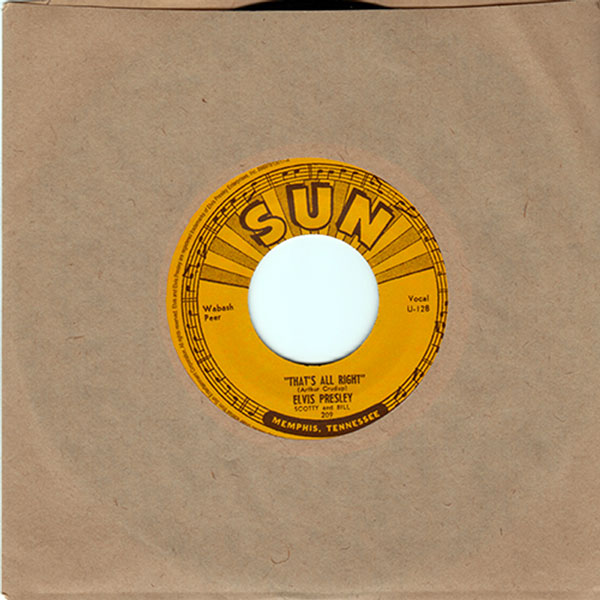
Above is a SUN 209 reproduction from my collection. I hope someday to own the real thing!

Above is a SUN 209 reproduction from my collection. I hope someday to own the real thing!

Sixty years ago today, on July 5, 1954, the whole world changed for 19-year-old Elvis Presley as he recorded his first record for Sam Phillips at SUN Records, “That’s All Right.” Soon thereafter, Elvis would change the whole world.

What I love about the SUN version of this song is that you can hear the joy in Elvis’s voice as he sings the blues number. Backed only by Scotty Moore on electric guitar, Bill Black on the upright bass, and his own strumming on acoustic guitar, Elvis poured his all into the song and produced something that transcended its individual parts.

Arthur “Big Boy” Crudup wrote and recorded “That’s All Right” in 1946 for the RCA Bluebird label. Both recordings are essential in the history of American music.

Though “That’s All Right” essentially became a regional hit for Elvis, in less than two years he would become an international superstar.

Recommended reading to learn more at some of my favorite sites:

iTunes Speedway: Race for the Elvis Cup

Elvis Presley is Steve Grayson in SPEEDWAY (1968)

Elvis Presley is Steve Grayson in SPEEDWAY (1968, MGM)

On the iTunes Speedway

Ever since I finished backing up all of my Elvis music to iTunes, I have been wanting to do some number-crunching. I usually rate a song when I first place it on iTunes, using the built-in star ratings of 1-5 (I reserve 0 stars to mean “not yet rated”). I then update the rating, if necessary, whenever the track plays.

For updates, I only allow myself to move the song one star rating in either direction per play. That way, if I am in an extremely bad or good mood, it will not overly influence the rating of a given song.

I now have nearly five years worth of data about how I really feel about the songs within my Elvis collection. This will allow me to determine which individual years and multi-year spans are truly my favorites, at least according to the numbers.

My Picks

Before crunching those numbers, though, I used my heart to answer some basic questions. I thought this would make for an interesting comparison against the iTunes race results.

Favorite Elvis Year: 1970
Top Five Elvis Years: 1970, 1968, 1969, 1957, 1955
Favorite 5-year Elvis Span: 1968-1972
Elvis Decade Ranking: 1970s, 1950s, 1960s

Race for the Elvis Cup: The Rules

For this analysis, I eliminated any years for which I had less than 40 Elvis tracks. This resulted in the removal of 1953 (2 tracks) and 1959 (19 tracks). I also eliminated all non-musical tracks (e.g., “Introductions By Elvis,” “Elvis Talks”).

For each of the remaining 23 years, I determined the average star rating for all applicable tracks. I also determined the percentage of tracks from that year that earned a perfect 5-star rating. For instance, the results for 1956 were:

1956
Total Tracks: 164
Average Rating: 3.91 (out of 5)
Perfect 5-star Tracks: 40.24%

The year with the highest average rating received 23 points on down to the year with the lowest average rating, which received 1 point. I then applied this same logic down the line by year for the percentage rankings for perfect 5-star tracks.

This gave each year a score ranging from a low of 2 to a high of 46. However, there were several ties down the line. The tie-breakers were:

1.) Average Rating (i.e., the tied year with the highest average rating wins the position)
2.) (If necessary) Perfect 5-Star Tracks (i.e., the year with the highest 5-star tracks percentage wins the position)

Victory Lane

The results were interesting. Leading the pack was the year 1968, with a perfect score of 46 points.

Nearly 85% of the Elvis tracks I had from 1968 were connected to the ELVIS television special project in some way, so that definitely helped stack the deck. Among them were “If I Can Dream,” one of my all-time favorite songs, and other tracks from Memories: The ’68 Comeback Special, a stellar album that includes the full June 27, 6 PM “Sit Down” show.

Top Five Elvis Years
#1 1968 (46 points)
#2 1970 (43 points, wins 2nd position over 1969 on Average Rating tie-breaker)
#3 1969 (43 points)
#4 1967 (38 points)
#5 1955 (37 points, wins 5th position over 1957 on Average Rating tie-breaker)

The real surprise for me was 1967 making the Top Five. Highlights for 1967 included the September sessions in Nashville that produced standouts like “Guitar Man,” “You’ll Never Walk Alone,” and “You Don’t Know Me.” In fact, alternate takes from that session, many of which are collected on FTD’s Elvis Sings Guitar Man, helped propel 1967 ahead due to the number of five-star ratings.

1965 came in last place, with a minimal score of 2 points (no surprise there). I was surprised that 1977 (5 points) was not able to overtake 1964 (8 points) and wound up as Elvis’ second-worst year.

5-Year Mission

I was also interested in determining my favorite 5-year span. As noted above, I usually say my favorite Elvis time period is 1968-1972, with 1954-1958 running a close second. How did the numbers match against my picks?

To my surprise, it turned out that my favorite 5-year Elvis span was actually 1966-1970, which came in at a whopping 198 points. 1968-1972 earned a collective 183 points, while 1954-1958 came in at 146 points. In other words, this race was not even close.

I often state that the opening salvos of Elvis’ comeback were actually fired in 1966 during the How Great Thou Art sessions, so perhaps I should have seen this coming. 1969 included the Memphis sessions that produced “Suspicious Minds,” “Kentucky Rain,” and “In The Ghetto,” his return to live performances, and even a strong soundtrack on the Change of Habit film. 1970 featured the That’s The Way It Is project, including the Nashville sessions, the summer rehearsals, and the August live performances.

The five-year span that earned the least points was 1961-1965, with a combined total of only 50, barely more than the single year of 1968.

Elvis Decades

Now, to answer that age-old question, what is your favorite Elvis decade? Though 1964 and 1965 are hard to love, I otherwise enjoy Elvis’ entire career. When pressed, however, I state that my favorite decade is the 1970s. What did the numbers say?

Again, they proved me wrong. The 1950s won out, with an average of 29.2 points. Second place was the 1970s, well behind at an average of 22.88 points. This barely edged out the 1960s, which had an average of 22.3 points.

Elvis professionally recorded during only five years in the 1950s, and the quality of his output was much more consistent in that time than in the 1960s and 1970s. The 1970s were brought way down by outliers like 1977 (5 points) and 1974 (10 points), while the same occurred for the 1960s with 1965 (2 points), 1962 (8 points), and 1964 (8 points). However, even the 1950s had its own outlier of 1958 (10 points).

Awarding the Elvis Cup

The analytical side of my personality loved reviewing these numbers. The emotional side of me, though, still believes that 1970 is my favorite Elvis year, no matter what iTunes says.

For me, feelings always rule out in the end, so the Elvis Cup is hereby awarded to 1970, the reigning champion.

King Creole: Alec falls just short of record in Elvis Trivialities #15 victory

Danny Fisher’s fake name did not fool Alec, who answered Elvis Trivialities #15 correctly before anyone else. Alec came just a minute short of tying Steve’s record time, which has stood for nearly two years.

And the answer is…

“George” is the name that Elvis Presley’s character first introduces himself as to Nellie (Dolores Hart) in the movie King Creole.

Though Danny meets her earlier in the film, he does not introduce himself to Nellie until he has her right outside of Room 205. Rather than give his real name, he tells her it is George. Within moments, however, he feels so guilty for propositioning her that he reveals his true identity. For a detailed breakdown of this scene, I refer you to the always fantastic work of Sheila O’Malley at the Sheila Variations blog.

Nellie (Dolores Hart) and "George" (Elvis Presley) outside of Room 205 in KING CREOLE

Nellie (Dolores Hart) and “George” (Elvis Presley) outside of Room 205 in KING CREOLE

First-time winner Alec not only gets a big batch of Southern Creole Bragging Rights, but also a spot among The Mystery Train’s Night Riders. An honorable mention also goes out to Gary Wells (AKA Wellsy) for giving the correct answer while Alec’s earlier comment was invisible due to being held for moderation.

* * *

Will you use your real name or a fake one if you win Elvis Trivialities next time? Subscribe to The Mystery Train Blog using the feature in the menu bar to the right. Then, you will be notified whenever there is a new post – because the next trivia challenge could come along at any moment. For all you know, I am typing it out right now.


The Mystery Train’s Night Riders

  • June 14, 2013: Alec (0:18) | Honorable Mention: Wellsy (3:01)
  • February 22, 2013: Thomas (13:36)
  • January 11, 2013: George Millar (4:19)
  • December 23, 2012: Thomas (0:36)
  • October 9, 2012: David (14:38) | Honorable Mention: John (22:06)
  • February 4, 2012: Thomas (13:52)
  • February 3, 2012: Thomas (2:18)
  • December 21, 2011: Wellsy (2:37)
  • October 31, 2011: Thomas (17:32)
  • October 1, 2011: Jimmy Cool (1:01)
  • September 9, 2011: Steve Brogdon (0:17) <— Record time
  • August 6, 2011: Thomas (2:26)
  • July 9, 2011: Thomas (5:26)
  • June 23, 2011: Fred Wolfe (0:18)
  • June 22, 2011: Ty stumps the train (no winner)

My grandmother worked in the ticket booth of a theater for decades. I dedicate this series of movie posts to her, who would have turned 103 this year. I often remember her when I watch movies.