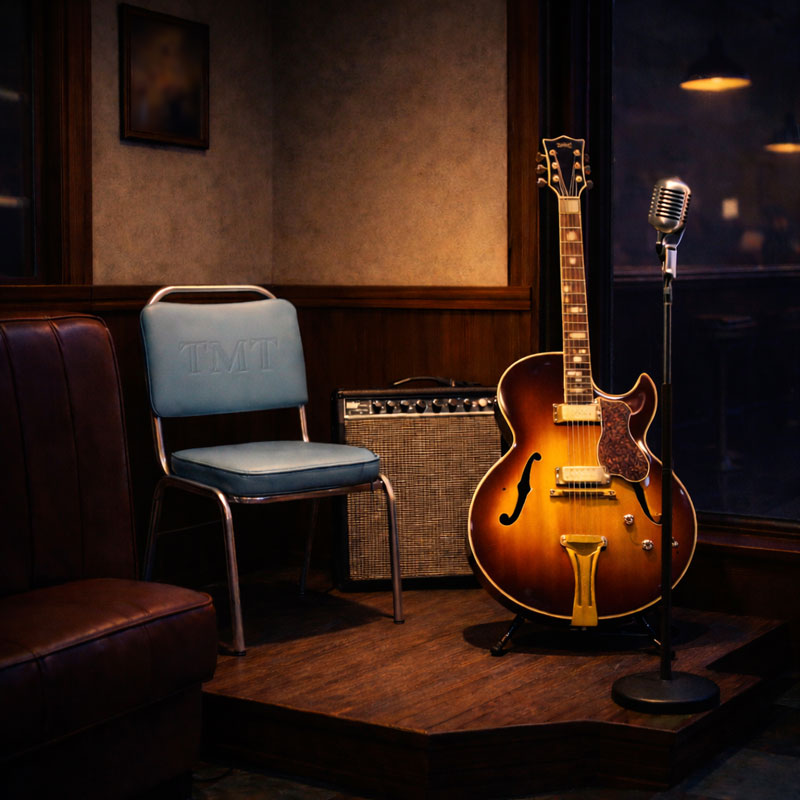
“Anticipation” (Artwork created for The Mystery Train with assistance from ChatGPT)
The Elvis Odyssey
Part V: Electric Dawn
With his movie career beginning to flounder and his recent singles receiving little notice, Elvis Presley is at a crossroads. As part of a package deal with yet another movie, he signs on to his first television appearance since a brief guest spot in 1960.
Slated to air on the NBC television network in December 1968, the pre-recorded special is supposed to feature Elvis singing Christmas songs for an hour.
Executive Producer Bob Finkel, however, convinces principal sponsor The Singer Company, NBC, and Elvis’ manager, Tom Parker, to widen the scope of the program beyond Christmas music. Finkel also meets with Elvis, who tells Finkel he wants the special to be completely different than anything in his past, especially his movies.
Elvis: “I want everyone to know what I can really do.”AM
Finkel then hires Steve Binder as Producer/Director of the Singer Presents ELVIS special.
Pre-production begins on June 3 with two weeks of informal rehearsals at NBC Studios in Burbank. Elvis and the crew are working 12-16 hour days, followed by jam sessions in the star’s dressing room.
On June 5, Senator Robert F. Kennedy is assassinated about thirty minutes away in Los Angeles while campaigning for President. Binder is taken with Elvis’ reaction to the news as well as his commentary on the assassination of Reverend Doctor Martin Luther King, Jr., in Memphis only two months earlier.
As a nation mourns, the rest of June is consumed with production of the ELVIS special. Elvis practically lives at NBC while making the program, even moving into his dressing room for a period of time. . . .
Listen along on Spotify.
#183 Trouble/Guitar Man (Alternate-1968)
Memories
June 22, Burbank, CA Master [alternate mix]
The ELVIS special begins with a tight close-up on Elvis’ face as he announces, “If you’re lookin’ for trouble, you came to the right place.” The opener is one of multiple production numbers in the show and begins a light storyline through the motif of “Guitar Man.”
I can only imagine what it must’ve been like to be an Elvis fan in 1968. To tune into this special after all of those years of mostly silly movies and see Elvis practically assault the television screen. Within seconds, it was obvious that he had something to prove.
#184 That’s All Right (Live-1968)
Tiger Man
June 27 8 PM, Burbank, CA
Elvis’ dressing room jam sessions inspire Binder to incorporate something similar into the special. When taping in the dressing room proves unfeasible, Binder instead plans to seat Elvis and his friends on a small stage completely surrounded by a studio audience. Elvis agrees to the concept on the condition that the surviving members of his original band, Scotty Moore (guitar) and DJ Fontana (drums), join him as well.
However, shortly before the first show, Elvis changes his mind and decides he cannot go on for what would be his first appearance since the Pearl Harbor concert in 1961. Binder convinces him to go out there, telling him he can come right back if he wants. Clad entirely in black leather, Elvis even jokes, “Well, goodnight!” shortly after the audience applauds his entry.
In addition to Moore and Fontana, on stage are Elvis’ friends Charlie Hodge and Alan Fortas. Lance LeGault, another friend, plays tambourine at the edge of the audience near Elvis.
Elvis: “It’s more important to try to surround yourself with people who can give you a little happiness because you only pass through this life once, jack. You don’t come back for an encore.”AN
Though dozens are recorded, only five or six of the informal songs make it in the actual special and album.
Among those left out is a rousing performance of “That’s All Right,” the song that started it all for Elvis.
The night, which includes tapings of two “sit-down” shows with similar setlists, is unlike any other in Elvis’ entire body of work.
#185 Baby, What You Want Me To Do (Live-1968)
Tiger Man
June 27 8 PM, 2nd version, Burbank, CA
Early on in both shows, Elvis trades his acoustic guitar for Moore’s burnt-orange electric guitar.19 Producing a raw, raucous sound, Elvis then drives the shows hard, including multiple versions of the Jimmy Reed blues number “Baby, What You Want Me To Do.” This particular rendition also goes unused.
#186 Blue Suede Shoes (Live-1968)
Memories
June 27 6 PM,20 Burbank, CA
“Blue Suede Shoes” is not used in the special or album.
#187 Lawdy, Miss Clawdy (Live-1968)
Memories
June 27 6 PM, Burbank, CA
For the special and album, the 8 PM version of “Lawdy, Miss Clawdy” is used.
From the 6 PM show, this live version manages to be even better than Elvis’ 1956 studio master of “Lawdy, Miss Clawdy.”
#188 Tryin’ To Get To You (Live-1968)
Memories
June 27 6 PM, Burbank, CA
“Tryin’ To Get To You” is not used in the special or album.
Again, Elvis improves upon his original 1955 studio master of “Tryin’ To Get To You” with this rock-infused live version.
#189 One Night (Live-1968)
Memories
June 27 6 PM, 1st version, Burbank, CA
This particular rendition of “One Night” is not used in the special or album.
#190 Baby, What You Want Me To Do (Live-1968)
Memories
June 27 6 PM, 3rd version, Burbank, CA
A portion of this rendition of “Baby, What You Want Me To Do” is used in the special, though it does not appear on the album.
It is difficult to choose between this one and the version already covered from the 8 PM show (track 185 above), but this is probably Elvis’ best-ever version of “Baby, What You Want Me To Do.” While he would return to the song in his first engagement at the International Hotel in Las Vegas the next year, it just was not the same.
#191 No Strap/One Night (Live-1968)
Memories
June 27 6 PM, 2nd version, Burbank, CA
As the sit-down show nears its end, Elvis declares that he wants to stand up–an idea he had been flirting with throughout the performance. He asks Moore if he has a strap for the borrowed electric guitar that Elvis has been using for most of the show. Moore says there is no strap, leading Elvis and the gang to begin singing joking lyrics to the tune of “One Night”:
“No strap today is what I’m now looking for. The things I did and I saw would make the dream–where, where, where, where’s the strap?”
Finally, Elvis stands up, props his foot on his chair and the guitar on his knee and completes another rendition of “One Night” which appears in both the special and on the album.
A truly incredible performance.
#192 Memories (Alternate-1968)
ELVIS: ’68 Comeback Special – 50th Anniversary Edition
June 24, Burbank, CA Take 2 Master [stereo mix]
#193 Saved (Alternate-1968)
Let Yourself Go!
June 22, Burbank, CA Take B7
Among its production numbers, the ELVIS special includes a nine-minute gospel medley.21 For the first minute of the medley, Elvis steps aside such that the spotlight can shine on dancer and choreographer Claude Thompson and the voice of Darlene Love. In addition to Elvis, the segment then features the Blossoms vocal group (Love, Jean King, Fanita James) and a host of other spirited dancers.
Elvis: “Rock ‘n’ roll music is basically gospel or rhythm & blues, or it sprang from that. And people have been adding to it, adding instruments to it, experimenting with it.”AO
It’s an exciting sequence, and I get breathless on behalf of all of the dancers just watching it. The medley was recorded in segments prior to the taping. This particular version of “Saved” is actually an outtake, but it’s my favorite.
#194 Heartbreak Hotel/Hound Dog/All Shook Up (Live-1968)
Memories
June 29 6 PM, Burbank, CA
Two days after the sit-down shows, Elvis appears alone on the same stage in his black leather suit to perform two formal stand-up shows featuring updated arrangements of many of his biggest hits. Elvis is again surrounded by a small studio audience, but this time a full band and orchestra are set just beyond one side of the stage.
This medley of “Heartbreak Hotel,” “Hound Dog,” and “All Shook Up” is featured in both the special and on the album.
This is a powerhouse moment in the ELVIS special, particularly the reinvention of “Heartbreak Hotel” as a rock anthem. Elvis never sang it like this again, preferring a bluesy approach in 1969 and onwards.
#195 Can’t Help Falling In Love (Live-1968)
Memories
June 29 6 PM, Burbank, CA
This version of “Can’t Help Falling In Love” is used in both the special and the album.
This is a beautiful rendition of the song that is on par with his original studio master (1961).
#196 Jailhouse Rock (Live-1968)
ELVIS: ’68 Comeback Special – 50th Anniversary Edition
June 29 8 PM, Burbank, CA
This version of “Jailhouse Rock” is used in both the special and the album.
Though not quite as stellar as his original studio version (1957), this is, by far, Elvis’ best live recording of “Jailhouse Rock.”22
#197 Love Me Tender (Live-1968)
ELVIS: ’68 Comeback Special – 50th Anniversary Edition
June 29 8 PM, Burbank, CA
This version of “Love Me Tender” is used in both the special and the album.
This is another example of a 1968 live version exceeding the original studio master (in this case, 1956).
#198 Baby, What You Want Me To Do (Live-1968)
Memories
June 29 6 PM, Burbank, CA
Once the main portion of each stand-up show concludes, Elvis works on a couple of segments intended for larger production numbers in front of the same audience. During the 6 PM show, there is a brief pause while pre-recorded music is being cued. Left standing with nothing to do, Elvis begins to appear uneasy. “Give me my guitar, man. I’ll play something,” he says. He picks up yet another borrowed electric guitar, this time a cherry red one from session musician Al Casey, and riffs into his go-to comfort song, “Baby, What You Want Me To Do,” eventually dropping to his knees as he plays to an audience member. This rendition is not used in the special or album.
#199 Trouble/Guitar Man (Live-1968)
ELVIS: ’68 Comeback Special – 50th Anniversary Edition
June 29 8 PM, Burbank, CA
To serve as a conclusion to the storyline that began at the opening, a new verse is written for Jerry Reed’s “Guitar Man”:
“Well, I come a long way from the carwash, got to where I said I’d get. Now that I’m here, I know for sure I really ain’t got there yet. So, I think I’ll start all over, sling my guitar over my back. I’m gonna get myself back on the track, I ain’t never, ever gonna look back. I’ll never be more than what I am, oh, wouldn’t you know, I’m a swingin’ little guitar man? Take it home, son, take it home.”23
A portion of this live reprise of “Trouble/Guitar Man” is used in the special.
#200 If I Can Dream (Alternate-1968)
Memories
June 30, Burbank, CA TV-Take 4 Master
After ELVIS was restructured into something more than a Christmas special, “I’ll Be Home For Christmas” was at first still intended as the closing song. Based on Elvis’ reactions to the murders of King and Kennedy, Binder is convinced that Elvis should make a statement of some sort after singing the song. Earl Brown, who is creating vocal arrangements for the show, suggests using “You’ll Never Walk Alone” instead of “I’ll Be Home For Christmas.” When this idea is rejected, Brown writes the music and lyrics of an original song, “If I Can Dream,” which allows Elvis to make his statement in the medium he is most comfortable, music.
From “If I Can Dream”: “If I can dream of a better land where all my brothers walk hand in hand, tell me why, oh why, oh why can’t my dream come true?”
Taped on the last day of the special’s production, with Elvis dressed in a white double-breasted suit, “If I Can Dream” represents for me the greatest musical achievement of Elvis’ life.24
The ELVIS special airs on Tuesday, December 3, at 9:00 PM Eastern and becomes the most-watched program of the week and the highest-rated television special of the year.
“If I Can Dream” climbs to #12 on the charts, while the ELVIS-TV Special album makes it to #8.
Elvis: “I’m never going to sing another song I don’t believe in. I’m never going to make another picture I don’t believe in.”AP
It has been a long night, but the sun is starting to rise. You are back in your seat in one of the Mystery Train’s passenger cars. “So, this is it?” you ask. “The end of the line?”
I smile and shake my head. “Not at all. That’s the beauty of Elvis. There’s no end to his odyssey. Just when you think he’s done, you start all over.”
Somewhere, you hear a familiar song. Faint. Something from your childhood.
As the train rumbles along, you make your way into the dining car and enter a new world.
Elvis Presley returns in The Elvis Odyssey: A New Summit.
Dialogue from a teleplay, father to son: “Maybe there’s only one summer to every customer.” Only one summer? Only one ride? Only one Elvis? Experience them while you can between Heaven, the Earth, and . . . the edge of reality.
[With apologies to Serling.]
Assorted Rambles
19While some out there have tried to insinuate this was some kind of power play by Elvis, the trading of guitars is a scripted moment, as evidenced by a recording of Binder discussing it with Elvis and Moore during a rehearsal.↩︎
20I really could have added the entire June 27 6 PM Show to The Elvis Odyssey, but I had to at least attempt to control myself. The video of the complete 6 PM show made its debut on the fantastic HBO special Elvis: One Night With You (1985). Missing the boat at that time, RCA/BMG finally released the full audio of the show on Memories: The ’68 Comeback Special (1998) CD. Don’t get me wrong, the 8 PM show is great, too, but there’s something special about that first show. The full audio of the 8 PM show was first released on the Tiger Man CD (1998) and the full video on ELVIS: ’68 Comeback Special – Deluxe Edition DVD set (2004).↩︎
21The full medley consisted of “Sometimes I Feel Like A Motherless Child,” “Where Could I Go But To The Lord,” “Up Above My Head,” “I Found That Light,” and “Saved.”↩︎
22I hope that a 1957 live version of “Jailhouse Rock” will see the light of day at some point in my lifetime, for I suspect it would top even the 1968 one.↩︎
23For me, this new verse sums up the entire ELVIS special. In fact, I’d rather they call it ELVIS: Back On The Track today than ELVIS: ’68 Comeback Special.↩︎
24The version of “If I Can Dream” for the album and single was recorded at Western Recorders studio a week earlier and is just as good as the television version. According to Brown in Elvis Presley: Writing For The King – The Stories Of The Songwriters by Ken Sharp, all three of the Blossoms were in tears at the conclusion of Elvis’ performance of “If I Can Dream” with Love stating, “He really believes in the song and means every word of it.”
Once Parker saw the rough cut of ELVIS in August 1968, he was reportedly outraged that no Christmas songs remained in the special. To appease him, a live performance of “Tiger Man” from the 8 PM sit-down show was dropped from the special in favor of an edited version of “Blue Christmas” from that same show.↩︎
I’ve also created a Spotify version of the complete playlist for The Elvis Odyssey, incorporating all five parts of the series.
I originally planned for this series to be a single post, but my bride wisely convinced me that I needed to split it. Thank you to her for ongoing prayers and encouragement and for reading every word I ever write.
Sources for Elvis Quotes
AMMay 14, 1968 Private Conversation (as reported in Elvis Presley: A Life In Music – The Complete Recording Sessions by Ernst Jorgensen)↩︎
ANca. September 1962, Interview, Hollywood, CA↩︎
AOJune 27, 1968, 6 PM Show, Burbank, CA↩︎
APca. June 23, 1968 Private Conversation, Burbank, CA (as reported in Elvis Presley: A Life In Music – The Complete Recording Sessions by Ernst Jorgensen)↩︎
Additional Sources For The Entire Series/Further Reading
Any mistakes you might find in this series are purely my own. As for the stuff I got right, I primarily consulted the following sources for this series of posts. I also consider them as recommended reading if you want a deeper dive into the career and life of Elvis Presley than I could provide here.
- Keith Flynn’s Elvis Presley Pages.
- Elvis Presley: A Life In Music – The Complete Recording Sessions by Ernst Jorgensen, St. Martin’s Press, New York, 1998.
- Elvis Day By Day: The Definitive Record Of His Life And Music by Peter Guralnick and Ernst Jorgensen, Ballantine Books, New York, 1999.
- Last Train To Memphis: The Rise Of Elvis Presley by Peter Guralnick, Little, Brown And Company, Boston, 1994.
- Careless Love: The Unmaking Of Elvis Presley by Peter Guralnick, Little, Brown And Company, Boston, 1999.
- Elvis Presley: Writing For The King – The Stories Of The Songwriters by Ken Sharp, Follow That Dream Records, Denmark, 2006.
- Elvis Presley In Concert.
Thank you for reading. May your 2026 be full of peace, love, and health.
Blessings,
TY
Update
January 18, 2026
Out of the installments for The Elvis Odyssey, Electric Dawn is the one that has continued to feel unsatisfying to me in terms of representing the 1968 ELVIS special. I’m happy with the text of the post, but I had to leave out some music selections in order to maintain my arbitrary overall 200 song count for the Odyssey.
Blogging is inherently a self-indulgent exercise. Sure, I hope a reader or two out there enjoys my thoughts on Elvis, but I’m really just doing this for fun. With that in mind, I decided to make an expanded edition.
ELVIS: Back On The Track – Electric Dawn (2026 Expanded Edition)
01. Trouble/Guitar Man (Alternate-1968)
Memories
June 22, Burbank, CA Master [alternate mix]
02. That’s All Right (Live-1968)
Tiger Man
June 27 8 PM, Burbank, CA
BONUS: 03. Heartbreak Hotel (Live-1968)
Memories
June 27 6 PM, Burbank, CA
BONUS: 04. Love Me (Live-1968)
Memories
June 27 6 PM, Burbank, CA
05. Baby, What You Want Me To Do (Live-1968)
Tiger Man
June 27 8 PM, 2nd version, Burbank, CA
06. Blue Suede Shoes (Live-1968)
Memories
June 27 6 PM, Burbank, CA
07. Lawdy, Miss Clawdy (Live-1968)
Memories
June 27 6 PM, Burbank, CA
BONUS: 08. Are You Lonesome Tonight (Live-1968)
Memories
June 27 6 PM, Burbank, CA
BONUS: 09. Tiger Man (Live-1968)
Tiger Man
June 27 8 PM, Burbank, CA
10. Tryin’ To Get To You (Live-1968)
Memories
June 27 6 PM, Burbank, CA
11. One Night (Live-1968)
Memories
June 27 6 PM, 1st version, Burbank, CA
12. Baby, What You Want Me To Do (Live-1968)
Memories
June 27 6 PM, 3rd version, Burbank, CA
13. No Strap/One Night (Live-1968)
Memories
June 27 6 PM, 2nd version, Burbank, CA
14. Memories (Alternate-1968)
ELVIS: ’68 Comeback Special – 50th Anniversary Edition
June 24, Burbank, CA Take 2 Master [stereo mix]
15. Saved (Alternate-1968)
Let Yourself Go!
June 22, Burbank, CA Take B7
16. Heartbreak Hotel/Hound Dog/All Shook Up (Live-1968)
Memories
June 29 6 PM, Burbank, CA
17. Can’t Help Falling In Love (Live-1968)
Memories
June 29 6 PM, Burbank, CA
18. Jailhouse Rock (Live-1968)
ELVIS: ’68 Comeback Special – 50th Anniversary Edition
June 29 8 PM, Burbank, CA
BONUS: 19. Don’t Be Cruel (Live-1968)
ELVIS: ’68 Comeback Special – 50th Anniversary Edition
June 29 8 PM, Burbank, CA
BONUS: 20. Blue Suede Shoes (Live-1968)
ELVIS: ’68 Comeback Special – 50th Anniversary Edition
June 29 6 PM, Burbank, CA
21. Love Me Tender (Live-1968)
ELVIS: ’68 Comeback Special – 50th Anniversary Edition
June 29 8 PM, Burbank, CA
22. Baby, What You Want Me To Do (Live-1968)
Memories
June 29 6 PM, Burbank, CA
23. Trouble/Guitar Man (Live-1968)
ELVIS: ’68 Comeback Special – 50th Anniversary Edition
June 29 8 PM, Burbank, CA
24. If I Can Dream (Alternate-1968)
Memories
June 30, Burbank, CA TV-Take 4 Master
I’ve also created a new Spotify playlist with this version of Electric Dawn. I left the original out there as well.
But wait, there’s more!
Once I broke the 200 barrier, I went back and added even more songs to make an expanded edition of The Elvis Odyssey overall. It’s not as tight as the original, but it gives more of the story. Check it out over on Spotify. I also left the original version of this playlist out there. While I will leave the original version alone, I will keep updating the expanded version as the mood strikes me.
“The Light shines in the darkness, and the darkness has not overcome it.”
John 1:5


 The Mystery Train Blog