Endless Twilight

You’re wandering in an amazing land of imagination . . . the edge of reality.

Only Memories - Artwork created for The Mystery Train with assistance from ChatGPT

“Only Memories” (Artwork created for The Mystery Train with assistance from ChatGPT)

You awaken back in the Mystery Train Diner. As I welcome you over to the Conductor’s table again, you realize it wasn’t a dream. It was all real.

“When our story ended last time, Elvis was back on top,” I say. “His compelling work from June 1968 to August 1970 is rivaled only by his stunning output from 1955 to 1957. And after a stretch like that, well, even Elvis can’t run the whole race wide open. Maybe losing speed was bound to happen.”

Disappointed, you point out that Elvis still had seven years to go.

“Oh, don’t get me wrong, we have plenty more ’70s songs in the jukebox. Some of them will hold their own against even his peak work. However, after August 1970, something was different,” I contend.

I snap my fingers and the jukebox begins to play again.


The Elvis Odyssey

Part II: Endless Twilight

After completing his third stint at the International Hotel and a brief concert tour, his first since 1957, Elvis Presley’s grueling schedule sends him back to Nashville to finish a country album and record another single. The session is quick, and his mood is darker. . . .

Listen along on Spotify.

#49 Whole Lotta Shakin’ Goin’ On (Alternate-1970)
Walk A Mile In My Shoes
Nashville, TN [master, alternate mix]

Elvis’ studio take on “Whole Lotta Shakin’ Goin’ On” is impressive and provides a unique interpretation of the song first recorded by Big Maybelle in 1955 but best known for Jerry Lee Lewis’ 1957 version for Sun Records. Elvis’ live versions of this one tend to be throwaways, but this studio version is a solid rocker despite being used for the Elvis Country album.8

After all, it’s not just country, it’s Elvis country. There’s a difference.

Elvis: “Country music was always a part of the influence on my type of music, anyway. It’s a combination of country music and gospel and rhythm & blues all combined is what it really was. As a child, I was influenced by all that. . . .

“I liked all different types of music when I was a child. Of course, the Grand Ole Opry was the first thing I ever heard, probably, but I liked the blues, and I liked the gospel music, gospel quartets, and all that.”H

In January 1971, the United States Junior Chamber of Commerce (the Jaycees) award Elvis as one of the ten “Outstanding Young Men of the Nation” for 1970. Other recipients for 1970 include Dr. Mario Capecchi, biophysicist, and Thomas I. Atkins, politician and civil rights activist. Elvis is so honored by the civic award that he accepts it in person and gives a heartfelt speech.

Elvis: “When I was a child, ladies and gentlemen, I was a dreamer. I read comic books, and I was the hero of the comic book. I saw movies, and I was the hero in the movie. So every dream that I ever dreamed has come true a hundred times.

“These gentlemen over here, it is these type people who care, who are dedicated. You realize that it is . . . possible that they might be building the Kingdom of Heaven. It’s not too far-fetched from reality.

“I’d like to say that I learned very early in life that ‘Without a song, the day would never end. Without a song, a man ain’t got a friend. Without a song, the road would never bend. Without a song.’ So, I keep singing a song.”I

#50 Early Morning Rain (1971)
Elvis Now
Nashville, TN

After a fourth engagement at the International Hotel, Elvis is back at RCA’s Nashville studio in March 1971. This time, the goal of what is planned to be another marathon session is to create a number of singles and three albums, including his third Gospel LP and his second Christmas LP.9 Elvis initially leans toward making a folk album, but the concept never fully materializes.

Elvis’ version of “Early Morning Rain” is one of those tracks where the sound of his voice is simply soothing. I remember a local DJ “discovering” this song back in the 1990s when he picked up a copy of Elvis Now at a used record shop and played the song back-to-back on his weekly radio show the first night and then featured it for multiple weeks in a row.

Though suffering a severe cold, Elvis records four masters during the first night of the session, but is hospitalized the following day for a recurring glaucoma issue. The rest of the March session is eventually cancelled. He returns to Nashville in May and records over 30 more masters.

While many of the performances are strong, the underlying material is lacking at times compared to 1969 and 1970.

#51 I Shall Be Released (Informal-1971)
Walk A Mile In My Shoes
Nashville, TN

#52 Don’t Think Twice, It’s All Right (Informal-1971)
Our Memories Of Elvis: Volume 2 – More Of The Pure Elvis Sound
Nashville, TN Take 1 [extended master, alternate mix]

#53 Amazing Grace (Alternate-1971)
Walk A Mile In My Shoes
Nashville, TN Take 2

In this alternate take of “Amazing Grace,” Elvis and the musicians add a bluesy feel. Unfortunately, his producer suggests they back it off so the official master, though beautiful in its own right, sounds much more conventional.

#54 I’ve Got Confidence (1971)
He Touched Me
Nashville, TN

#55 Lead Me, Guide Me (1971)
He Touched Me
Nashville, TN

#56 I’m Leavin’ (1971)
I’m Leavin’ (Single)
Nashville, TN

#57 It’s Only Love (Alternate-1971)
Elvis Aron Presley
Nashville, TN Take 10 [master, alternate mix]

#58 It’s Still Here (Alternate-1971)
Elvis Aron Presley
Nashville, TN Take 5 [master, alternate edit]

I first heard “It’s Still Here” on the 1988 compilation album Elvis In Nashville. Not only did I appreciate the heartache of the lyrics, but I also loved that it featured Elvis on piano.

In June, Elvis returns to the Nashville studio. In the course of three nights, he records a half dozen more gospel masters and even takes a stab at Frank Sinatra’s signature hit “My Way” before leaving the studio in frustration. He never records in Nashville again.

Nevertheless, the gospel album, He Touched Me, goes on to earn Elvis his second Grammy Award.

Elvis: “Once you get involved in this racket, this business, your life is public, really.”J

#59 Burning Love (1972)
Burning Love (Single)
Hollywood, CA

Now formally separated from his wife, Elvis arrives at RCA’s Hollywood studio in March 1972 for a short but productive recording session. His focus and energy are on songs of love lost, so friends and bandmates must goad him into recording the upbeat “Burning Love.”

Peaking at number two, the song becomes his most successful since “Suspicious Minds.” “Burning Love” proves to be his 38th top ten hit in 16 years. Rather than release the cut as part of a regular Elvis album, RCA reserves it for a budget compilation consisting primarily of old movie tunes.

I can only imagine how confused potential new fans were who bought the album on the strength of “Burning Love,” and the move, in my opinion, undoubtedly impacted future record sales.

#60 Separate Ways (1972)
Separate Ways (Single)
Hollywood, CA

Written by Elvis’ friend and bodyguard Red West, “Separate Ways” is one of the love-lost songs that commands the singer’s attention during the Hollywood session.

Though released together as a single, “Separate Ways” and “Always On My Mind” from the session are also relegated to yet another budget album of otherwise old songs.

From “Separate Ways”: “Someday when she’s older, maybe she will understand why her mom and dad are not together. The tears that she will cry when I have to say goodbye will tear at my heart forever.”

Pass me that napkin, will ya? My cheeseburger must have some really strong onions.

#61 For The Good Times (1972)
Walk A Mile In My Shoes
Hollywood, CA

Elvis: “I’m in a publishing firm, but I’ll take songs from anywhere or from anybody if they’re good. It doesn’t have to be in my company, it could be just completely an unknown person, and just anybody that writes a song, if they can get it to me and if it’s good, I’ll do it.”K

After the session ends, Elvis and company stick around for a couple more days to rehearse for their April tour as well as run through a staged recording session for the benefit of MGM’s cameras that have arrived to film a new documentary, Elvis On Tour.

#62 Young And Beautiful (Rehearsal-1972)
Elvis On Tour
March 31, Hollywood, CA [alternate mix]

This surprise run through of “Young And Beautiful” from 1957’s Jailhouse Rock was a highlight of FTD’s 2004 album Elvis On Tour: The Rehearsals. I expected it to be a one-liner or tossed off, but Elvis actually does a serious, full version of the song.

#63 Always On My Mind (Remake-1972)
Elvis On Tour
March 30, Hollywood, CA Take 3 Master [alternate mix]

As part of the staged session for MGM, Elvis remakes “Always On My Mind,” the master version of which he had just recorded the night before.

This version of “Always On My Mind” is even better than the master, as it sounds a little less country. This same take is later used as the basis for a slight remix on the This Is Elvis soundtrack (1981), the version that first drew my attention to this incredible performance.

#64 Johnny B. Goode (Alternate-1972)
Elvis On Tour
March 30, Hollywood, CA Take 3 Master [alternate mix]

Elvis: “Man, I was tame compared to what they do now. Are you kidding? I didn’t do anything but just jiggle. . . . I really can’t criticize anybody in the entertainment field. I think there’s room for everybody, and I hate to criticize another performer.”L

Including his Vegas stints and multiple tours, Elvis performs 165 concerts in 1972. RCA records shows during his winter engagement at the Las Vegas Hilton (formerly the International), his April tour, and his June shows at Madison Garden. RCA captures so much live material that most of it remains unreleased for decades to come.

#65 Never Been To Spain (Live-1972)10
Elvis On Tour
April 10, Richmond, VA

#66 You Gave Me A Mountain (Live-1972)
Elvis On Tour
April 10, Richmond, VA

#67 It’s Over (Live-1972)
Walk A Mile In My Shoes
February 17 Dinner Show, Las Vegas, NV

#68 I Can’t Stop Loving You (Live-1972)
Elvis On Tour
April 10, Richmond, VA

#69 How Great Thou Art (Live-1972)
Elvis On Tour
April 9 Evening Show, Hampton Roads, VA

While MGM/Turner released this incredible live version of “How Great Thou Art” on the Elvis: The Lost Performances videotape back in 1992, RCA/BMG/Sony only first made it available in an audio release in 2022.

#70 It’s Impossible (Live-1972)
Elvis (Fool)
February 16 Midnight Show, Las Vegas, NV

I first heard “It’s Impossible” when a DJ spun it at a local restaurant that has long since closed (an inspiration for the Mystery Train Diner). I remember it felt amazing at that time to hear a “new” Elvis live song, as I (quite wrongly, I might add) thought I had heard them all by then. All these years later, I still haven’t heard ’em all.

In January 1973, Elvis arrives in Hawaii shortly after his 38th birthday. He’s there not to vacation but to deliver a live benefit concert that will be broadcast live via satellite to select countries.11

His last television special, 1968’s ELVIS, had closed with “If I Can Dream,” a “message” song written especially for Elvis and the show. Performed with passion by Elvis, it had been a bold musical statement on the tragic national events of that year while still maintaining hope for a better future. For the Elvis: Aloha From Hawaii special, however, there would be no such risks. In fact, no original songs were commissioned for the special at all.

Elvis: “It’s a great privilege to do this satellite program, and I’m going to do my best, and all the people that work with me, to do a good show, which is pure entertainment–no messages and no this and that–just to try to make people happy for that one hour that it comes across. If we do that, then, I think we’ve done our jobs.”M

#71 What Now My Love (Live-1973)
Aloha From Hawaii via Satellite
January 14, Honolulu, HI

From “What Now My Love”: “No one would care, no one would cry, if I should live or die.”

#72 I’ll Remember You (Live-1973)
Aloha From Hawaii via Satellite (2022 FTD Edition)
January 14, Honolulu, HI [master, alternate mix]

#73 A Big Hunk O’ Love (Live-1973)
Aloha From Hawaii via Satellite
January 14, Honolulu, HI

After the satellite show, Elvis returns to Las Vegas for his normal routine at the Hilton. In June and December, he records at Stax Studio in Memphis.

#74 Promised Land (Alternate-1973)
Promised Land (2011 FTD Edition)
Memphis, TN Take 6 [undubbed master]

I can still remember the first time I heard the Promised Land album. I was in 7th grade and borrowed it from my brother’s record collection. Due to the title, I thought it was a gospel album. I sure was in for a surprise when I dropped the needle and Elvis rocked into “Promised Land.” It remains one of my all-time favorite Elvis albums.

#75 It’s Midnight (Alternate-1973)
Memphis
Memphis, TN Take 19 [undubbed master]

#76 For Ol’ Times Sake (1973)
Raised On Rock (Single)
Memphis, TN

#77 You Asked Me To (1973)
Promised Land
Memphis, TN

#78 I’ve Got A Thing About You, Baby (Alternate-1973)
Memphis
Memphis, TN Take 15 [undubbed master]

#79 Lovin’ Arms (1973)
Good Times
Memphis, TN

#80 Good Time Charlie’s Got The Blues (Alternate-1973)
Memphis
Memphis, TN Take 9 [undubbed/unedited master]

In October, Elvis’ divorce from Priscilla is finalized.

From “Good Time Charlie’s Got The Blues”: “You know my heart keeps telling me, ‘You’re not a kid at 33. Play around you’ll lose your wife. You play too long, you’ll lose your life.'”

#81 Thinking About You (1973)
My Boy (Single)
Memphis, TN

#82 Your Love’s Been A Long Time Coming (Alternate-1973)
Rhythm And Country
Memphis, TN Take 4

Though Elvis does not record in the studio in 1974, RCA does capture a live album on March 20, Elvis Recorded Live On Stage In Memphis. A powerful rendition of “How Great Thou Art” on that album secures Elvis his third and final Grammy.

#83 Shake A Hand (1975)
Today
Hollywood, CA

In March 1975, Elvis returns to RCA’s Hollywood studio and efficiently records an entire album, Today.

#84 Bringing It Back (1975)
Bringing It Back (Single)
Hollywood, CA

#85 America The Beautiful (Live-1975)12
Holiday Season In Vegas
December 13 Midnight Show, Las Vegas, NV [undubbed master]

In anticipation of the 1976 U.S. bicentennial, Elvis begins trying out “America the Beautiful” in his live shows during 1975.

#86 For The Heart (Alternate-1976)
Memphis
Graceland, Memphis, TN [master, alternate mix]

With Elvis ever more reluctant to enter the studio, RCA takes the unusual step in 1976 of bringing equipment to Graceland to establish a temporary recording studio in Elvis’ den. Elvis records there in February and October.

Wasted as a B-Side to “Hurt,” “For The Heart” is one of those overlooked Elvis numbers that should be a real classic. I love both the master and this stripped-down mix released on last year’s Memphis boxed set. It was a real struggle to choose one over the other. I went with this one for now. Next week, I might swap the master back into the jukebox, though.

Elvis: “I suppose the most important thing in a person’s life is happiness. I mean, not worldly things because, gee whiz, you can have cars, you can have money, you can have a fabulous home, you can have everything. If you’re not happy, what have you got?”M1

#87 Solitaire (Alternate-1976)
Memphis
Graceland, Memphis, TN Take 11 [undubbed master]

From Elvis Presley Boulevard, Memphis, Tennessee is a dark, depressing album, but I have loved it since first hearing it as a teen. I consider it one of Elvis’ greatest achievements in terms of albums. “Solitaire” really stands out and this undubbed version from the 2024 Memphis set somehow makes it even better.

Elvis: “The image is one thing, and the human being is another. It’s very hard to live up to an image.”N

#88 She Thinks I Still Care (Alternate-1976)
Way Down In The Jungle Room
Graceland, Memphis, TN Take 2B

This slightly faster take on “She Thinks I Still Care” first surfaced as the underlying source of a remix on the 1980 Guitar Man album. Its first release in pure form on the 1995 Walk A Mile In My Shoes boxed set proved that it should have been chosen as the master for the Moody Blue album.

#89 Moody Blue (Alternate-1976)
Memphis
Graceland, Memphis, TN Take 10 [undubbed/unedited master]

#90 Blue Eyes Crying In The Rain13 (Alternate-1976)
Memphis
Graceland, Memphis, TN Take 5 [undubbed/unedited master]

#91 Unchained Melody (Live-1977)
Moody Blue
April 24, Ann Arbor, MI

#92 Pledging My Love (1976)
Way Down (Single)
Graceland, Memphis, TN

#93 Way Down (1976)
Way Down (Single)
Graceland, Memphis, TN

Elvis’ final single, his 100th, is Way Down/Pledging My Love.

Elvis: “What do I look at myself as? . . . As a human being, really, who has been very, extremely fortunate in so many ways. . . .

“I’ve experienced a lot of the different phases in life. I’ve experienced happiness and loneliness, the wealthy side of life, the average side of life–not having anything, but not knowing what it’s like to have anything–and tragedy . . . like losing my mother while I was in the Army. . . .

“I look at myself strictly as a human being who’s, like I said, been very lucky, but whose life–I have blood running through my veins–can be snuffed out in just a matter of seconds, not as anything supernatural or better than any other human being.”O

#94 My Way (Live-1977)
My Way (Single)
June 21, 1977, Rapid City, SD

Elvis: “Until we meet you again, may God bless you. Adiós.”P

Elvis performs his last concert on June 26, 1977, in Indianapolis, Indiana. The 42-year-old has the next six weeks off and then is scheduled to leave for another concert tour on August 16. He spends the downtime at Graceland, much of it with his 9-year-old daughter, Lisa Marie.

The next tour is never to be. Sometime on the morning of Tuesday, August 16, Elvis Presley dies alone at Graceland.

In the twilight glow, the music never ends.

Neither does our story.

Elvis Presley will return in The Elvis Odyssey Part III: Storming The Mountain.


Assorted Rambles

8An extended edit of “Whole Lotta Shakin’ Goin’ On” is available on some albums. Elvis sounds nearly manic after where the song traditionally fades, and I don’t like the longer version nearly as much. Sometimes less is more.↩︎

9I love Christmas music, especially by Elvis, so don’t take their exclusion thus far to mean anything other than I’m saving seasonal favorites to spotlight in the jukebox in a future post.↩︎

10This next stretch of songs in The Elvis Odyssey represents some of my personal favorites of live recordings from this year. However, you could reasonably swap in whatever 1972 versions of these songs you prefer, as just about all of them are strong. No need to use these exact versions.↩︎

11An entire mythology has built up around Aloha From Hawaii that I will not spend much time debunking. The special, though a ratings success, was not watched live by billions of people even when including the many countries that showed it on tape delay. In the US, NBC did not even air Aloha From Hawaii until April 4, which was over 11 weeks after Elvis performed the concert and 2 months after the accompanying live album hit record stores. During the Aloha concert, Elvis appears rather subdued and nervous at first, but eventually loosens up in the second half of the program, from which all of The Elvis Odyssey selections are drawn.↩︎

12This performance of “America The Beautiful,” captured directly from the soundboard rather than as a formal recording, was released as the flipside to “My Way,” the first Elvis single after his death. While I remember hearing his records before his death, these are the first two Elvis songs I can specifically remember, so I include “America The Beautiful” here for that reason alone.↩︎

13The whole reason I first got to hear From Elvis Presley Boulevard was because Mom bought the album for “Blue Eyes Crying In The Rain.” She had recently heard that this, along with “Unchained Melody,” was one of the last songs he ever sang on the morning of his death. Of course, the actual moment was not recorded. It was just Elvis rehearsing at the piano. No one knew it would be the last time.↩︎


Sources for Elvis Quotes

HFebruary 27, 1970, Press Conference, Houston, TX↩︎

IJanuary 16, 1971, Acceptance Speech, Memphis, TN↩︎

Jca. September 1962, Interview, Hollywood, CA↩︎

KJune 9, 1972, Press Conference, New York, NY↩︎

LJune 9, 1972, Press Conference, New York, NY↩︎

MNovember 20, 1972, Press Conference, Honolulu, HI↩︎

M1ca. Late 1956 Phone Interview with “Buddy”↩︎

NJune 9, 1972, Press Conference, New York, NY↩︎

Oca. September 1962, Interview, Hollywood, CA↩︎

PJune 19, 1977, Concert, Omaha, NE↩︎


“My health may fail, and my spirit may grow weak, but God remains the strength of my heart; He is mine forever.”
Psalm 73:26
As Recorded At Greensboro Coliseum: ELVIS ON TOUR – First (or Second) Reactions

I really struggled during my first run-through of CD 3 of Elvis On Tour, as I initially found it disappointing. I decided to give it another try about a week later, so this consolidated review actually represents impressions from both my first and second listens of the show.


I’ve been enjoying the new Elvis On Tour boxed set, so I’m continuing my informal, off-the-cuff reviews. This time, I’ll be listening to CD 3, which captures Elvis Presley’s concert on Friday, April 14, 1972, at the Greensboro Coliseum in North Carolina. Though this show is previously unreleased, it does have 3 songs that appear in the actual movie.

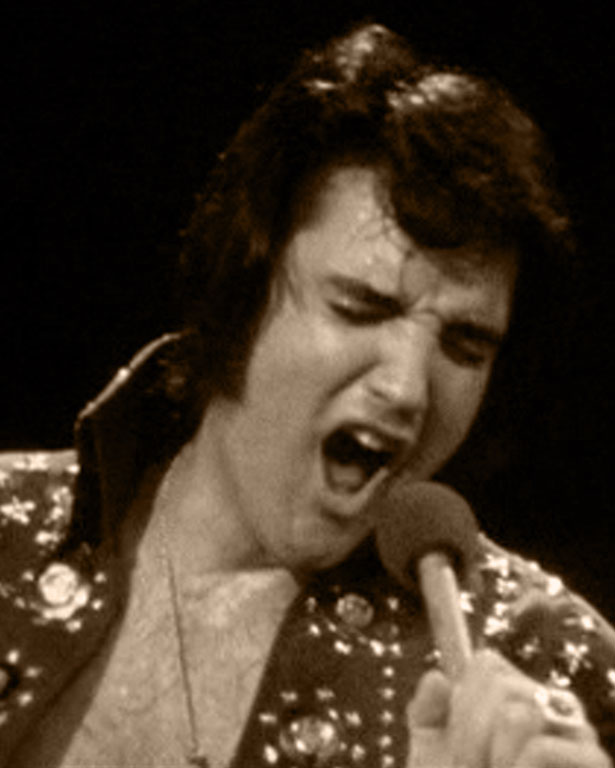
Elvis Presley performing at the Greensboro Coliseum on Friday, April 14, 1972 (MGM)

Also Sprach Zarathustra (Theme from 2001: A Space Odyssey)

See See Rider: Though nothing really distinguishes it, this is a fine 1972 version of “See See Rider.”

Proud Mary: This is a rockin’ version but, much like “See See Rider,” nothing really distinguishes this one from other fine performances of this tune in 1972.

Never Been To Spain: This is an okay version of this song on Elvis’ part, with nothing standing out. “We’ll get the ending right one day,” he notes after completing it.

I must admit, I’m disappointed in this concert so far. I’d been looking forward to it. Hopefully things will pick up. I’m also hoping for a surprise or two in terms of the setlist (I have not read the accompanying booklet yet, which includes the track listing).

You Gave Me A Mountain: I’ve mentioned in previous reviews that this is a poor spot in the setlist to downshift to slow songs. “Polk Salad Annie” right here would be so much better. I love slow songs, but this should be a little later in the show. This is not an especially good version of “You Gave Me A Mountain,” either.

Until It’s Time For You To Go

Polk Salad Annie: The Greensboro crowd reacts loudly as “Polk Salad Annie” begins. I love the wild Jerry Scheff bass guitar solos on the 1972 versions of the song, and this one is no exception.

Love Me: The crowd is definitely enthusiastic in Greensboro. Way to go, North Carolina!

All Shook Up: Elvis offers up a surprisingly spirited version. At least he doesn’t seem bored like he often does on this song.

Teddy Bear/Don’t Be Cruel: I usually don’t enjoy the “oldies” section of the show in 1972, but Elvis again seems enthusiastic on this medley.

Hound Dog: Well, that all just went out the window. Elvis really should have retired “Hound Dog” after 1970. This is a rather poor version.

Heartbreak Hotel: I normally like 1972 versions of “Heartbreak Hotel.” This one is good, though he gets distracted.

A Big Hunk O’ Love: Here we go! “A Big Hunk O’ Love” really takes off! Elvis says, “It’s your big chance, man” during Glen Hardin’s piano solo. I love how this song has two instrumental breaks, one for Glen and the other for James Burton on lead guitar. This should have happened more often. I love this song! So awesome!

Bridge Over Troubled Water: This version of “Bridge Over Troubled Water” appeared in the Elvis On Tour movie. I know some fans consider it Elvis’ best version ever, but I can’t grasp how they can think that when 1970 exists. In any event, it’s fun to hear a 1972 version of this song. As a teen, I remember being surprised to see this in Elvis On Tour when I watched it for the first time. I associated the song with 1970, for it was such a climactic moment in Elvis: That’s The Way It Is, and I didn’t realize he continued performing it after that year.

Suspicious Minds: All right, let’s do it right, Elvis! The start is fairly strong, for 1972. Overall, a decent version. It’s probably the best version of the three I’ve heard so far on this set – which isn’t necessarily a huge compliment. Why did Elvis allow his most recent #1 hit to become almost a throwaway?

As the band begins “Comin’ Home Baby” for the introductions portion of the show, Elvis says, “My first movie, ladies and gentlemen, was Love Me Tender. I’d like to sing that for you,” and the band quickly shifts into “Love Me Tender” instead.

Love Me Tender: A short but fine version. Includes the ad-lib, “You have made my suit turn blue, and I love you so.”

Elvis Presley performing at the Greensboro Coliseum on Friday, April 14, 1972 (MGM)

Comin’ Home Baby/Introductions By Elvis

For The Good Times: I really enjoyed the multiple attempts of “For The Good Times” on the Hollywood Studio CDs of this set. While I prefer studio versions of this song, this live version is still good. Possibly my favorite live version of this song.

An American Trilogy: Dixie/Battle Hymn Of The Republic/All My Trials – This appeared in the Elvis On Tour movie. It’s a great version. I like the Hampton Roads version better, but I can see why they went with this one for the movie – it’s visually better than Hampton. This makes me want to watch the movie again. It’s been a few years.

Burning Love: Oh, cool! Elvis debuts his soon to be hit song, recorded only a couple of weeks earlier. You’ve gotta crank the sound up on this one. Go Elvis! Who cares if some of the words are wrong? It’s the feel of the song. That’s always been the case when listening to Elvis. This Greensboro version of “Burning Love” is possibly my second favorite live version, after San Antonio.

Release Me: This one appeared in the excellent Elvis: The Lost Performances VHS video in 1992. It’s a good version of “Release Me,” but certainly anticlimactic after “Burning Love.”

Funny How Time Slips Away: This is a good 1972 version of “Funny How Time Slips Away.” It will probably be my go-to version for that year. This performance appears in Elvis On Tour. I love finally hearing these songs in context of the full shows. When multiple police officers pull a fan away after trying to reach Elvis on the stage, he says “Let her have that, let her have that, man,” to one of them, handing the officer a scarf to give to the overzealous fan. How cool.

Generally, this song indicates the show is almost over (because time is slipping away). I am hoping he squeezes in at least one more song before the “Can’t Help Falling In Love” finale, though. “Let me drink a little Gatorade, and I’ll sing another song for you,” he says. Maybe!

Can’t Help Falling In Love: Well, darn. The show is just about over. 1972 versions of “Can’t Help Falling In Love” are way too fast, but he does sound good here.

I really wish the show was a bit longer. Most Elvis concerts are around 60 minutes. This one clocks in at 62 minutes. For some reason, it feels shorter than that. The overall Greensboro experience feels unsatisfying compared to Hampton and San Antonio.

Well, 51 years later, I guess I shouldn’t complain since at least I get to hear this show at all. The first listen was definitely disappointing, but I enjoyed it more the second time through, including multiple highlights noted above.


“May the mountains yield prosperity for all, and may the hills be fruitful.”
Psalm 72:3

As Recorded At RCA Hollywood Studios: ELVIS ON TOUR – First Reactions

Before the 15-city, April 1972 concert series chronicled in MGM’s Elvis On Tour documentary even began, Elvis Presley already had a busy year.

In mid-January, Elvis began rehearsals for his next Las Vegas season – his sixth such month-long engagement since 1969. From January 26 to February 23, he performed 57 concerts at the Las Vegas Hilton. RCA recorded portions of various concerts in mid-February. Most of these recordings would go unreleased during Elvis’ lifetime. “An American Trilogy,” however, was released as a single in April, while “It’s Impossible” would appear the following year on the Elvis (Fool) album.

His wife, Priscilla, had moved out of Graceland in late 1971, and the couple formally separated on February 23. A month later, on March 27, Elvis began a recording session at RCA’s Hollywood Studios. The session lasted through March 29 and yielded the following masters:

  • Separate Ways (Single A-Side)
  • For The Good Times (Studio version unreleased until 1995)
  • Where Do I Go From Here (Album cut)
  • Burning Love (Single A-Side)
  • Fool (Single B-Side)
  • Always On My Mind (Single B-Side)
  • It’s A Matter Of Time (Single B-Side)

Though Elvis was not a songwriter, many of the songs he chose to record during the session reflected his personal life and featured heartbreaking lyrics about love lost:

Separate Ways: “Someday when she’s older, maybe she will understand why her mom and dad are not together. The tears that she will cry when I have to say goodbye will tear at my heart forever” (written by Red West and Richard Mainegra).

For The Good Times: “Hear the whisper of the raindrops flowing soft against the window, make believe you love me one more time” (written by Kris Kristofferson).

Fool: “Fool, you didn’t have to hurt her. Fool, you didn’t have to lose her. Fool, you only had to love her, but now her love is gone” (written by Carl Sigman and James Last).

Always On My Mind: “If I made you feel second-best, girl, I’m so sorry I was blind” (written by Mark James, Wayne Carson, and Johnny Christopher).

Due to its happy lyrics, the singer had to be goaded into recording “Burning Love,” the only rock ‘n’ roll number of the session. It became his last big hit on the pop charts.

On March 30, MGM’s camera crews arrived at the studio and began rolling for the Elvis On Tour documentary. For two days, Elvis and his band re-created the recording session they had just completed and then rehearsed for the upcoming tour. The majority of these recordings are captured on Discs 5 and 6 of Sony’s new Elvis On Tour set, the focus of today’s post. As I have done with the live recordings, this will mostly be a stream-of-consciousness approach as I listen to the discs for the first time – so bear with me.


Disc 5 kicks off with a slightly slower, gritty-sounding version of “Burning Love.” Unfortunately, this version of “Burning Love” eventually falls apart. I really liked it!

After some studio chatter, another version of “Burning Love” kicks off. Maybe Elvis will finish this one. I honestly wasn’t looking forward to the studio discs on the set. I was more focused on the live concerts. Uh oh, a couple minutes in, and it sounds like it might turn into another long false start. All right, Elvis is back on track, maybe he will finish it. Close enough, anyway. I really enjoyed this version.

A third attempt at “Burning Love.” Sounds awesome! Definitely reminiscent of the master so far. Maybe Elvis will stay focused. We’re closing on the ending. Maybe a complete version. I love it!

Elvis sings a line of “Sweet, Sweet Spirit,” and then they are off into a rehearsal of “For The Good Times.” This is such a beautiful song.

I’m not sure why they never released Elvis’ studio version of “For The Good Times.” The live version recorded a few months later on As Recorded At Madison Square Garden, which is inferior, beat it to record stores, but surely they could have used it on a subsequent studio album? It seemed they were always trying to fill gaps on albums, so why not use a quality recording like this one that was just sitting in the vault?

Elvis sounds so good on this. His voice is perfect for this song. “For The Good Times” is one of those, like 1970’s “How The Web Was Woven,” where it’s fun even to listen to rehearsal snippets. There’s a lot of laughter and clowning around between takes. I’m glad his fellow performers are seemingly able to keep Elvis in good spirits during such a rough period.

“For The Good Times,” at least that I’ve heard so far, doesn’t work nearly as well in a live concert setting as it does here in the studio. While I do wish Elvis had tried “Always On My Mind” on stage, I suspect the same would have been true of that song.

I could listen to “For The Good Times” all day, which is a good thing, because there are apparently a lot of takes of this song on this set. I just like to close my eyes and listen to his voice.

Elvis sings a few lines of “El Paso” between takes, which I remember hearing before on FTD’s Elvis On Tour: The Rehearsals. Too bad he didn’t attempt a full version.

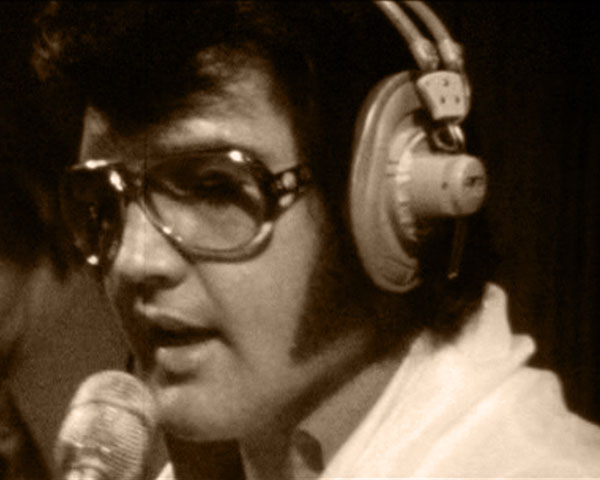
And suddenly they are rockin’ again with “Johnny B. Goode”! It falls apart quick, though. James Burton sounds so awesome on electric guitar. They launch it again, and it falls apart again just as Elvis begins to sing. I don’t know if this was the first session where Elvis is using headphones, but they seem really to bother him.

A third attempt… will they keep going this time? Oh, yes they will! This is the version which is excerpted at the beginning of the Elvis On Tour documentary and appears in full on the Elvis On Tour: The Rehearsals CD.

Then we pick up in progress on a rehearsal of “Always On My Mind.” This is one of my favorite songs, specifically the version from This Is Elvis – which was recorded during this mock session. Though the term wasn’t in use back then, that version was a bit of a remix in that it had some 1981 overdubs, but the untampered version was later released on The Great Performances and Elvis On Tour: The Rehearsals. I still tend to gravitate towards the This Is Elvis version.

Elvis has started a proper version of the song now. It’s not the This Is Elvis take yet, and it unfortunately turns out to be a long false start. The song begins again, but the band is not together, so it stops.

Take 3, and it’s the one from This Is Elvis. It sounds good. I love James’ guitar part on this, rather than the steel guitar of the master version. This gives it more of a pop and less of a country feel. In the realm of lost Elvis opportunities after his death, one of the biggest is that the This Is Elvis remix version of “Always On My Mind” was not released as a single in 1981. Instead, Willie Nelson got the hit when he recorded and released his version in 1982. Nelson’s version became so popular that many people think the song originated with him.

Now we are on to “Separate Ways.” I was typing about “Always On My Mind” and missed it. I need to back the CD up. Okay, here we go. Track 16. This feels slower than usual. Too slow. This might be one of the takes used in the Elvis On Tour movie. Let’s see if he cuts it for being too slow.

I don’t know how Elvis sang the lines about Lisa Marie, which I excerpted above. I wouldn’t have been able to get through it.

“I think I can do it better,” Elvis says after the song concludes. How many times is he going to torture himself?

Some of the dialogue from Elvis On Tour is here, including Elvis saying, “Ronnie, it seems a little bit slow in the beginning.” It appears he didn’t actually cut the song in progress like the movie makes it appear, though. This next take still seems a bit too slow. It was also used in the movie.

Elvis Presley recording at RCA Hollywood Studios on Thursday, March 30, 1972 (MGM)

On to “Proud Mary” – so presumably the concert rehearsals have begun. It’s an okay version. Lots of microphone feedback at times. This is one where it works better in concert, I guess because Elvis played off the energy of the crowd. Ronnie Tutt is great on drums, of course.

“Never Been To Spain” is next, much like in the live show. Elvis did not do a studio version of a number of these songs, including “Proud Mary” and “Never Been To Spain,” so these rehearsals could have filled that gap – but Elvis is simply not focused enough. This portion of the CD is disappointing – though not unexpected. I’m glad the mock studio session portions were so great, at least.

Hmm…the rest of this disc and then all of another disc with this? Come on Elvis, get on it, man.

“You Gave Me A Mountain” is next. I’ve been enjoying the live versions from this set, even though it’s normally not a standout song for me. The first attempt is a false start due to more microphone feedback. This is another one without a formal studio version. Elvis sounds tired or slightly out of it. He stops the song early on.

And then we’re on to “Until It’s Time For You To Go,” which has been tiring on the live shows and is really no better here. I wish they had finished “You Gave Me A Mountain” instead.

I hope there aren’t ten takes of “Until It’s Time For You To Go” on here. Otherwise, it might be time for me to go!

Yay, “Polk Salad Annie” is next. Elvis doesn’t seem right here, I unfortunately have to say. I guess something happened between the excellent mock session on the 30th and the lackluster rehearsal so far on the 31st.

Well, I guess the rehearsal version doesn’t have the Scheff solo like the live versions do. I have played it back a couple of times, but I keep getting distracted in the middle of it by how Elvis sounds. So, it is actually possible I missed it. I don’t have the heart to play it again.

“Love Me” is next. He sounds a little better here. At least at the beginning. I don’t know. If only Elvis had taken some time off to get his life together instead of making this movie – but he just wasn’t like that. The Elvis Presley Show must go on.

That’s the end of CD 5. A strong start and a poor finish. I can’t say I’m too excited anymore about CD 6, which picks up where this one left off.


All right, I took a little break and put some LEGOs together with my bride. Now, on with the rehearsal.

Up first is “All Shook Up.” At least Elvis has some spunk in him at the beginning of this song. Then, it’s time for “Heartbreak Hotel.” Elvis continues to sound a little better, and James Burton is terrific as always on electric guitar. The “Teddy Bear/Don’t Be Cruel” medley is up next. Elvis seems slightly more engaged with “Teddy Bear” than usual. Elvis then launches into the bluesy “Hound Dog” intro before accelerating into the full-speed version. You can tell he’s holding back here, which I think is fine for a rehearsal, actually. This is a song that thrives on an audience, so doing it with the band and a camera crew, I can see how it’s not that inspiring.

“The First Time Ever I Saw Your Face” is up next. He had recorded the song in Nashville in 1971, and it would soon be the B-Side of “An American Trilogy” in April. I like the arrangement here better than the single version. The Ronnie Tutt drumming adds an extra dimension to it. It’s not one of my favorite songs, but it is better than “Until It’s Time For You To Go” – particularly in this arrangement.

“A Big Hunk O’ Love” picks the pace back up. I love how this arrangement is so respectful of his original 1958 version. After a decent version, Elvis has them run through it again. And it is still good! Elvis seems much better now than at the beginning of the rehearsal. I love this song, especially the 1972 and 1973 versions.

The band then tears into a great version of “See See Rider.” Elvis seems quite engaged on the song, even without an audience.

Next in the rehearsals for the live show, they run through “For The Good Times” – the first overlap with the mock session. It’s not as fantastic as the previous day, but it still sounds good. A second attempt sounds better, though it eventually falls apart. They go a third time. Elvis’ voice really suits this song. He doesn’t like something, though, and he stops it early on, and they go a fourth time. I still like even these rehearsal versions better than the live versions I’ve heard thus far. That voice. Wow.

Elvis had recorded a studio version of “Funny How Time Slips Away” in 1970, after running through it live the previous year. They rehearse it next. The 1972 versions just don’t compare at all to the stellar 1970 studio version or even the 1969 live version. For 1972, this rehearsal isn’t a bad version, though. I like it better than the live versions I’ve heard of that year, at least.

Elvis rocks into “Burning Love” next, another overlap with the mock session of the previous day. And again, it’s not as good here, but it’s still a fun version. This feels faster than the previous day as well. The first rehearsal attempt falls apart near the end, so they go a second time.

I wish they would keep going with “Burning Love,” but instead they move to “Help Me Make It Through The Night,” which Elvis had recorded in 1971. It appeared the previous month on the album Elvis Now. It’s not a bad song, and Elvis is engaged on it.

“Can’t Help Falling In Love” is next. Too fast for my taste. An unremarkable version.

Elvis dips way back into his past with “Young And Beautiful,” a song from the movie Jailhouse Rock (1957). I would love to know how this one came about as a contender for his 1972 setlist. It has a decent arrangement and everything. Unfortunately, he did not put the song in the live show. This would have been far better than “Until It’s Time For You To Go,” for instance. I first heard this “Young And Beautiful” rehearsal on Elvis On Tour: The Rehearsals, and I have loved it ever since.

“Lawdy Miss Clawdy” sounds good. Elvis could still rock ‘n’ roll when he wanted. “Release Me” is next and sounds good as well. Elvis first recorded the song live during his early 1970 Las Vegas engagement. He sings slightly different lyrics in 1972, though. In 1970 he sings, “To live a lie would be a sin,” whereas in 1972 he sings, “To live a lie would bring us pain.” They run through “See See Rider” again for some reason. It sounds as good as earlier in the rehearsal. “See See Rider” is another song that made its debut in the early 1970 Vegas season. “Proud Mary,” again from the early 1970 Vegas season, is rehearsed a second time as well. This is much better than the version from the beginning of the rehearsal.

They run through “Never Been To Spain” again, too. I’m glad he hit these songs again so that we can have decent versions. If only they had done “Polk Salad Annie” again.

The rehearsals, which took place on Good Friday, close out with a number of inspirational songs. Up first is “I, John,” which Elvis had recorded in 1971 and would release on the He Touched Me album in April. The album would earn Elvis his second Grammy award. It’s a fun version of the song. Next is a brief rendition of “Bosom of Abraham,” which has a similar feel and also appears on He Touched Me. This performance appears in the Elvis On Tour movie.

The group then sings “You Better Run.” There is real joy in this music, and I’m glad this aspect of Elvis was captured.

A great version of “Lead Me, Guide Me,” also from He Touched Me, is next. This performance appears in the Elvis On Tour movie as well.

The group closes out the rehearsal and the CD with a medley of additional inspirational songs: “Must Jesus Bear The Cross Alone/Turn Your Eyes Upon Jesus/Nearer My God To Thee.” This is the kind of music Elvis sang when he was unwinding with friends, and it’s the perfect way to end the rehearsals.

These rehearsals had a rocky start, but finished strong. Overall, CDs 5 and 6 end up being winners.


Selected Sources

  • Elvis Presley: A Life In Music – The Complete Recording Sessions by Ernst Jorgensen, St. Martin’s Press, New York, 1998.
  • Elvis Day By Day: The Definitive Record Of His Life And Music by Peter Guralnick and Ernst Jorgensen, Ballantine Books, New York, 1999.
  • Elvis Presley In Concert, accessed February 12, 2023.
  • Keith Flynn’s Elvis Presley Pages, accessed February 12, 2023.
  • ELVIS: His Life From A To Z by Fred Worth and Steve Tamerius, Wings Books, New York, 1992.

“Lead me, O LORD, in thy righteousness because of mine enemies; Make thy way straight before my face.”
Psalm 5:8

As Recorded At San Antonio Convention Center: ELVIS ON TOUR – First Reactions

My last Elvis On Tour post was so off-the-cuff that I failed to give much background. MGM in 1972 filmed portions of Elvis Presley’s April concert tour for a documentary. Multitrack recorders captured audio from four of the concerts, which make up four of the six CDs of Sony’s Elvis On Tour set released last month (also released digitally in late 2022). Elvis’ record label released none of the audio recordings during his lifetime, and, until this release, only one of the four concerts had been officially available in audio form.

Here is the itinerary for the April 1972 concert tour, sourced from the 2010 Elvis On Tour Blu-ray book (Warner Home Video):

April 5: Buffalo, NY
April 6: Detroit, MI
April 7: Dayton, OH
April 8: Knoxville, TN (Afternoon Show)
April 8: Knoxville, TN (Evening Show)
April 9: Hampton Roads, VA (Afternoon Show)
April 9: Hampton Roads, VA (Evening Show) [Elvis On Tour CD 1]
April 10: Richmond, VA [Elvis On Tour CD 2]
April 11: Roanoke, VA
April 12: Indianapolis, IN
April 13: Charlotte, NC
April 14: Greensboro, NC [Elvis On Tour CD 3]
April 15: Macon, GA (Afternoon Show)
April 15: Macon, GA (Evening Show)
April 16: Jacksonville, FL (Afternoon Show)
April 16: Jacksonville, FL (Evening Show)
April 17: Little Rock, AR
April 18: San Antonio, TX [Elvis On Tour CD 4 | Close Up CD 4]
April 19: Albuquerque, NM

Elvis and his band played 19 shows for 15 straight days in 15 different cities. This must have been grueling. Last time I covered the previously unreleased Hampton Roads concert from the evening of Sunday, April 9, 1972. For today’s post, I’m going to jump ahead to Disc 4, which has a new mix of the San Antonio Convention Center concert from Tuesday, April 18, 1972. BMG released the first mix of this show way back in 2003. The reason I’m jumping ahead to this one is to “save” the remaining two previously unreleased concerts.

Elvis Presley performing at the San Antonio Convention Center on Tuesday, April 18, 1972 (MGM)

Though I stopped playing it once I heard this new set was coming, I already know this concert from Close Up, so there shouldn’t be any surprises here.

Also Sprach Zarathustra (Theme from 2001: A Space Odyssey)  I just love this opening. So perfect for an Elvis concert. If I recall correctly, it was conductor Joe Guercio’s wife who came up with the idea for this piece to introduce Elvis.

See See Rider: People might find listening to four shows recorded within nine days to be boring, but I enjoy it. I think of it as if I was fortunate enough to follow Elvis on part of his tour. Of course you’d hear mostly the same songs, but there would always be a little something different in there, too. It does make reviewing a little difficult, though, because my thoughts are as similar as the song versions. Anyway, this is a strong “See See Rider,” and Elvis sounds better than he does at the beginning of Hampton.

Proud Mary: I first heard “Proud Mary” on the As Recorded At Madison Square Garden (June 10, 1972, Evening Show) album. While his 1970 versions of “Proud Mary” might be better (e.g., On Stage), the 1972 versions remain compelling, and this is one of the best from that year. This version also appears in the film.

Never Been To Spain: All-in-all, San Antonio has a better start than Hampton. Elvis seems more focused. This is a great version of “Never Been To Spain,” another song that I first heard on the Madison Square Garden album. This version is better, and it appears in the movie.

You Gave Me A Mountain: Introduced during his February 1972 Las Vegas engagement, “You Gave Me A Mountain” became a mainstay of Elvis’ setlist. The song appears in Elvis On Tour (1972) [Hampton Roads version], Aloha From Hawaii (1973), and Elvis In Concert (1977). The version here is solid.

Until It’s Time For You To Go: This song just doesn’t work well live. Even the studio version of “Until It’s Time For You To Go” should have simply been an album track rather than becoming a single. Elvis begins to lose some focus here. Hopefully, “Polk Salad” will get things back on track.

Polk Salad Annie: A good version.

“Good evening, ladies and gentlemen. Welcome to the show,” Elvis says. This is probably the latest in a show I’ve heard Elvis welcome the audience. “I’d like to do some of my first records for you,” he continues, before jokingly singing a half-line of “Carry Me Back To Old Virginia.”

Wait, we are still in Texas, right? I guess Elvis wanted to go back to Virginia.

I don’t blame him.

Love Me: The only real interest here is James Burton on guitar.

All Shook Up

Teddy Bear/Don’t Be Cruel

Heartbreak Hotel: Elvis first introduced this bluesy arrangement in his 1969 Las Vegas shows. A decent version for 1972.

Hound Dog: The bluesy “Heartbreak Hotel” nicely sets up the bluesy “Hound Dog” intro before Elvis launches into the song full bore. Madison Square Garden has a better take on the slow-to-fast “Hound Dog,” though.

How Great Thou Art: Oh, to have been there to see Elvis perform “How Great Thou Art” live. This is another stellar version of the song he first recorded in 1966. Glen Hardin features on piano.

I Can’t Stop Loving You: This was one of my favorite songs on the Madison Square Garden album (it is hard to talk about Elvis live in 1972 without mentioning that classic album). This is a great version. This is one of the very rare occasions where 1972 versions of a song equal or exceed Elvis’ 1969 and 1970 versions.

Love Me Tender

Suspicious Minds: James Burton’s guitar intro is fantastic. The more I repeatedly listened to Hampton after writing my review, the less I liked the “Suspicious Minds” on there. This one seems much better so far. Well, not so fast, Elvis sounds distracted again. I like when he has fun, but “Suspicious Minds” is one of his best songs and is a highlight of concerts from this era, so it is disappointing when a version is subpar. Madison Square Garden has it beat by a mile.

Comin’ Home, Baby/Introductions By Elvis: This version of the introductions appears in the Elvis On Tour movie.

For The Good Times: Elvis’ voice is so beautiful. At times, “For The Good Times” sounds like a lullaby. I love his phrasing on “Don’t say a word about to-mor-row or forever. There’ll be time enough for sadness when you leave me.”

Burning Love: Featured in the movie, this is a killer version of “Burning Love.” Much better than Aloha From Hawaii several months later.

An American Trilogy: Dixie/Battle Hymn Of The Republic/All My Trials – Elvis substitutes “Disneyland” for “Dixieland” in the opening song of “An American Trilogy” before proceeding to perform an okay version. The orchestra is sloppy at times. Hampton remains his best version ever of “An American Trilogy.”

Funny How Time Slips Away: The 1970 studio version is so much better than any live version I’ve heard so far. This version of “Funny How Time Slips Away” is nothing special.

Can’t Help Falling In Love: Wow, the show seems short. I forgot to check the run time before starting the CD. Before “Funny How Time Slips Away,” Elvis said they weren’t leaving yet, and joked they still had 30 songs to go. I guess he really meant 2 songs to go. While San Antonio started stronger, Hampton is by far the better Elvis On Tour show of the two I’ve played so far.

So, it turns out the Texas show is just under 56 minutes long! About ten minutes shorter than Hampton.

Not a bad show, and it was definitely a welcome highlight of the Close Up box back in the day, but it is not all that memorable compared to other shows of 1972. Arguably, the two showstoppers of a 1972 Elvis concert are “Suspicious Minds” and “An American Trilogy,” and both versions here are subpar.

“How Great Thou Art” is certainly a stand-out here, though, as are some others, including “Never Been To Spain” and “I Can’t Stop Loving You.” It may not be his best show, but Elvis still delivers.


“All the nations You made will come and bow before You, Lord; they will praise Your holy name.”
Psalm 86:9

As Recorded At Hampton Coliseum: ELVIS ON TOUR – First Reactions

Some Elvis Presley fans have been waiting over 50 years for his record label to release an extensive collection of audio from MGM’s 1972 concert documentary Elvis On Tour. Though there have been some scattered releases over the years, a comprehensive, six-volume set for Elvis On Tour audio finally appeared last month on digital and this week on CD. It’s been only about 30 years of waiting for me, though, as I wasn’t aware of the amount of Elvis On Tour recordings until the early 1990s.

While much of this material has been bootlegged in varying degrees of quality, the vast majority of it has not been officially released. As I tend to avoid bootleg releases, it appears my patience is finally being rewarded.

I don’t really feel like doing a formal review as I did for 2014’s similar That’s The Way It Is: Deluxe Edition, which covered MGM’s 1970 documentary of the same name. While there is less material here, I also have far less time and energy than I did back then. Instead, I am going to write in a “live” stream-of-consciousness type way. I hope you don’t mind. I plan to cover one CD in this first post.

I am cutting the packing tape off the outer shipping box now. I am really not into unboxing videos, but I’m sure you can find one from someone else out there. The packaging wasn’t the best. The outer case of the actual CD set is slightly bulged out on the top. However, it’s acceptable to me. I am liable to mar it myself at some point anyway. So, I’m proceeding to remove the shrink wrap. Otherwise, this would have been the shortest post ever as I arranged a return and exchange.

ELVIS ON TOUR (Sony, 2023) | Credit: Sony

The box art isn’t bad. I like the vintage style logos. Elvis has always looked a little “off” in Elvis On Tour to me, and that is reflected in many of the related photos.

It’s the music I care about, though, so on with Disc 1. I don’t even know which show is up first! Let’s see…

Well, the disc doesn’t even bother to say. Let me check the booklet.

Disc 1 is the Hampton Coliseum in Virginia, April 9, 1972. This concert formed the bulk of the Elvis On Tour movie, for which the four concerts included in this set were recorded and filmed. Outside of the film footage itself, only “An American Trilogy” from this Hampton show has been officially released on audio until now.

Let me hook up my headphones. I don’t want to blast the family out of the house.

The show is over 66 minutes – pretty long for an Elvis concert. He usually kept them at about an hour, probably due to the influence of his Las Vegas stints on his tour shows. The hotel’s priority in Vegas was to get the audience back out into the casino to gamble, so management did not like when his show lasted over an hour. While that wouldn’t have been a consideration as he criss-crossed the country on multiple tours throughout the 1970s, Elvis was definitely a creature of habit.

Also Sprach Zarathustra: Best known as the theme to MGM’s 1968 movie 2001: A Space Odyssey, “Also Sprach Zarathustra” is an exciting way to begin a concert – perfect for Elvis, despite having been written in 1896! It’s unfortunate that a “sound-alike” piece was used in the film itself in lieu of “Also Sprach Zarathustra” due to rights issues with the composition. The inferior piece, called “2001 Alternate,” was re-used in 1981’s This Is Elvis as well. As proven here, Elvis concerts used the real version, not the one you hear in the Elvis On Tour and This Is Elvis movies.

See See Rider: Right off the bat, Elvis sounds a little off. I know this is a good show, though, based on the movie, so I’m not too concerned. This song was used in the 1972 film.

I Got A Woman: This track has audio issues on Elvis’ vocals. He is in the background only. A disappointing way to start the set, I have to say. This song is used in the movie without these kinds of issues. Okay, about a minute or so in, Elvis is now fully audible. Why wouldn’t they fix this? Some fans have done so, taking minutes. Why not a company with the resources of Sony? I will never understand these kinds of missteps on Elvis releases. Well, no matter, it’s just a minute, and on a lesser song at that.

“I’d like to tell you it’s a pleasure to be here in West Virginia,” Elvis jokes. And then we’re on to the next song.

Never Been To Spain: In the realm of useless trivia, former racecar driver Dale Earnhardt, Jr.’s favorite song is Elvis’ version of “Never Been To Spain” (presumably from the As Recorded At Madison Square Garden album). Here in Hampton, this is a decent version. James Burton on electric guitar is a highlight.

You Gave Me A Mountain: Oh, Elvis, it’s too early in the set for such a downer song. But here we go. Just a few weeks into his separation from his wife Priscilla, this is where Elvis was at this time in his life, and I respect that he was attempting to heal through his music. “You Gave Me A Mountain” has never been a huge favorite of mine, but this is certainly a decent and committed version. You can hear the pain in his voice as he sings, “My woman got tired of the heartaches.” This rendition appears in the film.

Okay, I got bored during “You Gave Me A Mountain” and looked up what day of the week this concert was held. It was a Sunday.

Until It’s Time For You To Go: Elvis keeps the pace slow. This was one of his singles in 1972, and it wasn’t a good choice. His voice sure is pretty on it, though. I wasn’t even born when Elvis performed this show, but how I wish I could have somehow been there. I was only two when Elvis died, so never had the chance to see him in concert. In some ways, you could say my intense fandom of Elvis Presley is due to him being ripped away from the world too soon… and this has all been my quest to experience what it would have been like to witness Elvis first-hand.

Polk Salad Annie: Here we go! Elvis picks the pace back up. This song is a showcase for Jerry Scheff on bass. You’ll recognize this performance from the movie, too. It is great to hear the Sweet Inspirations – as this is a showcase song at times for them as well.

“I’d like to do a few oldies but goodies for you, ladies and gentlemen,” Elvis says before launching into “Love Me.” I believe this is the first time I’ve heard Elvis use that phrase – and about his own classic songs at that.

Love Me: It’s a typical 1972 version. In the recent past, he did it much better in 1970.

All Shook Up: The video of this one made its debut on Elvis: The Lost Performances VHS in 1992. This is its first official audio release. It’s really not that notable, however.

Teddy Bear/Don’t Be Cruel: Also from Elvis: The Lost Performances, Elvis has fun with Glen D. Hardin by making him begin the song on piano multiple times before finally singing. This medley isn’t a favorite, but it’s a decent version. Unfortunately, the audio of the “Don’t Be Cruel” part of this performance was later used in the 2010 DVD & Blu-ray release of Elvis On Tour to replace “Johnny B. Goode” over the opening credits due to rights issues. New old stock of that release was included in the physical version of this Elvis On Tour set – i.e., the Blu-ray included in this 2023 set has the butchered opening from 2010. The real selling points of this release are the CDs. I see the Blu-ray as a free bonus disc. Best used as a drink coaster. For the proper opening, I recommend watching the movie by buying/renting a digital version or streaming it. Or catch it during a TV broadcast, of course (how quaint!).

Are You Lonesome Tonight: A beautiful rendition of one of my favorite songs. Featured in The Lost Performances, I’m thrilled finally to have this rendition in my collection.

“Please ‘Release Me,’ baby,” Elvis says, but Glen instead launches into “I Can’t Stop Loving You.” Getting Elvis back for that “Teddy Bear” fun?

I Can’t Stop Loving You: Okay, so I guess the whole segment from “All Shook Up” to “I Can’t Stop Loving You” was in The Lost Performances. Between that release and Elvis On Tour itself, we have most of this concert available in video form. I never thought it would take over 30 years for this audio from The Lost Performances to be released – much less 50 for the audio from the film proper.

Hound Dog: This has the “bluesy” intro, as later featured on the As Recorded At Madison Square Garden album (June 10, 1972). I practically grew up on that album, so I like it. This Hampton version has a little too much “scatting” from Elvis for my taste, though.

Bridge Over Trouble Water: Elvis absolutely conquered this song in 1970. By 1972, it just wasn’t the same, though. Elvis had an unfortunate tendency to speed up a song over time. I guess to fit as much into those 60 minutes as possible.

Suspicious Minds: Wow, this feels way too early in the show for this song. This is a fast version, but he sounds good. His best versions are from 1969 and 1970, but if you can put that aside, the 1972 and 1973 versions are good on their own terms. Oh, to have been there! “Suspicious Minds” is one of those songs I always look forward to on a new-to-me concert. This one was a slight let-down due to Elvis playing around a bit with the audience, but still good. This was my Mom’s favorite song (specifically the Alternate Aloha version).

For The Good Times: Better than the sleepy version later recorded at Madison Square Garden.

Comin’ Home, Baby/Introductions By Elvis

An American Trilogy: Dixie/Battle Hymn Of The Republic/All My Trials – The video and audio from this first appeared in 1981’s This Is Elvis movie and album, albeit with additional instrumental overdubs added after Elvis’ 1977 death. That version is by far my favorite of “An American Trilogy.” The more authentic version here is unfortunately disappointing by comparison. The prominent scream from an audience member prior to the reprise of “Battle Hymn Of The Republic” is still there, at least (I used to wonder if that was overdubbed as well).

I mean, it’s still a great version, but it loses something. Maybe due to not having the overdubs. Anyway, it’s wonderful finally to have it in the context of the full show. A version of this song recorded during a February Las Vegas show was another 1972 single for Elvis. While a powerful and dramatic song in concert, this didn’t make for a great single choice, either.

Love Me Tender: Not a bad version until ruined by Elvis joking near the end of the song.

A Big Hunk O’ Love: By 1972, Elvis wasn’t treating many of his “oldies but goodies” with very much respect. This one is an exception. Fantastic version. This appears in the movie.

How Great Thou Art: Stunning. Probably his best live version. The highlight of this show so far. This can also be viewed on The Lost Performances.

Sweet, Sweet Spirit (J.D. Sumner And The Stamps): I didn’t really “get” this song and thought it was a waste of time in Elvis On Tour until I finally saw the movie on the big screen in 2010. Watching Elvis become lost in the moment while hearing his backing vocalists perform this gospel song at his request was really something special, particularly while being part of the theater audience – and I wasn’t even saved yet at that point of my life.

Lawdy, Miss Clawdy: Oh no, based on what I remember from the movie, the show is nearing its end. No, Elvis, we want more! This is a great version for the 1970s. Probably the best one from that decade, at least of the ones I’ve heard, of course. This one appears in the movie.

Can’t Help Falling In Love: Noooo, the show is indeed ending! This rendition appears in the movie. What a terrific concert. Songs from throughout his career. Different styles. A strong voice.

All in all, a wonderful start to exploring the Elvis On Tour set.

Elvis Presley performing at the Hampton Coliseum on Sunday, April 9, 1972 (MGM)


“After his baptism, as Jesus came up out of the water, the heavens were opened and he saw the Spirit of God descending like a dove and settling on him.”
Matthew 3:16

Vinyl Elvis #5: MOODY BLUE (1977)

Portions of this post were first published on one of my pop-culture blogs, now retired.


Today marks the 45th anniversary of the July 19, 1977, release of Moody Blue, an album that turned out to be the last Elvis Presley record before his death four weeks later.

MOODY BLUE (RCA, 1977; from Tygrrius’ collection)

MOODY BLUE (RCA, 1977; from Tygrrius’ collection)

Moody Blue
Label: RCA
Catalog Number: AFL1-2428
Recorded: 1974-1977 | Memphis, TN; Ann Arbor, Michigan; Kalamazoo, Michigan
Released: 1977

Before I had Elvis records of my own, I remember checking out a couple of his albums from the public library. I must have been about ten-years-old.

The two records I took home that day in 1985, which I believe represented the entirety of the library’s Elvis music collection, were The Sun Sessions and Moody Blue. The fact that I had borrowed both his very last record and a compilation of his very first records escaped me.

I enjoyed both albums, but the one that really drew me in was Moody Blue. For one thing, the record was pressed on blue vinyl. I had never seen anything like that. Plus, I just loved the sound of the album — particularly “Way Down,” which I played over and over.

I played “Way Down” for my older brother later that day to show off knowing a “new” Elvis song, only for him to inform me that he had his very own copy of Moody Blue.

At that time, I was not allowed to touch my brother’s records (and rightly so, as I was often unintentionally destructive of his things). Today, as he generously gave me all of his Elvis records several years ago, his copy of Moody Blue is mine.

Side A of MOODY BLUE (RCA, 1977; from Tygrrius’ collection)

Side A of MOODY BLUE (RCA, 1977; from Tygrrius’ collection)

Side A

  1. Unchained Melody (1977)
    A compelling live version of “Unchained Melody” leads off the record. I normally prefer to open with a rocker, but this choice works perfectly for Moody Blue. Incidentally, this is my beloved bride’s favorite Elvis song she has heard so far, and she notes Elvis’ emphasis on the word “God” versus versions of this song by others. Indeed, in Elvis’ hands, the lyric “God speed your love to me” can be heard as “God, speed Your love to me.” Similarly, “I’ll be coming home, wait for me,” can be interpreted as “I’ll be coming Home, wait for me” in Elvis’ version. Elvis seems to be calling out not to a lost love, but to God.
  2. If You Love Me (Let Me Know) (1977)
    When I was listening to the library’s copy as a 10-year-old, I distinctly remember recognizing this live song from the Elvis In Concert album and wondering why this one sounded better. Part of the reason was that it was actually recorded a couple of months earlier than the version on Elvis In Concert. Some debate whether this song, made popular by Olivia Newton-John, should have been in his setlist. No matter, this is his best version of a song that obviously spoke to him.
  3. Little Darlin’ (1977)
    Next up is another live recording, Elvis’ fun take on the 1950s classic, “Little Darlin'”, which also provides a much-needed change in tempo. I love his ad-lib of “To hold in mine…your little foot…uh, hand!”
  4. He’ll Have to Go (1976)
    The tempo slows back down for “He’ll Have To Go,” the last studio recording ever made by Elvis. In addition to the resonance of the Elvis vocals, I love the guitar work of James Burton here. Six of the songs on this album were recorded at Graceland in 1976 in an effort to make the artist feel more comfortable, as Elvis in later years had become reluctant to record in a formal studio setting. Two sessions at a makeshift studio in his den resulted in sixteen songs, ten of which had already been used on the From Elvis Presley Boulevard album by the time RCA was assembling Moody Blue.
  5. Let Me Be There (1974)
    In early 1977, Elvis backed out of a planned session in Nashville to finish the Moody Blue album. Instead, a few live performances were recorded that April. Only three suitable songs were captured, however, which brought the album’s total to nine. In desperation, RCA re-released “Let Me Be There” from 1974’s Recorded Live On Stage In Memphis album to round out Side A of Moody Blue. Another Olivia Newton-John hit, “Let Me Be There” fits well on Moody Blue, despite being slightly older than the other recordings. In addition to the Newton-John connection tying it to “If You Love Me,” it was also recorded in Memphis like the majority of the other songs on this album.

Side B

Side B of MOODY BLUE (RCA, 1977; from Tygrrius’ collection)

Side B of MOODY BLUE (RCA, 1977; from Tygrrius’ collection)

  1. Way Down (1976)
    All of the songs on Side B of Moody Blue were recorded at Graceland. I probably have the master of “Way Down” on at least a half dozen CDs. None of them sound as incredible as listening to this record. Is it all in my head? Possibly, but if it is, do not tell me. “Way Down” really rocks, making it an appropriate A-side for what turned out to be Elvis’ last single before his death.
  2. Pledging My Love (1976)
    “Pledging My Love” is another terrific performance by Elvis. He might have lost much of the joy in his life by this point, but you can still hear it on this song.
  3. Moody Blue (1976)
    I find it cool that the album’s title song is buried in the middle of Side B. “Moody Blue,” another great song, almost sounds like disco. Compare the guitar licks on “Moody Blue” with Kool & the Gang’s “Celebration” (1980), for instance.
  4. She Thinks I Still Care (1976)
    Elvis recorded many country songs, particularly in the 1970s. “She Thinks I Still Care” is a stellar performance. At the end, he just will not let the song go, either.
  5. It’s Easy For You (1976)
    “It’s Easy For You” was written by Broadway legends Andrew Lloyd Webber and Tim Rice, bringing to a close an album that was almost as varied as Elvis’ entire career: Adult Contemporary, Country, and Rock ‘n’ Roll. It is hard to ask for more in an Elvis album, and I still consider Moody Blue one of his best. A fun bit of trivia: Note the misspelling of Webber’s name on the Moody Blue Side B label in the image above. Proofreading has apparently never been a strong point for Elvis’ music label.

I mentioned that my brother did not let me touch his records when I was young. This turned out to be a good thing for me, as Moody Blue sounds flawless. Not a crackle or a pop to be heard on either side.

Back cover of MOODY BLUE (RCA, 1977; from Tygrrius’ collection)

Back cover of MOODY BLUE (RCA, 1977; from Tygrrius’ collection)

The interesting thing about Moody Blue is that such a fantastic album could result from not only a hodgepodge of recordings but also such a low point in Elvis’ life. “You don’t have to face the music, you don’t have to face the crowd,” he laments on “It’s Easy For You.” Depression, loneliness, and various personal demons were consuming his life by this point. Years of prescription drug addiction and abuse were beginning to take a public toll.

Part of the credit for the unlikely strength of Moody Blue must go to producer Felton Jarvis. While he occasionally went too far with overdubs on previous Elvis projects, Moody Blue is all the better for his extra work and attention to detail–particularly on the 1977 live recordings. Credit must also go to the musicians and vocalists who worked with Elvis on the album. On occasion, they carry Elvis. Finally, credit is due to Elvis as well, who managed to pull these performances from somewhere inside himself, despite not being in the right frame of mind to record.

Inner sleeve (front) from MOODY BLUE (RCA, 1977; from Tygrrius’ collection)

Inner sleeve (front) from MOODY BLUE (RCA, 1977; from Tygrrius’ collection)

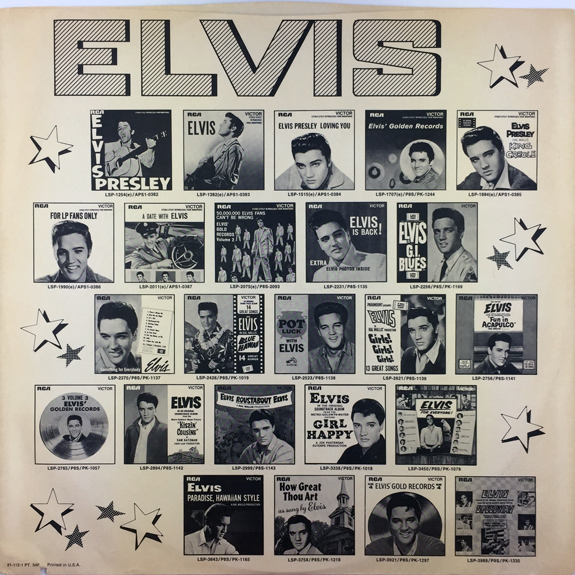
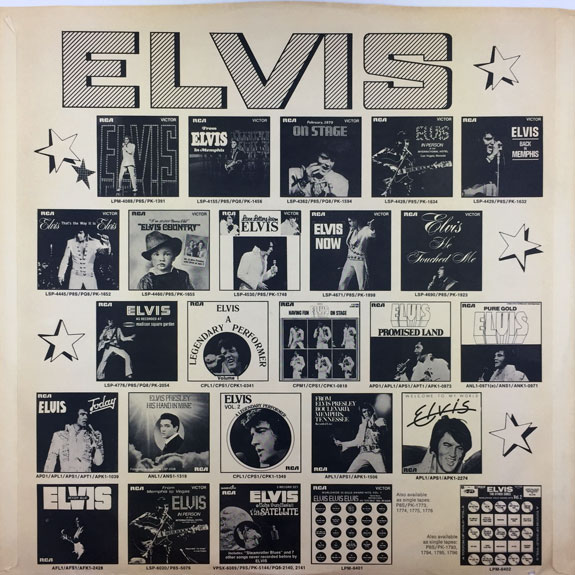
I love the inner sleeves on vintage Elvis albums. Check out the ads for other albums, which must have acted as combination check lists and wish lists for fans of the time. In some cases, it was also a way to see some alternate cover designs. For example, note the Moody Blue concept artwork in the bottom left of the image below.

Inner sleeve (back) from MOODY BLUE (RCA, 1977; from Tygrrius’ collection)

The fall of the curtain came much too early for Elvis, but Moody Blue certainly made for an impressive last act. If you collect Elvis on vinyl, this one is a must.


“Anyone who believes in Me may come and drink! For the Scriptures declare, ‘Rivers of living water will flow from His heart.'”
John 7:38

THAT’S THE WAY IT IS: Six in the Summer of ’70 (Playlist Recipes #9)

Elvis Presley performs “Polk Salad Annie” at the August 12, 1970, Midnight Show, in Las Vegas, Nevada, captured for the ELVIS: THAT’S THE WAY IT IS documentary film (MGM)

About seven years ago, I wrote a review of That’s The Way It Is: Deluxe Edition. The 2014 Elvis Presley boxed set included 8 CDs and 2 DVDs, and my review rambled on about them for nearly 10,000 words.

Despite the length of that review, there are some loose ends that I would finally like to begin tying up regarding my all-time favorite Elvis event. I don’t know how many posts this will actually take, and they won’t necessarily run sequential to one another, either. Such is the way of things when you ride The Mystery Train.

By the time of the That’s The Way It Is project, Elvis had already performed two month-long engagements at the International Hotel in Las Vegas. From July 31 to August 28, 1969, he performed 57 concerts, 11 of which RCA recorded in full near the end of the series and compiled into the Elvis In Person half of the From Memphis To Vegas/From Vegas To Memphis double album.

Elvis performed another 57-show engagement from January 26 through February 23, 1970. RCA recorded portions of nine shows from the middle of this engagement, which resulted in the core of the album On Stage.

MGM’s camera crews were rolling for the Elvis: That’s The Way It Is documentary as he began his 3rd engagement on August 10, 1970. Marketed as the “Elvis Summer Festival,” this one ran through September 8 and included 59 shows. RCA recorded the first 6 concerts in full–concluding with the August 13 Dinner Show. Only four of the live songs found their way onto the That’s The Way It Is album, which acted as a tie-in to the film but otherwise featured studio songs Elvis had recorded in June.

These first three engagements at the International Hotel include some of the greatest live performances of Elvis’ career, but the vast majority of the recordings languished away in RCA’s vaults until long after his death. While performances of individual songs were often superior in the two previous engagements, to the extent there was overlap, the overall shows in the third engagement, as captured for That’s The Way It Is, are better than any that preceded or followed them.

All right, if I’m not careful, I’ll be on the way to another unreadable 10,000 word post. I love this topic, but let’s get on with it.

To assist with today’s post, I created the following infochart covering the six concerts RCA recorded for That’s The Way It Is. The numbers in the concert columns represent the sequence he performed those songs in that particular show.

Elvis Presley Summer 1970 Setlists Infochart | Compiled by Tygrrius

Focusing on the 6 shows that RCA recorded in the course of 4 days, Elvis performed only 6 of the songs at every single concert:

  • That’s All Right
  • Love Me Tender
  • You’ve Lost That Lovin’ Feelin’
  • Polk Salad Annie
  • Bridge Over Troubled Water
  • Can’t Help Falling In Love

All of these are strong highlights, with only a couple of exceptions in individual shows.

The following songs appeared in 5 of the 6 concerts:

  • Hound Dog
  • I Just Can’t Help Believin’
  • Heartbreak Hotel
  • Suspicious Minds

Of these, the highlights are tremendous versions of “Suspicious Minds” and “I Just Can’t Help Believin'”. While the “Suspicious Minds” live performances are not quite as good as his August 1969 renditions, the August 1970 versions are still stellar and far better than the ones captured in February 1970. Though again inferior to 1969, “Hound Dog” and “Heartbreak Hotel” remain entertaining at this point and are not yet the throwaways they would unfortunately soon become – particularly “Hound Dog.”

Not including snippets, the following songs appeared in only 1 of the 6 concerts:

  • The Next Step Is Love
  • Don’t Cry Daddy/In The Ghetto
  • Stranger In The Crowd
  • Make The World Go Away
  • Twenty Days And Twenty Nights
  • The Wonder Of You
  • Don’t Be Cruel
  • Little Sister/Get Back
  • I Was The One
  • Are You Lonesome Tonight

All of the one-off songs have something to offer. One of the great “misses” of the time period, in my opinion, is “Stranger In The Crowd” not being chosen and promoted as a single for That’s The Way It Is, in lieu of “You Don’t Have To Say You Love Me.” The “Stranger In The Crowd” studio track is amazing, and his subsequent rehearsals with his core rhythm group for the live show prove it could have been dynamite. Unfortunately, the sole live version is marred by featuring too much of the Imperials vocal group and the orchestra’s horns. If only the Elvis team had worked out a simpler arrangement that was closer to those early rehearsals.

As it was his most recent hit at the time of these concerts, it is interesting that Elvis performed “The Wonder Of You” only once during the six shows.

Featuring Elvis on electric guitar, “Little Sister/Get Back,” “I Was The One,” “Love Me” (August 12 version only), and “Are You Lonesome Tonight” are all top-notch. Even the non-guitar version of “Love Me” (August 11) is a stand-out and far better than any post-1970 version.

With revised arrangements, “Words” and “I Can’t Stop Loving You” are two songs Elvis improves in Summer 1970 over his Summer 1969 performances.

Other highlights of the overall six-concert span include “Mystery Train/Tiger Man” (of course) and “Just Pretend.”

These are darn-near perfect shows. The only major Elvis categories they are lacking are gospel and the blues. It is unfortunate that Elvis did not perform “Oh Happy Day” at any of these concerts, despite having rehearsed it at the last minute, as he surely would have recorded a superlative version at this time in his career. However, the gospel sound is certainly present on a few of the secular recordings, including showstoppers “I Just Can’t Help Believin'” and “Bridge Over Troubled Water.” As for the blues, some of that influence can certainly be heard in the aforementioned electric guitar segment from the August 12 Midnight Show.

Here is my “August 1970 Ultimate Show” playlist recipe for this concert engagement. As noted, Elvis’ setlist varied widely each night, so no single show actually contained all of these songs. In fact, such a concert would have been longer than any show Elvis actually gave in his entire life, to my knowledge.

  1. Opening Riff/That’s All Right (August 10, 1970, Opening Show [OS])
  2. Mystery Train/Tiger Man (August 12, 1970, Midnight Show [MS])
  3. I Got A Woman (August 13, 1970, Dinner Show [DS]
  4. Hound Dog (August 11, 1970, MS)
  5. Love Me Tender (August 11, 1970, MS)
  6. The Next Step Is Love (August 10, 1970, OS)
  7. Just Pretend (August 11, 1970, MS)
  8. Don’t Cry Daddy/In The Ghetto (August 13, 1970, DS)
  9. Men With Broken Hearts/Walk A Mile In My Shoes (August 11, 1970, MS)
  10. I’ve Lost You (August 11, 1970, DS)
  11. There Goes My Everything (August 11, 1970, MS)
  12. I Just Can’t Help Believin’ (August 12, 1970, DS)
  13. Stranger In The Crowd (August 13, 1970, DS)
  14. Words (August 12, 1970, MS)
  15. Something (August 11, 1970, MS)
  16. Make The World Go Away (August 13, 1970, DS)
  17. Patch It Up (August 10, 1970, OS)
  18. Sweet Caroline (August 12, 1970, MS)
  19. I Can’t Stop Loving You (August 11, 1970, DS)
  20. Twenty Days And Twenty Nights (August 12, 1970, DS)
  21. You’ve Lost That Lovin’ Feelin’ (August 12, 1970, MS)
  22. You Don’t Have To Say You Love Me (August 10, 1970, OS)
  23. Polk Salad Annie (August 12, 1970, MS)
  24. The Wonder Of You (August 13, 1970, DS)
  25. Heartbreak Hotel (August 12, 1970, MS)
  26. One Night (August 12, 1970, MS)
  27. Don’t Be Cruel (August 11, 1970, MS)
  28. Blue Suede Shoes (August 12, 1970, MS)
  29. All Shook Up (August 12, 1970, MS)
  30. US Male (August 11, 1970, MS)
  31. Little Sister/Get Back (August 12, 1970, MS)
  32. I Was The One (August 12, 1970, MS)
  33. Love Me (August 12, 1970, MS)
  34. Are You Lonesome Tonight (August 12, 1970, MS)
  35. Bridge Over Troubled Water (August 11, 1970, DS)
  36. Suspicious Minds (August 12, 1970, MS)
  37. Can’t Help Falling In Love (August 12, 1970, MS)

Though I did not structure it this way on purpose, all 6 shows are represented in this “best of” playlist. If you want an even fuller compilation, you could even include “Introductions By Elvis” from the August 12 Midnight Show after “Polk Salad Annie” and before “The Wonder Of You.”

As you can probably predict from the above playlist, my favorite show of the Summer 1970 engagement is the August 12 Midnight Show (disc 6 of 2014’s That’s The Way It Is: Deluxe Edition and disc 2 of 2000’s That’s The Way It Is: Special Edition). In fact, this is my favorite Elvis concert ever. It features an impeccable setlist, Elvis in top form, and the fun electric guitar segment.

Though he still had many stellar recordings and accomplishments ahead of him, Elvis was never quite as awesome again as he was in Summer 1970. I am grateful we have so much material from that time period to enjoy. I wouldn’t be as strong an Elvis fan without the magic of That’s The Way It Is.

Blessings,
TY


“We put our hope in the LORD. He is our help and our shield. In him our hearts rejoice, for we trust in his holy name. Let your unfailing love surround us, LORD, for our hope is in you alone.”
Psalm 33:20-22