Presley wins clash of cultures in Elvis At 21

There are over 23,000 works of art in the Virginia Museum of Fine Arts, spanning some 5,000 years. There is so much to see there, in fact, that it cannot be adequately covered in a single day.

Yesterday, though, my mission was to explore only 56 of those works, all created just over 55 years ago. In VMFA time, 55 years is but a second.

The traveling Elvis At 21: Photographs by Alfred Wertheimer exhibition covers March 17, 1956, and June 30 through July 4, 1956, in the life of Elvis Presley. The images capture the young singer on the brink of fame, in the midst of a nation on the brink of change.

By March 17, “Heartbreak Hotel” is at number 15 and still rising on Billboard‘s sales chart. That evening, Elvis is to make his fifth of six appearances on Jackie Gleason’s Stage Show – a CBS variety program hosted by Tommy and Jimmy Dorsey. Initially hired by RCA to take publicity photos, Alfred Wertheimer is along with Elvis in New York City.

Entering The Warwick shows Elvis in a moment of freedom between rehearsals and the actual show. On the sidewalk, he is alone, unrecognized, unbothered – making it one of the exhibition’s most striking photographs.

Later, in his hotel room, Elvis reads fan mail and then rips it to shreds, according to one of the exhibition notes accompanying the photos. Wertheimer asks him why. “I’m not going to carry them with me. I’ve read them and seen what’s in them. It’s nobody else’s business,” Elvis tells him.

With Scotty Moore, Bill Black, and DJ Fontana behind him, he performs “Blue Suede Shoes” and “Heartbreak Hotel” on television that night. Though Wertheimer’s images are stills, there is no doubt that Elvis is very much in motion. In Jump, his feet are not even touching the ground.

When Elvis arrives in Richmond, Virginia, 15 weeks later for two concerts at the Mosque Theater (now the Landmark Theater) on June 30, his life is already changing.

He has made a final appearance on Stage Show and appeared twice on The Milton Berle Show. The second Berle appearance has proven controversial, due to his exaggerated hip movements on “Hound Dog” – a song only recently added to his stage act. In that brief time, he has also given over 85 concerts in tours criss-crossing the country (including two other shows at the Mosque on March 22). He has even cut a new record, “I Want You, I Need You, I Love You.” “Heartbreak Hotel” has now sold a million copies and hit number one. After a series of screen tests in Hollywood, he has been signed to a multi-movie deal. Production has not yet begun on his first film. Elvis does not plan to sing in his movies.

Most Elvis fans have seen Wertheimer’s images at least a dozen times over. It is striking, though, to see them within the context of an art museum. Who in 1956 would have ever believed Elvis would end up here? The prints vary in size, are framed in black, and fill two small halls. The exhibition is crowded with people, but there is plenty of time to examine each picture. Visitors talk softly to each other. In the background, though, I can hear that unmistakable voice:

“Welll, since my baby left me…well, I found a new place to dwell…well, it’s down at the end of Lonely Street…”

It’s true that I have seen these pictures before, but there is always something new. For instance, until this exhibition pointed it out, I never noticed in the image Elvis Leaving Richmond Train Station (AKA Elvis Did Have A Pelvis) that he is actually carrying and playing a portable radio as he walks out of Richmond’s Broad Street Station (now the Science Museum of Virginia).

Elvis Leaving Richmond Train Station (Detail)

Elvis Leaving Richmond Train Station (Detail): Elvis went to Richmond for two shows at the Mosque Theater. Getting off the train, he turned on his RCA portable radio. Richmond, Virginia, June 30, 1956 © Alfred Wertheimer. All rights reserved. Original image courtesy of the Virginia Museum of Fine Arts. Used with permission.

Several other Richmond images are included, including two at the Jefferson Hotel and six backstage at the Mosque. Of the Richmond images presented, one stands out among the rest. It is Elvis on stage in the magnificent Kneeling At The Mosque – used as the (unfortunately colorized) cover for the Close Up boxed set, among other projects.

After the welcome detour to Richmond, it is back to New York, this time for the Steve Allen Show. Wertheimer captures rehearsals for Elvis’ July 1 appearance.

“I went to the Steve Allen Show,” Elvis recalled in 1969. “They were going to tame me down, so they told me to stand still. They had me dressed in a tuxedo and singing to a dog on a stool.”

Much worse than singing to a dog, though, Elvis is also forced to perform with Allen in a “Range Round-up” skit. Andy Griffith and Imogene Coco also appear during the nearly unwatchable Western parody. “Allen signified his own importance by wearing the biggest white hat,” states Wertheimer in a note accompanying one of the rehearsal photos.

Allen’s attempts to embarrass Elvis and put the singer in his place, of course, have the opposite effects. The legend of Elvis only grows.

The next day, July 2, he records 31 grueling takes of “Hound Dog” and 28 more of “Don’t Be Cruel” at RCA’s New York studio. The single would prove to be one of his most popular. Included in the exhibition is RCA Victor Studio I, a shot of Elvis rehearsing “Hound Dog” with his band and the Jordanaires. It is literally history in the making.

Elvis Screams is a Wertheimer photo that has always jumped out at me. I’m pretty sure the first time I saw it was back in the 1980s on the old Cinemax documentary Elvis ’56. The shot goes by quickly, as part of a montage. At the time, I thought the documentary producers had made a glaring error.

To me, the photo looks for all the world like an image of Elvis singing in the 1970-1973 era. It is not often that a 1956 image of Elvis can be confused with one from 1973, yet the only mistake was, of course, mine. According to Wertheimer, the image captures the moment that Elvis accepted take 31 of “Hound Dog.” I still find it fascinating, because my eyes still see the “Aloha” Elvis in this image, despite what my brain tells me.

Another series of images are striking. Elvis returns to Memphis after the “Hound Dog” recording session and departs the train on July 4. He walks alone through a field and then down a sidewalk. No bodyguards, no hanger-ons, no fans. Just Elvis.

The impression is not completely “normal,” however, He has just left the train from a multiple-day trip. He holds only his acetates of “Hound Dog,” “Don’t Be Cruel,” and “Any Way You Want Me” from the recording session. No bags or other luggage in sight.

Next, we see Elvis with his father (Vernon looks positively annoyed with Wertheimer, with a “back off” look) and then with his mother. He has just moved them into a new home. Not Graceland, which is still a year away.

One of the largest images in the exhibition, Elvis plays the rebel on his Harley in No Gas In The Tank – an image which inspired one of my favorite album covers, Return of the Rocker. Surely, there is a best-selling poster to be made here.

Finally, the photo exhibition concludes with images of Elvis on stage that same night at Russwood Park in Memphis. The image that stands out most to me from the entire exhibition, perhaps because it is one I do not recall seeing before, is Elvis Onstage: Russwood. As far as the eye can see are fans. Scotty Moore is picking away on guitar, and Elvis is turning around with a look of intense joy back at the crowd behind them. You can hear the screams. You can hear the music.

“He would listen respectfully backstage to criticism from agents that wanted him to contain his movements on stage. But once Elvis got on stage, he always did it his way. He really did it his way,” states Wertheimer. His text narrative throughout the exhibition is interesting, for it reveals what the photographer thought of his subject and those around him.

It could be argued that Wertheimer spent more time with and was allowed greater access to Elvis than any other “outsider.” For all of their spectacular moments, for instance, the 1970s documentaries That’s The Way It Is and Elvis On Tour are but illusions in terms of revelations about Elvis beyond his music.

Here, in 1956, Wertheimer is able to capture everything with his lens. No one would ever get this close to the real man again. That is what makes the Elvis At 21 collection and Wertheimer’s many other Elvis photographs significant.

* * *

Feeling almost like an afterthought, though at least providing an appropriate soundtrack that can be heard throughout the experience, there is a little television and bench in the exit alcove at the end of the exhibition. The short video, licensed by Jackie Gleason Enterprises for Elvis At 21, features three complete performances of Elvis on Stage Show:

  • “I Got A Woman” (January 28, 1956)
  • “Blue Suede Shoes” (February 11, 1956)
  • “Heartbreak Hotel” (February 11, 1956)

The audio and video of the performances breathe additional life into the Wertheimer photos just witnessed.

Elvis At 21 is a simple exhibition, and that is all that is required. The works and the subject stand alone. The short video, though, leads me to wonder about the possibilities of future Elvis exhibitions benefitting from complete audio-visual integration.

* * *

I am an American, so I must admit that I looked forward to seeing what Elvis items would be available in VMFA’s gift shop almost as much as I did seeing the exhibition itself.

As we all know, Elvis merchandise can range from the sublime to the chintzy. Fortunately, most of what VMFA had to offer was closer to the former category. No Elvis potato heads, thankfully. I picked up Elvis 1956: Photographs by Alfred Wertheimer (2009), a terrific hardcover that presents all of the photos and information from the exhibition.

I also splurged on Elvis At 21: New York To Memphis by Alfred Wertheimer (2006), a massive, coffee-table sized volume that explores even more of his photographs.

Jerry Hopkins’ consolidated Elvis biography and Sonny West’s Still Taking Care Of Business were available there as well, as were some lesser titles. Anachronistic considering the theme of the exhibition, the omnipresent aviator-style Elvis sunglasses that he wore in the 1970s were also available – in both gold and silver plastic, of course. There was even a stuffed “Steve Allen” style hound dog. For this occasion, I stuck with the Wertheimer books.

* * *

For anyone who is ever near Richmond, Virginia, I can always recommend the Virginia Museum of Fine Arts. If you are an Elvis fan, though, then you really should try to make it out while this exhibition is still there. Elvis At 21 will be available through March 18, 2012. Museum admission is always free, while tickets for the exhibition are $8 for adults and $6 for seniors, students, and youths. There is no charge for museum members.
From Sweden To Richmond/From Richmond To Sweden: A Little More Conversation

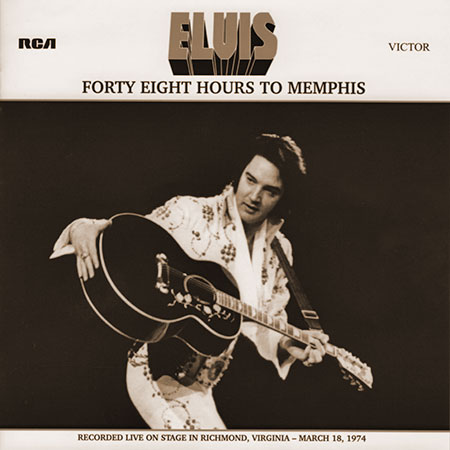
Welcome to the first ever simultaneous post of Elvis Today Blog and The Mystery Train Blog. We’re going to try something a little different and present a discussion of Forty-Eight Hours To Memphis: Recorded Live On Stage In Richmond, Virginia – March 18, 1974, one of the latest CDs from Sony’s Follow That Dream Records collectors label for Elvis fans.

The Forty-Eight Hours To Memphis title reflects that Elvis closed out his tour two days after the Richmond concert with a show in Memphis – portions of which became the 1974 album Elvis Recorded Live On Stage In Memphis.

Forty-Eight Hours To Memphis (2011 FTD, booklet cover)

Forty-Eight Hours To Memphis (2011 FTD, booklet cover)

Ty [The Mystery Train Blog]
I’m glad you thought of this idea, Thomas.

Thomas [Elvis Today Blog]
Yeah, well, it must have been exciting when you heard of this release. What was your first impression when you listened to it?

Ty
That this was obviously the best Elvis Presley release in history, as I’m sure you’ll agree! Just kidding… The first time I played it, I just tried to imagine being there, in the Richmond Coliseum that night.

Thomas
I would’ve loved to be there, that’s for sure. The atmosphere during that particular tour in the southern states obviously was an indescribably electric one, and the shows were of high quality. Have you noticed the joyful laughter from one person in the audience when “Also Sprach Zarathustra” begins? A safe bet is he’s one excited man.

Ty
That almost nervous laughter was the first thing I noticed. My other first impression, I was really happy to hear Elvis make Richmond-related references not once, not twice, but three times during the show. I think you’ve heard more Elvis concerts than I have, Thomas, but I believe it is rare for him to mention what city he is in – outside of Las Vegas, that is.

Thomas
And multiple times at that! Also, I was pleased that he mentioned Sweden as well!

Ty
This is probably the only concert where he mentions both Richmond and Sweden. Now that I think about it, I suppose he very well could have mentioned both during the March 12 show in Richmond, too. This March 18 Richmond show was added because the March 12 one sold out so quickly. So there might be two concerts where he mentions both Richmond and Sweden

Thomas
The reason Elvis mentioned my country is because Sweden’s Per-Erik “Pete” Hallin was playing piano for the group Voice at the time. I actually interviewed him once, but that’s another story.

Ty
He was a second piano player on the stage at the same time as Glen Hardin? Or just when Voice was opening?

Thomas
I think he was just playing the piano when Voice was opening, and then sang together with them on stage while Elvis was on. Elvis actually mentions Pete at the end of this concert, during “Can’t Help Falling In Love,” when he sings “… some things, you know, Pete, are meant to be…” He did this two days later in Memphis as well, where he also introduced Pete and the other members of Voice individually.

Ty
I had always wondered who “Pete” was on the Memphis show, so that clears it up. Funny that he gets the exact same mention here on the Richmond concert. As far as I could tell, it is just Elvis doing the same joke, not an audio repair or anything where they pulled it from the Memphis show.

Thomas
I agree, it’s the same joke. Elvis obviously liked to recycle his jokes, like the “I saw J.D., with baldheaded Sally” that was used both in Richmond and in Memphis during the “Rock Medley.”

Ty
I’m also pretty sure, outside of Vegas, I’ve never heard Elvis reference the hotel where he stayed. After the introductions on Forty-Eight Hours To Memphis, he thanks Richmond’s John Marshall Hotel.

Thomas
Yes, I was actually surprised to hear him mention the hotel. That is unusual.

Ty
So, that first time through, I was really happy with this CD. I was all kinds of worried that I would be disappointed with either the sound or the show itself.

Thomas
Glad you liked the show as well as the sound. Now there’s been a lot written about the sound, this being a newly discovered 2-track copy of a 16-track tape.

Ty
Right, we should address the sound controversy. I was already excited about this release when it was first announced. This represents the first official release of an Elvis concert in Richmond, after all. However, when the news later came out that the source of this concert was a 16-track professional recording, rather than the expected soundboard, I think that brought the rest of the Elvis World to where I already was in anticipating this CD.

Thomas
Yes, I was excited when I heard of this, also. A newly discovered 16-track professional recording, where did that one come from?

Ty
That’s right. All the fans were excited until FTD essentially said, “Oops, did we mention this was mono?” Then, I think FTD took a lot of heat for that. Some of it deserved, for poor communication. At the same time, I think the reaction by some fans was way overblown. But, hey, I guess that’s what Elvis fans do. How did you feel when you found out Forty-Eight Hours To Memphis would actually be in mono?

Thomas
At first, a little disappointed, maybe, but I was looking forward to the album anyway, and I have to say I was pleasantly surprised when I listened to the show for the first time. I think the sound is great!

Ty
I agree, the sound is incredible, especially considering that it is from a mono tape. I was glad to be able to put that concern to rest. I’m not someone who hates mono recordings, though. After all, Elvis has quite a few more mono songs that maybe a few of the complainers should try hearing someday. Such “unknowns” as “Mystery Train,” “Jailhouse Rock,” “One Night,” “Baby, Let’s Play House,” “Love Me,” “Santa Claus Is Back In Town,” and “Don’t Be Cruel” – to name but a few. There are also some 1960s movie soundtrack songs that I think sound better in mono than their stereo counterparts. “Viva Las Vegas” is one that immediately comes to mind. You can never please everyone, though.

Thomas
Yes, they should give them a spin. I remember when RCA made “electronically created stereo” out of a lot of the mono albums – they sounded terrible!

Ty
I’m glad they didn’t try that here.

Thomas
Yeah, me too. Thinking about it, it’s really incredible that a show in this sound quality surfaces so many years after it was recorded.

Ty
That is the real mystery here, and the liner notes really do nothing to clear that one up. Just the same kinds of speculation all of us were doing when we first heard.

Thomas
So, what about the actual show, Ty? No doubt Elvis is in good spirits and enjoying his work, wouldn’t you agree? He sounds happy and close to laughter on many occasions. “Fever” is probably as close to a laughing version as it gets. “That’s a fun song to do!” he says. At the same time, he delivers good, solid renditions of many of the songs. “Steamroller Blues” is one of the highlights to me, as is “Polk Salad Annie” and “An American Trilogy.” Not to mention “Trying To Get To You,” where he really uses his voice to the fullest.

Ty
Well, jumping right into “Fever,” I’ve never been a big fan of the “I light up when you call my name… ELVIS!” versions of this song, for some reason. So, that is my least favorite track on the album.

Thomas
In a way I agree, but I think the version two days later in Memphis is even worse.

Ty
I agree that the Richmond Fever is better than the Memphis Fever, but it’s a bad bug, either way. At times, “Let Me Be There” also grates on my nerves, and don’t even get me started on J.D. Sumner’s “Amen” dive-bomb routine. However, those are just about the only negatives I ultimately found about this show.

Thomas
Maybe that was a song that was more fun to watch than only hear.

Ty
I was also worried about “Suspicious Minds” – a favorite of mine.  I was really disappointed by the Memphis live version of that one when it finally came out a few years ago. So, I was worried that I wouldn’t like the Richmond version, either. But it’s great, very energetic. It would’ve been great to see.

Thomas
Yes, by this time he’d performed “Suspicious Minds” for five years or something, and I always thought he was tired of it, when I heard the version from Memphis. But in Richmond he does sound happier with it, that’s true, Ty!

Elvis at the Richmond Coliseum, March 18, 1974 (FTD)

Elvis at the Richmond Coliseum, March 18, 1974 (FTD)

Ty
The other highlights for me were “Also Sprach Zarathustra”/”See See Rider,” for the excitement of imagining Elvis taking the Richmond Coliseum stage by storm. “Steamroller Blues,” which I might like even better than Memphis version, my favorite rendition until this point.

Thomas
I just love the way he shouts “Aargh!” at the intro of “Steamroller Blues,” and what then follows really lives up to the song’s name.

Ty
Let’s see, I also enjoyed the “Rock Medley” – what a great idea for Elvis to link together all those songs. Rather than just do the typical “Hound Dog” throwaway, I think it worked somewhat better like this, at the tail end of the medley. It’s still too fast, but not as disappointing as most of the other post-1970 Hound Dogs.

Thomas
For some reason I thought the “Rock Medley” rocked even more than it did in Memphis, and I love the tail end too!

Ty
Yes, the “Rock Medley” was another one that Elvis performed better than its Memphis counterpart.
“Polk Salad Annie” was one I didn’t care for on Memphis, but loved it in Richmond.

Thomas
I always enjoy hearing Elvis saying things I’ve never heard in songs before, like during the guitar solo in “Polk Salad Annie” by James Burton where he says something like “Sneak up on him, Ronnie!” I can just imagine him casting a glance in Tutt’s direction while saying this.

Ty
Yeah! I guess because we’ve heard so many of his shows, that’s the kind of stuff that stands out to us. While the general public would say, “Why do I need another ‘Polk Salad Annie’?”

Thomas
The two songs that got the most serious renditions were the gospel songs, “Why Me, Lord” and “Help Me.”

Ty
I was relieved that “Why Me” wasn’t a laughing/joking version. Not that I mind some joking, but it seems ill-suited for a gospel song. I think I like the Memphis version of “Why Me” better, though.

Thomas
Elvis cared deeply for that kind of music.

Ty
You know, that’s one of the terrific things about his show, especially from this time period, the way it brings together so many kinds of music – gospel, country, blues, rock ‘n’ roll. What other so-called “rock star” could do that?

Thomas
That’s true, Ty, Elvis sang “Something for Everybody.” Speaking of the gospel stuff, I did miss “How Great Thou Art.” But hey, that’s a minor complaint.

Ty
Funny, I was just about to say the same thing about “How Great Thou Art,” which of course featured prominently on the Memphis concert album. I had a slight twinge of disappointment when I saw the Richmond track listing and it wasn’t there.

Thomas
I just love it when he sings the ending one more time in Memphis. And his voice, so powerful, it gives me goose bumps!

Ty
At least the Grammys got that one right. So, what did you think about the bonus songs, recorded in Tulsa and Memphis? I thought it was cool to hear “Sweet Caroline” in 1974. I don’t remember hearing that one outside of 1970 before. Also, “Johnny B. Goode” is always welcome.

Thomas
I think the most important thing was that they showed what a difference there is in sound quality between a soundboard and the professionally recorded Richmond concert. And once again I was reminded how very similar “My Baby Left Me” and “That’s All Right” sound.

Ty
It was really awesome to hear a 1974 version of “That’s All Right” in Memphis. That live performance was just a few months shy of the 20th anniversary of Elvis first recording it at Sun Studio there – the record that started it all.

Thomas
I hadn’t thought of that. That is indeed awesome!

Ty
What do you think about Forty-Eight Hours To Memphis being presented in the oversized, 7-inch digipack format usually reserved for FTD’s Classic Albums series?

Thomas
I thought it was great that it was presented this way. I’m a bit tired of the live material not getting treated as serious as the classic album series.

Ty
Agreed. If I remember correctly, they originally planned this treatment for As Recorded At Boston Garden last year, but a production issue or something caused them to put it in the standard, smaller format.

Thomas
Or was it the latest 1969 concert, I don’t remember.

Ty
That’s right, it was actually the Live In Vegas release they originally planned for the larger format. Maybe, FTD now intends to use that format more often? Perhaps, at least on “special” releases of live material where the sound and/or show is of a high quality.

Thomas
Here’s hoping the last couple of August 1969 and 1970 concerts will get this treatment.

Ty
That would be great. I hope that’s the case as well.

Thomas
Hopefully the 1972 concert in Richmond will also get an official release soon, together with the other shows recorded for Elvis On Tour.

Ty
Yes, that is the Richmond show that has the best chance of also getting an official release at some point.  I just hope it’s sooner, rather than later. Do you think the release of this 1974 show will mean that there will be less of a chance of the 1972 Richmond show coming soon?

Thomas
I hope not, Ty. I’ve heard that Ernst Jorgensen is waiting for Turner/Warner Home Video to make a move with the unreleased footage, to do a combo of sorts, but that won’t happen anytime soon, I’m afraid. I just hope he realizes this and releases the shows from Elvis On Tour anyway. For now I’m really pleased with FTD for releasing this Richmond show, it’s not an album that’s going to collect a lot of dust on the shelf for a long time yet.

Ty
I’m definitely happy about this release as well. This is a special CD that I’ll be playing often for the rest of my life. What are your final thoughts on this CD? What are you going to remember most about it?

Thomas
You know what I thought halfway into listening to it the first time? It hit me how happy I am being an Elvis fan, and what a pleasure it gives me to listen to a great concert like the one from Richmond. Also, that Elvis was in great shape during the March 1974 tour, delivering the goods in style! But I guess, I’m gonna remember the most how incredible it is that a professionally Elvis concert like this can suddenly make an appearance out of the blue. It was almost as exciting waiting for it as listening to it. Well, not really, but hopefully you see my point.

Ty
Yes . . . it shows hope that there is still more out there, waiting to be discovered. Things not even rumored to exist.
For me, it was really something to finally hear an Elvis concert recorded here in Richmond, where he appeared 15 times. This is number 14, yet he still sounds engaged, like he’s having a great time. Obviously, the audience was, too. It was a fantastic show. Though he came back to Richmond once more in 1976, my understanding is that this 1974 concert was his last great show in Richmond.
Thanks again, Thomas. This has been a fun little experiment, but I wonder if people will enjoy reading this kind of post?

Thomas
I sure hope so. At least it was enjoyable to write, so thank you, Ty!


As with other FTD releases, the only physical store in the US authorized to sell the Forty-Eight Hours To Memphis CD is Good Rockin’ Tonight, a Graceland gift shop in Memphis. However, the CD may be obtained online from a variety of other Elvis stores – including Graceland’s ShopElvis.com.

Forty-Eight Hours To Memphis

Live At The Richmond Coliseum, March 18, 1974
01) Also Sprach Zarathustra/
02) See See Rider
03) I Got A Woman/Amen [edited with Memphis, March 20, 1974]
04) Love Me
05) Tryin’ To Get To You
06) All Shook Up
07) Steamroller Blues
08) Teddy Bear/Don’t Be Cruel
09) Love Me Tender
10) Long Tall Sally/Whole Lotta Shakin’ Goin’ On/Your Mama Don’t Dance/Flip, Flop & Fly/Jailhouse Rock/Hound Dog
11) Fever
12) Polk Salad Annie
13) Why Me
14) Suspicious Minds
15) Introductions By Elvis
16) I Can’t Stop Loving You
17) Help Me
18) An American Trilogy
19) Let Me Be There
20) Funny How Time Slips Away
21) Can’t Help Falling In Love/
22) Closing Vamp

Elvis at the Richmond Coliseum, March 18, 1974 (FTD)

Elvis at the Richmond Coliseum, March 18, 1974 (FTD)

Bonus Songs
23) Sweet Caroline [Tulsa, March 1, 1974]
24) Johnny B. Goode [Memphis, March 17, 1974]
25) That’s All Right [Memphis, March 17, 1974]

20 reasons to love Elvis after 1972 (Conductor’s Reflections #10)

Elvis rocks the world, 1973

Elvis rocks the world, 1973

If you believe many accounts, exploring the work of Elvis Presley after 1972 is a fruitless journey through five depressing years best left forgotten. While a downward spiral of personal problems certainly affected his music, I cannot agree with the overall sentiment.

Inspired by a recent Elvis Today Blog post, I want to share 20 reasons to love Elvis after 1972.

#1 Promised Land album (recorded 1973)
Any discussion around the greatest albums of Elvis’ career should include Promised Land. Featuring that perfect Elvis blend of rock ‘n’ roll, country, and gospel, this is one of his strongest efforts. Standouts include “Promised Land” – destroying any doubts that Elvis could still rock, “Thinking About You,” “It’s Midnight,” “You Asked Me To,” and the funky “If You Talk In Your Sleep.”

#2 Aloha From Hawaii event (1973)
The magnitude of performing the first worldwide satellite broadcast by an entertainer at times seemed to overwhelm even Elvis, particularly in the first half of the main show. All too easily dismissed by some fans, the overall Aloha From Hawaii event still remains worthy of praise. Beyond the actual television special, there was also a double album that remains a classic representation of the excitement of his 1970s stage show, with standouts including “An American Trilogy,” “A Big Hunk O’ Love,” “I’ll Remember You,” “Fever,” and “What Now My Love.”

The 1988 release of The Alternate Aloha on CD revealed Elvis was much more at ease during the rehearsal/back-up concert. “Burning Love,” despite the fact that Elvis misses some of the words, and “Suspicious Minds” exceed their counterparts on the real show.

Elvis Presley Enterprise’s definitive 2-DVD set Aloha From Hawaii Deluxe Edition (2004) captures both shows in terrific audio and video quality, as well as other footage shot at that time. Though he did not pass away until over four years later, for the mainstream public, Aloha From Hawaii would prove to be Elvis’ last hurrah.

#3 Moody Blue album (1974, 1976-1977)
Moody Blue is an album recorded at Elvis’ home, Graceland, and at Elvis’ second home, on stage in front of his fans. Of the four live numbers, the strongest is a haunting version of “Unchained Melody,” recorded on April 24, 1977, in Ann Arbor, Michigan. Many of the Graceland recordings are also stellar, including “Pledging My Love,” “Way Down,” “Moody Blue,” “She Thinks I Still Care,” and “He’ll Have To Go.” As the final album released before his death, Moody Blue allowed Elvis to finish in style.

#4 “Your Love’s Been A Long Time Coming,” Take 10 (1973)
“Your Love’s Been A Long Time Coming,” which expresses a father’s love for a newborn, never stood out to me until I heard this alternate take, first released on 2002’s Today, Tomorrow & Forever boxed set.

#5 Bringing It Back/Pieces Of My Life single (1975)
Much like “Always On My Mind” backed with “Separate Ways” from 1972, 1975’s “Bringing It Back” backed with “Pieces Of My Life” evokes a complete story on one record. Though the music may not have been as groundbreaking, Elvis recorded songs of a much more personal nature in the 1970s compared to other times of his career. It’s not flashy jumpsuits that draw people to this time, but the sheer honesty of the music.

#6 My Way/America The Beautiful single (1977/1975)
“My Way” backed with “America The Beautiful” is the first Elvis record I can specifically remember playing. Recorded just weeks before his death for the Elvis In Concert television special at a show in Rapid City, South Dakota, “My Way” worked effectively as a farewell of sorts, while 1975’s “America The Beautiful,” recorded live in Las Vegas, spoke to his love of the United States and God. Though rock ‘n’ roll is not to be found on it, this record sums up Elvis Presley about as well as any other contender.

#7 “Pledging My Love,” Take 3 (1976)
One of the pleasant surprises of 1997’s Platinum: A Life In Music was take 3 of “Pledging My Love,” recorded at Graceland. Devoid of subsequent production overdubs, this works as a kind of “stripped-down” version.

#8 “Way Down,” Take 2A (1976)
Also from Platinum: A Life In Music, take 2A of “Way Down” is strong for the same reasons as “Pledging My Love” – a stripped-down sound reminiscent of earlier times. The extra band riff near the end is a delight and should have been included on the master.

#9 From Elvis Presley Boulevard, Memphis, Tennessee album (1976)
Recorded at Graceland, From Elvis Presley Boulevard is the saddest album released by Elvis. It is also his most honest. This one gives us a view into the man living in the famous mansion on Elvis Presley Boulevard. Overblown production and all, From Elvis Presley Boulevard is a beautiful and moving album. Highlights include “For The Heart,” “Hurt,” “Never Again,” and “Love Coming Down.”

#10 Good Times album (1973)
Unlike Promised Land, Moody Blue, and From Elvis Presley Boulevard, Good Times is unable to take a spot among the best albums of his career due to a few clunkers that weigh it down. However, “Good Time Charlie’s Got The Blues,” “Lovin’ Arms,” “I’ve Got A Thing About You, Baby,” and “My Boy” are standouts on this worthy album.

#11 “Where No One Stands Alone,” Live Recording (1977)
Whether we are talking 1953, 1977, or anywhere in between, Elvis Presley was always full of surprises. “Where No One Stands Alone,” released on 2007’s Unchained Melody, is one of his most incredible performances. Accompanying himself on piano, he sings the song on stage for what is apparently the only time. This live version from a February 16, 1977, concert in Montgomery, Alabama, exceeds his 1966 original.

#12 “Good Time Charlie’s Got The Blues,” Take 7 (1973)
Part of appreciating Elvis involves understanding that he never took himself as seriously as many others do. This broken up take and the resulting jokes after the fact highlight some of his behind-the-scenes humor. First released on Follow That Dream’s 2009 edition of Good Times.

#13 “She Thinks I Still Care,” Take 2B (1976)
“She Thinks I Still Care” is another alternate from the Graceland sessions. Released on 1995’s Walk A Mile In My Shoes, Take 2B takes the song at a brisker pace and works even better than the master.

#14 “I’m So Lonesome I Could Cry,” Home Recording (1973)
Though “I’m So Lonesome I Could Cry” seemed almost like album-filler on Aloha From Hawaii, Elvis sings a superior version with only himself on acoustic guitar several months later in private. Fortunately, someone rolled a tape recorder. This is a particularly poignant performance when you consider that it takes place only weeks after his divorce from Priscilla is finalized. This one can be found on 2005’s Elvis By The Presleys.

#15 Elvis Recorded Live On Stage In Memphis album (1974)
Yes, his third live album in three years had some repetitive material, but “How Great Thou Art,” “Lawdy, Miss Clawdy,” and “My Baby Left Me” help to make this one special, not to mention that it was recorded in Memphis. This version of “How Great Thou Art” earned Elvis his third and final Grammy.

#16 Raised On Rock album (1973)
Raised On Rock receives a lot of criticism, yet contains some strong tracks. Two of the best are “For Ol’ Times Sake” and “Sweet Angeline.”

#17 “I Really Don’t Want To Know,” Live Recording (1977)
Like “My Way,” this one was recorded in Rapid City on June 21, 1977, for the Elvis In Concert special, which aired posthumously. This is a great, though all too short, live version of a song he first recorded in 1970 (Elvis Country).

#18 “Reconsider Baby,” Live Recording (1977)
Elvis could always draw inspiration from the blues, even near the end. Recorded February 21, 1977, this is from the Unchained Melody album. Though Elvis formally recorded the song in 1960 for Elvis Is Back, he was playing around with this one at least as far back as 1956.

#19 “Shake A Hand,” Take 2 (1975)
2002’s 6363 Sunset included this stellar alternate of “Shake A Hand,” recorded at RCA’s Hollywood studio.

#20 “Bridge Over Troubled Water,” Live Recording (1977)
On April 29, 1977, in Duluth, Minnesotta, Elvis knocked out a great rendition of “Bridge Over Troubled Water,” though, like many 1977 recordings, it can be a painful listen. Featured on Spring Tours 77.

* * *

Elvis never claimed to be anything special. It seems, at times, people tear him down for being a flawed man rather than the perfect god they wrongly imagined him to be.

“I’m not a king, I’m just a man,” he sang in 1971’s “Until It’s Time For You To Go,” as if pleading for understanding. No one listened.

It turns out that our hero was only human, just like us. I think that makes his many accomplishments shine that much brighter.


October 23, 2011, Update:
In the comments, Joe mentioned that he decided to try all of the songs mentioned above as a playlist. I liked his idea, so here’s what I came up with.

  • For The Heart (From Elvis Presley Boulevard, Memphis, Tennessee)
  • You Asked Me To (Promised Land)
  • Bringing It Back (Today)
  • Love Coming Down (From Elvis Presley Boulevard, Memphis, Tennessee)
  • Lovin’ Arms (Good Times)
  • Pledging My Love (Moody Blue)
  • I’ve Got A Thing About You, Baby (Good Times)
  • For Ol’ Times Sake (Raised On Rock)
  • She Thinks I Still Care [Alternate] (Walk A Mile In My Shoes)
  • Good Time Charlie’s Got The Blues (Good Times)
  • Burning Love [Live] (The Alternate Aloha)
  • What Now My Love [Live] (Aloha From Hawaii Via Satellite)
  • Bridge Over Troubled Water [Live] (Spring Tours 77)
  • A Big Hunk O’ Love [Live] (Aloha From Hawaii Via Satellite)
  • Unchained Melody [Live] (Moody Blue)
  • An American Trilogy [Live] (Aloha From Hawaii Via Satellite)
  • Promised Land (Promised Land)
  • Never Again (From Elvis Presley Boulevard, Memphis, Tennessee)
  • It’s Midnight (Promised Land)
  • Way Down [Alternate] (A Life In Music)
  • He’ll Have To Go (Moody Blue)
  • If You Talk In Your Sleep (Promised Land)
  • Moody Blue (Moody Blue)
  • Your Love’s Been A Long Time Coming [Alternate] (Today, Tomorrow & Forever)
  • My Boy (Good Times)
  • I’ll Remember You [Live] (Aloha From Hawaii Via Satellite)
  • Fever [Live] (Aloha From Hawaii Via Satellite)
  • Lawdy, Miss Clawdy [Live] (Elvis Recorded Live On Stage In Memphis)
  • Suspicious Minds [Live] (The Alternate Aloha)
  • America The Beautiful [Live] (Elvis Aron Presley)
  • How Great Thou Art [Live] (Elvis Recorded Live On Stage In Memphis)
  • Way Down (Moody Blue)
  • Pieces Of My Life (Today)
  • Hurt (From Elvis Presley Boulevard, Memphis, Tennessee)
  • Sweet Angeline (Raised On Rock)
  • Thinking About You (Promised Land)
  • Good Time Charlie’s Got The Blues [Outtake] (Good Times [2009 FTD Edition])
  • I’m So Lonesome I Could Cry [Informal] (Elvis By The Presleys)
  • Pledging My Love [Alternate] (A Life In Music)
  • She Thinks I Still Care (Moody Blue)
  • Shake A Hand [Alternate] (6363 Sunset)
  • Reconsider Baby [Live] (Unchained Melody)
  • My Baby Left Me [Live] (Elvis Recorded Live On Stage In Memphis)
  • I Really Don’t Want To Know [Live] (Elvis In Concert)
  • Where No One Stands Alone [Live] (Unchained Melody)
  • My Way [Live] (Elvis Aron Presley)

REVIEW: Stage Rehearsal CD (FTD)

Stage Rehearsal (FTD CD)

August 10, 1970. The MGM camera crew has been following Elvis around for almost a month now. This afternoon, it’s time for one final rehearsal before the opening show later tonight. No camera crew allowed this time, but RCA is rolling tape in preparation for the concert recordings. Follow That Dream Records’ latest release, Stage Rehearsal, takes us behind the scenes of this event.

One of the things I’d been wondering about this release was how FTD would deal with the fact that most of the songs from this rehearsal were incomplete, due to having a “late start.” The first several seconds of these songs were not recorded. After all, RCA never intended this rehearsal for release.

The way I saw it, FTD had at least three options:

1.) Leave the recordings alone and let them start in progress — a bit jarring, but historically accurate
2.) Fade the songs up slightly as they start in progress — a little less jarring
3.) Repair the beginnings using recordings from other summer 1970 rehearsals — requires more work and is not historically accurate

I usually try to avoid reading the opinions of others when I’m planning to review something. That way, my expectations and reactions do not get swayed one way or the other in advance. Sometimes, this is impossible with FTD releases because I am in the United States, and we tend to receive them two or three weeks after most of the rest of the world.

In the case of Stage Rehearsal, I came across a comment revealing that FTD had repaired the beginnings of the songs by using live versions. My initial reaction was shock and dismay. Why would they make such a strange choice?

Once I had the actual CD in hand last week, though, and played it for the first time, it became obvious why FTD chose this path.

The sound quality of the August 10, 1970, stage rehearsal contained on this CD is comparable to the concert recordings that began later that night and continued for the next few days. To my knowledge, there are no other That’s The Way It Is rehearsals that have this level of sound quality. Using subpar sounding rehearsals as lead-ins would have probably been too obvious as splices. Instead, FTD elected to go with the live recordings to more closely match the sound of this rehearsal.

My personal preference would have been that FTD just release the rehearsal as-is, with truncated introductions. This is supposedly a collectors label, after all.

However, I can understand and appreciate their desire to make this a quality listening experience. After all, we were Elvis listeners prior to becoming Elvis historians! In this case, entertainment value won out over historic context. Considering how much I otherwise enjoy this CD, I can forgive them that.

One thing different about this rehearsal compared to some of the others I’ve heard over the years is that it does not feature Elvis really working on the songs. It feels more like a live show in that regard. This may be because this is literally hours before the opening show (captured on One Night In Vegas, a must-have FTD) and most of the kinks have already been worked out, or it could be because the recording was obviously turned off between songs. Two of the songs are repeated, so that’s evidence they were doing some work.

The stage microphones experience feedback a number of times, foreshadowing what would happen later that night during the actual concert. I wonder why this problem was not resolved prior to the show, since it was evident in the rehearsal?

There are many loose, fun moments but, in the end, the real appeal of the 1970 portion is the sound quality. None of the versions are revelations, though “version 1” of both “You Don’t Have To Say You Love Me” and “You’ve Lost That Lovin’ Feelin'” are stellar. Oddly enough, “version 2” of both of these songs splices the exact same live introductions as used on version 1. I suppose the tempo matched better than other alternatives, but this really shows why repairing the audio in this fashion was not the way to go.

A few years ago, Warner Brothers released “The Richard Donner Cut” of Superman II, showing what that director’s version of the 1980 movie may have been like had he not been replaced midway through production. To augment the available footage, screen tests of the main actors were used. This footage looks totally different compared to the rest of the film. Stage Rehearsal‘s “what if” splices between live and rehearsal material reminds me of this.

The 1972 and 1973 bonus songs that comprise the rest of this CD were recorded on a portable tape recorder. Therefore the sound quality is akin to “When The Snow Is On The Roses” and other recordings of that nature. These are definitely listenable, though they suffer a bit in following up the near-pristine-sounding 16-track recordings from 1970. I suggest playing the bonus songs first to avoid this effect.

Finally, here, we get some rehearsal work, which is pretty much lacking from the 1970 portions of this CD.

Any Day Now: By 1972, it seemed that Elvis had all but abandoned the songs he recorded at American Sound Studios only three years earlier, save the obligatory “Suspicious Minds.” Apparently not, though, for here’s Elvis sounding awesome on “Any Day Now,” leaving me to wonder why this apparently did not become part of the show.

True Love Travels On A Gravel Road: This is a good version, but seems less concert-ready than “Any Day Now.” It could’ve worked for occasional use as something different. Who knows, maybe he did use it that way.

Portrait Of My Love: Elvis does a brief, unidentified blues number before launching into “Portrait of My Love” on a whim. This is not so much a “rehearsal,” then, as it is an off-the-cuff song. It’s pretty and probably would’ve been a decent number if further developed. Wonderful to hear a “new” Elvis song, I might add.

I’m Leavin’ It All Up To You: Another “new” Elvis song. This one sounds pretty basic, but I believe that is because Elvis severely shortened it.

The funny thing is, I bought this CD because of the 1970 material, but it is the 1972 and 1973 material that stands out.

Ultimately, Stage Rehearsal is a well-intentioned release that I recommend with reservations. It offers 1970 rehearsals in terrific sound quality, but with unfortunate splicing decisions. It also offers some 1972 and 1973 rarities, but in subpar sound quality. Be aware of what you’re buying so that you won’t be disappointed. Then, just crank it up and enjoy. That’s what Elvis is supposed to be all about anyway.

REVIEW: Elvis Sings Guitar Man 2-CD set (2011 FTD edition)

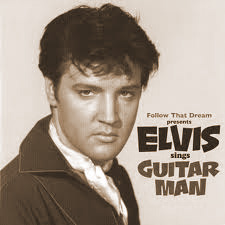
Elvis Sings Guitar Man (2011 FTD, booklet cover)

Elvis Sings Guitar Man (2011 FTD, booklet cover)

I’ve reviewed the main album masters from Elvis Sings Guitar Man in the past, so today’s review will focus on the alternate and bonus tracks that complete this latest release from Follow That Dream Records.

I should note that I don’t  have the FTD albums So High or Long Lonely Highway, so some of these tracks are new to me that may not be new to you.

“Guitar Man” [September 1967]

  • Disc 1, Track 16, Takes 1, 2, 5: After reading about this session many times over the years, it was great finally to hear for myself guitarist and singer/songwriter Jerry Reed  (the real “Guitar Man”) chatting in the studio. This is the kind of stuff that makes FTD shine, hearing a classic recording slowly come together. Sound is incredible. You can imagine you are in the studio. Take 5 is just plain fun to hear (first released on A Life In Music).
  • Disc 2, Track 11, Takes 7, 9: The ELVIS TV special may have still been a year away, but it is obvious from this track that Elvis’ comeback was already underway. Finally, he was starting to live up to his potential again. Elvis sounds inspired by Reed’s presence in the studio. Take 9 was first released on So High.
  • Disc 2, Track 12, Take 10: “Sing the living stuffing out of it, Elvis” producer Felton Jarvis encourages him just prior to this take. Oddly enough, though, take 10 is actually somewhat more subdued compared to takes 5 and 9. A decent take, but not a standout like the others. From Long Lonely Highway, this is the first take to include the “What’d I Say” jam ending.
  • Disc 2, Track 13, Takes 11, 12 (unedited, undubbed master): A treat to have the master take in its raw form here, keeping in line with the previously mentioned takes. It’s hard to sit still listening to this.

“Tomorrow Is A Long Time” [May 1966]

Disc 1, Track 17, Takes 1, 2: I mentioned above that Elvis’ comeback was underway by the September 1967 timeframe of “Guitar Man.” The opening round of the comeback actually began with the May 1966 sessions that produced this song as well as the Grammy-winning How Great Thou Art album. Though a departure for him at the time, Elvis is well-suited to this Bob Dylan tune. Take 2, first released on So High, is as good as the master, which was the very next take. Again, the sound on this CD is beyond impressive.

“Big Boss Man” [September 1967]

  • Disc 1, Track 18, Take 2: Back to the September 1967 session now, this was the second song with Jerry Reed on guitar. First heard on From Nashville To Memphis, this is overall a weak take that quickly becomes tiresome. Elvis is still trying to find his way.
  • Disc 2, Track 14, Takes 1, 3, 4, 5: This track is all false starts, but the studio chatter makes it interesting at least.
  • Disc 2, Track 15, Takes 7, 9: Jerry Reed infuses a bit of guitar-driven country into Jimmy Reed’s blues standard as the group closes in on a master. This is another impressive number. Take 9 was first released on Today, Tomorrow & Forever.

“Love Letters” [May 1966]

  • Disc 1, Track 19, Take 2: I’m not a huge fan of this song, but I will say this may well be the best version I’ve heard to date. Elvis doesn’t sound bored with it yet. In the past, I’ve generally favored his 1970 re-recording of this tune over the 1966 version. This 1966 take was first released on the Today, Tomorrow & Forever set. I don’t remember it standing out to me at the time, though.
  • Disc 2, Track 3, Takes 3, 4, 5, 7: “Too slow” Elvis announces quite correctly as the piano begins the song at what would have been a dreadful, snail’s pace. Takes 4 and 5 are also too slow, causing Elvis to end them early and call for a replay of the demo. Take 7 obviously benefits from that replay as far as tempo, but I still like Take 2 better. I’m ready to fall asleep by the end. Takes 3, 4, and 7 were first released on Collectors Gold.
  • Disc 2, Track 4, Take 8: One take back from the master. Elvis sounds weaker. Again, hard to sit through the whole thing. [First release: So High.]

“Indescribably Blue” [June 1966]

Disc 2, Track 9, Vocal Overdub Take 1: I’m not smart enough to explain why “Indescribably Blue” is a million times better than “Love Letters,” but I know that it is. One of his finest performances. Vocal overdub take 1 first released on Today, Tomorrow & Forever.

“Fools Fall In Love” [May 1966]

Disc 1, Track 20, Takes 1, 4: I think its the arrangement more than anything else that ruins what otherwise might have been a decent version of this Drifters classic. Take 4, first released on Long Lonely Highway, manages to be even more annoying than the master by including what sounds like a “chirping” trumpet in the right channel. Elvis does not yet sound as comfortable as he does on the final version.

“High Heel Sneakers” [September 1967]

  • Disc 1, Track 21, Take 5: Take 5 is more than worthy, benefiting from an awesome mix. Sounding more like a jam than a formal studio cut, this track will definitely go into heavy rotation for me. [First release: So High.]
  • Disc 2, Track 21, Takes 1, 6: Elvis sounds so good on Take 1, it’s a shame that Felton calls a halt to it early on for being too slow. Take 6 also falls apart.
  • Disc 2, Track 22, Take 7 (unedited master): First heard on From Nashville To Memphis, Elvis sings a line of “Ode To Billy Joe” before what became the master take begins. This “unedited” version runs nearly two minutes longer than the original single. As many fans have said before me, if only Elvis had gotten around to doing an entire blues album.

“Down In The Alley” [May 1966]

  • Disc 1, Track 22, Take 1 [First release: From Nashville To Memphis]
  • Disc 2, Track 1, Takes 2, 3, 4
  • Disc 2, Track 2, Take 6 [First release: So High]

Though the groove is somewhat similar, I definitely prefer “High Heel Sneakers” over “Down In The Alley.” It’s hard not to crack a smile at lyrics like, “I’ll plant you now and dig you later, because you’re a fine sweet potato,” though. Speaking of lyrics, for years I misheard one line of this song as, “The clock is striking on Uncle Sam…” so I never quite understood what that part of the song was supposed to mean. He actually says, “The clock is striking a mournful sound…” The funny thing is, I still have a hard time not hearing it as the “Uncle Sam” version, even though I know it’s wrong. In any event, if you like this song, you’ll enjoy takes 1 and 6. Takes 2, 3, and 4 are all false starts.

“Come What May” [May 1966]

  • Disc 1, Track 23, Take 2 [First release: So High]
  • Disc 2, Track 6, Takes 3, 4 [Today, Tomorrow & Forever]
  • Disc 2, Track 7, Take 6 [Collectors Gold]
  • Disc 2, Track 8, Take 7 [From Nashville To Memphis]

While fun, “Come What May” seems out-of-place on this album (right up there with “Fools Rush In”). Maybe the imaginary album should have been 12 tracks and these two listed as additional bonus songs. The more I listen to it, I think my main problem with this song is the trumpet. If only there was a version without it, I might like it more. I have nothing against trumpets in general, by the way. In fact, I used to play trumpet in middle school band way back when.

“Just Call Me Lonesome” [September 1967]

  • Disc 2, Track 19, Takes 3, 4 [First release: So High]
  • Disc 2, Track 20, Takes 5, 6

For this song, I was hoping for at least one take without the steel guitar. No such luck.

“You Don’t Know Me” [September 1967]

Disc 2, Track 23, Take 2: This alternate is a little slower. Elvis’ voice sounds like velvet. This was a perfect song for him. First released on So High.

“Singing Tree” [September 1967]

  • Disc 1, Track 24, Take 1 [First release: So High]
  • Disc 2, Track 16, Takes 2, 4 [Take 4: Close Up]
  • Disc 2, Track 17, Take 8
  • Disc 2, Track 18, Takes 10, 13 [Take 13: Long Lonely Highway]

I have a soft spot for “Singing Tree,” so I was interested to hear his first attempts at it. Take 1 is slower, but otherwise unremarkable. Take 8 has some potential, but begins to feel repetitive after awhile. One problem with all of these takes is simply too much Jordanaires for my tastes. As I’ve noted in the past, I really need a Jordanaire-specific mute button when listening to Elvis. After 13 takes without an acceptable master, they gave up on the song and moved on to “Just Call Me Lonesome” (above).

Disc 2, Track 24, Takes 1, 2, 3 (remake): The following night, Elvis and the band took another stab at “Singing Tree.” I definitely like the “remake” arrangement better. However, the background vocalists are even more annoying on take 3, so I won’t be playing it too often. Elvis throws in a somewhat incongruous “take it home, baby” near the end of the song. Remake take 5 would become the released master.

“I’ll Remember You” [June 1966]

  • Disc 1, Track 25, Vocal Overdub Take 2: Having grown up on the Aloha From Hawaii live version, I never heard the studio version of “I’ll Remember You” until release of the From Nashville To Memphis set. Though it is a remarkable performance, vocal overdub take 2, first released on So High, does not really stand out in a significant way from the master.
  • Disc 2, Track 10, Vocal Overdub (unedited master): This is a case where I prefer the edited version of a song. For my tastes, this unedited master, first released on From Nashville To Memphis, just goes on too long. As on most tracks, sound quality here is outstanding. Listen to the percussion in the right channel – awesome!

Bonus Song: “Beyond The Reef” [May 1966]

  • Disc 2, Track 5, Takes 1, 2 [undubbed master]: This has an informal feel that I enjoy. “Beyond The Reef” also fits in well as a bonus song on this album. Undubbed master first released on From Nashville To Memphis.
  • Disc 1, Track 15, Take 2 [overdubbed master]: The undubbed version is superior to this version. “Beyond The Reef” went unreleased during Elvis’ lifetime. This overdubbed version made its debut on 1980’s Elvis Aron Presley boxed set.

Source for “first release” information was the excellent Elvis In Norway site.

* * *

Cover art for Elvis Sings Guitar Man is well-done and suits the 1967 time period. The booklet is informative, and I particularly enjoyed seeing the repertoire (material submitted by Elvis’ music companies; songs requested directly by Elvis; song list sent to arranger) for a cancelled August 1967 session originally scheduled for Los Angeles. As for sound quality, it is incredible. FTD seems to be getting better and better with every release. In particular, the Classic Album series has reinvigorated the label.

The absolute highlight of this release for me is hearing Elvis Presley and Jerry Reed in the studio together on “Guitar Man” and “Big Boss Man.” It was a collaboration that would sadly prove to be all too short.

Elvis Sings Guitar Man is a unique album, compiling music from scattered releases to better document an important timeframe in Elvis’ career. The opening salvos of the comeback had been fired, but few noticed because of the release strategy around his music at that time. Whether acknowledged or not, Elvis had taken the first steps down his path of musical redemption. Big changes were just around the corner.

* * *

DISC 1

01) Guitar Man 2:22
02) Tomorrow Is A Long Time 5:24
03) Big Boss Man 2:54
04) Love Letters 2:52
05) Indescribably Blue 2:50
06) Fools Fall In Love 2:08
07) Hi-Heel Sneakers 2:48
08) Down In The Alley 2:54
09) Come What May 2:03
10) Mine 2:39
11) Just Call Me Lonesome 2:08
12) You Don’t Know Me 2:32
13) Singing Tree 2:22
14) I’ll Remember You 2:48

Bonus Song
15) Beyond The Reef (overdubbed version)

First Takes
16) Guitar Man – takes 1,2,5 4:22
17) Tomorrow Is A Long Time – takes 1,2 6:15
18) Big Boss Man – take 2 3:35
19) Love Letters –take 2 2:53
20) Fools Fall In Love – takes 1,4 2:40
21) Hi-Heel Sneakers – take 5 4:58
22) Down In The Alley – take 1 3:13
23) Come What May – take 2 2:12
24) Singing Tree – take 1 3:11
25) I’ll Remember You – vocal overdub take 2 4:14

DISC 2

May 1966 Sessions
01) Down In The Alley – takes 2,3,4 2:18
02) Down In The Alley – take 6 2:51
03) Love Letters – takes 3,4,5,7 4:39
04) Love Letters – take 8 3:12
05) Beyond The Reef – takes 1,2 (undubbed master) 5:42
06) Come What May – takes 3,4 2:27
07) Come What May – take 6 2:07
08) Come What May – take 7 – 2:21

June 1966 Sessions
09) Indescribably – (vocal overdub) take 1 2:55
10) I’ll Remember You – (unedited master) vocal overdub 1 4:10

1967 Sessions
11) Guitar Man – takes 7,9 2:52
12) Guitar Man – take 10 2:55
13) Guitar Man – takes 11, 12 (unedited/undubbed master) 4:02
14) Big Boss Man – takes 1,3,4,5 3:19
15) Big Boss Man – takes 7, 9 3:48
16) Singing Tree – takes 2,4 3:28
17) Singing Tree – take 8 3:03
18) Singing Tree – takes 10,13 3:44
19) Just Call Me Lonesome – takes 3,4 2:55
20) Just Call Me Lonesome – takes 5,6 2:31
21) Hi-Heel Sneakers – takes 1,6 2:51
22) Hi-Heel Sneakers – take 7 – (unedited master) 4:57
23) You Don’t Know Me – take 2 2:57
24) Singing Tree – (remake) takes 1,2,3 3:21

Elvis 1967: The Once And Future Album (The Edge Of Reality #3)

There are infinite universes, beyond that which is known to man. Imagine, if you will, one such alternate dimension in which an entertainer named Elvis Aaron Presley set a slightly different course for his life. In that universe, one of the entertainer’s fans was also born thirty years sooner. This allowed him to document what happened when the entertainer took a stand in 1967. Submitted for your approval is this brief glance into… the edge of reality.

The Mystery Train Elvis Newsletter (November 1967)

The Mystery Train Elvis Newsletter (November 1967)

THE MYSTERY TRAIN ELVIS NEWSLETTER
Volume XII, Issue 4, Number 48
November 1967
– Page 2 –

Hitchhike all the way down to Memphis with Big El
A review of Elvis Sings Guitar Man by Ty.

Word has it that Elvis had a major blow-up with RCA Records over Elvis Sings Guitar Man, which hit record stores last week. RCA originally planned to issue some of these songs on a soundtrack record for the new Clambake movie, which will be playing at a theater near you later this month.

Elvis insisted on an album with no movie songs, though. If the rumors are true, he apparently even threatened to fire his long-time manager over the debacle until the Colonel worked it out with RCA. Meanwhile, Elvis’ newly hired personal attorney is still reviewing management and recording contracts he signed earlier this year. With two cancelled movie soundtrack albums in as many years, could major shakeups be on the way? Stay tuned.

Ironically, the similarly-titled Elvis Sings Memphis, Tennessee came about due to similar circumstances back in 1963. As you probably recall, the legend goes that Elvis nearly fired the Colonel back then, too. Seems the Colonel wanted to replace that album’s release with a new installment of the Golden Records series. Elvis’ instincts proved right back then, for the platinum-selling Memphis, Tennessee album made it to number three on the charts.

In any event, with the Clambake songs shelved for now, we Elvis fans get this album instead. Was he right to take the same stand for Guitar Man as he did for Memphis, Tennessee? Let’s find out.

SIDE 1

Guitar Man: Elvis has gone Country & Western? That’s what this first song tells us. Musically, this is much better than anything on the Double Trouble LP and the Easy Come, Easy Go EP from earlier this year. In terms of Elvis’ commitment, this is more on par with the How Great Thou Art LP Gospel album that kicked off this year. Can the whole album live up to this first song, though?

Tomorrow Is A Long Time: While writer Bob Dylan has not released this song himself, Folk music fans may have heard it on the Odetta Sings Dylan album that she put out a couple years ago. I must admit, I never expected Elvis to sing Dylan, though! Even more so than “Guitar Man,” this is a very unusual song compared to what we are used to from him. I like it as something different, but hope the entire album isn’t like this.

Big Boss Man: Some people think that Country & Western is about as far apart from the Blues as you can get. Apparently not Elvis, who delivers yet another fine performance. This time, it is a Blues song done in what is almost a Country & Western style. It was combining different styles of music that helped Elvis to create Rock ‘n’ Roll back in the old days anyway. Be sure to listen out for a slight change to the words. Instead of “I want a little drink of water, but you won’t let Jimmy stop,” he sings, “I want a little drink of water, but you won’t let Big El stop.” I like the sound of that. I think I’ll call him that from now on. Of note, RCA originally planned this for release on 45 in the fall. They even put out ads for it, but the single was held back – probably while waiting for the various parties to resolve the whole Clambake album controversy.

Love Letters: After such a start, this is a ballad for the ladies. Not as strong as “Can’t Help Falling In Love,” but more along the lines of “Ask Me.” You might remember that Big El had a bit of a hit last year with this on 45 RPM.

Indescribably Blue: We know this one already, too. It was a 45 earlier this year. Though it didn’t do very well, I still say it is one of his best records. Sounds a lot like a modern take on his early days. I don’t mind hearing it again in the context of what is starting to sound like, dare I think it, his finest album in years.

Fools Fall In Love: Now the B-side of the above single. I didn’t like this one as much. Stick with the Drifters for this one. From the sound of things, Big El might have thought this one was for a movie. Most albums have a little filler, though.

High Heel Sneakers: Finally, back to new songs. Big El takes the Blues head on here and triumphs. A real treat!

SIDE 2

Down In The Alley: Big El starts Side 2 in much the same way that he ended Side 1, with a Blues number. Not as effective as “High Heel Sneakers” and a little whiney for my tastes, but still an enjoyable performance. At least he sounds like he cares about these songs.

Come What May: This was the flip side to the “Love Letters” 45. Big El’s version is a little faster than Clyde McPhatter’s from ten years ago. Much like “Fools Fall In Love,” the arrangement here sounds like a movie song. He has to be more careful not to let that sound carry over into his “real” music. After taking his stand against RCA, would he have been better served to demand another recording session to properly finish this album? Maybe that’s expecting too much at once.

Mine: Here we are on the very next song and Big El makes up for “Come What May” and then some. “Mine” is a beautiful song, one of his very best love songs – right up there with “Can’t Help Falling In Love.” Way better than “Love Me Tender.”

Just Call Me Lonesome: And now the album turns Country & Western again! You can’t say you’re not getting variety here. Only Big El could pull off making all of these styles work as one album.

You Don’t Know Me: Ever since I first heard the Ray Charles version of this Eddy Arnold Country & Western song a few years ago, I always wondered what an Elvis version would sound like. Now, I no longer have to wonder. Big El turns in a somber performance that truly conveys the heartache of the lyrics. This is Elvis at his best. Look for a version of this when you go see Clambake. Is it possible that the rest of the Clambake songs were this good? I have a hard time believing that, but I guess we’ll know when the movie comes out.

Singing Tree: Big El stays in the Country & Western neighborhood for this one. While it does not compare to “Mine” or “You Don’t Know Me,” this song about lost love is still interesting and a fine performance.

I’ll Remember You: This one is another surprise, sounding like a cross between “Tomorrow Is A Long Time” from Side 1 and the Blue Hawaii soundtrack. With a little Country & Western thrown in. I’m not kidding! Again, only Big El could pull this off. Another beautiful song.

* * *

I don’t know in what insane universe RCA would waste these songs as filler on movie soundtracks, but I’m sure glad it’s not ours. 1967 has certainly been a year of change for Elvis. As covered in our previous newsletter, he married his longtime sweetheart just a few months ago. Early next year, he and Ann-Margret are expecting their first child (see article on page 1 of this issue). Let’s hope that How Great Thou Art and Elvis Sings Guitar Man mean more good things are on the way in 1968.

So, I know the completists among you are wondering about the songs recorded for the Clambake movie. Will we ever get to hear them on record? Word around the rumor mill (which sure has been busy this year) is that they might be combined with songs from last year’s cancelled Spinout soundtrack album to make an Elvis Double Feature album. Stranger things have happened.

Thanks for reading, everyone. Have a Happy Thanksgiving, a Merry Christmas, and a Happy New Year! See you in 1968!

A fairytale? A fantasy? A careless product of wild imagination? You can believe or disbelieve, accept or reject; but if this isn’t real, then we’re all condemned to… the edge of reality.

[With apologies to Serling.]


Throughout 2011, The Mystery Train is commemorating the 44th anniversary of 1967. Find out why here.

REVIEW – Live In Vegas: August 26, 1969 Dinner Show CD (FTD)

Live In Vegas: August 26, 1969 Dinner Show CD (Follow That Dream Records, 2011)

If you believe some fans, surely we’ve already heard enough 1969 Las Vegas concerts. Now that Live In Vegas: August 26, 1969 Dinner Show is available from FTD, let’s take a closer look at their claims.

Claim: If you’ve heard one 1969 show, you’ve heard them all.
Verdict: FALSE

For those who believe there are no more revelations to discover in these shows, I can easily pull one example of many from this release alone. For over 40 years now, Elvis fans have listened to the 1969 compilation Elvis In Person. How many ever realized that Elvis dedicated the specific performance of “Suspicious Minds” contained on that album to Barbara McNair, one of his Change Of Habit co-stars?

Elvis evidently thought a lot of McNair, who played Sister Irene, for he plugged her upcoming TV series, The Barbara McNair Show, when presenting her to the audience. As mentioned, Elvis’ introduction of the familiar version of “Suspicious Minds” is now slightly different: “A new record that just came out, ladies and gentlemen, I hope you like it, I’d like to do this especially for Barbie, it’s called ‘Suspicious Minds.'”

Though it is the sixth full-length show released from this engagement, Live In Vegas actually marks the first release of a concert that contributed songs to the Elvis In Person compilation (“Suspicious Minds” and “Can’t Help Falling In Love”). One of the joys of being able to hear complete 1969 shows like this one is re-discovering a song within its original context.

Claim: Every 1969 show had the same set list.
Verdict: FALSE

Live In Vegas is actually the first full show released thus far to include “My Babe” (previously compiled on Elvis Aron Presley) or “Inherit The Wind” (previously compiled on Collectors Gold). This is also the first full show so far where Elvis omits “Are You Lonesome Tonight” and only the second where he omits “What’d I Say.”

Incidentally, the inane argument that the set lists were always the same wasn’t even true of the first five shows released. Don’t get me wrong – of course, the core set lists are similar. These shows were all recorded within less than a week’s time, after all. The amusing part is that some fans apparently expect that Elvis should have completely revamped his show night after night. The 1969 concerts were about as perfect as any Elvis did in his career, but that’s not good enough for some.

Claim: If you’ve already heard the Midnight Show from this same date on All Shook Up, Live In Vegas will just be more of the same.
Verdict: FALSE

Though indeed recorded just a few hours apart from one another, the shows captured on All Shook Up and Live In Vegas are quite different from one another and do not play like repeats of the same show. The biggest difference is tone. While Elvis seems unable to control his infectious laughter through much of All Shook Up – including the fantastic “Are You Laughing Tonight” – he is much more focused on Live In Vegas. In fact, other than a few snickers here and there, there is little foreshadowing in the Dinner Show as to what will occur in the Midnight Show.

As far as the songs performed for these specific shows, the Dinner Show (Live In Vegas) features “Memories,” “My Babe,” and “Inherit The Wind,” which are not present on the later show. The Midnight Show (All Shook Up), on the other hand, features “I Can’t Stop Loving You,” “Are You Lonesome Tonight,” “Rubberneckin’” and “This Is The Story,” which are not present on the earlier show.

I find being able to listen to two shows from the same day during this incredible time of Elvis’ career to be one of the most positive aspects of this release, certainly not a drawback. It is fascinating to imagine being there for that single day, somehow fortunate enough to have tickets to both shows.

Show & Sound Quality

I’m just glad Ernst Jorgensen and the rest of Sony’s Follow That Dream team do not subscribe to the sort of claims refuted above. If they did, we might have missed out on Live In Vegas.

With that out of the way, we can now move on to more important things, like show and sound quality. The first few times I played this disc, my opinion was that no 1969 show had ever sounded this vibrant.

I have played all six full shows this week and part of me believes that Live In Vegas is the best of the complete 1969 shows released so far, in terms of Elvis’ performance. I am not quite ready to say that yet, though. I want to give more time for the newness to wear off and allow myself to compare the various shows more objectively. Like all of the other 1969 shows thus far released, though, this is without a doubt one of Elvis’ greatest concerts.

Elvis treats his classics with more respect in 1969 than he would in later years. “Blue Suede Shoes,” “All Shook Up,” “Love Me Tender,” “Jailhouse Rock,” and “Don’t Be Cruel” are all contenders as his best 1969 versions.

“You see, they fixed these lights up for Nancy Sinatra. They wouldn’t do it for me. That shows where the pull is. . . . I’ll show ’em, I won’t come back,” Elvis states shortly after welcoming the audience early on. Nancy’s engagement on the same stage would begin on August 29, just a day after Elvis’ would end. Elvis stuck around and caught her show and, despite his joke, returned to the International for another engagement just six months after this first one.

“Hound Dog” is also great, once you get past his cringe-inducing introduction of the song that also plagues every other version released so far from this engagement.

There are two tracks I always pay close attention to on the 1969 shows. One is “Suspicious Minds” – already a known factor on this album – and the other is the “Mystery Train/Tiger Man” medley. Elvis does a kickin’ rendition of this medley on Live In Vegas.

While Ronnie Tutt’s jungle drums are the focus in the first bits of “Tiger Man” before the second guitar break, the mix turns over to James Burton’s rockin’ guitar riffs for the other half of the song. It makes for a great compromise and one of the best versions of the song yet released.

I have yet to hear a bad version of “Runaway” from these shows, and this one is no exception. What a terrific performance from Elvis, driven again by James Burton. Too bad it was dropped from the show after 1969.

“Yesterday” is the typical “I’m not half the stud…” version and, as usual, the tacked on “Hey Jude” ending is no help.

After introducing the band, Elvis has Barbara McNair stand and introduces her as “a young lady that I just got through making a picture with called Change Of Habit, and I found her to be one of the nicest, warmest, lovingest people I’ve ever met.” When audience members complain they could not see her, he has the lights turned back on so she can stand up again.

It’s really cool hearing Elvis promote one of his movies on stage. Since he took a break from concerts through most of the 1960s, when he made the bulk of his movies, this was not an opportunity he had very often.

“In The Ghetto” is beautiful, similar to the Elvis In Person version.

On both of his August 26 shows, Elvis omits his breakneck speed version of “What’d I Say” and, in my opinion, the shows are all the better for it. “Suspicious Minds” is the ideal penultimate song, segueing perfectly into “Can’t Help Falling In Love.”

Speaking of “Can’t Help Falling In Love,” the Elvis In Person version has always been my favorite from 1969, and it sounds even better here.

* * *

Live In Vegas showcases Elvis Presley at his best on stage in a sound presentation that is richly mastered and crystal clear.

Sony reportedly has another six full shows from this engagement in its vault, including three more that contributed songs to the Elvis In Person album: the August 25 Dinner Show and the August 24 & 25 Midnight Shows.

There will always be complainers–even when Elvis was alive, he couldn’t please everyone, not even in 1969–but here’s hoping the rest of those 1969 shows, particularly the Elvis In Person ones, are eventually released. I’m looking forward to hearing each and every one of them.