“Elvis Song Of The Year” for 2013

According to iTunes, out of 3,572 unique Elvis tracks in my collection, the one I played most often in 2013 was “Stay Away,” the flip side of “U.S. Male” in 1968. I played the track 22 times.

Based on the traditional melody of “Greensleeves,” which also inspired the 19th century Christmas classic “What Child Is This,” “Stay Away” played over the opening titles of Stay Away, Joe, Elvis’ 26th movie.

Considering how little time I have had for this blog lately, “Stay Away” indeed seems like the perfect Elvis song to represent 2013 for me.

Stay Away (1968)

Stay Away (1968)

I listened to 8,499 Elvis songs using iTunes or my iPods in 2013 (including duplicates). That is an average of 23 Elvis songs a day. I listened to 2,353 different Elvis tracks during the year.

Out of 3,700 non-Elvis tracks in my collection, my most played piece in 2013 was Michael Giacchino’s “Spock Drops, Kirk Jumps,” from his 2013 Star Trek Into Darkness film score. I played that one 26 times.

Among vocal performances, the non-Elvis track I played most was 2008’s “All I Want” by Darius Rucker (20 plays), from his Learn To Live album.

Overall, I listened to 12,629 songs using iTunes or my iPods this year. That works out to 35 songs a day.

* * *

Thank you for reading. May 2014 be your best year yet!

King Creole: A Stone For Danny Fisher

A Stone For Danny Fisher: Now A Major Motion Picture From Paramount

Herbert Baker and Michael Vincent Gazzo based the King Creole screenplay on the 1952 novel A Stone For Danny Fisher by Harold Robbins. Until I read the book, my knowledge of the author was limited to the following exchange between Jim Kirk and Spock in 1986’s Star Trek IV: The Voyage Home.

Jim Kirk and Spock discuss language on 20th century Earth in STAR TREK IV

Jim Kirk (William Shatner) and Spock (Leonard Nimoy) discuss language on 20th century Earth in STAR TREK IV: THE VOYAGE HOME (1986).

In the film, the Enterprise crew has journeyed back in time 300 years to 20th century Earth. Kirk has been trying to fit in with the natives.

Spock: Your use of language has altered since our arrival. It is currently laced with, shall I say, more colorful metaphors….
Kirk: You mean the profanity?
Spock: Yes.
Kirk: That’s simply the way they talk here. Nobody pays any attention to you unless you swear every other word. You’ll find it in all the literature of the period.
Spock: For example?
Kirk: Well, the collected works of Jacqueline Susann, the novels of Harold Robbins.
Spock: Ah. The giants.

With Vulcan sarcasm in mind, I was not quite sure what to expect from Robbins’ novel.

While I feel the acting potential of Elvis Presley was never fully realized, even I acknowledge that he probably would have been less than convincing in 1958 playing a Jewish boxer from Brooklyn. Who am I to say, though? Maybe he would have pulled it off.

While Danny Fisher morphs into a religiously-ambiguous singer from New Orleans in King Creole, the interesting thing about reading the novel is that it does feel like the same character. The book, then, acts as an excellent back story for the film. According to biographer Peter Guralnick, Elvis even read the novel as part of his preparations for the movie (Last Train To Memphis, page 450).

Guralnick’s claim is backed up by the sheer strength of Elvis’ performance in the role. The character seems more than what is on the page of the film script, and I believe Elvis reading the novel beforehand is part of what makes Danny so believable. This is a character who has already lived, already has a history, before the events of the movie begin. Compare that with Vince Everett of Jailhouse Rock, who seems to fade into existence just to serve the purpose of the movie.

A Stone For Danny Fisher is written in first person perspective, meaning in this case that Danny is actually the one telling his story. I could not help but imagine much of the book with Elvis as Danny.

As one would expect, the novel captures a much broader story than the film does. While the movie focuses on Danny at 19-years-old in 1958, the book covers his life from 8-years-old in 1925 up until 27-years-old in 1944.

Only touched upon in the film, one of the recurring elements of the novel is Danny’s house. Danny’s family moves from a tight apartment into a more spacious home. Moving day is his eighth birthday, and his father tells him the house is his present.

I turned and pressed my lips to the cool floor. “I love you, house,” I whispered. “You’re the most beautiful house in the whole world, and you’re mine and I love you.”

Danny’s father loses the house during the depths of the Great Depression in 1932, and they are forced to move again. From that point on, his relationship with his father is different.

That was the night when for the first time I admitted to myself that it was not my house, that it really belonged to someone else, and there was no heart left in me for tears.

As in the movie, Danny takes Nellie to see his old house, vowing to someday buy it back.

Nellie listens to Danny talk about his house in KING CREOLE

Nellie (Dolores Hart) listens to Danny (Elvis Presley) talk about his house in KING CREOLE (1958).

The movie version of the scene is illustrative of the issues in the relationship between Danny and Nellie. More so than any other point in the movie, Danny is being open with Nellie and sharing something that is extremely important to him. She misses this entirely, barely reacting at all. It is a telling moment, as the two characters appear to be in the middle of completely different conversations.

Danny: You see that house over there? Way over there. See it? That used to be our house. Pa bought it when I was about 8-years-old. It was kind of my birthday present. We sure had a lot of happy times there. I’m gonna buy that house back someday or one just like it. And I guarantee nobody’s gonna take it away from me. Nobody.
Nellie: I told my mother about you. I told her I met a million-dollar boyfriend in a five and ten cents store.

In the novel, Nellie is much more present in the scene. It draws them closer together, while the film version seems to distance them.

We were standing on a dark empty corner, almost ten o’clock at night, in a neighborhood in Brooklyn she had never even known about. I raised my hand and pointed across the street. “See it?” I asked. […] “It’s my house. I used to live there. Maybe soon we’ll be able to move back.”

A sudden light came into her eyes. She glanced quickly at the house, then back at me. Her mouth softened gently. “It is a beautiful house, Danny,” she said in an understanding voice.

My hand tightened on her arm. “Papa gave it to me for my birthday when I was eight years old,” I explained to her. […]

“And now you will move back here,” she whispered softly, pressing her face against my shoulder. “Oh, Danny, I’m so happy for you!”

As told through Danny’s eyes, the writing of the novel varies from crude to eloquent. Even the movie shows some of this dichotomy of character. Think of the crudeness of Danny propositioning the innocent Nellie outside of Room 205 versus the eloquence of him singing “As Long As I Have You,” for instance. While the overall tone is often gritty, I was surprised at the beauty of certain passages of the novel. Though a boxer and later a business man of questionable virtue, Danny has a poet’s soul.

I find Danny in King Creole to be a frustrating character because he seems to have a good heart, yet keeps taking the wrong steps or simply getting bad breaks. The novel version of Danny has many of the same qualities. Like his house, true happiness often seems just within his reach, before it is ripped away from him. Seeing this pattern, Nellie eventually becomes afraid of the house, afraid of what will happen when Danny finally obtains what he has sought for so long.

Reading the book made me realize that Baker and Gazzo’s screen adaptation represents a masterpiece of writing in its own right. It pulls bits and pieces from the novel and carves out a new, yet familiar story. To reference more recent Star Trek movies, King Creole feels like an alternate universe version of the Danny Fisher story.

It was almost as if I were watching this from a seat in the movies. I wasn’t really a part of it. It was another guy named Danny Fisher, and he had gone away two years ago and never really come back.

Though the fates of certain characters differ from the film, the book also offers the rare opportunity to find out “what happens next.”

While a departure from what I normally read, A Stone For Danny Fisher is a worthwhile, well-written novel that sheds more light on the story behind King Creole and the material that inspired how Elvis portrayed his character.


My grandmother worked in the ticket booth of a theater for decades. I dedicate this series of movie posts to her, who would have turned 103 this year. I often remember her when I watch movies.


Steve Brogdon sets new record conquering Elvis Trivialities #5

The Mystery Train’s Night Riders have a new member. Setting a new record, Steve Brogdon correctly answered Elvis Trivialities #5 in only 17 minutes. In recognition of this outstanding achievement, Steve now has a brand-new set of bragging rights.

And the answer is…

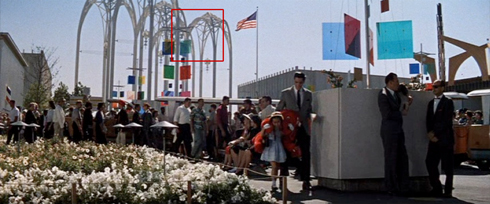
The Mystery Train Elvis Trivia 5

The above image slice is from the Elvis movie It Happened At The World’s Fair.

It Happened At The World's Fair (1963)

The real question should have been, what exactly happened at the world’s fair?

The 1963 film also starred Joan O’Brien and Gary Lockwood. Kurt Russell had a bit part in the movie as the boy who kicks Elvis. Russell went on to portray the singer in 1979’s Elvis, directed by John Carpenter. An homage to the scene appears in 2001’s 3,000 Miles To Graceland, which also starred Russell.

The 1979 Elvis movie was produced by Dick Clark. Now, stay with me, here’s some even stranger trivia for you. John Carpenter (best known for directing Halloween) shares his name with the character Elvis played in 1969’s Change Of Habit. Change Of Habit was directed by William A. Graham. Graham directed 1993’s Elvis & The Colonel: The Untold Story (one of the worst movies about Elvis, and that’s an accomplishment), which, get this, was also produced by Dick Clark! Confused yet?

Whew! Meanwhile, Gary Lockwood from It Happened At The World’s Fair went on to play Gary Mitchell in “Where No Man Has Gone Before,” the Star Trek pilot that sold the series. Yesterday, Star Trek celebrated its 45th anniversary. Lockwood is most known, however, for playing Dr. Frank Poole in 1968’s 2001: A Space Odyssey. Elvis, of course, went on to use “Also Sprach Zarathustra” as his opening theme in most of his 1971-1977 concerts. Richard Strauss’ 1896 composition was also used as the theme to 2001.

If you’re lookin’ for trivia, you came to the right place.

Meanwhile, you never know when I’ll post the next question. The best way to have a chance to win is to subscribe to The Mystery Train Elvis Blog using the feature in the menu bar to the right. Then, you’ll be notified by email whenever there is a new post.

Congratulations again to Steve!


The Mystery Train’s Night Riders

  • September 9, 2011: Steve Brogdon (0:17) <— Record time
  • August 6, 2011: Thomas (2:26)
  • July 9, 2011: Thomas (5:26)
  • June 23, 2011: Fred Wolfe (0:18)
  • June 22, 2011: [Ty stumps the train]

Thomas claims victory in Elvis Trivialities #4, becomes first back-to-back winner

Thomas has once again triumphed over Elvis Trivialities by being the first person to correctly answer the fourth installment.

With a response time of two hours and twenty-six minutes, he becomes the first member of The Mystery Train’s Night Riders to score not only a repeat victory, but a back-to-back one at that. Thomas now receives even more bragging rights.

And the answer is…

Brett Reno in Love Me Tender was played by an actor who later had two different roles on Star Trek.

Veteran character actor William Campbell portrayed Brett Reno, a brother to Clint (Elvis). Among many other television roles, he went on to appear as Trelane in the first season Star Trek episode “The Squire of Gothos” (1967) and Koloth, a Klingon captain, in the second season episode “The Trouble With Tribbles” (1967). Both installments consistently rate among Trek’s best.

He reprised the role of Koloth in “Blood Oath,” a 1994 episode of Star Trek: Deep Space Nine. Campbell passed away earlier this year.

Congratulations again to Thomas!


The Mystery Train’s Night Riders

  • August 6, 2011: Thomas (2:26)
  • July 9, 2011: Thomas (5:26)
  • June 23, 2011: Fred Wolfe (0:18) <— Record time
  • June 22, 2011: [Ty stumps the train]

Elvis Trivialities #4

Welcome to Elvis Trivialities. Your question is:

Which character in Love Me Tender was played by an actor who later had two different roles on Star Trek?

Bragging rights to the first person to post the correct answer in the comments below.

Will we have our first repeat winner? Or will a new winner join their ranks? Can anyone break Fred Wolfe’s speed record? Check in next time to find out.

Space: An Elvis Odyssey [The Film Frontier blog]

Thomas Melin over at the Elvis Today Blog asks readers what song they would choose to be woken up to if they were flying in space for NASA (“Hound Dog Most Played Elvis Song In Space” — Elvis Today Blog). NASA’s astronaut wake-up songs are a tradition dating back to the mid-1960s. As Thomas notes, the most played Elvis song for astronauts is “Hound Dog.”

As much as I love Elvis, I have to admit that I would pick the classic Star Trek theme as my wake-up song. As for Elvis songs, it definitely would not be “Hound Dog.” That would not even make the long list, much less the short one.

Maybe something like “If I Can Dream,” or even “Follow That Dream” — because surely I would feel like I was dreaming if I were fortunate enough to be there.

Thomas is also the author of The Elvis Today Blog, a book that shares his thoughts and insights on Elvis, available now from Blurb.

REVIEW: The Christmas TV Companion book [The Film Frontier blog]

The Christmas TV Companion:
A Guide to Cult Classics, Strange Specials, & Outrageous Oddities
1701 Press, softcover
Release date: November 10, 2009
Author: Joanna Wilson

The Christmas TV CompanionI cover many subjects here on The Film Frontier. Beyond key ones like Star Trek, Star Wars, Superman, and Elvis Presley, I also give love to, among others, The Twilight Zone, Mystery Science Theater 3000, and Charles Schulz’ Peanuts gang from time-to-time. I like to think this is a rather eclectic combination not soon to be found anywhere else.

To some degree, however, all of these topics and more are covered in The Christmas TV Companion by Joanna Wilson. (Fair warning to Superman fans: the associated reference is just an “also appeared in” credit for Margot Kidder on one page.) The book’s main revelation to me is demonstrating a common thread among all of these topics I previously thought were so diverse: Christmas.

The Christmas TV Companion takes readers on a journey through some of pop-culture’s best and worst Christmas moments. Hold on tight for this ride from the traditional to the blasphemous and every point in between.

Core sections of the book are Macabre, Sci-Fi, Variety, Animation, and Dark. With dozens, perhaps hundreds of productions referenced, Wilson is obviously well-versed on her topic. When reading books like this, I fact check by looking at what the writer states about topics on which I am knowledgeable. Wilson’s Elvis, Star Trek, and Star Wars references are all correct – which leads me to trust her on the multitude of other topics covered.

While some shows warrant a line or two, 1978’s infamous Star Wars Holiday Special (is it possible to write the name of that special without including “infamous” in front?) merits five pages of coverage, including a photo of Harvey Korman and Bea Arthur from the show. The special was actually my first exposure to Star Wars, as a three-year-old. I remember very little of it, as I likely fell asleep – which is probably a good thing.

One of my favorite features of this book is the “Make Your Own Marathon” concept. We geeks have been doing this for years, and Wilson’s suggestions add new and creative elements to setting up such marathons. A Star Trek-themed marathon and an Elvis-themed marathon are among the several she provides. She also includes tips on creating your own based on a subject of your choice.

Fellow Trekkies, I can hear you asking, “The only Christmas scene was in Star Trek Generations. How can you have a Star Trek Christmas marathon?” I will not reveal all, but I will throw you a clue as to how these marathons of loose associations work: A certain Star Trek: The Next Generation actor has also appeared as Ebenezer Scrooge.

The Elvis marathon mentions the 1968 ELVIS television special, which aired during the holidays that year, as well as several other Christmas TV shows that have included Elvis in some fashion. An unfortunate omission was Perry White (Lane Smith)’s appearance as “Santa Elvis” in the 1994 “Season’s Greedings” episode of Lois & Clark: The New Adventures of Superman. Superman even pulls Santa Elvis’ sleigh to deliver toys to orphans. Written by series star Dean Cain, it is one of my favorite episodes of the series.

Very little else is left out, though, and the variety that serves as this book’s strength may also leave your head spinning at times. The Christmas TV Companion works best as a fun reference to thumb through, rather than something to read cover-to-cover. You probably want to keep this book near a computer or notepad, too, as you will find yourself wanting to seek out certain specials or look up more about some topics.

For instance, one of my favorite Christmas songs is “Have Yourself A Merry Little Christmas.” I had no idea until reading this book that the song’s original lyrics were actually quite depressing and changed at the last moment for its first appearance in the Judy Garland movie Meet Me In St. Louis. Curious about the original lyrics? You can find them here. You can bet I will start keeping an eye out for Carol for Another Christmas, Rod Serling’s take on A Christmas Carol that aired in 1964, too.

I must give credit to 1701 Press for including an index. A book like this demands one. A couple of recent Elvis books by other publishers lack indexes, and I was beginning to think they were going out of style.

If you are a Christmas special addict like me, you will be glad to know that Wilson’s current project (of which this book is actually derived) is a “comprehensive encyclopedia of Christmas on TV,” due out next year.

With about 135 pages of content outside of the thorough index, it would be easy to underestimate The Christmas TV Companion. Do not let this book’s seemingly short length fool you, though. Each page is full of information. Often Wilson even covers the margins with more trivia on the various productions, performers, or creative types mentioned. Whether by design or fortuitous accident, The Christmas TV Companion appears just small enough to make a perfect stocking stuffer.

The Christmas TV Companion goes on sale Tuesday. It is available for pre-order on Amazon.

Overall Experience: 9 (out of 10)

(1701 Press provided a review copy of this book free-of-charge.)