July 19 Represents a Beginning and an End for Elvis Presley

Portions of this post were first published on one of my pop-culture blogs, now retired.


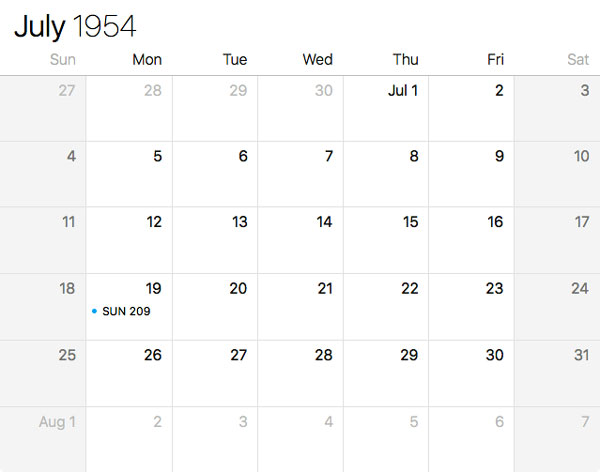
July 19, 1954

The date is July 19, 1954, and Sun releases the debut record of 19-year-old Elvis Presley. Produced by Sam Phillips, the single consists of “That’s All Right” backed with “Blue Moon of Kentucky.” Elvis, who in childhood dreamed of being “the hero of the comic book,” begins his adventure.

The years come and go. In many ways, Elvis accomplishes far more than he could have possibly dreamed, including becoming a musical hero throughout the world. As they do for everyone, though, some of his dreams still manage to slip away from him.

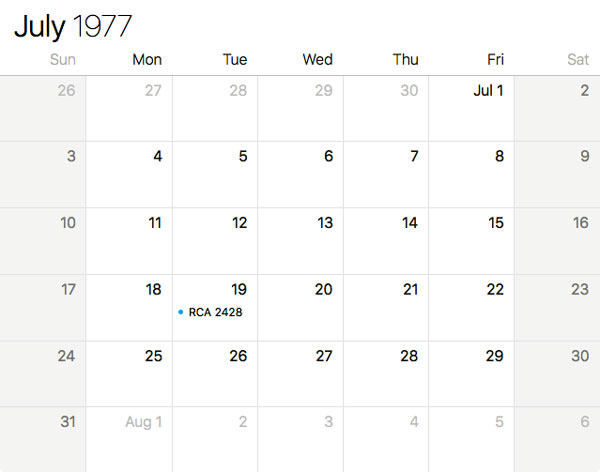
The date is July 19, 1977, and RCA releases Moody Blue, an album that proves to be the final Elvis record before his death exactly four weeks later at the age of 42. An unprecedented level of fame helped Elvis place himself on a path that brought his earthly journey to a tragic end.

Only 23 years, a mere blink of history’s eye, separate the release of the last Elvis record from the first.

More time passes. Other heroes come and go, yet Elvis somehow remains. As some fans fade away, others take their places.

The date is now July 19, 2022, but those 23 years continue to resonate.

Journey with The Mystery Train Elvis Blog today to the beginning and the end with two editions of Vinyl Elvis:

July 19, 1977


“Sing to the LORD, for he has done wonderful things. Make known his praise around the world.”
Isaiah 12:5

Vinyl Elvis #4: THAT’S ALL RIGHT/BLUE MOON OF KENTUCKY (1954)

Portions of this post were first published on one of my pop-culture blogs, now retired.


Today marks the 68th anniversary of the release of Elvis Presley’s first record on July 19, 1954.

I have two near-mint copies of That’s All Right/Blue Moon of Kentucky.

By far, they would be the most financially valuable pieces of my entire record collection or of all of my collections of anything, for that matter, except that they were both pressed in 2009, rather than 1954. Oh well. It’s not about the money, it’s about the music. Always has been.

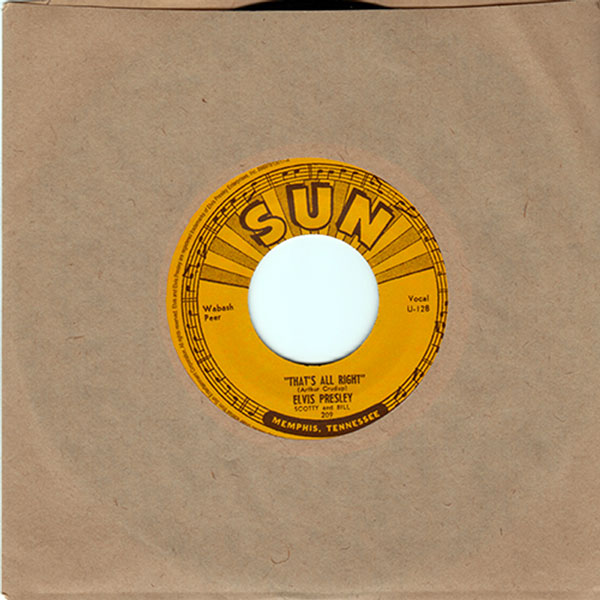
THAT'S ALL RIGHT/BLUE MOON OF KENTUCKY (Single; Sun, 1954; Reissue: Sony RCA/Legacy 2009--included as bonus with the Franklin Mint's ELVIS: THE COMPLETE MASTERS COLLECTION CD set; from Tygrrius' collection)

THAT’S ALL RIGHT/BLUE MOON OF KENTUCKY (Single; Sun, 1954; Reissue: Sony RCA/Legacy 2009–included as bonus with the Franklin Mint’s ELVIS: THE COMPLETE MASTERS COLLECTION CD set; from Tygrrius’ collection)

That’s All Right/Blue Moon of Kentucky (Single)
Label: Sun [Reissue: Sony RCA/Legacy]
Catalog Number: 209 [Reissue: 88697613017 (Label) / 88697673597 (2010 Outer Sleeve)]
Recorded: 1954 | Memphis, TN
Released: 1954 [Reissue: 2009]

Packaged in a plain, brown sleeve much like the original, my first copy of the record was included with Franklin Mint’s Elvis: The Complete Masters Collection CD set from 2009. A few years ago, I acquired a second copy of That’s All Right/Blue Moon of Kentucky, which Sony had released back in April 2010 for Record Store Day. Unlike the simple brown sleeve, this one included a gaudy cover, but I was surprised to discover that the record contained within is actually identical to the one that shipped with the Franklin Mint set. Sony must have been thinking ahead and pressed extra copies for the Record Store Day promotion.

Side A

Side A of THAT'S ALL RIGHT/BLUE MOON OF KENTUCKY (Single; Sun, 1954; Reissue: Sony RCA/Legacy 2009; from Tygrrius' collection)

Side A of THAT’S ALL RIGHT/BLUE MOON OF KENTUCKY (Single; Sun, 1954; Reissue: Sony RCA/Legacy 2009; from Tygrrius’ collection)

“That’s All Right” (1954)
One of the endearing aspects of this performance of “That’s All Right” is the sheer joy in the voice of Elvis as he sings. He finally has his opportunity in the studio, and he is making the most of it.

Elvis in 1970 reflected on his style, stating that it was “a combination of country music and gospel and rhythm & blues […]. That’s what it really was. As a child, I was influenced by all that.”

He added, “Of course, the Grand Ole Opry is the first thing I ever heard, probably, but I liked the blues, and I liked the gospel music–gospel quartets–and all that.”

On this first single, the blues and country influences are as clear as they ever would be. Some credit That’s All Right/Blue Moon of Kentucky as the first rock ‘n’ roll record, but to say Elvis invented the style is to make a false assumption that any one person actually did.

Rock ‘n’ roll evolved from the very sources that Elvis himself described. Besides, “Rocket 88,” “Rock Around the Clock,” and other potential contenders pre-date Elvis’ version of “That’s All Right.”

What Elvis did with his early records for Sun and RCA, though, was ignite the smoldering evolution of rock ‘n’ roll into a full-blown blaze. By melding country into the blues of “That’s All Right,” Elvis in 1954 unleashed a sound that not only built upon the foundation established by Arthur “Big Boy” Crudup‘s original 1946 recording, but took the song in a new direction. Absorbing the music of his youth, Elvis knew instinctively that blues and country explore many of the same themes, which allowed him to re-interpret these kinds of songs in a unique way.

Unfortunately, despite what the beautiful record label would have you believe, this reissue actually contains an RCA mastering of “That’s All Right,” rather than the original Sun mastering. It is the same 1954 recording, but RCA added echo to its versions not present on the Sun original.

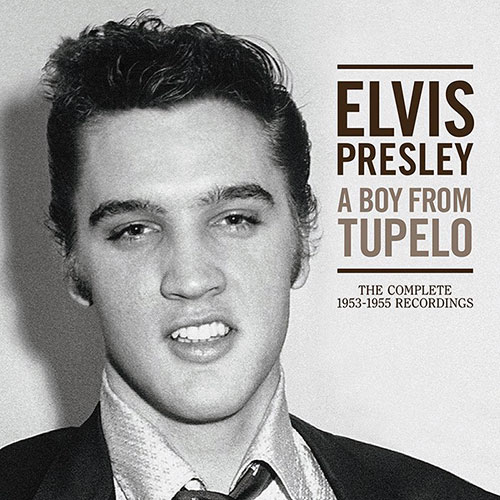
A few years after this 2009 reissue of SUN 209, the “dry” version of “That’s All Right” finally became available again via FTD’s A Boy From Tupelo boxed set in 2012. Sony RCA/Legacy re-released A Boy From Tupelo in a much more affordable package for mainstream retail in 2017.

The dry version of “That’s All Right” is superior, though it takes some getting used to because the echo versions were used in every official release of the song from December 1955 through 2011. Unless, of course, you have been spinning a Sun original.

Side B

Side B of THAT'S ALL RIGHT/BLUE MOON OF KENTUCKY (Single; Sun, 1954; Reissue: Sony RCA/Legacy 2009; from Tygrrius' collection)

Side B of THAT’S ALL RIGHT/BLUE MOON OF KENTUCKY (Single; Sun, 1954; Reissue: Sony RCA/Legacy 2009; from Tygrrius’ collection)

Blue Moon of Kentucky (1954)
While Elvis added country to the blues of “That’s All Right,” he created a literal flip side by melding rhythm & blues into the country bluegrass of “Blue Moon of Kentucky.” Again, the sound is markedly different from Bill Monroe’s 1946 original. Again, there is that joy in Elvis’ voice.

A fun tidbit is That’s All Right/Blue Moon of Kentucky contains only three musicians: Elvis on acoustic guitar, Scotty Moore on electric guitar, and Bill Black on the upright bass.

One of the earliest rock ‘n’ roll records, and no drummer to be heard. Credit goes to Black, whose bass makes it sound like there must be a drummer.

A drummer did not join the group in the studio until the early 1955 session that produced “I’m Left, You’re Right, She’s Gone,” the flip side of Elvis’ fourth record for Sun.

“That’s All Right” and “Blue Moon of Kentucky” became regional hits for Elvis. He would follow-up the single with four more records on the Sun label before signing with RCA in late 1955.


“History merely repeats itself. It has all been done before. Nothing under the sun is truly new.”
Ecclesiastes 1:9

A Squirrel Loose at the Big, Freaky International Hotel (Part 1)

“Welcome to the big, freaky International Hotel, with these little, weirdo dolls on the walls and these little funky angels on the ceiling. You ain’t seen nothing until you’ve seen a funky angel, boy. I tell you for sure.”
–Elvis Presley, 1969, on the ornate design of the hotel’s concert showroom

Sony Legacy last year released Elvis Live 1969, a boxed set containing all 11 concerts RCA recorded during Elvis Presley’s August 1969 engagement at the International Hotel in Las Vegas, Nevada.

The concert series, which spanned 57 shows from July 31 to August 28, represented the singer’s first appearance on a public stage in nearly 9 years – though he had performed 4 shows in front of small audiences at NBC’s studio in Burbank, California, as part of taping his ELVIS television special the previous summer.

RCA cherry-picked 12 of the strongest performances from 3 of the 1969 shows to form the Elvis In Person portion of the From Memphis To Vegas/From Vegas To Memphis double album, released in November 1969. A year later, RCA re-released Elvis In Person as a stand-alone album with the same content.

As for the rest of the performances, they amazingly remained in the vault until after Elvis’ death. While RCA released several individual songs over the years, including a compilation disc on 1991’s Collectors Gold boxed set, a complete 1969 show did not officially surface until 2001’s Live In Las Vegas boxed set.

By the time of Elvis Live 1969 last year, however, 7 of the 11 shows had already been released in their entireties on CD, with a good portion of songs from 3 of the 4 remaining shows having been released as well – many of them on Sony’s Follow That Dream (FTD) collectors label for Elvis fans.

Elvis Live 1969 stands out among the previous releases because it gathers all of the recordings in one place for the first time, with homogeneous sound quality. The recordings capture the August 21-26 portion of the engagement.

Sony Legacy’s ELVIS LIVE 1969 boxed set (2019, from Tygrrius’ collection)

Mixed by Matt Ross-Spang in what was apparently a marathon session, Elvis Live 1969 features a “slapback” echo effect mimicking the sound of Elvis’ first recordings in 1954 & 1955 at Sun Studio in Memphis. Ross-Spang had applied the same effect to alternate takes on 2016’s Way Down in the Jungle Room, an overview of Elvis’ last formal recordings in 1976 at Graceland.

As it was not representative of the original intent in 1976 or 1969, some fans have been quite critical of Ross-Spang’s slapback effect. As for me, I don’t mind it at all. It breathed some life into the 1976 studio recordings and brought Elvis’ music full-circle, in a sense, with an homage to the Sun sound. Though less effective on the 1969 live recordings, it’s not too distracting. On a few songs, such as “Mystery Train,” which of course originated in the Sun era anyway, the effect can actually be phenomenal.

Where I differ from Ross-Spang on Elvis Live 1969 is on some of his mixing choices, especially as far as which instruments are prominent. For instance, horns overwhelm a portion of James Burton’s lead guitar solo in the middle of the “Blue Suede Shoes” opener on all 11 shows. The horns weren’t even audible at all during Burton’s solo on the original Elvis In Person album and most of the subsequent revisits of this material.

The horns distracting from the lead guitar vaguely reminds me of Elvis’ February 11, 1956, appearance on Stage Show (CBS), the Jackie Gleason-produced television series hosted by Tommy and Jimmy Dorsey. In his third of six appearances on the program, Elvis debuts “Heartbreak Hotel” for the national TV audience. At the point where Scotty Moore would normally rip into his now classic electric guitar solo, a trumpeter improvises a jazz-inspired solo instead. While I enjoy jazz, it did not work in the context of this rock ‘n’ roll song. Fortunately, Moore is able to let loose in performances of “Heartbreak Hotel” on two subsequent shows. The 1969 “Blue Suede Shoes” is thankfully not affected to nearly this extent, though, for Burton is at least playing his solo!

Another example is that Larry Muhoberac’s piano is mixed far too loudly on certain shows, especially the August 26 Midnight Show, the last 1969 concert captured. Was Ross-Spang running out of time or is this truly how he felt the show should sound? “Mystery Train/Tiger Man,” which should be a showcase for the guitar and drums, suffers greatly from the distracting and overbearing piano in this particular show.

The August 25 Dinner Show and August 26 Dinner Show versions of “Mystery Train/Tiger Man” are similarly impacted by too much piano in the mix. Five of the remaining shows that include this medley fortunately keep the piano at low or moderate volumes, while the August 25 Midnight Show version, which was the performance used as the master on Elvis In Person, actually strikes a great balance – having the piano quite present but at an appropriate level.

Of course, it is all a matter of taste. For an Elvis live show, I want the lead guitar (Burton), Elvis guitar (when applicable), drums (Ronnie Tutt), and bass (Jerry Scheff) prominent in the mix among the instruments, generally in that order of priority, but certainly varying to some extent per song.

The rock ‘n’ roll numbers, at least, should heavily feature guitar, drums, and bass. That is the core of rock ‘n’ roll, Elvis style. The piano, other guitars, and orchestra should be present as needed, but not so much as to overwhelm that core. The piano is far less annoying on a slow song like “Love Me Tender,” for instance, where it better suits being prominent in the mix.

To be clear, the mixing on the majority of these shows is great. For example, “Mystery Train/Tiger Man” is mixed to perfection on the August 22 Midnight Show and is of course buoyed by a committed and powerful vocal performance by Elvis, as with many of the songs in this boxed set. This version of “Mystery Train” I can’t help but crank up every single time it comes on, much as I do with the 1955 Sun studio master.

Ross-Spang also tends to favor the Sweet Inspirations over the Imperials, as far as the background vocalists – an approach I heartily support. Millie Kirkham notwithstanding, Elvis sounds better with female voices behind him instead of males, and I love the Gospel-infused quality of the Sweet Inspirations. I should note that I intend no disrespect to any of the musicians and singers involved, all of whom are very talented. I am just talking about how I best feel the music when it comes to Elvis.

Before I get too far off track here, I think that covers it for the technical aspects of the set. I actually wasn’t even intending for this to become a review per se, but I just go where the writing leads me.

Next week, we’ll continue our look at Elvis Live 1969 and, possibly, get to the actual reason I started this post.

Blessings,
TY

[Read Part 2]


“Speak up for those who cannot speak for themselves; ensure justice for those being crushed. Yes, speak up for the poor and helpless, and see that they get justice.”
Proverb 31:8-9
Take a Ride on the Mystery Train with Updated A BOY FROM TUPELO [Pastimescapes blog]

One of the best Elvis Presley stories in recent memory was an audio collector’s July 2012 discovery of a live recording of “I Forgot To Remember To Forget.” Not realizing the rarity of what he had found, the collector posted the 1955 Louisiana Hayride radio show segment on YouTube as a curiosity piece.

Once Elvis experts began to take notice, it was soon revealed that this performance had never been heard by the public since the original October 1955 broadcast. It was also in better audio quality than most other Elvis live recordings from the same era. Ernst Jørgensen, Sony’s Elvis chief, acquired the recording, and the video came down.

Meanwhile, A Boy From Tupelo: The Complete 1953-1955 Recordings, a limited-edition collection covering the same time period, was on the verge of release. Unfortunately, it was too late to add the newly found recording, so the massive book and 3-CD set was slightly less comprehensive than it otherwise would have been when Sony’s Follow That Dream (FTD) collectors label released it in August 2012.

Though I never did finish writing my review at the time, A Boy From Tupelo was a masterpiece even if only for the three CDs. Due to its limited availability, however, many fans were unable to obtain a copy. Five years later, it unfortunately sells for six or seven times its original price.

Sony announced today that an updated version of A Boy From Tupelo will be available as a mainstream release on July 28.

The live recording of “I Forgot To Remember To Forget” is finally taking its rightful place on this set and making its debut on an official release. Thank you to “amberola1b” (the audio collector who discovered the recording) and Jørgensen for making this possible.

I consider A Boy From Tupelo to be one of the most important releases since Elvis died in 1977, and I am glad that it will now be readily available at a reasonable price to any music fan that wants it.

While I had been hoping for a boxed set of Elvis On Tour (1972) concerts and rehearsals this year, A Boy From Tupelo is even better than that would have been. Sony’s mainstream Elvis releases have been very 1970s-heavy for the last several years, so Elvis On Tour can wait a few more years, as far as I am concerned.

While the original came with a 512-page book, this 2017 edition will be condensed to 120 pages. The music will also be available in a digital download edition. A 1-LP vinyl edition will be available, containing only the SUN masters (i.e., no alternate or live recordings).

A BOY FROM TUPELO (2017 Sony Edition)

A BOY FROM TUPELO (2017 Sony Edition)

Scotty Moore (1931-2016) [Pastimescapes blog]

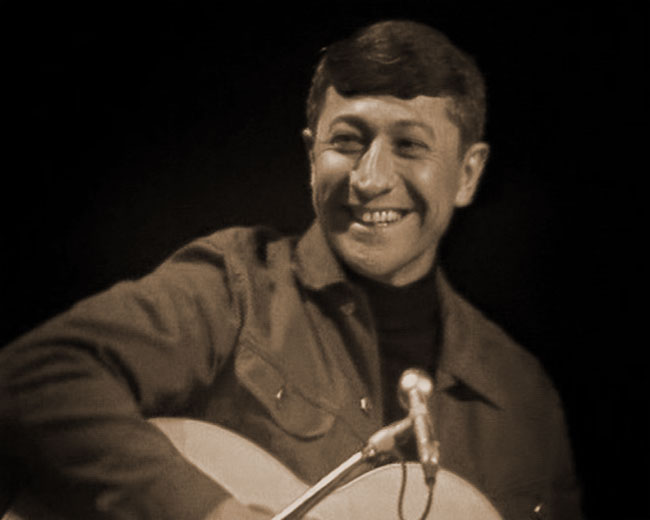
Scotty Moore in 1968

Scotty Moore in 1968

Legendary guitarist Scotty Moore, who backed Elvis Presley from the beginning of his career in 1954 at Sun Records through his 1968 comeback special, passed away yesterday at his Nashville, Tennessee home. He was 84.

I have been rather disconnected from the news lately, so I only just now learned about Moore’s death from my friend and fellow Elvis fan Thomas Melin.

It is impossible to overstate Moore’s importance in Elvis’s early sound, which helped catapult rock ‘n’ roll to worldwide attention.

Those now-classic electric guitar licks on “That’s All Right,” “Mystery Train,” “Heartbreak Hotel,” “Don’t Be Cruel,” “King Creole,” and so many other records are all Moore.

During production of his 1968 television special, Elvis pokes a little fun at Moore in a live segment:

Twelve years, man, he played guitar for me and never said anything. The other night, he leaned over and said–he was dead serious–he said, “Would you sing that ‘Lawdy, Miss Clawdy’ one time, man?” First time–12 years! … I told him, “Naw, forget it.”

Elvis then rips into an incredible version of the song. As the performance ends, an appreciative Moore quietly remarks, “I won’t say anything for another 12 years.”

My condolences go out to Moore’s family and friends.


I’ll be listening to Scotty and Elvis the rest of the week. Here’s my first stab at a playlist.

  1. That’s All Right (1954)
  2. Blue Moon Of Kentucky (1954)
  3. Good Rockin’ Tonight (1954)
  4. I Don’t Care If The Sun Don’t Shine (1954)
  5. Milkcow Blues Boogie (1954)
  6. You’re A Heartbreaker (1954)
  7. Baby, Let’s Play House (1955)
  8. I’m Left, You’re Right, She’s Gone (1954)
  9. I Forgot To Remember To Forget (1955)
  10. Mystery Train (1955)
  11. Blue Moon (1954)
  12. Just Because (1954)
  13. Tryin’ To Get To You (1955)
  14. Heartbreak Hotel (1956)
  15. Money Honey (1956)
  16. I’m Counting On You (1956)
  17. I Was The One (1956)
  18. Blue Suede Shoes (1956)
  19. My Baby Left Me (1956)
  20. Lawdy, Miss Clawdy (1956)
  21. Shake, Rattle & Roll (1956)
  22. I Want You, I Need You, I Love You (1956)
  23. Hound Dog (1956)
  24. Don’t Be Cruel (1956)
  25. Any Way You Want Me (1956)
  26. Too Much (1956)
  27. Jailhouse Rock (1957)
  28. As Long As I Have You (1958)
  29. King Creole (1958)
  30. That’s All Right (Live-1968-06-27 6 PM Show)
  31. Heartbreak Hotel (Live-1968-06-27 6 PM)
  32. Love Me (Live-1968-06-27 6 PM)
  33. Baby, What You Want Me To Do (Live-1968-06-27 8 PM Show; version #2)
  34. Blue Suede Shoes (Live-1968-06-27 6 PM)
  35. Lawdy, Miss Clawdy (Live-1968-06-27 6 PM)
  36. Are You Lonesome Tonight (Live-1968-06-27 6 PM)
  37. When My Blue Moon Turns To Gold Again (Live-1968-06-27 8 PM)
  38. Tryin’ To Get To You (Live-1968-06-27 6 PM)
  39. One Night (Live-1968-06-27 6 PM; version #1)
  40. Baby, What You Want Me To Do (Live-1968-06-27 6 PM; version #3)
  41. One Night (Live-1968-06-27 6 PM; version #2)
  42. Tiger Man (Live-1968-06-27 8 PM)

Download the End of Lonely Street: Top 5 Elvis Starter Albums on iTunes [Pastimescapes blog]

While I buy much of my music online these days, the overwhelming majority of my Elvis Presley purchases continue to be in the form of CDs.

The times I tend to download Elvis are when I only need a few tracks from a new album or set. For instance, I purchased a December 15, 1956, concert and various non-music tracks as online downloads from the Young Man with the Big Beat: The Complete ’56 Elvis Presley Masters set a few years back, as I already owned all of the other content.

However, iTunes and other online music stores certainly present great oppotunities to find jumping-on places for many artists, including Elvis. With that in mind, I thought I would take a look at the current iTunes offerings and suggest various starting points for exploring the music of Elvis Presley.

There are many possible paths when first listening to Elvis. The below starter albums represent only a few of those possibilities, focusing on different aspects of his career, avoiding duplication, and keeping a maximum $10 US budget in mind.

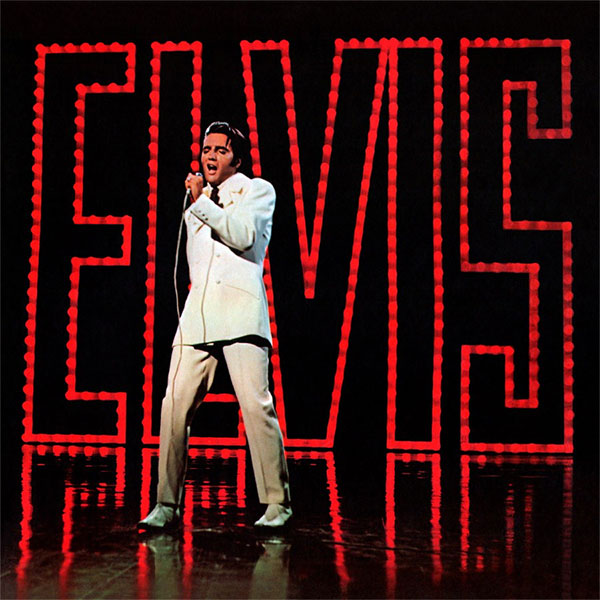
Cover of ELVIS-TV SPECIAL (1968 album)

1968’s ELVIS-TV SPECIAL is a strong starter album for those new to Elvis Presley.

#1 ELVIS-TV Special

This is the soundtrack of the 1968 television special that marked a turning point for Elvis. As he finally began to break away from repetitive movies that dominated so much of his 1960s career, he adopted a new, mature sound on songs like “If I Can Dream” and reinterpreted many of his older hits, such as a pounding version of “Heartbreak Hotel.”

The ELVIS-TV Special album thus serves both as an overview of his career to that point as well as a navigation beacon for the direction of his future, reinvigorated work.

#2 Promised Land (Expanded)

The first ten tracks of this release represent the original Promised Land album proper. Recorded in 1973 at Stax Studios in Memphis, Promised Land features a perfect blend of rock ‘n’ roll (the title track), country (“It’s Midnight”), and inspirational (“Help Me”).

This 2000 expanded edition includes several tracks from the inferior Good Times album, recorded at the same sessions. While this has the benefit of adding choice cuts “Good Time Charlie’s Got The Blues,” “Lovin’ Arms,” and “My Boy,” it also detracts by including clunkers “She Wears My Ring,” “If That Isn’t Love,” and “I Got A Feelin’ In My Body.”

#3 Elvis At Sun

Whoever decided to lead off this collection of Elvis’s earliest professional recordings with the lightweight “Harbor Lights” and nearly unlistenable “I Love You Because” allowed recording order to dictate over common sense and entertainment value. Producer and SUN founder Sam Phillips wisely rejected both of these cuts. Had they become Elvis’s first record, there might not have been a second.

Elvis then “stumbled upon” what became his first single, “That’s All Right” b/w “Blue Moon of Kentucky,” which should have started this collection of 1954-1955 recordings. Despite the sequencing issues, Elvis At Sun is a stellar release, with career highlights including “Mystery Train,” “Baby, Let’s Play House,” “Good Rockin’ Tonight,” “That’s All Right,” “Blue Moon,” and “Tryin’ To Get To You.”

There is a certain appeal to starting an Elvis musical journey at the literal beginning, and this 2004 release does a fine job without delving too far into outtakes and alternates best left for more seasoned fans.

#4 Elvis’ Golden Records

Essentially picking up where Elvis At Sun left off, Elvis’ Golden Records captures the singer in his early years at RCA Records. These 1956-1957 recordings include many of his best known hits.

Along with his SUN records, these cuts represent some of his most influential work. Every song here is a classic, but “Jailhouse Rock” and “Love Me” manage to shine even among the top-notch competition.

#5 From Elvis In Memphis

After the success of the ELVIS television special in 1968, Elvis recorded for the first time in Memphis since his SUN days. His 1969 recordings at American studios eventually produced two albums and several singles.

From Elvis In Memphis was easily the strongest of the two albums and certainly one of the best of his career. Stand-outs include “Power Of My Love,” “Wearin’ That Loved-On Look,” “After Loving You,” “Any Day Now,” and “Long Black Limousine.”

That’s All Right: July 5, 1954

Above is a SUN 209 reproduction from my collection. I hope someday to own the real thing!

Above is a SUN 209 reproduction from my collection. I hope someday to own the real thing!

Sixty years ago today, on July 5, 1954, the whole world changed for 19-year-old Elvis Presley as he recorded his first record for Sam Phillips at SUN Records, “That’s All Right.” Soon thereafter, Elvis would change the whole world.

What I love about the SUN version of this song is that you can hear the joy in Elvis’s voice as he sings the blues number. Backed only by Scotty Moore on electric guitar, Bill Black on the upright bass, and his own strumming on acoustic guitar, Elvis poured his all into the song and produced something that transcended its individual parts.

Arthur “Big Boy” Crudup wrote and recorded “That’s All Right” in 1946 for the RCA Bluebird label. Both recordings are essential in the history of American music.

Though “That’s All Right” essentially became a regional hit for Elvis, in less than two years he would become an international superstar.

Recommended reading to learn more at some of my favorite sites: