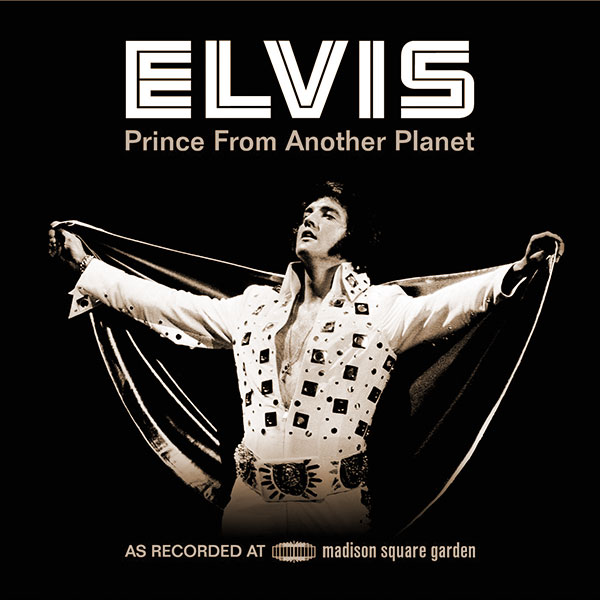
Prince From Another Planet highlights an unreachable star

Sony released three new Elvis titles to US stores on Tuesday, all of them related to his 1972 appearances at Madison Square Garden. While I commend Sony for bringing these releases to market, they have also brought along with them much confusion over the similar contents.

I’m no miracle worker, but I’ll try to clear this up for you as best I can.

Prince From Another Planet: As Recorded At Madison Square Garden is a 2-CD/1-DVD boxed set. CD 1 is a 2012 mix by Michael H. Brauer of Elvis’ June 10, 1972, afternoon show at the Garden, mastered by Vic Anesini. CD 2 is a 2012 mix by Brauer of Elvis’ June 10 evening show at the Garden, mastered by Anesini. The DVD contains a new documentary (Like A Prince From Another Planet), footage from Elvis’ June 9 press conference in New York, and fan-shot 8-millimeter footage of the June 10 afternoon show. Also included is a 50-page book, featuring liner notes by Lenny Kaye.

Elvis Presley's 1972 New York press conference

Elvis at his June 9, 1972, press conference

Elvis As Recorded At Madison Square Garden: Legacy Edition is a 2-CD set. CD 1 is a vintage 1972 mix of Elvis’ June 10 evening show at the Garden, mastered by Anesini in 2007. This represents the 1972 album Elvis As Recorded At Madison Square Garden, which hit store shelves only a week after the actual show. Due to Anesini’s mastering, which was first released on 2009’s Elvis: The Complete Masters Collection and 2010’s The Complete Elvis Presley Masters, the sound quality is improved over the 1992 CD release. CD 2 is a vintage 1997 mix of Elvis’ June 10 afternoon show at the Garden, mastered by Anesini for this 2012 edition. This represents the 1997 album An Afternoon In The Garden.

Sony has also released a new vinyl version of Elvis As Recorded At Madison Square Garden. This 2-LP release of the June 10 evening show is a newly mastered version of the vintage 1972 mix. Despite the fact that it is now two records, this does not contain the afternoon show. The original 1972 vinyl issue of this album was only one record, but the two record format is for better sound quality.

As you can see, fans of Elvis in 1972 have a nice selection from which to choose. As for me, I went with the deluxe Prince From Another Planet set because I wanted to hear the 2012 mixes. The Legacy Edition was not appealing to me because I already have the vintage As Recorded At Madison Square Garden mix as mastered by Anesini on The Complete Masters Collection, and I was not interested in a new mastering of the 1997 mix of An Afternoon In The Garden. I may eventually pick up the vinyl, though I tend to gravitate more towards records produced while Elvis was alive.

Prince From Another Planet (2012)

I’m not going to do a formal review, but I can’t close out without saying that Prince From Another Planet is incredible. Brauer has done a fantastic job mixing these shows. Crank up your sound system and maybe, just maybe, you can be transported back to June 10, 1972, and experience Elvis at the Garden.

As you might expect, the difference is most striking on the evening show. To say that the 1972 mix was rushed would be an understatement. This new 2012 mix finally illuminates this show in the fashion it deserves.

The Like A Prince From Another Planet documentary is worthwhile. I would like to see more documentaries of this nature, highlighting specific points in Elvis’ career. It does “spoil” a lot of the fan-shot footage, though, so you may want to watch that first.

The amateur video of the June 10 afternoon show looks about as good as 8 millimeter footage can possibly appear. Do not go in expecting professional Elvis On Tour or Aloha From Hawaii quality, though. This understandably looks grainy on large television sets. Though the original footage was silent, Sony has meticulously synched the 2012 mix of the show’s audio with the footage. To put it mildly, the footage is stunning and makes for a terrific experience . . . almost.

Elvis on stage at the Garden

Elvis on stage at the Garden

Only about twenty minutes of footage from this sixty minute show actually exists. During parts of the show for which there is no footage, the screen goes black while the audio continues. There are several long stretches of songs with no footage at all. To be honest, I cannot imagine a member of the “general public” (i.e., someone who is not an obsessed Elvis fan) sitting through this. Even I became restless at times, afraid to take my eyes off the big blank screen for fear I would miss the video. Sony should have provided an option to “View All Footage” and skip over the blank portions. This is but a minor quibble, though. Keep in mind while watching this that Warner Home Video is sitting on hours of professionally-filmed 1972 tour footage of Elvis. Unfortunately, Sony has no control of that footage, so kudos to them for at least bringing us this grainy alternative.

My larger complaint with the set has to do with the packaging. It is beautiful, but fails miserably at its primary job – protecting the CDs and DVD. Good luck getting them out without scratching the discs and/or creasing the packaging. As it is, my DVD has a fault during the press conference, and I have no doubt that the packaging and my admittedly anxious hands are to blame.

Elvis and the music more than make up for these shortcomings, though. If you are a fan of Elvis in 1972, Prince From Another Planet is a must-have. If you are not a fan of Elvis in 1972, I do not think this release will change your opinion. That’s okay, though. Everyone is entitled to be wrong!

* * *

Coming so soon on the heels of the recent storm, this New York themed release also reminded me to think of those in New York and neighboring areas that are affected. I think it would be a great gesture, and certainly within the spirit of Elvis’ generosity, if Sony were to release a single from this set with proceeds to benefit disaster relief efforts. In any event, we fans can also help on our own by donating funds to the American Red Cross.

REVIEW: Elvis – The Complete Masters Collection (Part 4)

This is Part 4 of an ongoing series reviewing Elvis: The Complete Masters Collection. Read Part 3.


CD Vol. 6: Heartache

Elvis: The Complete Masters Collection - Volume 6This volume of The Franklin Mint‘s 36-disc Elvis: The Complete Masters Collection (mastered by Vic Anesini) presents songs falling under the theme of “Heartache.” The booklet describes this disc as “Twenty haunting melodies that reveal Elvis’ familiarity with the darker side of love.”

Heartache is certainly a theme Elvis revisited often in his recordings over the years. Many of my favorite Elvis songs would probably fit into this category, so I’m excited to give Heartache a spin.

01. That’s When Your Heartaches Begin: Elvis actually first recorded “That’s When Your Heartaches Begin” as a demo at the Memphis Recording Service in 1953. This is his professional version, though, recorded four eventful years later for RCA. He does a masterful job with the song, including the spoken-word recital in the middle – a technique that he would perfect even further a few years later with the similar “Are You Lonesome Tonight.” (Recorded: 1957)

02. Don’t: If you listen too closely to the words to “Don’t,” it can actually sound creepy from a modern perspective:

“Don’t, don’t,” that’s what you say each time that I hold you this way. When I feel like this and I want to kiss you, baby don’t say “don’t.”

This song should be judged within the context of innocence from which it sprang, though. The Jerry Leiber & Mike Stoller song features masterful lyrics, indicative of the quality of material Elvis lost out on when his association with that team ended. “Don’t” includes a quite beautiful and sincere love pledge:

I’m your love and yours I will stay. This you can believe, I will never leave you, Heaven knows I won’t.

Oddly, this track has about ten seconds of extra silence at the end once the song concludes – not reflected in the runtime on the CD sleeve, either. (1957)

03. Are You Lonesome Tonight?: “Are You Lonesome Tonight” is an Elvis masterpiece, recorded shortly after the end of his stint in the US Army. Listen to that voice. He was back, better than ever. (1960)

04. Starting Today: “Starting Today” is the first of four songs written by Don Robertson that appear on Heartache. This is a quiet, likable song. (1961)

05. (Marie’s The Name) His Latest Flame: “His Latest Flame” is one of three Doc Pomus songs on this disc. “His Latest Flame” is fantastic and includes a much-needed increase in tempo over the opening songs of Heartache. (1961)

06. Anything That’s Part Of You: Another Don Robertson song, “Anything That’s Part Of You” is as relevant to broken relationships today as it was when first recorded. This is a perfect, subtle performance by Elvis. (1961)

07. Just Tell Her Jim Said Hello: It’s hard for me to believe this weak number is from Leiber & Stoller, yet it is. “Just Tell Her Jim Said Hello” sounds like it should be a movie tune. (1962)

08. Suspicion: Doc Pomus delivers the goods again, this time with the fantastic “Suspicion.” I first heard this song on a cassette variant of Elvis Country and have loved it ever since. (1962)

09. She’s Not You: “I’d trade all of someone new for anything that’s part of you,” lamented Elvis in “Anything That’s Part Of You.” On “She’s Not You,” though the writers are different, he continues that theme: “She’s everything a girl should be, but she’s not you.” For this song, Doc Pomus teamed up with Leiber & Stoller, ensuring a sure-fire hit when also combined with another great performance by Elvis. The original pressing of Franklin Mint’s Elvis: The Complete Masters Collection contained an error on this track – the last several seconds were missing. They issued replacement discs and subsequent pressings (including mine) have not had this error [6]. (1962)

10. They Remind Me Too Much Of You: More from the pen of Don Robertson, “They Remind Me Too Much Of You” again continues the theme of “Anything That’s Part Of You” and “She’s Not You,” except now the singer has reached the stage where he wants all reminders of the love gone wrong wiped away. Robertson’s lyrics are masterful at portraying the anguish: “Must I evermore be haunted, day after day my whole life through, by the memory of each moment that I spent alone with you?” (1962)

11. What Now, What Next, Where To: “What Now, What Next, Where To,” while still lamenting a lost love, manages to strike some hopeful tones as well. This is the fourth and final Robertson composition on Heartache, wrapping up this mini-storyline as the singer finally moves on. I have to give the compiler credit for putting all of these songs together, actually making for a coherent album of sorts. (1963)

12. Blue River: I can’t stand this song and hardly ever play it. The sooner “Blue River” ends, the better. (1963)

13. It Ain’t No Big Thing (But It’s Growing): I had to go and say that, didn’t I? As soon as “Blue River” ends, an even worse song begins, “It Ain’t No Big Thing.”  While Elvis’ June 1970 marathon recording session in Nashville produced some of the best songs of his career, it also produced junk like “It’s Ain’t No Big Thing.” Nearly unlistenable. (1970)

14. I’ve Lost You [Live]: After two duds in a row, Elvis’ live version of “I’ve Lost You” is a welcome reprieve. While not as interesting as the studio version, this is still a fine performance in its own right. I love how his voice nearly blends with the Sweet Inspirations as the chorus repeats at the song’s end. (1970)

15. When I’m Over You: Like most songs, “When I’m Over You” is better than “It Ain’t No Big Thing,” but it is still one of the weaker songs from the 1970 Nashville sessions. I do enjoy the gospel sound that the background vocalists bring to the song. (1970)

16. I Will Be True: Accompanying himself on piano, Elvis takes on the Ivory Joe Hunter song “I Will Be True.” A decent performance, with much conviction. (1971)

17. Love Me, Love The Life I Lead: Elvis did not write this song, but it sure sounds like he could have:

If you’re gonna love me, love the life I lead. Need the things I need. Don’t try to change me. If you’re gonna take me, take me for what I am. I can’t be another man. I can’t be free from the life I lead.

Unfortunately, though Elvis must have connected with the lyrics, the song never really develops – a good song that probably could have been better. (1971)

18. Thinking About You: Featured on the Promised Land album and recorded at Stax Studio in Memphis, “Thinking About You” is one of Elvis’ best country songs. Wow, does it sound great on this set. Nice to have the original mix back. (1973)

19. Mr. Songman: “Mr. Songman” is a decent album cut that also served well as the flip-side to 1975’s “T-R-O-U-B-L-E.” (1973)

20. Woman Without Love: “Woman Without Love” is the worst of the songs Elvis recorded at his March 1975 Hollywood session that produced the very solid Today album. Unless I’m listening to the entire album in context, I always skip this dreadful song. (1975)

Though it contains a few duds (this is a complete masters collection, after all), Heartache is overall a stellar collection of songs. The early 1960s tracks in particular are real highlights.

Sources

(6) “Complete Masters compared/contrasted with Franklin Mint” by elvissessions, For Elvis CD Collectors Forum, 2010.


Read Part 5.

From Elvis Presley Boulevard to your CD player

From Elvis Presley Boulevard (1976)I’ve been a little behind on Elvis news lately, so I just found out that one of my favorite albums is getting an FTD release in October. From Elvis Presley Boulevard, Memphis, Tennessee, recorded at Graceland in 1976, will now be an expanded, 2-CD edition. This marks yet another exciting release for 2012.
September 20, 2012, Update: Back In Memphis, the lesser of the two resulting albums of his 1969 American Sound Studio sessions, will be the FTD Classic Album release for December. Also to be released by FTD that month is a 2-CD package consisting of a 1972 rehearsal tape and an August 1972 Las Vegas show.

REVIEW: Elvis – The Complete Masters Collection (Part 3)

This is Part 3 of an ongoing series reviewing Elvis: The Complete Masters Collection. Read Part 2.


CD Vol. 5: Complete Aloha From Hawaii Concert

Volume 5 of The Franklin Mint‘s 36-disc Elvis: The Complete Masters Collection (mastered by Vic Anesini) presents the 1973 concert album Aloha From Hawaii via Satellite as well as bonus songs recorded for insertion into the NBC version of the Elvis: Aloha From Hawaii TV special.

Elvis: The Complete Masters Collection - Volume 5

This disc features the original mix of the 1973 double album. In 1998, BMG/RCA released a CD with a new mix and mastering by Dennis Ferrante. At that time, I tried to keep my Elvis CD collection consolidated. Since I much preferred the new mix, I gave away my older Aloha From Hawaii via Satellite CD with the original mix. Therefore, I do not have anything to make fair sound comparisons against for this CD. These days, I put more stock into owning the original mixes as released during Elvis’ lifetime than I did back then.

Elvis recorded all songs on the Complete Aloha From Hawaii Concert on January 14, 1973. Though it aired live in some parts of the world, Aloha From Hawaii did not air in the United States until April 4 of that year. To this day, many Americans wrongly believe they saw the special live. In reality, it had an even longer “tape delay” than NBC’s abysmal Summer Olympics 2012 coverage.

01. Also Sprach Zarathusta/02. See See Rider: “Also Sprach Zarathustra” (used as the theme for 2001: A Space Odyssey) was the perfect way to open Elvis concerts in the 1970s. This is a particularly fine version, beginning with low rumbles and building into a fantastic crescendo as Elvis appears on stage and quickly rocks into “See See Rider.” Listen to James Burton’s guitar work on the solo, sounding better than I remember it.

03. Burning Love: Elvis moves right into another rocker, “Burning Love.” The sound on this CD is so incredible, I can already tell I may go back to this mix when I want to listen to Aloha, over the 1998 version. Elvis just kills the song on the end during the “Hunka’ hunka’ burnin’ love” segment. What a fantastic opening to the live broadcast. Sounding sheepish, Elvis quietly tells the audience after the song, “Good evening, and I hope you enjoy our show tonight. We’re gonna try to do all the songs you wanna hear, you know.”

04. Something: For this third song of the international event, Elvis launches into a Beatles number, “Something.” The performance is okay, but a bit of a letdown after the concert’s stellar opening. Wow, this CD sure does sound awesome, though. It can make an okay song sound a little better.

05. You Gave Me A Mountain: Elvis had first tackled Marty Robbins’ “You Gave Me A Mountain” while on tour in 1972, including one performance used in the 1972 documentary Elvis On Tour. While this version is a step down from that one, Elvis still sounds great here.

06. Steamroller Blues: Next up, Elvis takes on James Taylor with “Steamroller Blues,” adding some much-needed energy back into the show. Elvis earned a top 20 hit when RCA released this performance as a single (backed with the 1972 studio cut “Fool”). Authentic to the original album (the end of side 1), the CD fades on the applause after the song ends.

07. My Way: As with the original album, “My Way” begins with the piano strains, leaving out Elvis’ introduction of the song. This is a fine, though not very compelling, version of the Frank Sinatra hit. In the first six songs of his live event, Elvis has already tackled the blues, rock ‘n’ roll, the Beatles, country, James Taylor, and Frank Sinatra.

08. Love Me: Before the song, Elvis mentions that he’s planning to do a medley of his records later in the show, to which an audience member shouts, “Do all of them!” Elvis hears this and replies, “Okay, I’ll do it, all 429 of ’em. I’ll do it.” He then dips back into his own catalog for a disappointing version of 1956’s “Love Me.” The song borders on being a throwaway, which is a shame.

09. Johnny B. Goode: James Burton carries this Chuck Berry classic on guitar, as Elvis forgets some of the lyrics early on (the song was added to fill time when a rehearsal revealed the planned show was too short). Still, Elvis rocks the song and the show benefits from its inclusion.

10. It’s Over: “I’ll watch you walk away somehow, I have to let you go, because it’s over,” Elvis sings in what must have been another heart-wrencher for him, as his own marriage was ending at this time. Unfortunately, “It’s Over” is otherwise forgettable.

11. Blue Suede Shoes: It’s back to rock ‘n’ roll, this time with a rousing but short rendition of Carl Perkins’ “Blue Suede Shoes.”

12. I’m So Lonesome I Could Cry: Elvis introduces the Hank Williams classic “I’m So Lonesome I Could Cry” as “the saddest song I’ve ever heard” and proceeds to do a commendable job.

13. I Can’t Stop Loving You: Next, Elvis moves right into “I Can’t Stop Loving You.” Though the arrangement is the same, Elvis sounds much more subdued here compared to the rocking version found on the previous year’s As Recorded At Madison Square Garden.

14. Hound Dog: Elvis then launches into a perfunctory version of “Hound Dog,” lasting a mere 45 seconds and leaving me to wonder, “Why bother?” As with the record, the CD fades out shortly after the song ends, leaving out Elvis’ joke about first performing that song when he was twelve-years-old.

15. What Now My Love: Elvis gets serious again and puts more effort into “What Now My Love” than his own hit material. This is one of the highlights of the show, and the sound quality on this CD makes it shine even more.

16. Fever: Maybe it’s because I heard this one first, but I’ve always preferred this live version of “Fever” over Elvis’ 1960 recording of the song for the Elvis Is Back! album. The song just works better in a concert setting. I also see this as the point in Aloha From Hawaii where Elvis finally shakes off the rest of his nerves and really loosens up – making for a better second half to the show.

17. Welcome To My World: This is a lightweight song that serves as a breather for Elvis between “Fever” and “Suspicious Minds.”

18. Suspicious Minds: Growing up, the first versions I heard of “Suspicious Minds” were on this album and the similar one released on As Recorded At Madison Square Garden. It took me a long time to become accustomed to the studio version. While I now prefer the studio and early live versions best, I still enjoy the 1972 and 1973 versions. Great to hear Elvis rocking on one of his more contemporary hits.

19. Introductions By Elvis: I’m not going to start reviewing band introduction tracks, but I will point out that this is the edited version as released on the original album (i.e., Elvis calling Charlie Hodge a “general flunky” and later mentioning Hawaii Five-O star Jack Lord have been omitted).

20. I’ll Remember You: Also omitted is Elvis explaining that proceeds from the concert would benefit the Kui Lee Cancer Fund. “I’ll Remember You,” first recorded by Elvis in 1966, was written by Kuiokalani Lee, who passed away from cancer that same year. The lyrics take on even more signficance if you listen with that in mind: “I’ll remember you long after this endless summer is gone. I’ll be lonely, oh so lonely, living only to remember you.” Though a decent live version that matches the mood of the show, “I’ll Remember You” really does not live up to Elvis’ 1966 recording – both in terms of the vocals and the percussion.

21. Long Tall Sally/Whole Lotta Shakin’ Goin’ On: The closest thing the show gets to the promised medley is this combination of Little Richard’s “Long Tall Sally,” which Elvis recorded in 1956, and “Whole Lotta Shakin’ Goin’ On,” popularized by Jerry Lee Lewis in 1957 and recorded by Elvis in 1970. While the medley works in the show and picks up the pace as needed, both songs pale next to Elvis’ studio efforts. “Whole Lotta Shakin’ Goin’ On” in particular has a completely different, watered-down arrangement compared to Elvis’ version from less than 3 years earlier.

22. An American Trilogy: Reportedly, when asked what kind of costume he wanted for the live broadcast, Elvis noted that he wanted something that said “America.” The custom-designed American Eagle jumpsuit fit the bill visually, while “An American Trilogy” sealed the deal on the musical side. This is both the climax of the show and the most impressive performance on the album. An argument could even be made that this moment was the climax of his career as well. Though not evident on the record, Elvis throws his jewel-studded belt into the audience shortly after this song.

23. A Big Hunk O’ Love: Serving as a bookend of sorts with the similar “Burning Love,” Elvis reaches back to 1958 for this hit and serves up a great rendition. If only he had treated his other classics with this respect for this show. “A Big Hunk O’ Love” provides a powerful rock ‘n’ roll ending for the live broadcast.

24. Can’t Help Falling In Love: Finally, Elvis closes out the show with a quick version of “Can’t Help Falling In Love.” It is not in the same league as his 1968 or 1969 live versions, but it almost does not matter at this point. The power of the overall concert wins out, and it ends in utter excitement. What a performer.

25. Blue Hawaii [Re-recording]: For the NBC version of the special, Elvis recorded several “insert” songs without an audience to extend the length of the special. This is a fine version of the title song to his 1961 movie Blue Hawaii.

26. Ku-U-I-Po [Re-recording]: The remaining songs on this CD were first released after Elvis’ death, on the 1978 album Mahalo From Elvis. Though they are technically outside of the parameters of Franklin Mint’s Elvis: The Complete Masters Collection, I am happy to have them as bonuses. This is a great re-recording of “Ku-U-I-Po” from Blue Hawaii.

27. No More [Re-recording]: Though recorded for the NBC version of the show, “No More” actually went unused. The visual portion of this performance was first released on DVD in 2004. This is another strong re-recording of a song from Blue Hawaii.

28. Hawaiian Wedding Song [Re-recording]: “Hawaiian Wedding Song” was featured in the finale of Blue Hawaii. Elvis does another good job on this re-recording. Perhaps he should have performed one or two of these Blue Hawaii songs during the actual concert. Why not drop “Welcome To My World” or “It’s Over” for one of these? (Other than the fact that the other two songs had never been released before by Elvis.)

29. Early Mornin’ Rain [Re-recording]: Though Elvis had first recorded it only two years earlier, this re-recording of “Early Mornin’ Rain” has a different vibe. I enjoy both versions. Again, this would have made a great number for the actual concert.

The sound is terrific, and so is the show. This will now become my go-to edition of Aloha From Hawaii.

* * *

I was about 13-years-old before my older brother would allow me to touch his record collection. As a small child, I had a bad habit of accidentally destroying his stuff (Star Trek posters, a trumpet, and pretty much anything else I could get my curious little hands on), so his records were off limits for a long time.

Of his fifty or sixty Elvis albums, the one I considered the most special was Aloha From Hawaii via Satellite. I was sure at the time that this was the greatest Elvis concert ever. Though I could name dozens of live recordings now that would top it, I did relive some of that youthful exuberance when listening to the Complete Aloha From Hawaii Concert. While I do not have the older release to compare, I am sure this album has never sounded better on CD.

* * *

With thirty-one CDs still to go, continue to look for future installments here on The Mystery Train Blog.


Read Part 4.

REVIEW: Elvis – The Complete Masters Collection (Part 2)

This is Part 2 of an ongoing series reviewing Elvis: The Complete Masters Collection. Read Part 1.


We haven’t finished the summer yet, folks, but why not take a break from the heatwave to enjoy a Christmas-themed review?

CD Vol. 4: Christmas With Elvis

Elvis: The Complete Masters Collection - Volume 4This volume of The Franklin Mint‘s 36-disc Elvis: The Complete Masters Collection (mastered by Vic Anesini) presents nearly all of the Christmas songs that Elvis released during his lifetime (a live version of “Blue Christmas” appears on a later disc).

Christmas With Elvis contains each of the Christmas songs featured on Elvis’ Christmas Album (1957), his 1966 Christmas single, and Elvis Sings The Wonderful World Of Christmas (1971).

01. Blue Christmas: I think of “Blue Christmas” as the “Hound Dog” of Elvis Christmas songs. It’s the one the general public most associates with him. It is an okay recording and certainly appropriate to kick off this CD. I wish it had less or no backing vocals, though. I much prefer his live versions from 1968. (Recorded: 1957)

02. White Christmas: “Blue Christmas” does not transition very well into “White Christmas,” but the compiler has once again taken the easy way out and confined the song sequencing of this disc to recording order. I’m actually not a huge fan of “White Christmas” by Elvis. For this one, my go-to versions tend to be those by The Drifters (whose 1954 recording inspired the Elvis one) or Burl Ives (1965). Incidentally, this track differs from the one released during Elvis’ lifetime in that a finger-snap near the beginning of the song has been omitted (5). I must admit, I would never have noticed such a small detail on my own. That’s the wonder of the For Elvis CD Collectors Forum. (1957)

03. Here Comes Santa Claus (Right Down Santa Claus Lane): You’ll be happy to know that no finger-snapping has been omitted from this terrific version of “Here Comes Santa Claus.” I love how Elvis swings some of the lyrics. (1957)

04. Silent Night: I probably would have saved “Silent Night” for the closer, but what a beautiful recording. For the gentle voice of a 22-year-old to convey this kind of passion and conviction speaks volumes about the faith of Elvis Presley. (1957)

05. O Little Town Of Bethlehem: On the other hand, Elvis’ version of “O Little Town Of Bethlehem” tends to wear on me a bit. Like “White Christmas,” it is an okay performance, but nothing special. Nat King Cole’s 1960 recording tends to be my go-to version of this one. (1957)

06. Santa Bring My Baby Back (To Me): It’s more finger-snapping fun on “Santa Bring My Baby Back.” What’s not to love? (1957)

07. Santa Claus Is Back In Town: Here it is, not only Elvis’ best Christmas song, but also one of his best blues numbers – right up there with 1960’s “Reconsider Baby.” When it comes to Elvis performances, they do not get much better than “Santa Claus Is Back In Town.” Incredible. (1957)

08. I’ll Be Home For Christmas: Elvis delivers yet another stunning performance on his classic version of “I’ll Be Home For Christmas.” This also would have worked as a great album closer. Sound quality is noticeably cleaner here than it was on 1994’s If Every Day Was Like Christmas CD, my previous source. (1957)

09. If Every Day Was Like Christmas: Recorded just a couple of weeks after the session that produced the How Great Thou Art album, the unique “If Every Day Was Like Christmas” makes me wish Elvis had recorded a few more Christmas tunes at this time. This one seems to have slightly more reverb than my previous source on the same 1994 CD. As I’ve not seen any experts make note of this, I assume this reflects the original release. (1966)

10. It Won’t Seem Like Christmas: Flash forward five years now to May 1971 and the sessions that produced Elvis Sings The Wonderful World Of Christmas, my favorite of his Christmas albums. I used to write off “It Won’t Seem Like Christmas” as too depressing for a Christmas song, but it has definitely grown on me over the years. (1971)

11. If I Get Home On Christmas Day: Though it covers much the same theme as “It Won’t Seem Like Christmas,” “If I Get Home On Christmas Day” sounds much more hopeful. A very enjoyable performance. (1971)

12. Holly Leaves And Christmas Trees: Written by Elvis’ longtime friend Red West, “Holly Leaves And Christmas Trees” takes its place among the best of Elvis’ Christmas recordings. (1971)

13. Merry Christmas Baby [Album Master]: While it does not quite meet the stature of “Santa Claus Is Back In Town,” “Merry Christmas Baby” is another solid blues take on the holiday season by Elvis. This studio jam ran for well over eight minutes, about 5:45 of which appeared on the Elvis Sings The Wonderful World Of Christmas album. The single version, edited to 3:15, does not appear in The Complete Masters Collection. (1971)

14. Silver Bells: Elvis delivers a fine rendition of “Silver Bells,” a Christmas classic. (1971)

15. I’ll Be Home On Christmas Day: Written by Michael Jarrett (“I’m Leavin'”), “I’ll Be Home On Christmas Day” is a perfect Christmas song for Elvis. I put this one just below “Santa Claus Is Back In Town” as his best Christmas recording ever. Really, one of his best-ever songs, period. It is always a highlight of any album on which it appears. (1971)

16. On A Snowy Christmas Night: Though it does not often get mentioned, I love “On A Snowy Christmas Night,” especially the reminder to “Give thanks for all that you’ve been blessed with and hold your loved ones tight.” (1971)

17. Winter Wonderland: For some reason, many Elvis fans criticize this performance of “Winter Wonderland.” Even Thomas over at Elvis Today Blog, with whom I almost always agree, called it “spiritless.” I don’t hear it that way at all. Perhaps some feel this song should remain in the territory of a performer like Johnny Mathis, whose 1958 version is horrible. For me, Elvis owns “Winter Wonderland” – particularly by adding on his signature ending style. This sounds exactly like “Winter Wonderland” as interpreted by Elvis should: Perfect. (1971)

18. O Come All Ye Faithful: “O Come All Ye Faithful” is the “Silent Night” of the second Christmas album and is just as effective. This is a great arrangement, too. I love the percussion leading into “Sing choirs of angels…” (1971)

19. The First Noel: While I would not call it “spiritless,” Elvis does begin to sound a bit tired on “The First Noel.” To continue the comparison, “The First Noel” is the “O Little Town Of Bethlehem” of the 1971 album. Good, but not great. (1971)

20. The Wonderful World Of Christmas: It is strange that “The Wonderful World Of Christmas,” the weakest song of the 1971 Christmas album session, became the title track. It also does not serve very well as the closing track here. (1971)

As I stated last time, since The Franklin Mint has chosen to theme their CDs anyway, I would have preferred the compiler put more thought into the sequencing. It is much easier to intermingle Elvis’ Christmas music from different decades than many of his other recordings (also true of his gospel music), so this is a missed opportunity on this CD.

However, Christmas With Elvis at least gathers his Christmas masters in one place. It’s really hard to go wrong with an Elvis Christmas CD and this one is no exception. With upgraded audio, I’m all set for the Christmas season in a few months.

* * *

In Part 1 of this review, I mentioned that I was planning to frame the reproduction of the 1954 SUN 45 “That’s All Right” b/w “Blue Moon Of Kentucky” that came with this set. Here are the results, and it looks beautiful.

SUN 209 Reproduction - Framed

I’ve just obtained an RCA vintage-1977 edition of “Way Down” b/w “Pledging My Love” to hang beneath it. Just waiting for the frame to arrive.

Well, that’s four CDs down and … wow … thirty-two to go. Continue to look for future installments here on The Mystery Train Blog. I hope to finish within the next eight or nine years.

Sources

(5) “Re: Complete Masters compared/contrasted with Franklin Mint” by Claus, For Elvis CD Collectors Forum, 2010.


Read Part 3.

Guest Blog #6: From Hawaii To The Rest Of The World (The Edge Of Reality #7)

What if the previously unreleased cassette recording of Elvis rehearsing the day before his opening show at the Las Vegas Hilton on January 26, 1973, had been a rehearsal for an upcoming world tour instead? In an alternate universe, a review of the recently released From Hawaii To Las Vegas album from FTD would have sounded a bit different…. You’ve just crossed over into… the edge of reality.

The Edge Of Reality

[Read the full post by Thomas Melin over on Elvis Today Blog.]

Check out A Boy From Tupelo track listing

A Boy From Tupelo (concept cover art)

This has been another fantastic week of Elvis release news. Today, Follow That Dream Records revealed the track listing for the long-awaited A Boy From Tupelo: The Complete 1953-55 Recordings, FTD’s SUN boxed set that includes a 512-page book and three CDs. FTD, Sony’s collectors label for Elvis fans, will release the set next month.

It appears that Elvis Matters was the first site to break the track listing news, though I first read about it over on a For Elvis CD Collectors Forum thread started by Greg1995. On that thread, FECC member Good Time Charlie took the time to reformat the track listing to make it more palatable. I’ve used his version for the below, with a few very minor tweaks of my own. A big thank you to Charlie for allowing me to use his work.

Elvis Presley: A Boy From Tupelo – The Complete 1953-55 Recordings

Disc 1: MRS Acetates, The SUN Masters & The RCA Masters

01) My Happiness 2:33
02) That’s When Your Heartaches Begin 2:52
03) I’ll Never Stand In Your Way 2:04
04) It Wouldn’t Be The Same (Without You) 2:09
05) Harbor Lights 2:38
06) I Love You Because 2:43
07) That’s All Right [45 RPM SUN Master] 2:00
08) Blue Moon Of Kentucky [45 RPM SUN Master] 2:07
09) Blue Moon 2:44
10) Tomorrow Night 3:01
11) I’ll Never Let You Go (Little Darlin’) 2:27
12) I Don’t Care If The Sun Don’t Shine 2:32
13) Just Because 2:34
14) Good Rockin’ Tonight 2:15
15) Milkcow Blues Boogie [78 RPM SUN Master] 2:39
16) You’re A Heartbreaker [78 RPM SUN Master] 2:13
17) I’m Left, You’re Right, She’s Gone [Slow version] 2:43
18) Baby Let’s Play House 2:19
19) I’m Left, You’re Right, She’s Gone 2:38
20) I Forgot To Remember To Forget 2:31
21) Mystery Train 2:30
22) Tryin’ To Get To You 2:36
23) When It Rains It Pours 2:06
24) That’s All Right 1:59 [RCA single version]
25) Blue Moon Of Kentucky 2:05 [78 RPM SUN Master]
26) I Love You Because 2:45 [RCA LP version – spliced from takes 3 & 5]
27) Tomorrow Night 2:56 [RCA LP version – overdubbed and slowed down]

Tracks 1-2: Self-financed demo recorded July, 1953 at SUN Studio, Memphis.
Source for tracks 1-2: Digital transfer of acetate.

Tracks 3-4: Self-financed demo recorded January 4, 1954 at SUN Studio, Memphis.
Source for tracks 3-4: Digital transfer of acetate in very poor condition.

Track 5 possibly recorded July 5, 1954.
Tracks 6-7 recorded July 5, 1954 at SUN Studio, Memphis.
Sources for tracks 5-6: Original SUN tapes.
Source for track 7: 45 rpm SUN single (plastic).

Track 8: Recorded July 7, 1954 at SUN Studio, Memphis.
Source for track 8: 45 rpm SUN single (plastic).

Track 9: Likely recorded between August 15 and 19, 1954 at SUN Studio, Memphis.
Source for track 9: Original SUN tape.

Tracks 10-14 likely recorded between September 12-16, 1954 at SUN Studio, Memphis.
Sources for tracks 10, 11, 13 and 14: RCA reference tapes (30 ips).
Source for track 12: Digital transfer of SUN tape, with repairs from a digital transfer of a tape copy.

Tracks 15-16 recorded either mid-November or mid-December 1954 at SUN Studio, Memphis.
Sources for tracks 15-16: 78 rpm SUN single (shellac).

Track 17 Recorded between mid-November 1954 and mid-April 1955 at SUN Studio, Memphis.
The reel has March 5 written on it, but Elvis was at the Louisiana Hayride that day.
Source for track 17: Original SUN tape.

Track 18 likely recorded between January 30 and February 4, 1955 at SUN Studio, Memphis.
“I Got a Woman” and “Tryin’ to Get to You” were also recorded, but have been lost.
Source for track 18: RCA reference tape (30 ips).

Track 19 likely recorded mid-April 1955 at SUN Studio, Memphis.
Source for track 19: RCA reference tape (30 ips), with first part of ending from RCA tape copy (15 ips) and last part of ending from digital transfer of the RCA EPA-965 production master tape.

Tracks 20-22 recorded mid-July, 1955 at SUN Studio, Memphis.
Source for track 20: SUN tape copy.
Source for track 21: SUN tape copy, with ending from digital transfer of 78 rpm RCA single.
Source for track 22: RCA reference tape (30 ips).

Track 23 recorded November 1-4, 1955 at SUN Studio, Memphis.
Source for track 23: Original SUN (vocal channel) slapback tape.
Elvis’ 1957 re-recording of the song was released under the title “When It Rains, It Really Pours.”

Source for track 24: RCA reference tape (30 ips).

Source for track 25: Elvis at SUN master, derived from digital transfer of 78 RPM SUN single (shellac).

Track 26: Steve Sholes’ original notes have these takes as 2 & 4.
Source for track 26: RCA master tape.

Source for track 27: 1965 RCA work part tape for the Elvis for Everyone LPM-3450 production master tape.

Disc 2: The SUN Studio Sessions

01) Harbor Lights (takes 1-2, level adjustments) 0:33
02) Harbor Lights (take 3/M) 2:53
03) Harbor Lights (take 4) 2:38
04) Harbor Lights (takes 5-6) 1:23
05) Harbor Lights (take 7) 2:25
06) Harbor Lights (take 8) 0:26
07) I Love You Because (take 1) 0:23
08) I Love You Because (take 2) 3:28
09) I Love You Because (take 3) 3:36
10) I Love You Because (take 4) 0:40
11) I Love You Because (take 5) 3:28
12) That’s All Right (takes 1-2) 0:20
13) That’s All Right (take 3) 1:58
14) Dialogue 0:20
15) Blue Moon Of Kentucky [slow tempo outtake] 1:08
16) Blue Moon (takes 1-3) 0:38
17) Blue Moon (take 4) 2:59
18) Blue Moon (take 5) 3:25
19) Blue Moon (takes 6-7) 0:53
20) Blue Moon (take 8) 3:01
21) Blue Moon (take 9/M) 2:44
22) Dialogue fragment [before “Tomorrow Night”] 0:11
23) I’ll Never Let You Go (Little Darlin’) [incomplete take] 0:49
24) Good Rockin’ Tonight [fragment from vocal slapback tape] 0:10
25) I Don’t Care If The Sun Don’t Shine (takes 1-2) 1:13
26) I Don’t Care If The Sun Don’t Shine (take 3/M) 2:35
27) I’m Left, You’re Right, She’s Gone (slow version, take 1) 3:00
28) I’m Left, You’re Right, She’s Gone (slow version, take 2) 2:51
29) I’m Left, You’re Right, She’s Gone (slow version, take 3) 2:51
30) I’m Left, You’re Right, She’s Gone (slow version, take 4) 0:10
31) I’m Left, You’re Right, She’s Gone (slow version, take 5/M) 2:40
32) I’m Left, You’re Right, She’s Gone (slow version, take 6) 2:40
33) I’m Left, You’re Right, She’s Gone (slow version, take 7) 1:35
34) How Do You Think I Feel (guitar slapback tape, rehearsal + take 1) 3:17
35) How Do You Think I Feel (guitar slapback tape, rehearsals) 1:14
36) When It Rains It Pours (vocal slapback tape, take 1) 1:37
37) When It Rains It Pours (vocal slapback tape, take 2 – rehearsal) 2:12
38) When It Rains It Pours (vocal slapback tape, takes 3-4) 2:14
39) When It Rains It Pours (vocal slapback tape, take 5/M) 2:02
40) When It Rains It Pours (vocal slapback tape, take 6-7) 1:40
41) When It Rains It Pours (vocal slapback tape, take 8) 1:40

Tracks 1-6 possibly recorded July 5, 1954 at SUN Studio, Memphis.
Source for tracks 1-6: Original SUN tape.

Tracks 7-13 recorded July 5, 1954 at SUN Studio, Memphis.
Source for tracks 7-13: Original SUN tape.

Tracks 14-15 likely recorded July 7, 1954 at SUN Studio, Memphis.
Source for tracks 14-15: Digital transfer of SUN tape.

Tracks 16-21 likely recorded between August 15 and 19, 1954 at SUN Studio, Memphis.
Source for tracks 16-21: Original SUN tape.

Tracks 22-26 likely recorded between September 12 and 16, 1954 at SUN Studio, Memphis.
Source for track 22: RCA reference tape (30 ips) for “Tomorrow Night”.
Sources for tracks 23-26: Digital transfers of SUN tapes (also see source note for Disc 1, track 12).

Tracks 27-33 recorded between mid-November 1954 and mid-April 1955 at SUN Studio, Memphis.
The reel has March 5 written on it, but Elvis was at the Louisiana Hayride that day.
Source for tracks 27-33: Original SUN tape.

Tracks 34-35 recorded between mid-November 1954 and mid-April 1955 at SUN Studio, Memphis.
Source for tracks 34-35: Digital transfer of SUN (guitar channel) slapback tape.

Tracks 36-41 recorded between November 1-4, 1955 at SUN Studio, Memphis.
Source for tracks 36-41: Original SUN (vocal channel) slapback tape.

Disc 3: Live & Radio Performances

01) That’s All Right 2:52
02) Blue Moon Of Kentucky 2:23
03) Shake, Rattle And Roll 2:24
04) Fool, Fool, Fool 1:59
05) Hearts Of Stone 2:02
06) That’s All Right 1:52
07) Tweedlee Dee 2:51
08) Shake, Rattle And Roll 2:23
09) KSIJ Radio commercial with DJ Tom Perryman 0:16
10) Money Honey 2:43
11) Blue Moon Of Kentucky 2:04
12) I Don’t Care If The Sun Don’t Shine 2:33
13) That’s All Right 1:54
14) Tweedlee Dee 2:15
15) Money Honey 2:17
16) Hearts Of Stone 1:37
17) Shake, Rattle And Roll 1:39
18) Little Mama 2:03
19) You’re A Heartbreaker 2:06
20) Good Rockin’ Tonight 2:36
21) Baby Let’s Play House 2:22
22) Blue Moon Of Kentucky 1:47
23) I Got A Woman 3:03
24) That’s All Right 2:17
25) Tweedlee Dee 2:47
26) Interview with Mae Boren Axton 3:19
27) That’s All Right 2:37
28) I’m Left, You’re Right, She’s Gone 3:16
29) Baby Let’s Play House 3:19
30) Maybellene 3:09
31) That’s All Right 2:49
32) Interview with Bob Neal 5:31

Tracks 1-2 recorded at Louisiana Hayride debut, Shreveport, Louisiana, October 16, 1954.
Source for tracks 1-2: RCA reference tape copy.

Tracks 3-4 recorded at KDAV Radio, Lubbock, Texas, January 6, 1955.
Source for tracks 3-4: Digital transfer of acetate.

Tracks 5-7 likely recorded at the Louisiana Hayride, Shreveport, Louisiana, January 15, 1955.
Source for tracks 5-7: Digital transfer of acetate in very poor condition.
Some parts duplicated and edited to create near-complete performances.

Track 8 recorded at WJOI Radio, Florence, Alabama January 19, 1955.
Source for track 8: Digital transfer of acetate in poor condition.

Track 9 recorded at KSIJ Radio, Gladewater, Texas, 1955.
Source for track 9: Digital transfer.

Tracks 10-13 likely recorded at the Louisiana Hayride, Shreveport, Louisiana, January 22, 1955.
Source for tracks 10-13: Digital transfer of acetate in very poor condition. Some parts duplicated and edited to create near-complete performances.

Tracks 14-19 likely recorded at the Louisiana Hayride, Shreveport, Louisiana, March 5, 1955.
Source for tracks 14-19: Digital transfer of fragments of acetate in very poor condition (which was destroyed in the process). Some parts duplicated and edited to create near-complete performances.

Tracks 20-24 likely recorded at the Eagles’ Hall, Houston, Texas, March 19, 1955. Track 21 could be from a different performance the same week.
Source for tracks 20-24: RCA reference tape copy.

Track 25 recorded at Gladewater High School, Gladewater, Texas, April 30, 1955.
Source for tracks 25: RCA reference tape copy.

Track 26 recorded at motel in Jacksonville, Florida on either May 12 or July 28, 1955.
Source for track 26: Digital transfer of 1981 BBC broadcast tape copy.

Track 27 recorded at the Jimmie Rodgers Memorial Festival, Meridian, Mississippi, May 26, 1955.
Source for track 27: Broadcast tape.

Track 28 recorded at the Louisiana Hayride, Shreveport, Louisiana, July 2, 1955.
Source for track 28: Digital transfer of acetate in very poor condition. Some parts duplicated and edited to create near-complete performance.

Tracks 29-31 recorded at the Louisiana Hayride, Shreveport, Louisiana, August 20, 1955.
Source for tracks 29-31: RCA reference tape copies.

Track 32 recorded at WMPS Radio, Memphis Tennessee, between August 29-31, 1955.
Source for track 32: Digital transfer.

* * *

A Boy From Tupelo looks like it will indeed be the definitive SUN set. I’m most looking forward to hearing the original SUN 45 RPM version of “That’s All Right.” I’ve only heard the RCA version, which has added echo.

In Other News…

One of the many reasons I finally pounced on Elvis: The Complete Masters Collection was to obtain the Vic Anesini mastering of Elvis As Recorded At Madison Square Garden, which has been in dire need of an audio upgrade since its original CD release in the early 1990s. As soon as I placed the order, I thought, “Now everyone will have to thank me for finally buying it, as this will guarantee a Sony Legacy Edition release of Madison Square Garden in the near future.” This kind of thing happens to me all the time, you see.

Sure enough, Sony recently announced a Legacy Edition release of As Recorded At Madison Square Garden. So, you’re welcome!

The Legacy Edition, due in October for the US, will contain a remastered version (presumably, Anesini’s) of the original album using the vintage mix of the June 10, 1972, Evening Show. Sony will couple it with the June 10, 1972, Afternoon Show, previously released as An Afternoon In The Garden, to make a nice two-disc set. Since I already have the upgraded As Recorded At Madison Square Garden on The Complete Masters Collection, I’ll be skipping this Legacy Edition.

However, Sony is releasing another Madison Square Garden set at the same time. Prince From Another Planet: As Recorded At Madison Square Garden is a three-disc set consisting of two CDs and one DVD. The CDs will contain new mixes of both of the June 10 shows by Michael Brauer (i.e., this is not the vintage As Recorded At Madison Square Garden mix that will be on the Legacy Edition).

Since the historic mix has been properly preserved, this is a chance to do something different. I’m excited to hear what Brauer has come up with for these shows.

The 40-minute DVD will contain portions of Elvis’ Madison Square Garden press conference (a favorite of mine) and live performance material from the show. To date, no video footage of the Madison Square Garden shows has been officially released, so that alone makes Prince From Another Planet a must-have for fellow fans of this Elvis era.

So, something funny happened when I was Googling for more information on Prince From Another Planet. I found out that I named it!

Well, not really. However, I came across my own comment from July 3, 2011, on this very blog in the search results:

“[C]an you imagine… a 5 CD set, the 1972 equivalent of ‘Young Man With The Big Beat,’ containing the 3 CDs I mentioned above [the remaining April 1972 ‘Elvis On Tour’ shows], plus the two Garden shows to round out the other 2 CDs? Call it ‘A Prince From Another Planet.’ Then, the Garden shows could be a Legacy Edition as a separate release as well (much like the ‘Elvis Presley’ Legacy Edition is to the 1956 boxed set).”

I had forgotten all about this and was literally shocked to read my own words. I’m sure it’s a total coincidence, of course.

(In case it’s not a coincidence, though, and Sony is really reading this little blog – just give me a call, because I have plenty more Elvis ideas. I’ll be waiting by the phone.)