Endless Twilight

You’re wandering in an amazing land of imagination . . . the edge of reality.

Only Memories - Artwork created for The Mystery Train with assistance from ChatGPT

“Only Memories” (Artwork created for The Mystery Train with assistance from ChatGPT)

You awaken back in the Mystery Train Diner. As I welcome you over to the Conductor’s table again, you realize it wasn’t a dream. It was all real.

“When our story ended last time, Elvis was back on top,” I say. “His compelling work from June 1968 to August 1970 is rivaled only by his stunning output from 1955 to 1957. And after a stretch like that, well, even Elvis can’t run the whole race wide open. Maybe losing speed was bound to happen.”

Disappointed, you point out that Elvis still had seven years to go.

“Oh, don’t get me wrong, we have plenty more ’70s songs in the jukebox. Some of them will hold their own against even his peak work. However, after August 1970, something was different,” I contend.

I snap my fingers and the jukebox begins to play again.


The Elvis Odyssey

Part II: Endless Twilight

After completing his third stint at the International Hotel and a brief concert tour, his first since 1957, Elvis Presley’s grueling schedule sends him back to Nashville to finish a country album and record another single. The session is quick, and his mood is darker. . . .

Listen along on Spotify.

#49 Whole Lotta Shakin’ Goin’ On (Alternate-1970)
Walk A Mile In My Shoes
Nashville, TN [master, alternate mix]

Elvis’ studio take on “Whole Lotta Shakin’ Goin’ On” is impressive and provides a unique interpretation of the song first recorded by Big Maybelle in 1955 but best known for Jerry Lee Lewis’ 1957 version for Sun Records. Elvis’ live versions of this one tend to be throwaways, but this studio version is a solid rocker despite being used for the Elvis Country album.8

After all, it’s not just country, it’s Elvis country. There’s a difference.

Elvis: “Country music was always a part of the influence on my type of music, anyway. It’s a combination of country music and gospel and rhythm & blues all combined is what it really was. As a child, I was influenced by all that. . . .

“I liked all different types of music when I was a child. Of course, the Grand Ole Opry was the first thing I ever heard, probably, but I liked the blues, and I liked the gospel music, gospel quartets, and all that.”H

In January 1971, the United States Junior Chamber of Commerce (the Jaycees) award Elvis as one of the ten “Outstanding Young Men of the Nation” for 1970. Other recipients for 1970 include Dr. Mario Capecchi, biophysicist, and Thomas I. Atkins, politician and civil rights activist. Elvis is so honored by the civic award that he accepts it in person and gives a heartfelt speech.

Elvis: “When I was a child, ladies and gentlemen, I was a dreamer. I read comic books, and I was the hero of the comic book. I saw movies, and I was the hero in the movie. So every dream that I ever dreamed has come true a hundred times.

“These gentlemen over here, it is these type people who care, who are dedicated. You realize that it is . . . possible that they might be building the Kingdom of Heaven. It’s not too far-fetched from reality.

“I’d like to say that I learned very early in life that ‘Without a song, the day would never end. Without a song, a man ain’t got a friend. Without a song, the road would never bend. Without a song.’ So, I keep singing a song.”I

#50 Early Morning Rain (1971)
Elvis Now
Nashville, TN

After a fourth engagement at the International Hotel, Elvis is back at RCA’s Nashville studio in March 1971. This time, the goal of what is planned to be another marathon session is to create a number of singles and three albums, including his third Gospel LP and his second Christmas LP.9 Elvis initially leans toward making a folk album, but the concept never fully materializes.

Elvis’ version of “Early Morning Rain” is one of those tracks where the sound of his voice is simply soothing. I remember a local DJ “discovering” this song back in the 1990s when he picked up a copy of Elvis Now at a used record shop and played the song back-to-back on his weekly radio show the first night and then featured it for multiple weeks in a row.

Though suffering a severe cold, Elvis records four masters during the first night of the session, but is hospitalized the following day for a recurring glaucoma issue. The rest of the March session is eventually cancelled. He returns to Nashville in May and records over 30 more masters.

While many of the performances are strong, the underlying material is lacking at times compared to 1969 and 1970.

#51 I Shall Be Released (Informal-1971)
Walk A Mile In My Shoes
Nashville, TN

#52 Don’t Think Twice, It’s All Right (Informal-1971)
Our Memories Of Elvis: Volume 2 – More Of The Pure Elvis Sound
Nashville, TN Take 1 [extended master, alternate mix]

#53 Amazing Grace (Alternate-1971)
Walk A Mile In My Shoes
Nashville, TN Take 2

In this alternate take of “Amazing Grace,” Elvis and the musicians add a bluesy feel. Unfortunately, his producer suggests they back it off so the official master, though beautiful in its own right, sounds much more conventional.

#54 I’ve Got Confidence (1971)
He Touched Me
Nashville, TN

#55 Lead Me, Guide Me (1971)
He Touched Me
Nashville, TN

#56 I’m Leavin’ (1971)
I’m Leavin’ (Single)
Nashville, TN

#57 It’s Only Love (Alternate-1971)
Elvis Aron Presley
Nashville, TN Take 10 [master, alternate mix]

#58 It’s Still Here (Alternate-1971)
Elvis Aron Presley
Nashville, TN Take 5 [master, alternate edit]

I first heard “It’s Still Here” on the 1988 compilation album Elvis In Nashville. Not only did I appreciate the heartache of the lyrics, but I also loved that it featured Elvis on piano.

In June, Elvis returns to the Nashville studio. In the course of three nights, he records a half dozen more gospel masters and even takes a stab at Frank Sinatra’s signature hit “My Way” before leaving the studio in frustration. He never records in Nashville again.

Nevertheless, the gospel album, He Touched Me, goes on to earn Elvis his second Grammy Award.

Elvis: “Once you get involved in this racket, this business, your life is public, really.”J

#59 Burning Love (1972)
Burning Love (Single)
Hollywood, CA

Now formally separated from his wife, Elvis arrives at RCA’s Hollywood studio in March 1972 for a short but productive recording session. His focus and energy are on songs of love lost, so friends and bandmates must goad him into recording the upbeat “Burning Love.”

Peaking at number two, the song becomes his most successful since “Suspicious Minds.” “Burning Love” proves to be his 38th top ten hit in 16 years. Rather than release the cut as part of a regular Elvis album, RCA reserves it for a budget compilation consisting primarily of old movie tunes.

I can only imagine how confused potential new fans were who bought the album on the strength of “Burning Love,” and the move, in my opinion, undoubtedly impacted future record sales.

#60 Separate Ways (1972)
Separate Ways (Single)
Hollywood, CA

Written by Elvis’ friend and bodyguard Red West, “Separate Ways” is one of the love-lost songs that commands the singer’s attention during the Hollywood session.

Though released together as a single, “Separate Ways” and “Always On My Mind” from the session are also relegated to yet another budget album of otherwise old songs.

From “Separate Ways”: “Someday when she’s older, maybe she will understand why her mom and dad are not together. The tears that she will cry when I have to say goodbye will tear at my heart forever.”

Pass me that napkin, will ya? My cheeseburger must have some really strong onions.

#61 For The Good Times (1972)
Walk A Mile In My Shoes
Hollywood, CA

Elvis: “I’m in a publishing firm, but I’ll take songs from anywhere or from anybody if they’re good. It doesn’t have to be in my company, it could be just completely an unknown person, and just anybody that writes a song, if they can get it to me and if it’s good, I’ll do it.”K

After the session ends, Elvis and company stick around for a couple more days to rehearse for their April tour as well as run through a staged recording session for the benefit of MGM’s cameras that have arrived to film a new documentary, Elvis On Tour.

#62 Young And Beautiful (Rehearsal-1972)
Elvis On Tour
March 31, Hollywood, CA [alternate mix]

This surprise run through of “Young And Beautiful” from 1957’s Jailhouse Rock was a highlight of FTD’s 2004 album Elvis On Tour: The Rehearsals. I expected it to be a one-liner or tossed off, but Elvis actually does a serious, full version of the song.

#63 Always On My Mind (Remake-1972)
Elvis On Tour
March 30, Hollywood, CA Take 3 Master [alternate mix]

As part of the staged session for MGM, Elvis remakes “Always On My Mind,” the master version of which he had just recorded the night before.

This version of “Always On My Mind” is even better than the master, as it sounds a little less country. This same take is later used as the basis for a slight remix on the This Is Elvis soundtrack (1981), the version that first drew my attention to this incredible performance.

#64 Johnny B. Goode (Alternate-1972)
Elvis On Tour
March 30, Hollywood, CA Take 3 Master [alternate mix]

Elvis: “Man, I was tame compared to what they do now. Are you kidding? I didn’t do anything but just jiggle. . . . I really can’t criticize anybody in the entertainment field. I think there’s room for everybody, and I hate to criticize another performer.”L

Including his Vegas stints and multiple tours, Elvis performs 165 concerts in 1972. RCA records shows during his winter engagement at the Las Vegas Hilton (formerly the International), his April tour, and his June shows at Madison Garden. RCA captures so much live material that most of it remains unreleased for decades to come.

#65 Never Been To Spain (Live-1972)10
Elvis On Tour
April 10, Richmond, VA

#66 You Gave Me A Mountain (Live-1972)
Elvis On Tour
April 10, Richmond, VA

#67 It’s Over (Live-1972)
Walk A Mile In My Shoes
February 17 Dinner Show, Las Vegas, NV

#68 I Can’t Stop Loving You (Live-1972)
Elvis On Tour
April 10, Richmond, VA

#69 How Great Thou Art (Live-1972)
Elvis On Tour
April 9 Evening Show, Hampton Roads, VA

While MGM/Turner released this incredible live version of “How Great Thou Art” on the Elvis: The Lost Performances videotape back in 1992, RCA/BMG/Sony only first made it available in an audio release in 2022.

#70 It’s Impossible (Live-1972)
Elvis (Fool)
February 16 Midnight Show, Las Vegas, NV

I first heard “It’s Impossible” when a DJ spun it at a local restaurant that has long since closed (an inspiration for the Mystery Train Diner). I remember it felt amazing at that time to hear a “new” Elvis live song, as I (quite wrongly, I might add) thought I had heard them all by then. All these years later, I still haven’t heard ’em all.

In January 1973, Elvis arrives in Hawaii shortly after his 38th birthday. He’s there not to vacation but to deliver a live benefit concert that will be broadcast live via satellite to select countries.11

His last television special, 1968’s ELVIS, had closed with “If I Can Dream,” a “message” song written especially for Elvis and the show. Performed with passion by Elvis, it had been a bold musical statement on the tragic national events of that year while still maintaining hope for a better future. For the Elvis: Aloha From Hawaii special, however, there would be no such risks. In fact, no original songs were commissioned for the special at all.

Elvis: “It’s a great privilege to do this satellite program, and I’m going to do my best, and all the people that work with me, to do a good show, which is pure entertainment–no messages and no this and that–just to try to make people happy for that one hour that it comes across. If we do that, then, I think we’ve done our jobs.”M

#71 What Now My Love (Live-1973)
Aloha From Hawaii via Satellite
January 14, Honolulu, HI

From “What Now My Love”: “No one would care, no one would cry, if I should live or die.”

#72 I’ll Remember You (Live-1973)
Aloha From Hawaii via Satellite (2022 FTD Edition)
January 14, Honolulu, HI [master, alternate mix]

#73 A Big Hunk O’ Love (Live-1973)
Aloha From Hawaii via Satellite
January 14, Honolulu, HI

After the satellite show, Elvis returns to Las Vegas for his normal routine at the Hilton. In June and December, he records at Stax Studio in Memphis.

#74 Promised Land (Alternate-1973)
Promised Land (2011 FTD Edition)
Memphis, TN Take 6 [undubbed master]

I can still remember the first time I heard the Promised Land album. I was in 7th grade and borrowed it from my brother’s record collection. Due to the title, I thought it was a gospel album. I sure was in for a surprise when I dropped the needle and Elvis rocked into “Promised Land.” It remains one of my all-time favorite Elvis albums.

#75 It’s Midnight (Alternate-1973)
Memphis
Memphis, TN Take 19 [undubbed master]

#76 For Ol’ Times Sake (1973)
Raised On Rock (Single)
Memphis, TN

#77 You Asked Me To (1973)
Promised Land
Memphis, TN

#78 I’ve Got A Thing About You, Baby (Alternate-1973)
Memphis
Memphis, TN Take 15 [undubbed master]

#79 Lovin’ Arms (1973)
Good Times
Memphis, TN

#80 Good Time Charlie’s Got The Blues (Alternate-1973)
Memphis
Memphis, TN Take 9 [undubbed/unedited master]

In October, Elvis’ divorce from Priscilla is finalized.

From “Good Time Charlie’s Got The Blues”: “You know my heart keeps telling me, ‘You’re not a kid at 33. Play around you’ll lose your wife. You play too long, you’ll lose your life.'”

#81 Thinking About You (1973)
My Boy (Single)
Memphis, TN

#82 Your Love’s Been A Long Time Coming (Alternate-1973)
Rhythm And Country
Memphis, TN Take 4

Though Elvis does not record in the studio in 1974, RCA does capture a live album on March 20, Elvis Recorded Live On Stage In Memphis. A powerful rendition of “How Great Thou Art” on that album secures Elvis his third and final Grammy.

#83 Shake A Hand (1975)
Today
Hollywood, CA

In March 1975, Elvis returns to RCA’s Hollywood studio and efficiently records an entire album, Today.

#84 Bringing It Back (1975)
Bringing It Back (Single)
Hollywood, CA

#85 America The Beautiful (Live-1975)12
Holiday Season In Vegas
December 13 Midnight Show, Las Vegas, NV [undubbed master]

In anticipation of the 1976 U.S. bicentennial, Elvis begins trying out “America the Beautiful” in his live shows during 1975.

#86 For The Heart (Alternate-1976)
Memphis
Graceland, Memphis, TN [master, alternate mix]

With Elvis ever more reluctant to enter the studio, RCA takes the unusual step in 1976 of bringing equipment to Graceland to establish a temporary recording studio in Elvis’ den. Elvis records there in February and October.

Wasted as a B-Side to “Hurt,” “For The Heart” is one of those overlooked Elvis numbers that should be a real classic. I love both the master and this stripped-down mix released on last year’s Memphis boxed set. It was a real struggle to choose one over the other. I went with this one for now. Next week, I might swap the master back into the jukebox, though.

Elvis: “I suppose the most important thing in a person’s life is happiness. I mean, not worldly things because, gee whiz, you can have cars, you can have money, you can have a fabulous home, you can have everything. If you’re not happy, what have you got?”M1

#87 Solitaire (Alternate-1976)
Memphis
Graceland, Memphis, TN Take 11 [undubbed master]

From Elvis Presley Boulevard, Memphis, Tennessee is a dark, depressing album, but I have loved it since first hearing it as a teen. I consider it one of Elvis’ greatest achievements in terms of albums. “Solitaire” really stands out and this undubbed version from the 2024 Memphis set somehow makes it even better.

Elvis: “The image is one thing, and the human being is another. It’s very hard to live up to an image.”N

#88 She Thinks I Still Care (Alternate-1976)
Way Down In The Jungle Room
Graceland, Memphis, TN Take 2B

This slightly faster take on “She Thinks I Still Care” first surfaced as the underlying source of a remix on the 1980 Guitar Man album. Its first release in pure form on the 1995 Walk A Mile In My Shoes boxed set proved that it should have been chosen as the master for the Moody Blue album.

#89 Moody Blue (Alternate-1976)
Memphis
Graceland, Memphis, TN Take 10 [undubbed/unedited master]

#90 Blue Eyes Crying In The Rain13 (Alternate-1976)
Memphis
Graceland, Memphis, TN Take 5 [undubbed/unedited master]

#91 Unchained Melody (Live-1977)
Moody Blue
April 24, Ann Arbor, MI

#92 Pledging My Love (1976)
Way Down (Single)
Graceland, Memphis, TN

#93 Way Down (1976)
Way Down (Single)
Graceland, Memphis, TN

Elvis’ final single, his 100th, is Way Down/Pledging My Love.

Elvis: “What do I look at myself as? . . . As a human being, really, who has been very, extremely fortunate in so many ways. . . .

“I’ve experienced a lot of the different phases in life. I’ve experienced happiness and loneliness, the wealthy side of life, the average side of life–not having anything, but not knowing what it’s like to have anything–and tragedy . . . like losing my mother while I was in the Army. . . .

“I look at myself strictly as a human being who’s, like I said, been very lucky, but whose life–I have blood running through my veins–can be snuffed out in just a matter of seconds, not as anything supernatural or better than any other human being.”O

#94 My Way (Live-1977)
My Way (Single)
June 21, 1977, Rapid City, SD

Elvis: “Until we meet you again, may God bless you. Adiós.”P

Elvis performs his last concert on June 26, 1977, in Indianapolis, Indiana. The 42-year-old has the next six weeks off and then is scheduled to leave for another concert tour on August 16. He spends the downtime at Graceland, much of it with his 9-year-old daughter, Lisa Marie.

The next tour is never to be. Sometime on the morning of Tuesday, August 16, Elvis Presley dies alone at Graceland.

In the twilight glow, the music never ends.

Neither does our story.

Elvis Presley will return in The Elvis Odyssey Part III: Storming The Mountain.


Assorted Rambles

8An extended edit of “Whole Lotta Shakin’ Goin’ On” is available on some albums. Elvis sounds nearly manic after where the song traditionally fades, and I don’t like the longer version nearly as much. Sometimes less is more.↩︎

9I love Christmas music, especially by Elvis, so don’t take their exclusion thus far to mean anything other than I’m saving seasonal favorites to spotlight in the jukebox in a future post.↩︎

10This next stretch of songs in The Elvis Odyssey represents some of my personal favorites of live recordings from this year. However, you could reasonably swap in whatever 1972 versions of these songs you prefer, as just about all of them are strong. No need to use these exact versions.↩︎

11An entire mythology has built up around Aloha From Hawaii that I will not spend much time debunking. The special, though a ratings success, was not watched live by billions of people even when including the many countries that showed it on tape delay. In the US, NBC did not even air Aloha From Hawaii until April 4, which was over 11 weeks after Elvis performed the concert and 2 months after the accompanying live album hit record stores. During the Aloha concert, Elvis appears rather subdued and nervous at first, but eventually loosens up in the second half of the program, from which all of The Elvis Odyssey selections are drawn.↩︎

12This performance of “America The Beautiful,” captured directly from the soundboard rather than as a formal recording, was released as the flipside to “My Way,” the first Elvis single after his death. While I remember hearing his records before his death, these are the first two Elvis songs I can specifically remember, so I include “America The Beautiful” here for that reason alone.↩︎

13The whole reason I first got to hear From Elvis Presley Boulevard was because Mom bought the album for “Blue Eyes Crying In The Rain.” She had recently heard that this, along with “Unchained Melody,” was one of the last songs he ever sang on the morning of his death. Of course, the actual moment was not recorded. It was just Elvis rehearsing at the piano. No one knew it would be the last time.↩︎


Sources for Elvis Quotes

HFebruary 27, 1970, Press Conference, Houston, TX↩︎

IJanuary 16, 1971, Acceptance Speech, Memphis, TN↩︎

Jca. September 1962, Interview, Hollywood, CA↩︎

KJune 9, 1972, Press Conference, New York, NY↩︎

LJune 9, 1972, Press Conference, New York, NY↩︎

MNovember 20, 1972, Press Conference, Honolulu, HI↩︎

M1ca. Late 1956 Phone Interview with “Buddy”↩︎

NJune 9, 1972, Press Conference, New York, NY↩︎

Oca. September 1962, Interview, Hollywood, CA↩︎

PJune 19, 1977, Concert, Omaha, NE↩︎


“My health may fail, and my spirit may grow weak, but God remains the strength of my heart; He is mine forever.”
Psalm 73:26

A New Summit

You’re traveling through an amazing land of imagination . . . the edge of reality.

Five Cents, One Play — Artwork created for The Mystery Train with assistance from ChatGPT

“Five Cents, One Play” (Artwork created for The Mystery Train with assistance from ChatGPT)

As the train rumbles along, you make your way into the dining car and enter a new world. Your breath catches. You are in a 1950s restaurant that is much larger than any train car could ever be. Before you can ponder this further, a hostess seats you at a booth that says “Reserved – Conductor & Guests.”

Soft music begins to play from a large and colorful jukebox that helps illuminate a dance floor. You can’t quite figure out the tune, perhaps something from Star Wars? But who would play Star Wars music in a 1950s diner?

At that moment, I slide into the seat in front of you. “I’m TY, your conductor. Welcome to the Mystery Train Diner. I hope you’re hungry.” I produce a menu from nowhere and hand it to you.

You glance down the food list, which features cheeseburgers, old-fashioned milkshakes, crinkle fries, pizza, and even lasagna. Today’s special is somehow your all-time favorite food.

“Have whatever you want. It’s on me. But you’re not really here for the food, are you?”

You shake your head no. You entered the dining car because you thought you heard a song coming from here. A song from your childhood. Something by Elvis.

“It always comes back to Elvis, doesn’t it?” I ask. I point towards the jukebox. The incidental music stops and you hear a familiar voice.

Elvis: “I’d like to talk to you . . . about how I got in this business and when–a lot of things that happened from my side of the story. There’s a lot’s come out about what happened but never from my side.”A

As you listen to his words, you look around the restaurant. You don’t even feel the motions of the train anymore. You realize this isn’t really a 1950s diner, as you see decorations representing multiple decades. Above the conductor’s table is a large portrait of Elvis backstage in 1970, decked out in blue and wearing his aviator-style sunglasses.

“I filled that jukebox with a lot of my favorite music, including 200 Elvis songs,” I explain. “When I sequenced the Elvis songs, I realized they did a wonderful job of telling the story of his career. I call it, The Elvis Odyssey.”

Though you never ordered, your food arrives. Exactly what you want.

“So, enjoy yourself here at the Conductor’s table,” I tell you. “Or if you prefer the ice-cream counter, there’s still an open stool over there. Make yourself comfortable as I punch up the songs.”

You tell me to turn the jukebox way up high.

I nod and crank the sound as I say, “As all the best stories do, we’ll join the legend of Elvis Presley already in progress.”1


The Elvis Odyssey

Part I: A New Summit


Rejuvenated by his recent television special, Elvis Presley returns home to Memphis to record there for the first time in over a decade. Though he never truly left, the city has changed, and so has he. . . .

Listen along on Spotify.2

#1 Stranger In My Own Home Town3 (1969)
From Memphis To Vegas/From Vegas To Memphis (Back In Memphis)
Memphis, TN

#2 Power Of My Love (1969)
From Elvis In Memphis
Memphis, TN

#3 Only The Strong Survive (1969)
From Elvis In Memphis
Memphis, TN

#4 Any Day Now (1969)
In The Ghetto (Single)
Memphis, TN

#5 Suspicious Minds (1969)
Suspicious Minds (Single)
Memphis, TN

“Suspicious Minds” is a song Elvis believes in enough to fight for. His instinct is right. It becomes his first number one hit since 1962 and his eighteenth chart topper overall.

#6 Long Black Limousine (1969)
From Elvis In Memphis
Memphis, TN

#7 Wearin’ That Loved-On Look (1969)
From Elvis In Memphis
Memphis, TN

#8 After Loving You (1969)
From Elvis In Memphis
Memphis, TN

#9 Rubberneckin’ (1969)
Don’t Cry Daddy (Single)
Memphis, TN

Elvis ends up using “Rubberneckin'” in his movie Change of Habit, his final film as an actor.

It’s fun watching him jam to the song, and it’s a great little film as Elvis movies go.

#10 Don’t Cry Daddy (1969)
Don’t Cry Daddy (Single)
Memphis, TN

#11 In The Ghetto (1969)
In The Ghetto (Single)
Memphis, TN

The first single released from these sessions is “In The Ghetto,” which makes it to number three–scoring Elvis his first top ten hit since 1965. Songwriter Mac Davis also penned “Don’t Cry Daddy,” which made it to number six after the overwhelming success of “Suspicious Minds.”

Elvis: “‘Ghetto’ was such a great song. I just couldn’t pass it up after I heard it.”B

#12 Kentucky Rain (1969)
Kentucky Rain (Single)
Memphis, TN

#13 Do You Know Who I Am (1969)
From Memphis To Vegas/From Vegas To Memphis (Back In Memphis)
Memphis, TN

This quiet song wraps up the Memphis sessions perfectly for me.

From “Do You Know Who I Am”: “Do you know who I am, have you any idea who I am?”

If you don’t know, these sessions are the answer.

#14 Clean Up Your Own Backyard4 (Alternate-1968)
Double Features: Live A Little, Love A Little/Charro/The Trouble With Girls/Change Of Habit
Hollywood, CA [undubbed master]

#15 Change Of Habit (1969)
Let’s Be Friends
Hollywood, CA

I love the bass line on “Change Of Habit.” Though recorded after the Memphis sessions, it fits in quite well with “Rubberneckin'”. “Change Of Habit” does not have as much depth as “If I Can Dream” or “In The Ghetto” when it comes to social awareness, but it at least tries to say something.

#16 Let Us Pray (Alternate-1969)
Today, Tomorrow & Forever
Hollywood, CA Vocal Overdub Take 8 [rejected master]

Also from Change Of Habit, I love “Let Us Pray,” especially this alternate version that features Elvis singing the opening lick before the song begins and letting out a whew after the song ends.

His last movie in the can if not yet on screens, Elvis moves on to Las Vegas for his first public concerts since 1961. He performs 57 shows at the newly opened International Hotel from July 31 to August 28. RCA arrives during the last week and records 11 of the shows.

Elvis: “I missed the closeness of an audience, of a live audience, so just as soon as I got out of the movie contracts, I started to do live performances again.”C

#17 Mystery Train5/Tiger Man (Live-1969)
ELVIS LIVE 1969: International Hotel, Las Vegas, Nevada
August 25 Midnight Show, Las Vegas, NV [master, alternate mix]

#18 My Babe (Live-1969)
Hot August Night: The Complete Midnight Show, August 25, 1969
August 25 Midnight Show, Las Vegas, NV [master, alternate mix]

Elvis: “It’s really great to be back working again.”D

The summer 1969 stint is so successful that the International invites Elvis back for a multi-year deal, and he returns for a winter 1970 engagement. Vegas is usually empty during January and February, but not when Elvis comes to town. RCA arrives mid-engagement to record another live album.

#19 Polk Salad Annie (Live-1970)
On Stage: February 1970
February 18 Midnight Show, Las Vegas, NV

#20 See See Rider (Live-1970)
Today, Tomorrow & Forever
February 19 Dinner Show, Las Vegas, NV

#21 Runaway (Live-1969)
ELVIS LIVE 1969: International Hotel, Las Vegas, Nevada
August 23 Midnight Show, Las Vegas, NV [alternate mix]

#22 Are You Lonesome Tonight (Live-1969)
ELVIS LIVE 1969: International Hotel, Las Vegas, Nevada
August 24 Midnight Show, Las Vegas, NV [master, alternate mix]

#23 Suspicious Minds (Live-1969)
ELVIS LIVE 1969: International Hotel, Las Vegas, Nevada
August 25 Midnight Show, Las Vegas, NV [alternate mix]

The hit single of “Suspicious Minds” is a fine record, but the live version takes it to another level. This particular performance is probably my favorite due to an apparently flubbed opening that results in a longer than usual guitar intro by James Burton which only makes the song better.

#24 The Wonder Of You (Live-1970)
The Wonder Of You (Single)
February 18 Midnight Show, Las Vegas, NV

RCA releases this version of “The Wonder Of You” as a single, and Elvis scores another top ten hit. At the same concert, Elvis introduces one of his musical influences.

Elvis: “A guy that was a kind of an inspiration to me when I started out in the business, and he’s got, I don’t know how many gold records he’s got, man, 19 or 20 at least. I’d like you to say hello to Fats Domino.”E

Elvis has proven himself in Memphis. He has proven himself in Las Vegas. Now, he returns to Nashville for what turns out to be a marathon recording session that will produce two of his best albums.

#25 Stranger In The Crowd (Alternate-1970)
That’s The Way It Is (2008 FTD Edition)
Nashville, TN Take 9 [unedited master, rough mix]

I still can’t figure out why “Stranger In The Crowd” wasn’t a single. Instead, it’s one of a number of hidden gems on the That’s The Way It Is album.

Elvis’ next single after The Wonder Of You/Mama Liked The Roses is I’ve Lost You/The Next Step Is Love.

As much as I love “I’ve Lost You,” perhaps it should have been a B-side to “Stranger In The Crowd.” Instead, the chart momentum, if not the creative momentum, begins to slow here.

#26 The Next Step Is Love (Alternate-1970)
From Elvis In Nashville
Nashville, TN Take 11 [undubbed master]

#27 How The Web Was Woven (1970)
That’s The Way It Is
Nashville, TN

#28 I Just Can’t Help Believin’ (Live-1970)
That’s The Way It Is (2014 Deluxe Edition)
August 12 Dinner Show, Las Vegas, NV

#29 Bridge Over Troubled Water (Alternate-1970)
Heart & Soul
Nashville, TN Take 8 Master [alternate mix]

#30 Patch It Up (1970)
You Don’t Have To Say You Love Me (Single)
Nashville, TN

#31 Twenty Days And Twenty Nights (1970)
That’s The Way It Is
Nashville, TN

#32 Just Pretend (1970)
That’s The Way It Is
Nashville, TN

Elvis’ next single is You Don’t Have To Say You Love Me/Patch It Up.

“Just Pretend,” another incredible song left only as an album track, would have been a far better pairing with “Patch It Up” as a single.

#33 I’ve Lost You (Alternate-1970)
Heart & Soul
Nashville, TN Take 7 [unedited master, alternate mix]

#34 You Don’t Have To Say You Love Me (Alternate-1970)
From Elvis In Nashville
Nashville, TN Take 3 [undubbed master]

#35 You’ve Lost That Lovin’ Feelin’ (Live-1970)
That’s The Way It Is (2014 Deluxe Edition)
August 12 Midnight Show, Las Vegas, NV [unedited master; alternate mix]

Elvis’ powerhouse version of “You’ve Lost That Lovin’ Feelin'” runs over six minutes here due to a two-minute reprise that is left off of the original That’s The Way It Is album. While that is the right decision for 1970, it sure is a fun listen now.

During that Nashville session, in the middle of recording contemporary songs, Elvis begins playing around with some country songs, with the end result being an entire album dedicated to his interpretation of that genre.

#36 I Really Don’t Want To Know (Alternate-1970)
Walk A Mile In My Shoes
Nashville, TN [master, alternate mix]

#37 I Was Born About Ten Thousand Years Ago (Alternate-1970)
From Elvis In Nashville
Nashville, TN Take 1 [undubbed/unedited master]

#38 Make The World Go Away (Alternate-1970)
Walk A Mile In My Shoes
Nashville, TN [master, alternate mix]

#39 Tomorrow Never Comes (Alternate-1970)
Walk A Mile In My Shoes
Nashville, TN [master, alternate mix]

“Tomorrow Never Comes” is one of the best Elvis songs that no one has ever heard of.

#40 Funny How Time Slips Away (Alternate-1970)
Walk A Mile In My Shoes
Nashville, TN [master, alternate mix]

In July, MGM camera crews filming a documentary begin following Elvis as he prepares for his third concert series at the International Hotel.

#41 Little Sister/Get Back (Rehearsal-1970)
That’s The Way It Is (2020 Collector’s Edition)
July 29 Hollywood, CA [alternate mix]

In August, RCA is releasing the first Elvis LP boxed set, Worldwide 50 Gold Award Hits: Vol. 1. During rehearsals captured for the documentary movie, which will eventually be titled Elvis: That’s The Way It Is, Elvis is looking at what is most likely a listing of the 50 songs included on this set–resulting in a number of off-the-cuff performances of his classic hits.

A tune that Elvis and the band puts a little more effort into is “Little Sister” in a version that manages somehow to transcend even the original.

#42 I Washed My Hands In Muddy Water (Rehearsal-1970)
That’s The Way It Is (2020 Collector’s Edition)
July 29 Hollywood, CA [alternate mix]

#43 Oh Happy Day (Rehearsal-1970)
That’s The Way It Is (2020 Collector’s Edition)
August 7 Las Vegas, NV [alternate mix]

#44 Men With Broken Hearts6/Walk A Mile In My Shoes7 (Live-1970)
That’s The Way It Is (2014 Deluxe Edition)
August 11 Midnight Show, Las Vegas, NV [alternate mix]

Elvis: “There was a guy who said one time, he said, ‘You never stood in that man’s shoes or saw things through his eyes. Or stood and watched with helpless hands while the heart inside you dies. So, help your brother along the way, no matter where he starts. For the same God that made you, made him, too–these men with broken hearts.’ I’d like to sing a song along the same line: ‘Walk A Mile.'”F

In conjunction with the MGM documentary, RCA records the first six shows of the summer engagement. A few of the songs will wind up on the That’s The Way It Is album, while the rest are left in the vaults.

#45 Words (Live-1970)
That’s The Way It Is (2014 Deluxe Edition)
August 10 Opening Show, Las Vegas, NV [alternate mix]

#46 Don’t Be Cruel (Live-1970)
That’s The Way It Is (2014 Deluxe Edition)
August 11 Midnight Show, Las Vegas, NV [alternate mix]

#47 I Was The One (Live-1970)
That’s The Way It Is (2014 Deluxe Edition)
August 12 Midnight Show, Las Vegas, NV [alternate mix]

During the August 12 Midnight Show, with the documentary cameras still rolling, Elvis takes a seat and plugs in his electric guitar. After fiddling with the controls, he begins to run through a few of his classics.

He starts with the “Little Sister/Get Back” medley, excluded here only to make room for the longer rehearsal version that we played earlier, and then moves into “I Was The One.”

Elvis doesn’t know all of the lyrics to “I Was The One,” but it doesn’t matter. He’s having fun and so are we.

#48 Love Me (Live-1970)
That’s The Way It Is (2014 Deluxe Edition)
August 12 Midnight Show, Las Vegas, NV [alternate mix]

Still on the electric guitar, Elvis quickly moves into a bluesy rendition of “Love Me.” He ends this section of the show with “Are You Lonesome Tonight” before putting away his guitar for the grand finale: “Bridge Over Troubled Water,” “Suspicious Minds,” and “Can’t Help Falling In Love,” closing what may well have been the greatest concert of his career.

Elvis: “I just do whatever I feel on stage. I always did that.”G

Elvis Presley will return in The Elvis Odyssey Part II: Endless Twilight.


Assorted Rambles

1Credit to the great George Lucas for giving me this idea. He literally started the Star Wars saga in the middle of the story, finished it, then went back and told the beginning.↩︎

Since childhood, one of my many dreams has been to own a restaurant. Don’t get me wrong, I’m neither a chef nor someone who knows how to run a business. And I’m not likely to become either anytime soon.

Though it’s not a dream I’d actually pursue, I have fun thinking about the kind of place some alternate-universe version of me might open. At the center of this idea, probably the entire impetus behind it, really, is a jukebox. See? That proves I’m not a chef. I think about the music first, not the food.

When I started thinking about what Elvis songs I’d make available on this jukebox, I realized that, in reality, most jukeboxes focused on singles, but I didn’t want to limit myself to those.

Instead, I selected 200 Elvis songs from across his career that would be available for patrons to play. I’d probably include about 200 songs from other artists as well, but as this is primarily an Elvis blog, we’ll focus on the Elvis selections.↩︎

2The playlist I created on Spotify is not an exact duplicate of the intended playlist due to multiple compromises around track availability, splitting of tracks, extraneous content (Elvis introducing the next song at the tail end of a live track rather than at the start of the track it actually belongs, a pet peeve of mine; exacerbated in this playlist due to the next song being something different).↩︎

3Long-time fans will no doubt recognize that the sequencing of the opening twelve tracks is adapted from The Memphis Record (1987), the best compiled and sequenced release of the American Sound material ever and possibly the best sequenced Elvis release period. Credit to Gregg Geller and his team for an album that was formulative in my young fanhood.↩︎

4While actually recorded after the ELVIS special and before the Memphis sessions, I think “Clean Up Your Own Backyard,” from The Trouble With Girls, fits well here with the Change Of Habit songs. I know some fans want everything chronological, but I want to tell the story in the most effective way possible. Unfortunately, Spotify did not have the undubbed version of this song.↩︎

5I named this blog The Mystery Train because Elvis delivered stellar versions of “Mystery Train” in all three decades of his career: 1955, 1969, and 1970.↩︎

6In 1992, I was a 17-year-old kid who had loved Elvis all his life. On June 24 of that year, there were two momentous Elvis releases–an expensive 5-CD set containing all of his 1950s recordings and a VHS tape containing an hour of outtakes from Elvis: That’s The Way It Is (1970) and Elvis On Tour (1972). The CD set was financially out of the question for me at that time, but I was able to rent the VHS tape from Blockbuster Video on the day of release. Elvis: The Lost Performances began with this moment, which features Elvis quoting from what was later discovered to be an obscure Hank Williams, Sr., song that the country legend recorded under the name of “Luke the Drifter.” I acknowledge that two of my last three infrequent posts to this blog have included some form of this quote. It actually wasn’t intentional, but the sentiment means a lot to me. So, now, it is three of the last four posts.
↩︎

7I’m aware that this is not Elvis’ best version of “Walk A Mile In My Shoes,” but it’s the one that Elvis sang after that perfect intro, so it stays.↩︎


Sources for Elvis Quotes

AAugust 24, 1969, Dinner Show, Las Vegas, NV↩︎

BJuly 31, 1969, Press Conference, Las Vegas, NV↩︎

CJune 9, 1972, Press Conference, New York, NY↩︎

DAugust 24, 1969, Dinner Show, Las Vegas, NV↩︎

EFebruary 18, 1970, Midnight Show, Las Vegas, NV↩︎

FAugust 11, 1970, Midnight Show, Las Vegas, NV↩︎

GFebruary 27, 1970, Press Conference, Houston, TX↩︎


“I will sing to the LORD as long as I live. I will praise my God to my last breath!”
Psalm 104:33

Vinyl Elvis #5: MOODY BLUE (1977)

Portions of this post were first published on one of my pop-culture blogs, now retired.


Today marks the 45th anniversary of the July 19, 1977, release of Moody Blue, an album that turned out to be the last Elvis Presley record before his death four weeks later.

MOODY BLUE (RCA, 1977; from Tygrrius’ collection)

MOODY BLUE (RCA, 1977; from Tygrrius’ collection)

Moody Blue
Label: RCA
Catalog Number: AFL1-2428
Recorded: 1974-1977 | Memphis, TN; Ann Arbor, Michigan; Kalamazoo, Michigan
Released: 1977

Before I had Elvis records of my own, I remember checking out a couple of his albums from the public library. I must have been about ten-years-old.

The two records I took home that day in 1985, which I believe represented the entirety of the library’s Elvis music collection, were The Sun Sessions and Moody Blue. The fact that I had borrowed both his very last record and a compilation of his very first records escaped me.

I enjoyed both albums, but the one that really drew me in was Moody Blue. For one thing, the record was pressed on blue vinyl. I had never seen anything like that. Plus, I just loved the sound of the album — particularly “Way Down,” which I played over and over.

I played “Way Down” for my older brother later that day to show off knowing a “new” Elvis song, only for him to inform me that he had his very own copy of Moody Blue.

At that time, I was not allowed to touch my brother’s records (and rightly so, as I was often unintentionally destructive of his things). Today, as he generously gave me all of his Elvis records several years ago, his copy of Moody Blue is mine.

Side A of MOODY BLUE (RCA, 1977; from Tygrrius’ collection)

Side A of MOODY BLUE (RCA, 1977; from Tygrrius’ collection)

Side A

  1. Unchained Melody (1977)
    A compelling live version of “Unchained Melody” leads off the record. I normally prefer to open with a rocker, but this choice works perfectly for Moody Blue. Incidentally, this is my beloved bride’s favorite Elvis song she has heard so far, and she notes Elvis’ emphasis on the word “God” versus versions of this song by others. Indeed, in Elvis’ hands, the lyric “God speed your love to me” can be heard as “God, speed Your love to me.” Similarly, “I’ll be coming home, wait for me,” can be interpreted as “I’ll be coming Home, wait for me” in Elvis’ version. Elvis seems to be calling out not to a lost love, but to God.
  2. If You Love Me (Let Me Know) (1977)
    When I was listening to the library’s copy as a 10-year-old, I distinctly remember recognizing this live song from the Elvis In Concert album and wondering why this one sounded better. Part of the reason was that it was actually recorded a couple of months earlier than the version on Elvis In Concert. Some debate whether this song, made popular by Olivia Newton-John, should have been in his setlist. No matter, this is his best version of a song that obviously spoke to him.
  3. Little Darlin’ (1977)
    Next up is another live recording, Elvis’ fun take on the 1950s classic, “Little Darlin'”, which also provides a much-needed change in tempo. I love his ad-lib of “To hold in mine…your little foot…uh, hand!”
  4. He’ll Have to Go (1976)
    The tempo slows back down for “He’ll Have To Go,” the last studio recording ever made by Elvis. In addition to the resonance of the Elvis vocals, I love the guitar work of James Burton here. Six of the songs on this album were recorded at Graceland in 1976 in an effort to make the artist feel more comfortable, as Elvis in later years had become reluctant to record in a formal studio setting. Two sessions at a makeshift studio in his den resulted in sixteen songs, ten of which had already been used on the From Elvis Presley Boulevard album by the time RCA was assembling Moody Blue.
  5. Let Me Be There (1974)
    In early 1977, Elvis backed out of a planned session in Nashville to finish the Moody Blue album. Instead, a few live performances were recorded that April. Only three suitable songs were captured, however, which brought the album’s total to nine. In desperation, RCA re-released “Let Me Be There” from 1974’s Recorded Live On Stage In Memphis album to round out Side A of Moody Blue. Another Olivia Newton-John hit, “Let Me Be There” fits well on Moody Blue, despite being slightly older than the other recordings. In addition to the Newton-John connection tying it to “If You Love Me,” it was also recorded in Memphis like the majority of the other songs on this album.

Side B

Side B of MOODY BLUE (RCA, 1977; from Tygrrius’ collection)

Side B of MOODY BLUE (RCA, 1977; from Tygrrius’ collection)

  1. Way Down (1976)
    All of the songs on Side B of Moody Blue were recorded at Graceland. I probably have the master of “Way Down” on at least a half dozen CDs. None of them sound as incredible as listening to this record. Is it all in my head? Possibly, but if it is, do not tell me. “Way Down” really rocks, making it an appropriate A-side for what turned out to be Elvis’ last single before his death.
  2. Pledging My Love (1976)
    “Pledging My Love” is another terrific performance by Elvis. He might have lost much of the joy in his life by this point, but you can still hear it on this song.
  3. Moody Blue (1976)
    I find it cool that the album’s title song is buried in the middle of Side B. “Moody Blue,” another great song, almost sounds like disco. Compare the guitar licks on “Moody Blue” with Kool & the Gang’s “Celebration” (1980), for instance.
  4. She Thinks I Still Care (1976)
    Elvis recorded many country songs, particularly in the 1970s. “She Thinks I Still Care” is a stellar performance. At the end, he just will not let the song go, either.
  5. It’s Easy For You (1976)
    “It’s Easy For You” was written by Broadway legends Andrew Lloyd Webber and Tim Rice, bringing to a close an album that was almost as varied as Elvis’ entire career: Adult Contemporary, Country, and Rock ‘n’ Roll. It is hard to ask for more in an Elvis album, and I still consider Moody Blue one of his best. A fun bit of trivia: Note the misspelling of Webber’s name on the Moody Blue Side B label in the image above. Proofreading has apparently never been a strong point for Elvis’ music label.

I mentioned that my brother did not let me touch his records when I was young. This turned out to be a good thing for me, as Moody Blue sounds flawless. Not a crackle or a pop to be heard on either side.

Back cover of MOODY BLUE (RCA, 1977; from Tygrrius’ collection)

Back cover of MOODY BLUE (RCA, 1977; from Tygrrius’ collection)

The interesting thing about Moody Blue is that such a fantastic album could result from not only a hodgepodge of recordings but also such a low point in Elvis’ life. “You don’t have to face the music, you don’t have to face the crowd,” he laments on “It’s Easy For You.” Depression, loneliness, and various personal demons were consuming his life by this point. Years of prescription drug addiction and abuse were beginning to take a public toll.

Part of the credit for the unlikely strength of Moody Blue must go to producer Felton Jarvis. While he occasionally went too far with overdubs on previous Elvis projects, Moody Blue is all the better for his extra work and attention to detail–particularly on the 1977 live recordings. Credit must also go to the musicians and vocalists who worked with Elvis on the album. On occasion, they carry Elvis. Finally, credit is due to Elvis as well, who managed to pull these performances from somewhere inside himself, despite not being in the right frame of mind to record.

Inner sleeve (front) from MOODY BLUE (RCA, 1977; from Tygrrius’ collection)

Inner sleeve (front) from MOODY BLUE (RCA, 1977; from Tygrrius’ collection)

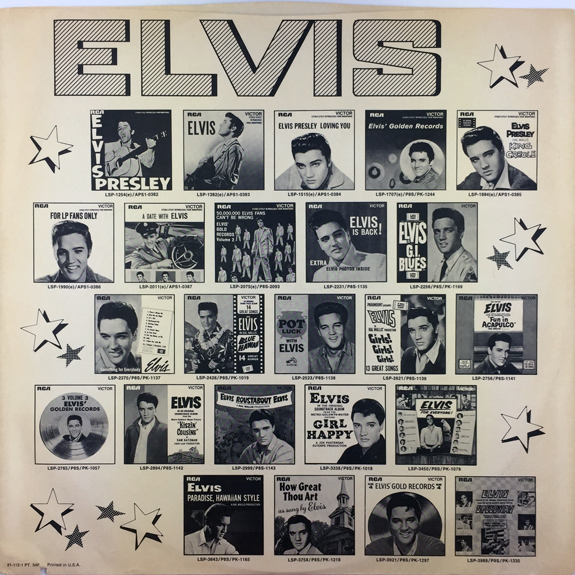
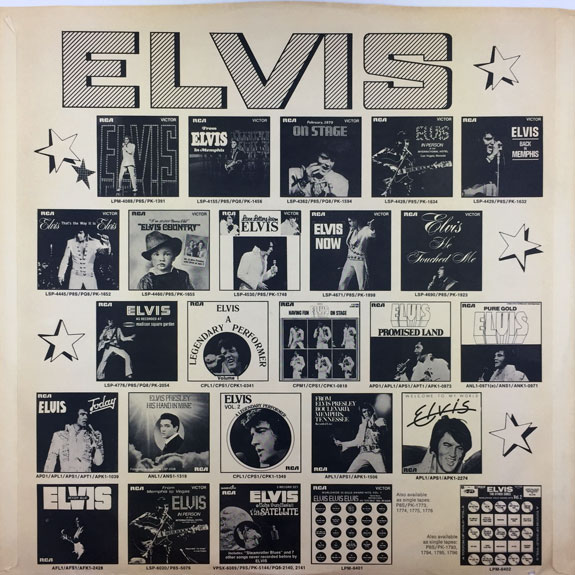
I love the inner sleeves on vintage Elvis albums. Check out the ads for other albums, which must have acted as combination check lists and wish lists for fans of the time. In some cases, it was also a way to see some alternate cover designs. For example, note the Moody Blue concept artwork in the bottom left of the image below.

Inner sleeve (back) from MOODY BLUE (RCA, 1977; from Tygrrius’ collection)

The fall of the curtain came much too early for Elvis, but Moody Blue certainly made for an impressive last act. If you collect Elvis on vinyl, this one is a must.


“Anyone who believes in Me may come and drink! For the Scriptures declare, ‘Rivers of living water will flow from His heart.'”
John 7:38

Elvis Movies: DOUBLE TROUBLE

Guy Lambert (Elvis Presley) departs for Belgium in 1967's DOUBLE TROUBLE (MGM)

Guy Lambert (Elvis Presley) departs for Belgium in 1967’s DOUBLE TROUBLE (MGM)

“[F]or the most part, Elvis movies take place in Elvis Land, a time outside of time, a time where Elvis is King, there is no outside world, there is no larger context – because when you have Elvis, that’s all the context you need. He justified films merely by being in them. You can imagine how that could be a disheartening experience for someone so competitive as Elvis, someone so determined to do well, but it is just one of the elements that make him fascinating as a performer.”
-Sheila O’Malley, 2012, The Sheila Variations

In his lifetime, Elvis Presley released 31 narrative movies and 2 documentaries. At the height of his film career in the 1960s, he was cranking out 3 movies a year.

When I was a teen, the local video rental store had dedicated sections for Action, Drama, Romance, Musicals, Horror, Science Fiction, and the like. It also had an entire section called Elvis Movies, with shelves full of VHS tapes of many of his films and concerts. Like Monster Movies or Superhero Movies, Elvis Movies really are their own genre. As writer Sheila O’Malley aptly notes above, they also occur in their own little reality.

As a second generation Elvis fan, and a child of the late 1970s and 1980s, my first exposure to Elvis Movies was not in the theater or even on VHS, but on broadcast television. A local, independent UHF channel would show a mini-marathon of themed movies on Saturday afternoons. On some Saturdays, for instance, I watched a double or triple feature of Monster Movies like King Kong vs. Godzilla (1963). On other Saturdays, I watched two or three Elvis Movies on this station. I can still hear the announcer excitedly proclaiming, “Up next, more Elvis in Harum Scarum!”

Though there are occasional exceptions, Elvis Movies are usually not remarkable achievements from an artistic perspective. Near the end of his film career, Elvis admitted that his movies made him “physically ill.” Though I cannot confirm the authenticity of this next quote, Elvis is also purported to have once said, “The only thing worse than watching a bad movie is being in one.”

As a child, though, I loved watching Elvis Movies with my family. They were fun, and Elvis played any number of characters of interest to an 8-year old: A racecar driver, a cowboy, a boxer, an Army man, etc. Elvis was the ultimate action hero, destined to win every fight and every girl. Elvis had a natural comedic flair, and there were also action scenes, often involving karate, that kept me interested as well. Of course, music was ever-present. The quality of many of his movie tunes were subpar, to say the least, but I didn’t really notice this back then, either. Elvis Movies were complete fantasy packages, as entertaining to young me as watching Godzilla and King Kong duke it out.

At some point, I suppose in my early adulthood, I began to see Elvis Movies in a different light. Maybe it was slogging through those dreadful movie tunes as I began exploring his entire catalog of music. Maybe it was reading about how much he disliked making them. Maybe it was the constant re-running of his movies on cable stations every January and August. At some point, I began to find it harder to sit through Elvis Movies. The completist in me has collected all of them on DVD, and I have watched each at least once. I don’t return to most of them too often, though. I love movies almost as much as I love music. I watched nearly 100 movies last year, but only one Elvis Movie.

In the spirit of that 8-year-old who watched a string of Elvis Movies on Saturday afternoons so long ago, I’ve decided to rewatch Elvis Movies over the next few years. I’m going to approach this in a random fashion, for that is how I first watched them. Along the way, I plan to blog about them. While I won’t go as deep into the details of these movies as someone like Gary Wells over at the Soul Ride blog might, I’ll hit what I consider the highlights as well as quirky tidbits that jump out at me, often on a personal level. Up first is Double Trouble.


“Elvis takes mad mod Europe by song as he swings into a brand new adventure filled with dames, diamonds, discotheques, and danger!!”

Double Trouble

Double Trouble (MGM)
Wide Release: April 5, 1967 (United States)
Starring: Elvis Presley, John Williams, Yvonne Romain, Annette Day
Screenplay By: Jo Heims
Story By: Marc Brandel
Music Score By: Jeff Alexander
Produced By: Judd Bernard and Irwin Winkler
Directed By: Norman Taurog
Running Time: 92 Minutes


You would be forgiven if, based on the movie’s title or the fact that he appears twice on its poster, you expected Elvis Presley to play dual roles in Double Trouble, his 24th film to be released. Alas, this is not the case, for he had already performed that schtick a few years earlier in Kissin’ Cousins (1964). The double in the trouble represents our hero, singer Guy Lambert (Elvis), being torn between two love interests – the innocent but zany Jill (Annette Day) and the seductive Claire (Yvonne Romain). The movie isn’t really about any of that, though. While Guy seems intrigued by Claire, his heart is obviously with Jill – despite his own misgivings, including a subplot involving Jill’s age that is cringe-worthy by today’s standards.

Instead, Double Trouble tries to be a madcap comedy/thriller. Most of the comedy external to Elvis doesn’t really work (I’m looking at you, Wiere Brothers).

Annette Day is Jill Conway and Elvis Presley is Guy Lambert in 1967's DOUBLE TROUBLE (MGM)

Annette Day is Jill Conway and Elvis Presley is Guy Lambert in 1967’s DOUBLE TROUBLE (MGM)

Double Trouble doesn’t really work as a thriller, either. Someone wants Guy and/or Jill dead. Though the ultimate mastermind of the murder plot might come as a surprise, this revelation comes about through the hackneyed explanation of a hired killer right before he is going to off his victim. Guy, of course, saves the day, and the would-be killer ends up succumbing to the very trap he had planned for his target. Death is rare in Elvis Movies, but it does happen.

1967’s DOUBLE TROUBLE includes multiple murder attempts (MGM)

Double Trouble is also rare among Elvis Movies in that it takes place in Europe. The film opens in London, England, and then takes us to Belgium. Not really, though, as Double Trouble was filmed in Culver City, California.

In Double Trouble, the Belgian police drive Volkswagen Beetles. The interesting thing about this, for me, is that, as a child, I was obsessed with wanting a red VW Beetle. I drew pictures of one throughout my elementary school years, often including a police siren on top and other special devices, like spotlights and ejection seats. Though I have no memory of picking up this particular fascination from an Elvis Movie, sure enough, a red VW Beetle police car appears during a chase sequence.

A Volkswagen Beetle police car appears in 1967’s DOUBLE TROUBLE (MGM)

Double Trouble marks the acting debut of Annette Day (Jill). You wouldn’t know it from the film, as she does a commendable job in both comedic and dramatic scenes. I love watching her observe and then mimic Elvis’ movements as he sings “Old MacDonald” to her. Unfortunately, this is Day’s only movie.

Jill Conway (Annette Day) snaps along as Guy Lambert (Elvis Presley) sings "Old MacDonald" in 1967's DOUBLE TROUBLE (MGM)

Jill Conway (Annette Day) snaps along as Guy Lambert (Elvis Presley) sings “Old MacDonald” in 1967’s DOUBLE TROUBLE (MGM)

I enjoyed watching many of the songs in the context of this film far more than I do listening to the soundtrack album in isolation. Elvis does appear quite stiff at times, though, particularly during his opening number, the title song. Incidentally, I really enjoyed the funky instrumental opening to the film and wish that ambience had been present on the actual Elvis music.

I admitted long ago that I’m a fan of Elvis’ version of “Old MacDonald” but the beautiful “City By Night” and “Could I Fall In Love” are Double Trouble‘s musical highlights.

A child (portrayed by Laurie Lambert) and Guy Lambert (Elvis Presley) ride a carousel as he sings “I Love Only One Girl” in 1967’s DOUBLE TROUBLE (MGM)

If you go with the flow, as is necessary with most Elvis Movies, Double Trouble is entertaining.


Boldly Go

Stanley Adams plays Captain Roach in Double Trouble. Adams is known to fellow Trekkies for his portrayal of Cyrano Jones in the Star Trek episode “The Trouble With Tribbles” (1967) and the animated Star Trek follow-up episode “More Tribbles, More Troubles” (1973).

Stanley Adams is Captain Roach in 1967's DOUBLE TROUBLE (MGM)

Stanley Adams is Captain Roach in 1967’s DOUBLE TROUBLE (MGM)

Leonard Nimoy is Mister Spock, Stanley Adams is Cyrano Jones, and William Shatner is Captain James T. Kirk in the 1967 STAR TREK episode "The Trouble With Tribbles" (Desilu)

Leonard Nimoy is Mister Spock, Stanley Adams is Cyrano Jones, and William Shatner is Captain James T. Kirk in the 1967 STAR TREK episode “The Trouble With Tribbles” (Desilu)


Double Trouble Tote Board

  • Kisses: 13
  • Karate Chops: 9
  • Songs: 8
  • Karate Kicks: 4
  • Broken Windows: 2
Elvis Presley is Guy Lambert in 1967's DOUBLE TROUBLE (MGM)

Elvis Presley is Guy Lambert in 1967’s DOUBLE TROUBLE (MGM)

Songs In Double Trouble

  1. “Double Trouble” (1966), written by Doc Pomus & Mort Shuman
  2. “Baby, If You’ll Give Me All Of Your Love” (1966), written by Joy Byers
  3. “Could I Fall In Love” (1966), written by Randy Starr
  4. “Long Legged Girl” (1966), written by J. Leslie McFarland & Winfield Scott
  5. “City By Night” (1966), written by Bill Giant, Bernie Baum, & Florence Kay
  6. “Old MacDonald” (1966), written by Randy Starr, based on the traditional composition
  7. “I Love Only One Girl” (1966), written by Sid Tepper & Roy C. Bennett, based on the traditional composition “Auprès de ma blonde
  8. “There Is So Much World To See” (1966), written by Sid Tepper & Ben Weisman

The Mystery Train’s Double Trouble Scorecard

  • Story: 2 (out of 10)
  • Acting: 5
  • Fun: 6
  • Songs: 5
  • Overall: 4 (For Elvis Fans Only)

TMT Files: Guy Lambert

Click image for larger, full-color version


“And whatever you do or say, do it as a representative of the Lord Jesus, giving thanks through him to God the Father.”
Colossians 3:17

Elvis: The Ultimate Live Top Ten Hits (Part 1)

Elvis Presley rocks “Heartbreak Hotel” during taping of 1968’s ELVIS special (NBC)

I was 13 years old during Spring Break of 1988. At that point, I had about a half dozen Elvis Presley albums to my name. At the record store that week, I bought my first 2-record set. The Top Ten Hits was part of an “Elvis Presley Commemorative Issue” series that marked a decade since his 1977 death. I eventually obtained all four of the albums in the series, though I never did mail away for the special bonus album (a future eBay purchase, no doubt).

I had been collecting Elvis records for about a year at that point, and The Top Ten Hits certainly firmed up the foundation of my new obsession by containing all 38 of Elvis’ top 10 hits on Billboard‘s key US charts. These are what I now call mainstream or “general public” Elvis songs in that they are his most famous songs. Back then, these were the ones that various radio stations would still play.

The only two general public Elvis songs that failed to make the US top ten and, thus, this album were “Blue Suede Shoes” (peaked at #20) and “Viva Las Vegas” (peaked at #29). If we include posthumous releases, 1977’s “My Way” (peaked at #22) and 2002’s JXL Radio Edit Remix of “A Little Less Conversation” (peaked at #50) are also general public Elvis songs that are not present on this 1987 release. Except for those few titles and maybe “Blue Christmas,” everything else is here from a mainstream audience perspective. Outside of boxed sets, which really belong in their own category, The Top Ten Hits remains one of the most comprehensive Elvis releases to date when it comes to the general public.

I wore this record out in my 7th and 8th grade years, to the point where many of these songs became boring to me for a time. I will at some point cover this and the other Elvis Presley Commemorative Issue albums as part of my ongoing Vinyl Elvis series. Today, however, I want to use The Top Ten Hits as a jumping off point for a series of four posts covering Elvis’ best live performance of each of his hits. As is the norm here on The Mystery Train Blog, the focus will be on officially released recordings. No bootlegs.

Today’s post will feature hits included on Side A of The Top Ten Hits, all of which were studio recordings on the original album.

01. Heartbreak Hotel (hit version recorded 1956)
Ultimate Live Version: June 29, 1968, 6 PM Show, Burbank, CA, ELVIS-TV Special
Recorded in front of small studio audience for Elvis’ 1968 NBC television special, ELVIS, this version of “Heartbreak Hotel” rocks more than any of his other takes on the song. It is unfortunately a shortened version, though, due to being part of a medley with “Hound Dog” and “All Shook Up.” I once created a splice with the June 27, 1968, 6 PM Show version of “Heartbreak Hotel” to partially rectify this (inspired by and in the same vein as the “Blue Suede Shoes” splice on the This Is Elvis album, except starting with the June 29 “stand up” show version and ending with the June 27 “sit down” show version).

02. I Want You, I Need You, I Love You (hit version recorded 1956)
Ultimate Live Version: June 5, 1956, Los Angeles, CA, A Golden Celebration
As performed on the Milton Berle Show, following a skit with the host.

03. Hound Dog (hit version recorded 1956)
Ultimate Live Version: December 15, 1956, Shreveport, LA, Young Man With The Big Beat: The Complete ’56 Elvis Presley Masters
The finale of one of Elvis’ greatest recorded concerts, this version of “Hound Dog” is not to be missed.

04. Don’t Be Cruel (hit version recorded 1956)
Ultimate Live Version: January 6, 1957, New York, NY, A Golden Celebration

Credit: The Ed Sullivan Show channel (YouTube)

After Elvis released “Don’t Be Cruel,” he caught an act in Las Vegas that was doing a number of his songs. The lead singer was Jackie Wilson, and Elvis liked his version of “Don’t Be Cruel” better than his own. When Elvis performed the song on his third Ed Sullivan Show appearance in 1957, he incorporated some of Wilson’s upgrades to the song. What I love about this story is that Elvis inspired Wilson, who, in turn, inspired Elvis. Incidentally, this is the infamous “from the waist up” Sullivan performance where TV cameras were ordered not to show Elvis’ hips and legs – which, of course, only added to his legend. Watch it above or over on YouTube.

05. Love Me Tender (hit version recorded 1956)
Ultimate Live Version: June 29, 1968, 8 PM Show, Burbank, CA, ELVIS-TV Special
This live version, recorded for the 1968 ELVIS special, far exceeds Elvis’ original studio recording of the song from 1956. His voice is like velvet.

06. Love Me (hit version recorded 1956)
Ultimate Live Version: June 27, 1968, 6 PM Show, Burbank, CA, Memories: The ’68 Comeback Special
This was a close call with the August 12, 1970, Midnight Show, version of “Love Me,” but I slightly prefer the raw sound of the 1968 version.

07. Too Much (hit version recorded 1956)
Ultimate Live Version: January 6, 1957, New York, NY, A Golden Celebration
This is the only live version officially released of “Too Much,” to my knowledge, so it wins by default. A decent if sloppy version, performed on the Ed Sullivan Show and broadcast from the waist up.

08. All Shook Up (hit version recorded 1957)
Ultimate Live Version: August 26, 1969, Midnight Show, Las Vegas, NV, All Shook Up
The earliest available live version of “All Shook Up,” which is closer to the arrangement of the studio recording, is March 25, 1961, but the performance is tepid compared to his 1968 and 1969 versions.

09. Teddy Bear (hit version recorded 1957)
Ultimate Live Version: January 26, 1970, Opening Show, Las Vegas, NV, The On Stage Season: The Opening And Closing Shows 1970
This live version of “Teddy Bear” was a pleasant surprise on one of my favorite FTD releases.

10. Jailhouse Rock (hit version recorded 1957)
Ultimate Live Version: June 29, 1968, 8 PM Show, Burbank, CA, ELVIS-TV Special

Credit: Vevo’s Elvis Presley channel (YouTube)

As with a few of the others on today’s list, this incredible live version of “Jailhouse Rock” was captured for the 1968 ELVIS special. It almost equals the flawless studio recording. Watch it above or over on YouTube.

If only some of Elvis’ 1957 concerts had been recorded. Perhaps ultimate live versions of “Too Much,” “All Shook Up,” and possibly even “Jailhouse Rock” would have been among them. Every now and then, new recordings are unearthed. I maintain hope that a 1957 concert will eventually see the light of day.

I pray all of you are doing well and staying healthy. Drop a note in the comments below about some of your favorite live versions of these Elvis classics.

Blessings,
TY

[Read Part 2]


“Dear brothers and sisters, when troubles of any kind come your way, consider it an opportunity for great joy. For you know that when your faith is tested, your endurance has a chance to grow. So let it grow, for when your endurance is fully developed, you will be perfect and complete, needing nothing.”
James 1:2-4

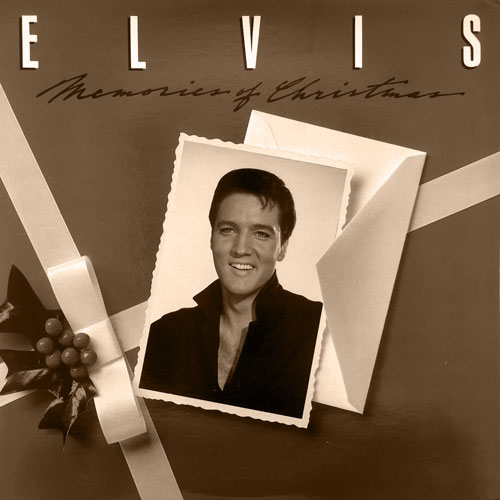
Vinyl Elvis #2: MEMORIES OF CHRISTMAS (1982)

This re-post was first published on one of my pop-culture blogs, now retired.


MEMORIES OF CHRISTMAS (RCA, 1982; from Tygrrius’ collection) | Click image for full-color version

Memories Of Christmas
Label: RCA
Catalog Number: CPL1-4395
Recorded: 1957-1971 | Nashville, Hollywood
Released: 1982

Memories Of Christmas is a perfectly named album for me, because it indeed fills me with nostalgia for many special Christmases growing up in the 1980s. When my brother gave me the album, along with the rest of his Elvis records, it marked the first time I had played Memories Of Christmas on vinyl in over 20 years.

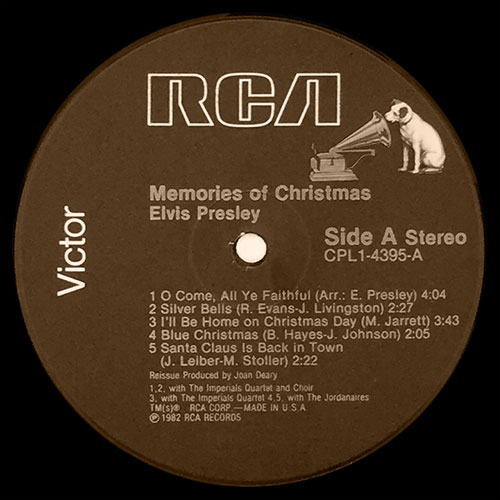
Side A of MEMORIES OF CHRISTMAS (RCA, 1982; from Tygrrius’ collection) | Click image for full-color version

Side A

  1. O Come, All Ye Faithful (1971)
    This previously unreleased version is a splice between the master (Take 1) and Take 2. It actually proves to be better than either take alone, making it my “go to” version of the song by Elvis. Fantastic performance and a perfect opener to the album. Sound quality on the record itself is excellent.
  2. Silver Bells (1971)
    Another stellar Christmas performance, first heard on Elvis Sings The Wonderful World Of Christmas (1971). I love the acoustic guitar here.
  3. I’ll Be Home on Christmas Day (1971)
    Here it is, the highlight of the album–the previously unreleased re-recording of “I’ll Be Home On Christmas Day.” Attempted in June 1971, this is a bluesier take on the Michael Jarrett song than the May 1971 version that became the official master on The Wonderful World Of Christmas. For my money, this is Elvis at his best.
  4. Blue Christmas (1957)
    It is apparently unlawful for RCA to release an Elvis Christmas compilation without this worn-out tune, featuring the grating background vocals of Millie Kirkham. I would have preferred the use of a live version from 1968. In fact, what would have been at the time the previously unreleased June 27 6 PM Show performance captured for the ELVIS special would have been perfect.
  5. Santa Claus Is Back in Town (1957)
    Side A finishes up in style with the greatest Elvis Christmas song of all, the down and dirty “Santa Claus Is Back In Town,” arguably the only real competition against “Reconsider Baby” (1960) as his finest blues performance.

Side B of MEMORIES OF CHRISTMAS (RCA, 1982; from Tygrrius’ collection) | Click image for full-color version

Side B

  1. Merry Christmas Baby (1971)
    Speaking of bluesy Elvis Christmas songs, here is another fine entry. This is the previously unreleased extended version of “Merry Christmas Baby,” over two minutes longer than the album master (Wonderful World Of Christmas) and nearly five minutes longer than the single version. As a kid, I loved hearing Elvis ad-lib, “Gave me a diamond ring for Christmas; now I’m putting it through Al’s mike.” Unfortunately, there are a couple of pops/crackles on the record on this song, but nothing too distracting. Side A had no noise at all! Like the 1969 live versions of “Suspicious Minds,” “Merry Christmas Baby” just goes on forever. In both cases, a very, very good thing.
  2. If Every Day Was Like Christmas (1966)
    This is the previously unreleased “undubbed” version of the master. The piano is beautiful here, and I believe more prominent than on the CD version I have of this performance. There is a “raw” sound to this version, but it makes for a very beautiful and effective performance.
  3. Christmas Message from Elvis/Silent Night (1967/1957)
    The opening message was recorded for Season’s Greetings From Elvis, his 1967 Christmas special that aired on radio stations across the United States. My only gripe here is that the message originally flowed into “I’ll Be Home For Christmas” (1957). The compilation producers decided to splice “Silent Night” on instead. I am assuming it is because they wanted to “bookend” the album with traditional Christmas songs. You can actually hear “I’ll Be Home For Christmas” begin during Elvis’ message before the segue into “Silent Night.” Unfortunately, this has never been corrected on subsequent releases of the message. The label has even released “Silent Night” on at least one Christmas compilation since then that did not contain the message, yet had the beginning of the song chopped off due to apparently using this version. Sloppy. I knew and recognized none of this when I first heard this album back in the 1980s. I loved hearing the message from Elvis, and I must admit, I still find it pretty cool today. Overall, this record sounds incredible, with the only extraneous noise being those two pops on “Merry Christmas Baby.”

Back cover of MEMORIES OF CHRISTMAS (RCA, 1982; from Tygrrius’ collection) | Click image for full-color version

Elvis recorded less than 25 Christmas songs during his entire career. Every year, though, it seems there is a “new” Elvis Christmas compilation that rearranges those songs with a new, cheap cover. Memories Of Christmas offers not only beautifully conceived cover art, but unique album content that is truly worthy of standing alongside the two Christmas albums that Elvis released in his lifetime, Elvis’ Christmas Album (1957) and Elvis Sings The Wonderful World Of Christmas.

Calendar insert from MEMORIES OF CHRISTMAS (RCA, 1982; from Tygrrius’ collection) | Click image for full-color version


“All right then, the Lord himself will give you the sign. Look! The virgin will conceive a child! She will give birth to a son and will call him Immanuel (which means ‘God is with us’).”
Isaiah 7:14

A Squirrel Loose at the Big, Freaky International Hotel (Part 3)

This is Part 3 of a look at Sony’s 2019 Elvis Live 1969 boxed set, which contains all 11 concerts RCA recorded in Elvis Presley’s August 1969 concert engagement at the International Hotel in Las Vegas.

[Read Part 1 | Read Part 2]

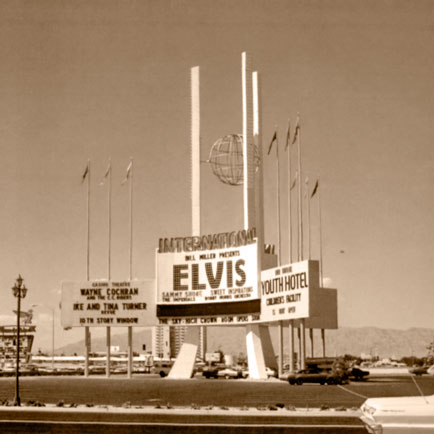
International Hotel marquee as displayed on back of a CD holder from Sony Legacy’s ELVIS LIVE 1969 boxed set (2019, from Tygrrius’ collection)

“When I was in the Army, the guys would say […], ‘Watch him, boy, he’s a squirrel, he’s just out of the trees.'”
–Elvis Presley, 1969

I mentioned last week that I prefer Elvis Presley’s overall Summer 1970 Las Vegas shows over the Summer 1969 Vegas shows – even though the 1969 versions of songs performed in both seasons win out in most cases.

One of the reasons I prefer the Summer 1970 engagement is the expanded setlist. Newly added songs like “You’ve Lost That Lovin’ Feelin'”, “Just Pretend”, and “I’ve Lost You” expanded the dimensions of the show for his third concert engagement at the International Hotel. Not to mention songs that Elvis retained after first introducing them in his second concert engagement earlier that year, like “Walk A Mile In My Shoes” and the show-stopping “Polk Salad Annie.”

Another reason I prefer the Summer 1970 engagement over the previous year is the amount of talking by Elvis in 1969. Though I prefer a “talkative Elvis” over the “all business Elvis” of, say, June 1972’s Madison Square Garden concerts, where he barely says a word between songs beyond the customary “thank you,” in the 1969 shows Elvis simply talks too much. Way too much.

Don’t believe me? Here are a couple of examples, using the shortest and the longest shows on the 1969 set:

  • The August 23 Midnight Show clocks in at just under 80 minutes (in fact, I wonder if Sony edited any bits out to get it to fit the 80-minute capacity of a CD). The actual musical content on this show is just over 56 minutes. Elvis talks for a whopping 24 minutes during this show – about 30% of the time!
  • The shortest show on the set is actually the very next night, the August 24 Midnight Show. I suspect management complained to Elvis about keeping the audience away from the casino too long the previous night, as he alludes to such conversations a couple days later in the engagement. This show is nearly 63 minutes long and features about 45 minutes of music. Elvis talks for about 18 minutes during this show – about 29% of the time.

The worst offender in driving up the talking times in 1969 is the “monologue” in the middle of each show where Elvis provides a joke-infused retrospective of his career for about ten minutes. While I’m sure it was entertaining to audiences in the showroom, it becomes a tough listen show after show on CD.

I understand he probably needed a cool down after “Tiger Man” or “Johnny B. Goode,” but the energy of the show is completely sapped each time before Elvis finally resumes singing – with an often uninspired version of “Baby, What You Want Me To Do,” completely lacking the raw magic of his versions from the previous year’s ELVIS special. For these Vegas shows, if only Elvis had bought himself a Gibson Super 400 CES like he borrowed from Scotty Moore in the special’s “sit down” shows, as Elvis accompanied himself so well on that electric guitar compared to anything else I have ever heard him play.

Overly long and bizarre introductions to “Hound Dog” and similar bits also detract from the listening experience when heard show after show. Repetitive jokes with the lyrics of “Jailhouse Rock,” “Yesterday,” and others become tiring, too. I imagine poor Felton Jarvis (producer), trying to capture material for the Elvis In Person album, getting his hopes up, thinking, “He’s going to sing it straight this time” and then, “Nope, not this time. Maybe tomorrow night.” Elvis did eventually perform straight versions of each song, probably after being asked to “clean up the act” as he mentions in some of the later shows as well.

Occasional lyrics twists are fun, don’t get me wrong. It is just hearing the same ones over and over that gets old. Of course, Elvis never intended or envisioned that someone like me would be listening to a complete collection of these shows over 50 years after the fact. From Elvis’ perspective, these shows served their purpose at the time in entertaining those audiences (of course) and supplying the 12 songs featured as masters on Elvis In Person. Yet, here I am, blessed to hear them all, so I might as well comment on them.

Anyway, it is actually a lyric twist on “Are You Lonesome Tonight” during the August 26 Midnight Show that results in one of my all-time favorite Elvis recordings – the “laughing version” of the song or, as I like to call it, “Are You Laughing Tonight.” If only movie cameras had been rolling like they were the next summer. Incidentally, the other eight versions of “Are You Lonesome Tonight” on this set are serious. I suspect if he performed a laughing version night after night, it would have lost much of its appeal.

I first heard “Are You Laughing Tonight” on the radio for what would have been Elvis’ 50th birthday in 1985. I recorded a radio special with a little cassette tape player my older sister gave me a Christmas or two before that, so Mom and I must have listened to that tape 500 times in the car before I finally found and bought a proper version of the song in 1991 (Collectors Gold).

I don’t have a tape player anymore, but I still have that cassette (below). It was one of the cheapest tape brands you could buy, yet it has survived all these years. I even played it several years ago so I could write down the song titles (of course, I have lost that list).

1985 cassette tape of “Elvis On The Air” radio special, including “Are You Laughing Tonight”

Mom went to see Jesus over a year ago now, but every time I hear “Are You Laughing Tonight,” I remember her laughing right along with Elvis. I still feel her with me sometimes, and I turn this one up for her.

Next week, (I promise) I’ll wrap up my unintended review of Elvis Live 1969, and we’ll even get to my original idea for this post!

Blessings,
TY

[Read Part 4]


“You have turned my mourning into joyful dancing. You have taken away my clothes of mourning and clothed me with joy, that I might sing praises to you and not be silent. O LORD my God, I will give you thanks forever!”
Psalm 30:11-12